Arc de Triomf Barcelona: The 1888 World's Fair Gateway Worth Your Time
Built as the ceremonial entrance to Barcelona's 1888 Universal Exhibition, the Arc de Triomf stands at the top of a wide pedestrian promenade leading to Parc de la Ciutadella. It's free, always accessible, and one of the few grand monuments in the city where you can simply stop and look without queuing or paying.
Quick Facts
- Location
- Passeig de Lluís Companys, 08003 Barcelona (El Born / Eixample border)
- Getting There
- Arc de Triomf station, Metro L1 & L5 (2-min walk)
- Time Needed
- 15–30 minutes at the arch; 1–2 hours if continuing to Parc de la Ciutadella
- Cost
- Free. No tickets, no reservation required.
- Best for
- Architecture fans, morning walkers, photography, families with strollers
- Official website
- www.barcelonaturisme.com/wv3/en/page/1211/arc-de-triomf.html
What Is the Arc de Triomf?
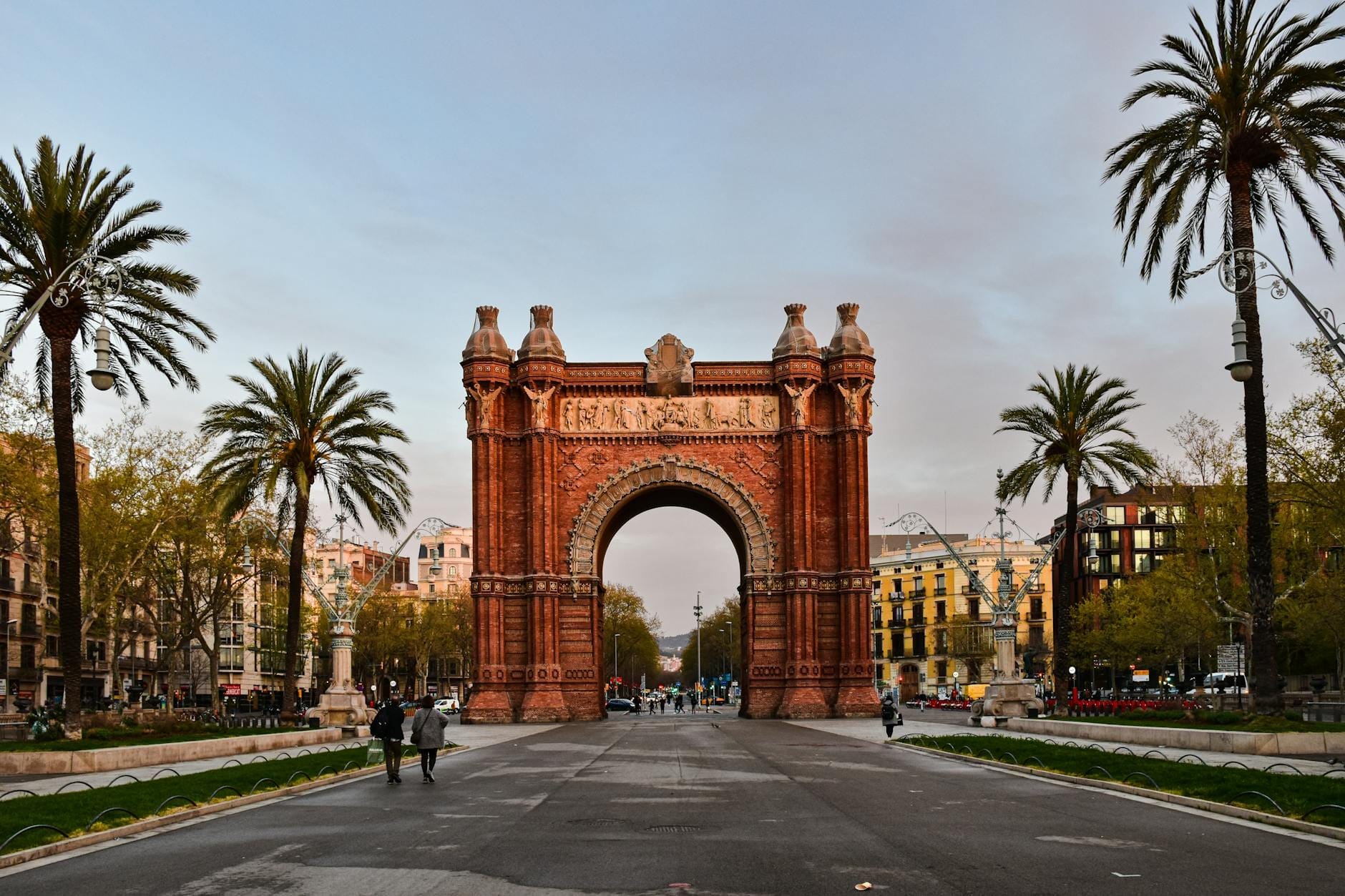
The Arc de Triomf is a freestanding triumphal arch built in 1888 by Catalan architect Josep Vilaseca i Casanovas as the main entrance gateway to Barcelona's Universal Exhibition, which was held in the adjacent Parc de la Ciutadella. Standing 30 metres tall and roughly 50 metres wide, it is constructed almost entirely in reddish brick, making it immediately distinctive among Barcelona's stone-heavy historic buildings.
Its architectural style is Neo-Mudéjar, a 19th-century Spanish revival movement that drew on the decorative vocabulary of medieval Moorish architecture: geometric brickwork, horseshoe arches, and intricate ceramic tile details. This was a deliberate choice at the time, presenting a design language that was uniquely Iberian rather than derivative of French or Italian triumphal arch traditions.
The arch sits at the northern end of Passeig de Lluís Companys, a broad, palm-lined pedestrian boulevard that leads directly south into Parc de la Ciutadella. This spatial relationship is the key to understanding the arch: it was never intended as a standalone monument but as the beginning of a procession, designed to frame the journey into the exhibition grounds.
ℹ️ Good to know
Admission is free and the exterior is accessible 24 hours a day, every day. There is no entrance, no ticket booth, and no queue. You simply walk up to it.
The Architecture Up Close
Approaching the arch from the metro exit, the scale becomes clear quickly. The central arch opening is wide enough to feel monumental without being oppressive, and the warm terracotta colour of the brick softens what could otherwise be an imposing structure. Look up at the keystone frieze on the main façade: it shows the city of Barcelona welcoming the nations of the world, a reference to the arch's original function as a welcome gate.
The lateral faces of the arch feature sculptural reliefs by Josep Reynés and Antoni Vilanova. On the seaward side, a frieze by Josep Llimona depicts the awards ceremony of the Universal Exhibition. The decorative programme is tight and legible even from ground level, which is unusual for 19th-century public monuments of this scale.
The brickwork itself rewards a close look. Unlike the smooth ashlar stone of Roman triumphal arches, Vilaseca's design uses the texture of the brick as an ornamental surface, with projecting courses and recessed bands creating shadow patterns that shift through the day. On a sunny afternoon, the western face catches the light in a way that makes the terracotta glow almost orange.
Tickets & tours
Live prices and dates from our booking partner. If you book, we may earn a commission at no extra cost to you.
Vermouth time and sailing experience in Barcelona
From 36 €Instant confirmationFree cancellationOne-day tour to Andorra and France from Barcelona
From 109 €Instant confirmationFree cancellationBest of Gaudi private walking tour in Barcelona with a local guide
From 90 €Instant confirmationFree cancellationInteractive Spanish cooking experience in Barcelona
From 65 €Instant confirmationFree cancellation
How the Experience Changes Through the Day
Early morning, roughly 7–9am, is the most peaceful time to visit. The Passeig de Lluís Companys fills with joggers and dog walkers, and the arch is clear of tour groups. The light at this hour falls from the east, catching the rear face of the monument and casting long shadows down the promenade toward the park. Photographers working with natural light will find the morning the most useful window.
By mid-morning and into the afternoon, the promenade becomes noticeably more active. Tour groups arrive from the Gothic Quarter and from cruise ship excursions; street vendors set up along the path; cyclists pass through. The arch itself does not generate long queues since there is nothing to enter, but the immediate surroundings can feel crowded between 10am and 2pm in peak season (June through September).
Evenings offer a different atmosphere entirely. The arch is lit from below after dark, and the warm tone of the artificial lighting complements the brick in a way that daylight sometimes flattens. Locals use the promenade for evening strolls, and the pace is slower and less touristy. If you are staying nearby or passing through after dinner, it is worth a five-minute detour.
💡 Local tip
For photography: arrive before 9am in summer for soft light, no crowds, and a clear sightline down the promenade. Bring a wide-angle lens or step back to the far end of the boulevard to capture the arch with the palm trees framing both sides.
The 1888 Universal Exhibition: Why It Matters
The 1888 Barcelona Universal Exhibition was a politically and culturally charged event. Coming just years after the end of the Third Carlist War and during a period of Catalan industrial ascendancy, it was Barcelona's assertion of modernity and international standing. The exhibition was held in the Parc de la Ciutadella grounds, which had previously housed a military citadel used to suppress the city. Its transformation into a public park and exhibition site carried significant symbolic weight.
Vilaseca chose the Neo-Mudéjar style for the arch partly as a statement of regional identity: it referenced a specifically Iberian architectural heritage rather than importing a Parisian or Roman model. This was consistent with the broader Catalan Modernisme movement, which was beginning to find its footing in the same years. Antoni Gaudí, then in his early career, also contributed work to the 1888 exhibition.
Understanding this context makes the arch considerably more interesting than it first appears. It is not a copy of the Arc de Triomphe in Paris or the Arch of Constantine in Rome. It is a specifically Catalan object with a specific political and cultural argument built into its design. If you want to go deeper into this period of Barcelona's architectural history, the Gaudí Barcelona guide covers the broader Modernisme context well.
Getting There and Getting Around
The most direct approach is Metro Line 1 (red line) to Arc de Triomf station. The exit deposits you almost directly at the northern end of the promenade, roughly a two-minute walk from the arch. This is one of the easier transit connections in the city: single journey tickets or the T-Casual card (10 trips) work on all TMB metro and bus lines.
Alternatively, if you are coming from the El Born neighbourhood on foot, the arch is a natural endpoint heading north from the Basilica de Santa Maria del Mar. The walk takes around ten minutes through streets that shift from tight medieval lanes to the wider avenues near the arch.
The arch is also an efficient starting point for a walk through Parc de la Ciutadella, which begins at the southern end of the promenade and takes roughly 20–40 minutes to cross at a relaxed pace. Bikes and scooters can be rented nearby, and the park paths are wide and mostly flat, making the combination genuinely accessible for families with young children or strollers.
💡 Local tip
Once a year, during Open House Barcelona (usually late October), it is possible to climb to the top of the arch via 120 steps. This is the only time interior access is available, and it is free. Check the Open House Barcelona website for the specific date each year.
Honest Assessment: Is It Worth Your Time?
The Arc de Triomf is not the most spectacular monument in Barcelona. It lacks the vertiginous scale of the Sagrada Família or the intimacy of the Palau de la Música. If your visit to Barcelona is short and you are choosing between major paid attractions, the arch alone would not justify a trip across town.
What it does well is function as part of a larger route. Arriving via the arch and walking south through the promenade into Parc de la Ciutadella is one of the more pleasant half-day itineraries in the city, especially on a weekday morning when the path is not overwhelmed. The architecture is genuinely interesting if you take five minutes to read the sculptural programme rather than walking past.
Travellers who prefer well-known monuments and have limited time might find it unremarkable compared to their expectations. But for those interested in 19th-century Catalan history, urban design, or the broader context of Barcelona's modernist movement, it is a useful and free addition to a day that also takes in the park or the El Born district further south.
⚠️ What to skip
Be aware of pickpockets around the promenade, especially during peak tourist hours. The wide open boulevard attracts a lot of foot traffic, and bag snatches have been reported in the area. Keep bags zipped and in front of you.
Insider Tips
- Stand at the far southern end of the promenade (near the park entrance) and look back north toward the arch for the best full-length view, with palm trees in the foreground and the brick arch centered in the gap. This vantage point is more photogenic than standing directly underneath.
- The arch faces northeast-southwest, which means the 'front' (seaward) face gets good afternoon light in summer. The 'back' (city-facing) face is better lit in the morning. Plan accordingly if photography matters to you.
- Combine the arch with a visit to the nearby Cascada Monumental inside Parc de la Ciutadella, a dramatic fountain that is rarely as crowded as other Barcelona landmarks and sits just ten minutes on foot from the arch.
- If you are visiting in late October, check the Open House Barcelona programme. The rooftop opening is free, the views down the promenade are good, and it is the only way to see the arch from above without visiting it on a tour bus.
- The street market along the promenade on weekends brings local artists and craft vendors. It is not a major market, but it makes the walk to the arch more interesting and is free to browse.
Who Is Arc de Triomf For?
- Architecture enthusiasts interested in 19th-century Catalan Modernisme and Neo-Mudéjar design
- Families looking for a free, stroller-friendly route that connects naturally to Parc de la Ciutadella
- Morning joggers and walkers who want a scenic, mostly flat promenade with a landmark endpoint
- Photographers seeking a well-composed urban monument that can be shot without crowds before 9am
- Travellers building a half-day El Born and Ciutadella walking itinerary
Nearby Attractions
Other things to see while in El Born (Sant Pere):
- Barcelona Zoo
Occupying over 14 hectares inside the historic Parc de la Ciutadella, Barcelona Zoo is one of Europe's oldest urban zoos, open since 1892. It balances conservation work with family-friendly programming, though the setting inside a 19th-century park gives it a character quite different from modern safari-style zoos.
- Basilica of Santa Maria del Mar
Built entirely between 1329 and 1383, the Basílica de Santa Maria del Mar stands as the finest example of Catalan Gothic architecture in existence. Funded and constructed by the waterfront workers of the Ribera district, it carries a human story that its stone geometry quietly amplifies. Fewer crowds, better proportions, and a profound atmosphere make it one of the most rewarding stops in Barcelona.
- Cascada Monumental
The Cascada Monumental is a sweeping neoclassical waterfall fountain inside Parc de la Ciutadella, designed in 1875 by Josep Fontserè and partially shaped by a young Antoni Gaudí. Free to visit and open daily, it rewards early morning visitors with calm light and empty paths, and makes for a striking photography subject at any hour.
- El Born Centre de Cultura i Memòria
El Born Centre de Cultura i Memòria is one of Barcelona's most unexpected cultural spaces: a soaring Victorian iron market hall sheltering the excavated ruins of an entire neighbourhood destroyed in 1714. Entry to the archaeological site is free, and the experience is unlike anything else in the city.
Planning a trip? Discover personalized activities with the Nomado app.