Basílica de Santa Maria del Mar: Barcelona's Cathedral of the Sea
Built entirely between 1329 and 1383, the Basílica de Santa Maria del Mar stands as the finest example of Catalan Gothic architecture in existence. Funded and constructed by the waterfront workers of the Ribera district, it carries a human story that its stone geometry quietly amplifies. Fewer crowds, better proportions, and a profound atmosphere make it one of the most rewarding stops in Barcelona.
Quick Facts
- Location
- Plaça de Santa Maria del Mar, El Born (Ribera district), Barcelona
- Getting There
- Metro Jaume I (L4), a 3-minute walk
- Time Needed
- 45 minutes to 1.5 hours
- Cost
- Entry free outside ticketed guided tour hours; guided tours available (Mon–Sat 10:00–18:00, Sun 13:30–17:00)
- Best for
- Architecture enthusiasts, history lovers, quiet moments away from tourist crowds
- Official website
- www.santamariadelmar.barcelona/en
What Makes Santa Maria del Mar Different
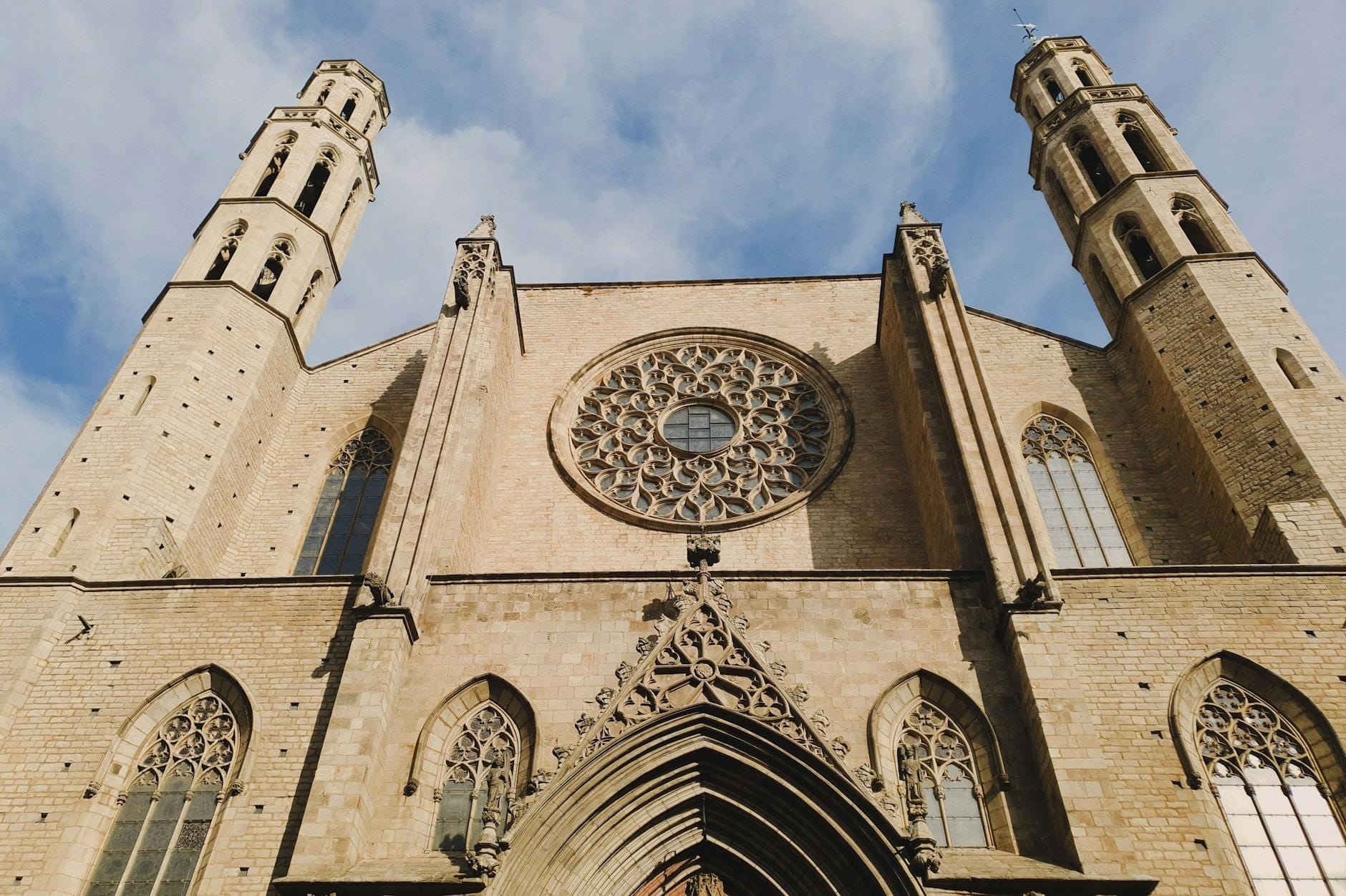
The Basílica de Santa Maria del Mar sits at the heart of El Born, a neighborhood of narrow medieval lanes and ochre facades, and it stops you cold the moment you round the corner into Plaça de Santa Maria del Mar. There is nothing tentative about this building. Its two octagonal towers and broad Romanesque-inflected facade occupy the square completely, and its scale relative to the tight streets around it feels almost improbable.
The basilica is often described, accurately, as the purest surviving example of Catalan Gothic architecture. That means something specific: unlike French Gothic cathedrals, which strain upward through forests of external flying buttresses, Santa Maria del Mar turns its structural logic inward. The weight is managed through the geometry of the interior, producing a nave of extraordinary clarity and calm. There are no side chapels crowding the view, no baroque altarpieces competing for attention. Just three aisles, eight slender octagonal columns spaced 13 meters apart, and light filtering through restored stained glass.
💡 Local tip
Entry is free during religious services and open hours outside ticketed visits. If you simply want to sit inside and absorb the space, plan your visit outside the guided tour windows (Mon–Sat 10:00–18:00, Sun 13:30–17:00) when ticket restrictions apply.
History Built in 55 Years Flat
A church has stood on this site since at least 998, but the current structure was begun in 1329 and completed in 1383, a span of 54 years. That speed is remarkable for medieval construction, and it shows: the building has a unity of style that cathedrals assembled over centuries rarely achieve. No mismatched towers, no jarring stylistic seams between nave and transept.
What gives the basilica its particular resonance is who paid for it and who built it. The Ribera district in the 14th century was Barcelona's commercial waterfront. Merchants, sailors, and the porters known as bastaixos, who carried the stone blocks from the royal quarry at Montjuïc down to the construction site on their backs, funded and physically built this church. It was consecrated in 1384 as the parish church of the seafaring community, not as an episcopal monument. That origin story shifts how you read the interior: the space is generous and uncluttered precisely because it was meant to hold ordinary people, not stage ceremonies for an elite.
The building was declared a basilica in 1923. It suffered serious fire damage during the Spanish Civil War in 1936, when anarchist groups burned the interior for eleven days. Much of the medieval stained glass was lost in that fire. The slow restoration process continued through to the 1990s, and the glass you see today is largely 20th-century work, though it handles light beautifully.
Tickets & tours
Live prices and dates from our booking partner. If you book, we may earn a commission at no extra cost to you.
What You Actually See Inside
The interior is the reason to come. Walking through the main portal, the nave opens in front of you at a width that defies expectations set by the exterior. The eight octagonal columns draw your eye toward the altar without obstruction. At midday, when sunlight catches the amber and rose tones of the stained glass in the apse, the stone takes on a warmth that photographs rarely capture. Early morning light from the west-facing rose window is colder and more dramatic.
The floor retains some of its original stone flagging, worn smooth by centuries of use. If you look carefully at the pavement near the entrance, you can find commemorative slabs from merchant families of the medieval Ribera. The side aisles are slightly lower than the nave, creating a rhythm of light and shadow as you walk the length of the building. It is a space that rewards slow movement.
The high altar, a relatively restrained baroque piece given the surroundings, is the one element that sits slightly at odds with the Gothic envelope. Most visitors find their attention pulled away from it and back to the columns. That is probably the right instinct.
How the Experience Changes by Time of Day
Weekday mornings before 11:00 are the quietest window. The square outside is occupied mainly by locals cutting through on their way to work, and the interior holds a stillness that is hard to find in Barcelona's more trafficked monuments. The stone is cool, there is often the faint smell of incense from an early mass, and you can hear your own footsteps on the flagging.
By midday, tour groups arrive and the plaza fills. The acoustics inside the basilica mean that even a moderate number of visitors creates significant noise, which changes the atmosphere considerably. Weekend afternoons, particularly in summer, are the most crowded and least contemplative. If the interior experience matters to you, avoid them.
Late afternoon is a second viable window. The guided tour crowds thin around 17:00, the low sun enters at an angle through the apse windows, and the plaza outside becomes a destination in its own right, with the terraces of nearby bars filling up for the pre-dinner hour. The contrast between the dim interior and the golden light outside when you exit is one of those transitions that stays with you.
⚠️ What to skip
The basilica is an active place of worship. Dress codes are enforced: shoulders and knees must be covered. Loud conversation and photography with flash are prohibited during services. Treat it as a church first, a monument second.
The Square and the Surrounding Neighborhood
Plaça de Santa Maria del Mar functions as a social hub for the neighborhood in a way that few Barcelona plazas do. Locals actually use it: older residents sit on the stone benches in front of the facade, children run across the pavement, and the bar terraces along the flanking streets are genuinely local rather than tourist-facing. The square itself is bookended by the memoria eternal flame, a memorial to those buried beneath it from the War of the Spanish Succession, and by the low medieval buildings on the south side. It connects naturally to the Carrer del Born, the pedestrian street that leads toward the El Born Centre de Cultura i Memòria, a short walk northeast.
The surrounding streets of El Born are among the best for aimless walking in Barcelona: independent boutiques, wine bars, and a density of medieval architecture that rivals the Gothic Quarter without the same volume of souvenir shops. The Mercat de Santa Caterina is ten minutes on foot and worth adding to any itinerary that includes the basilica.
Practical Notes for Your Visit
The basilica is open Monday through Sunday from 10:00 to 20:30. Ticketed guided visits run Monday through Saturday from 10:00 to 18:00, and Sunday from 13:30 to 17:00. Outside ticketed hours, entry is free for individual visitors observing the space. Verify current pricing and any seasonal schedule changes directly with the basilica before your visit, as these details do change.
Metro Line 4 (yellow line) stops at Jaume I, approximately a 3-minute walk from the basilica. The walk from the Gothic Quarter through Carrer de l'Argenteria is straightforward and passes several points of interest. If you are coming from the Passeig de Gràcia area, the walk through El Born takes around 25 minutes and is worth doing on foot rather than by metro.
Photography is permitted inside when no services are in progress, but flash photography is prohibited throughout. The interior light is low, particularly in the side aisles, so a camera or phone that handles low light reasonably well will serve you better than trying to compensate with flash.
ℹ️ Good to know
The basilica appears in Ildefonso Falcones's novel 'Cathedral of the Sea' (La Catedral del Mar), which traces its construction through the eyes of a fictional bastaixo family. Reading even a chapter or two before visiting gives the interior a narrative layer that purely architectural descriptions cannot.
Is It Worth Your Time?
Compared to the Barcelona Cathedral in the Gothic Quarter, Santa Maria del Mar is smaller, less ornate, and considerably less crowded. For many visitors, those are advantages rather than limitations. The Cathedral offers more historical layers and a spectacular cloister; Santa Maria del Mar offers architectural coherence and an atmosphere that is harder to find in Barcelona's major monuments.
If your interest in Barcelona's religious architecture runs deep, both are worth visiting. If you have time for one and want the more affecting interior experience, this basilica tends to win. Travelers who are primarily interested in Gaudí's work and the Modernista movement may find medieval Gothic less engaging, in which case time is better spent at Sagrada Família or Palau Güell. Those indifferent to architecture and churches in general will not find enough here to justify the visit.
Insider Tips
- Arrive before 10:30 on a weekday to have the interior largely to yourself. The first 30 minutes after opening are the quietest the building gets all day.
- Stand at the center of the nave and look up at the keystones of the vaulting. Each one bears the carved symbol of a guild or trade that contributed to the church's construction, an index of the medieval Ribera economy carved in stone.
- The exterior apse, facing Carrer de Santa Maria, is architecturally the most interesting elevation and far less photographed than the main facade. The narrow street forces a close, almost confrontational view of the buttresses and the polygonal chapels.
- The bar El Xampanyet on Carrer de Montcada, two minutes from the basilica, has been serving house cava and anchovies since 1929. It is a natural endpoint to any visit to this part of El Born.
- If you are visiting in late September, check whether the Festes de la Mercè program includes any concerts inside the basilica. Organ recitals and chamber performances in this acoustic space are exceptional and tickets sell out early.
Who Is Basilica of Santa Maria del Mar For?
- Architecture and art history enthusiasts who want to understand Gothic construction without the crowd pressure of the major monuments
- Travelers looking for a quiet, unhurried experience in the middle of a dense sightseeing day
- Readers of Ildefonso Falcones's 'Cathedral of the Sea' who want to see the building that anchors the novel
- Anyone spending the afternoon in El Born who wants to combine the basilica with the neighborhood's independent shops, wine bars, and the nearby Mercat de Santa Caterina
- Photographers interested in interior light, stone texture, and the play of medieval geometry
Nearby Attractions
Other things to see while in El Born (Sant Pere):
- Arc de Triomf
Built as the ceremonial entrance to Barcelona's 1888 Universal Exhibition, the Arc de Triomf stands at the top of a wide pedestrian promenade leading to Parc de la Ciutadella. It's free, always accessible, and one of the few grand monuments in the city where you can simply stop and look without queuing or paying.
- Barcelona Zoo
Occupying over 14 hectares inside the historic Parc de la Ciutadella, Barcelona Zoo is one of Europe's oldest urban zoos, open since 1892. It balances conservation work with family-friendly programming, though the setting inside a 19th-century park gives it a character quite different from modern safari-style zoos.
- Cascada Monumental
The Cascada Monumental is a sweeping neoclassical waterfall fountain inside Parc de la Ciutadella, designed in 1875 by Josep Fontserè and partially shaped by a young Antoni Gaudí. Free to visit and open daily, it rewards early morning visitors with calm light and empty paths, and makes for a striking photography subject at any hour.
- El Born Centre de Cultura i Memòria
El Born Centre de Cultura i Memòria is one of Barcelona's most unexpected cultural spaces: a soaring Victorian iron market hall sheltering the excavated ruins of an entire neighbourhood destroyed in 1714. Entry to the archaeological site is free, and the experience is unlike anything else in the city.
Planning a trip? Discover personalized activities with the Nomado app.