Sagrada Família: Gaudí's Unfinished Masterpiece Finally Takes Shape
The Basílica i Temple Expiatori de la Sagrada Família is the most visited monument in Spain and one of the most architecturally ambitious buildings ever constructed. After more than 140 years of continuous work, the basilica is now reaching its final form, with the central tower completed in 2026. A visit requires planning, but the interior alone justifies the effort.
Quick Facts
- Location
- Carrer de Mallorca, 401, L'Eixample, Barcelona
- Getting There
- Metro L2 & L5 — Sagrada Família station (direct)
- Time Needed
- 2 to 3 hours minimum; 4+ hours with towers
- Cost
- Tickets vary by package; book via official website to avoid surcharges
- Best for
- Architecture, history, photography, first-time visitors to Barcelona
- Official website
- sagradafamilia.org/en
What the Sagrada Família Actually Is
The full name says everything: Basílica i Temple Expiatori de la Sagrada Família — an expiatory temple, meaning it was conceived as an act of collective penance and has been funded entirely by private donations, ticket sales, and fundraising since construction began in 1882. Not a single euro from the Catholic Church or the Spanish government has financed the building. This unusual funding model means that visitor admissions directly drive construction, which lends the visit a strange moral weight you do not feel at other monuments.
Antoni Gaudí took over the project in the mid-1880s and reshaped it from a conventional neo-Gothic design into something the world had never seen. He worked on it for over 40 years, eventually devoting himself to it exclusively. When a tram struck him in 1926, he was buried in the crypt below, where his tomb remains today. The project outlived him by a century and counting.
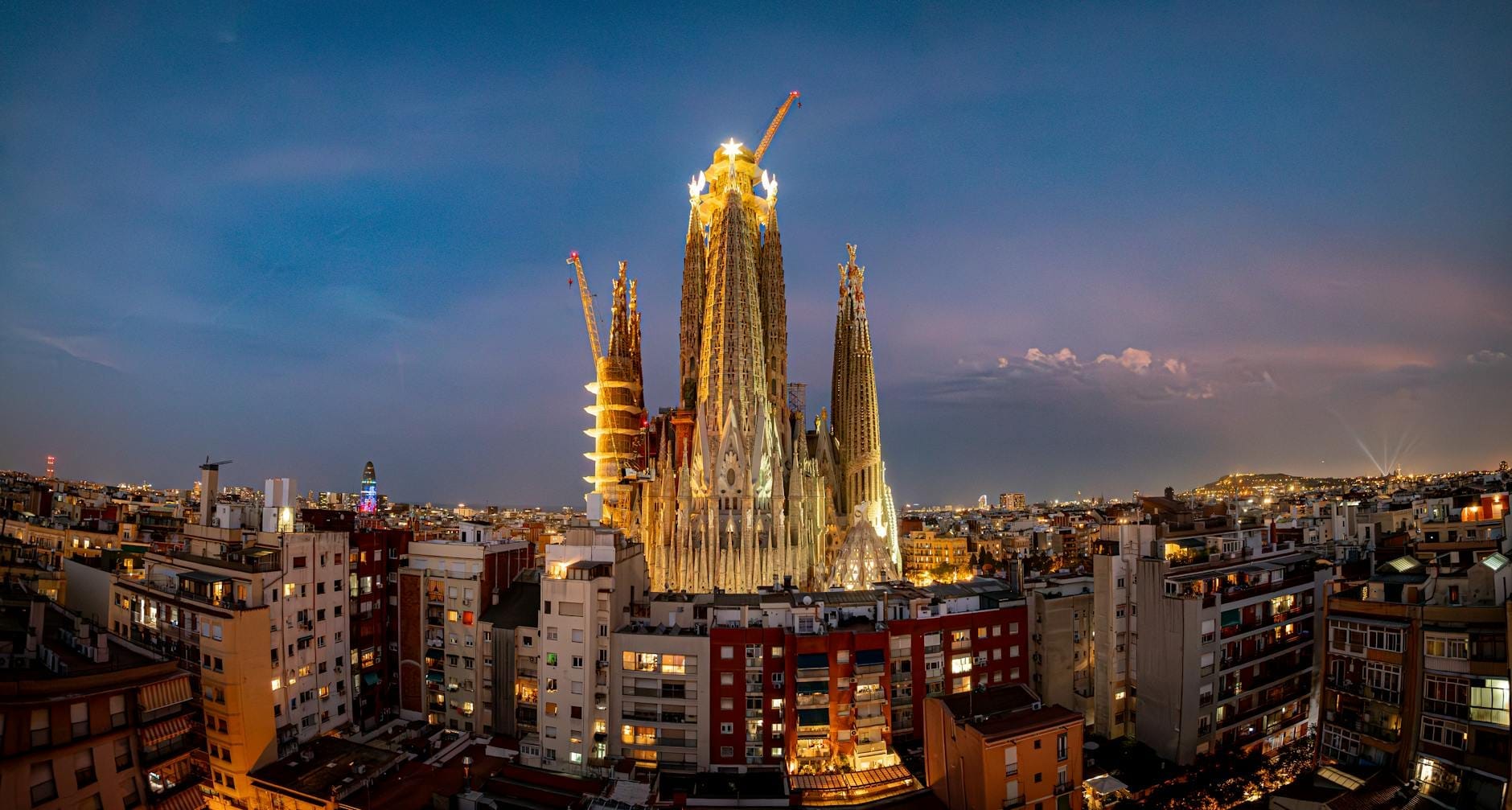
As of late 2025, the Sagrada Família holds the designation of the world's tallest church. The central tower, dedicated to Jesus Christ, was completed on February 20, 2026, reaching 172.5 meters — deliberately kept one meter lower than Montserrat Hill, Gaudí's way of ensuring no human creation surpassed the natural landscape. The Virgin Mary tower, at 138 meters, is capped with a twelve-pointed illuminated star visible from much of the city at night.
💡 Local tip
Book tickets on the official website (sagradafamilia.org) well in advance, especially for tower access. Walk-up tickets are rarely available. Peak season bookings can sell out weeks ahead.
The Façades: Three Faces, Three Theologies
The basilica has three major façades, each facing a different direction and representing a different phase of Christ's life. The Nativity Façade, on the eastern side, is the oldest and the portion Gaudí lived to see partially realized. It is dense with sculptural detail: flora, fauna, cascading stonework that looks less carved than grown. The UNESCO designation covering the Nativity façade and crypt reflects both its historical integrity and its status as Gaudí's most complete surviving outdoor work.
The Passion Façade on the western side was completed in the late 20th century by sculptor Josep Maria Subirachs, whose angular, almost brutalist figures intentionally contrast with the organic warmth of the Nativity side. Visitors frequently have strong reactions to this contrast. Some find it jarring; others find it the more emotionally affecting of the two. Early morning light falls on the Passion Façade directly, making it the better side for photography before 10am.
The Glory Façade, facing south toward Carrer de Mallorca, is still under construction and will be the largest of the three when completed. It will serve as the main entrance and represent humanity's path toward God. The scaffolding around this section is worth noting before your visit so you set accurate visual expectations for the exterior.
Tickets & tours
Live prices and dates from our booking partner. If you book, we may earn a commission at no extra cost to you.
Sagrada Familia Fast-Track Tickets and Guided Tour
From 59 €Instant confirmationFree cancellationBest of Gaudi private walking tour in Barcelona with a local guide
From 90 €Instant confirmationFree cancellationComplete Gaudi tour with Park Guell, Casa Batllo and Sagrada Familia
From 249 €Instant confirmationFree cancellationSagrada Familia Guided Tour
From 55 €Instant confirmationFree cancellation
Inside the Basilica: Light as Architecture
Nothing prepares first-time visitors for the interior. The nave uses a forest of branching columns inspired by tree canopies, and the effect once you step inside is of standing beneath a stone forest. The columns divide and branch toward the ceiling in ways that distribute structural load without flying buttresses, a structural innovation Gaudí spent years solving through physical models, many of which are displayed in the on-site museum below the apse.
The stained glass panels are arranged so that the cooler blues and greens dominate the western nave, while the warmer oranges and reds fill the eastern side. At midday, when the sun is overhead, the two color palettes overlap in the central nave, and the floor fills with shifting color that changes as clouds pass. Morning visits offer the warmest interior light from the east windows. Afternoon light shifts the atmosphere entirely. If your schedule allows, the interior looks materially different at 9am versus 3pm, and both versions are worth experiencing.
ℹ️ Good to know
The basilica is an active place of worship. Mass is celebrated regularly and the basilica may close to tourists during religious services. Check the official website for service times before planning your visit.
Dress codes are enforced: shoulders and knees must be covered. Staff at the entrance will turn visitors away or provide coverings if the requirement is not met. Bring a light layer regardless of the outdoor temperature.
The Towers: What to Expect When You Go Up
Tower access is a separate ticket tier and requires a specific time reservation. There are towers on both the Nativity and Passion sides. The Nativity towers are considered the more rewarding for views of the city stretching toward the sea and the forested hills behind. The Passion towers offer a closer perspective of the central spires.
Important practical note: the towers involve narrow spiral staircases and exterior stone bridges. If you have any issues with enclosed spaces, vertigo, or limited mobility, the tower experience will be uncomfortable or inaccessible. Descent is via a separate narrow staircase. The main basilica floor is wheelchair accessible, but the towers are not.
For context on how the Sagrada Família reads from across the city, it is worth visiting Bunkers del Carmel beforehand. From that hilltop ruin, the basilica's cluster of towers is the dominant landmark on the Barcelona skyline, and understanding the scale from a distance makes the interior impact sharper.
Timing Your Visit: Crowds, Light, and Season
The Sagrada Família receives millions of visitors per year. The difference between a pleasant visit and an exhausting one comes down almost entirely to what time you arrive. The opening slot, typically around 9am, is consistently the least crowded. By 11am, tour groups arrive in substantial numbers and the queue for the security screening can stretch around the block even with pre-booked tickets.
Midday in July and August is the worst combination: full summer heat, maximum crowds, and flat overhead light on the exterior. If you are visiting in peak summer, book the earliest available entry and bring water. The interior is cooler than outside but not air-conditioned.
Barcelona's shoulder seasons, roughly May to early June and late September to October, offer the best balance of light, temperature, and manageable visitor numbers. For a broader framework on seasonal timing, the best time to visit Barcelona guide breaks down weather and crowd patterns month by month.
Evening visits, where available, are worth considering. The illuminated towers and the play of artificial light through the stained glass at dusk create an atmosphere entirely unlike the daytime experience. Check current evening opening availability on the official site, as hours vary by season.
The Museum and the Crypt
Beneath the apse, the on-site museum houses Gaudí's original plaster models, many reconstructed after they were destroyed during the Spanish Civil War in 1936. These models reveal how Gaudí used hanging chains and weighted strings to calculate structural load, inverting the catenary curves to determine column angles. Seeing them explains the interior geometry better than any written description. The museum is included with standard entry and is frequently overlooked by visitors rushing toward the towers.
Gaudí's tomb is in the crypt chapel, accessible from inside the basilica. The crypt itself is still in liturgical use and is considered a sacred space. Photography is not permitted inside the crypt. It is a small, quiet room beneath the noise of the main floor, and the contrast in atmosphere is striking.
⚠️ What to skip
Photography is restricted inside the crypt where Gaudí is buried. Respect the space — it is an active place of Catholic devotion, not only a tourist attraction.
Getting There and the Surrounding Area
Metro Lines L2 (purple) and L5 (blue) both stop at Sagrada Família station, placing you directly at the northeast corner of the basilica in under a minute's walk. This is the simplest and most reliable approach. Multiple bus lines also serve the stop, including lines 19, 33, 34, 43, 44, 50, 51, B20, and B24. Taxis and ride-hailing services (Uber, Bolt, Cabify) can drop off on Avinguda de Gaudí.
The basilica sits in the Eixample district, Barcelona's 19th-century grid expansion. Ildefons Cerdà designed the octagonal blocks to allow light and air into each city block, and walking through the neighborhood toward the basilica gives a sense of how radical the urban plan was at the time. The avenue Passeig de Gràcia is a 15-minute walk away and worth combining in the same half-day, particularly if you are following Gaudí's work across the city.
For travelers who want to build a coherent route through Gaudí's Barcelona, the complete Gaudí guide maps all the key buildings and suggests practical walking and transit combinations.
Who Might Want to Reconsider
The Sagrada Família is genuinely extraordinary, but it is not for everyone. Travelers who are uncomfortable in large crowds, find religious architecture uninspiring, or have limited time in Barcelona may find the combination of queuing, security checks, and dense visitor numbers more draining than the building is rewarding. If you have only one day in the city, consider whether a quieter experience would serve you better.
Visitors who are specifically interested in Gothic religious architecture, as opposed to Gaudí's modernist interpretation of it, may find the Basilica de Santa Maria del Mar a more satisfying and far less crowded option. It is one of the finest examples of Catalan Gothic architecture in Europe and requires no ticket at all for general visits.
Insider Tips
- Buy the ticket that includes the audio guide even if you think you do not need it. The branching column geometry and the construction timeline make far more sense with audio commentary. The official app-based guide is particularly good on the structural models in the museum.
- The northeastern corner of Plaça de la Sagrada Família, across the street from the Nativity Façade, gives you a full front-on view of the façade from ground level without standing in the entrance queue. Spend ten minutes here before going inside to take in the sculptural detail at your own pace.
- If you are visiting in winter, the low sun angle in the afternoon creates unusually warm light through the western stained glass, flooding the nave with amber tones that are rare in summer. December and January visits are less scenic outside but can be spectacular indoors.
- The museum in the basement shows a scale model of the completed building as designed. Looking at this before touring the basilica helps you understand the relative proportion of what is finished versus what is still underway, particularly with the Glory Façade still under construction.
- Book tower access for the Nativity side if you have a choice. The views toward the sea and the Eixample grid are more expansive than from the Passion towers, and the stone detailing at close range on the Nativity towers is far richer.
Who Is Sagrada Família For?
- First-time visitors to Barcelona for whom this is the defining landmark of the city
- Architecture and design enthusiasts interested in structural innovation and Catalan Modernisme
- Photographers, particularly those who can visit at opening time for interior light and exterior crowd management
- Travelers on a dedicated Gaudí itinerary covering multiple sites across the city
- Anyone with an interest in the history of construction, given the basilica's 140-year build and unusual funding model
Nearby Attractions
Other things to see while in Eixample:
- Camp Nou & FC Barcelona Museum
Home to Europe's largest football stadium and one of Catalonia's most visited museums, the Camp Nou complex is a pilgrimage site for football fans worldwide. With the stadium under renovation until 2027, the Barça Immersive Experience now hosts the collection in a purpose-built 2,400 m² facility nearby.
- Casa Batlló
Casa Batlló is Antoni Gaudí's reimagining of an ordinary Eixample townhouse into something closer to a living organism. Covered in iridescent ceramic scales, crowned by a dragon-spine roof, and filled with rooms that ripple like underwater caves, it is one of Barcelona's most visually overwhelming interiors. This guide covers what to expect, when to go, and how to make the most of your visit.
- Casa Milà (La Pedrera)
Casa Milà, universally known as La Pedrera, is Antoni Gaudí's most architecturally daring residential building, completed in 1912 and declared a UNESCO World Heritage Site. From its wave-like stone façade to the otherworldly rooftop of chimney warriors, it remains one of Barcelona's most rewarding cultural experiences.
- Hospital de Sant Pau
The Recinte Modernista de Sant Pau is one of Barcelona's most architecturally significant sites and yet consistently overshadowed by its famous neighbor down the road. Designed by Lluís Domènech i Montaner and declared a UNESCO World Heritage Site in 1997, this former hospital complex is a riot of color, craft, and ambition spread across 14.5 hectares of the Eixample grid.
Planning a trip? Discover personalized activities with the Nomado app.