Passeig de Gràcia: Barcelona's Most Spectacular Boulevard
Passeig de Gràcia is Barcelona's most architecturally significant avenue, stretching 1.5 kilometres through the Eixample district past landmark Modernista buildings including Casa Batlló and Casa Milà. The boulevard itself is free to walk at any hour, offering one of the city's great urban experiences whether you visit at dawn or after dark.
Quick Facts
- Location
- Eixample, Barcelona (from Plaça de Catalunya to Carrer Gran de Gràcia)
- Getting There
- Metro: Catalunya (L1, L3), Passeig de Gràcia (L2, L3, L4), Diagonal (L3, L5)
- Time Needed
- 1–2 hours to walk the avenue; 3–4 hours if entering buildings
- Cost
- Free (the avenue); Casa Batlló and Casa Milà charge separate entry fees
- Best for
- Architecture lovers, design enthusiasts, serious shoppers, evening strollers
What Is Passeig de Gràcia?
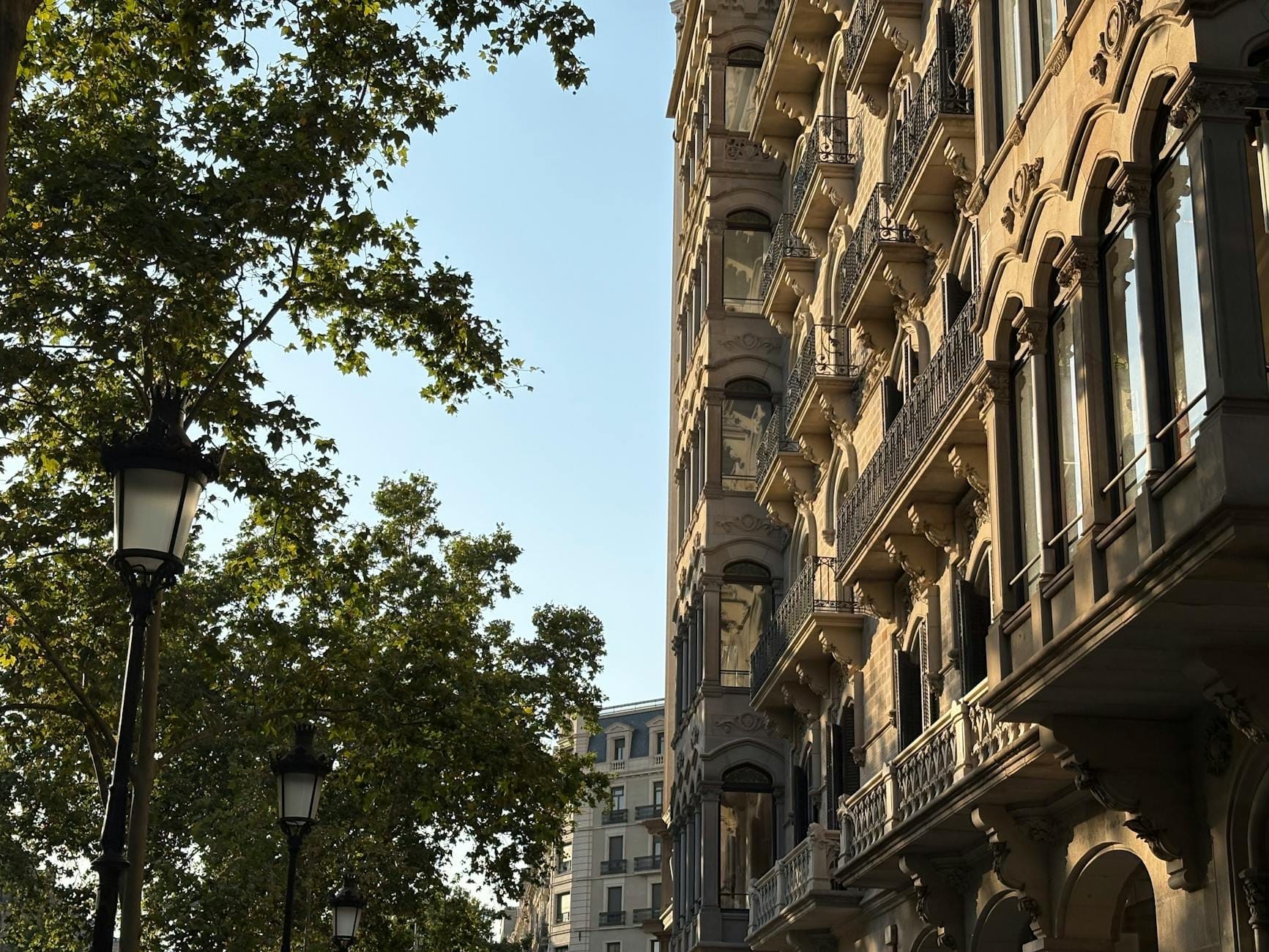
Passeig de Gràcia is a 42-metre-wide public boulevard running roughly 1.2 kilometres through the heart of Barcelona's Eixample district, linking Plaça de Catalunya in the south to Avinguda Diagonal in the north. It is one of Europe's most architecturally concentrated streets: within a few city blocks, you pass three of the finest examples of Catalan Modernisme ever built, including two UNESCO World Heritage-listed structures. Walking it costs nothing, yet it delivers one of the most layered urban experiences Barcelona offers.
The avenue sits at the centre of the Eixample grid, the rational 19th-century expansion of Barcelona designed by engineer Ildefons Cerdà. Wide pavements, chamfered corner blocks, and a central tree-lined promenade define the neighbourhood's character. Passeig de Gràcia is the spine of all of it. For a deeper sense of the surrounding district, the Eixample neighbourhood guide puts the avenue into its full urban context.
💡 Local tip
The avenue itself never closes and never charges admission. Even if you skip every ticketed building, an early-morning or late-evening walk along Passeig de Gràcia is one of Barcelona's genuinely unmissable experiences.
The Architecture: What You're Actually Looking At
The block between Carrer d'Aragó and Carrer del Consell de Cent is sometimes called the Manzana de la Discòrdia, or Block of Discord, because three rival architects each built a masterpiece here in the early 20th century. The name is a pun: manzana means both 'block' and 'apple', referencing the apple of discord from Greek mythology.
The most celebrated building on the avenue is Casa Batlló at number 43, completed by Antoni Gaudí in 1906. Its facade appears to shift colour depending on the angle and light, an effect created by thousands of ceramic fragments in blue, green, and purple. The roof is shaped like a dragon's back. Two blocks north stands Casa Milà, known as La Pedrera, Gaudí's final secular commission, finished in 1912. Its undulating limestone facade has no straight lines anywhere, and the rooftop is populated by twisted chimneys that look like armoured sentinels.
Between these two Gaudí buildings, at number 41, stands Casa Amatller by Josep Puig i Cadafalch (1900), with a stepped Dutch-Gothic gable that could not be more different from its neighbours. Next door at number 35, Casa Lleó Morera by Lluís Domènech i Montaner uses organic floral forms in stone and mosaic. Seeing all three side by side makes the rivalry feel almost tangible: three architects, three completely distinct visions, three buildings that somehow coexist on a single city block.
ℹ️ Good to know
Casa Batlló and Casa Milà both charge significant entry fees (guided tours typically around 35–40 EUR per adult, with premium night tours costing more). Book tickets online in advance, especially in summer. Neither building is included with any generic city pass, so verify inclusions before purchasing.
Tickets & tours
Live prices and dates from our booking partner. If you book, we may earn a commission at no extra cost to you.
Picasso Museum guided tour
From 30 €Instant confirmationFree cancellationOlympic and Sports Museum Juan Antonio Samaranch tickets
From 6 €Instant confirmationFree cancellationCasa Vicens skip-the-line tickets and guided visit in small groups
From 21 €Instant confirmationSunset Sailing Experience with Spanish Tapas and Premium Open Bar
From 69 €Instant confirmationFree cancellation
How the Boulevard Changes Through the Day
Before 9am on a weekday, Passeig de Gràcia is largely the domain of locals: dog walkers, cyclists using the central lane, delivery workers, and office commuters walking briskly toward the metro. The light is soft and often golden, particularly between May and September when the sun rises over the Mediterranean and filters through the plane trees. This is the best time to photograph the buildings without scaffolding of tourists in the foreground.
By mid-morning the tour groups arrive, clustering around Casa Batlló and La Pedrera. The central promenade fills with people stopping to photograph the ornate street furniture: the hexagonal pavement tiles (also designed by Gaudí), the cast-iron streetlamps by Pere Falqués, and the detailed bench-bollards that line the central walkway. By noon in summer it can feel overwhelming, with queues extending onto the pavement outside both major buildings.
Evenings transform the avenue again. After 8pm, the shop windows glow, the buildings are lit from below, and Barcelona residents reclaim the promenade for the traditional passeig, a slow, unhurried walk taken for its own sake. The dragon spine of Casa Batlló glitters under artificial light in a way that daylight cannot replicate. If you want the visual drama of the architecture with a calmer atmosphere, early evening on a weekday in shoulder season (May, early June, September, October) is close to ideal.
The Street Furniture You Probably Walk Past Without Noticing
The pavement tiles underfoot are a design detail worth pausing for. The hexagonal pattern, incorporating seaweed, starfish, and nautical motifs, was originally created by Antoni Gaudí for Casa Milà and later adopted for the entire boulevard. The same tile design was subsequently used in pavements across the wider Eixample grid, which means you encounter it repeatedly throughout the neighbourhood.
The street lamps are equally deliberate. Pere Falqués designed the twin and five-armed candelabra-style lamps in 1906, placing benches at their bases so they function simultaneously as seating, lighting, and street sculpture. Most visitors walk past them focused on the building facades and miss the fact that the furniture beneath their feet and at their backs is also considered high design.
Shopping, Food, and Ground-Floor Reality
At street level, Passeig de Gràcia is one of Barcelona's premium shopping addresses, with flagship stores for Zara, Mango, Loewe, and a range of international luxury brands occupying many of the historic ground floors. This creates a slight tension: you are walking past extraordinary architecture while the lower floors have been converted into storefronts that could exist in any major city. The buildings matter from the first floor up.
For food on or near the avenue, the surrounding Eixample streets have strong options across all budgets. The wider neighbourhood is detailed in the Barcelona restaurant guide, which covers both the Eixample and adjoining areas. Avoid the most tourist-facing cafes immediately adjacent to Casa Batlló: the quality drops and the prices rise sharply within about 50 metres of the entrance queues.
⚠️ What to skip
Pickpockets operate on Passeig de Gràcia, particularly around the queuing areas outside Casa Batlló and La Pedrera. Keep bags closed and worn in front. The corner of Passeig de Gràcia and Gran Via is a known spot for distraction-based theft.
Practical Information for Getting the Most from Your Visit
The full length of Passeig de Gràcia from Plaça de Catalunya to Avinguda Diagonal is approximately 1.5 kilometres, flat and entirely on paved surfaces. It is fully wheelchair accessible, with tactile paving for visually impaired pedestrians and lowered kerbs at every crossing. The central promenade is shaded by mature plane trees, which provides meaningful relief in summer, though the side pavements get full afternoon sun.
Most visitors start at the Plaça de Catalunya end, which sits at the junction of the old city and the Eixample. If you are coming from the Sagrada Família, the most practical approach is to take metro Line 2 or 5 to Passeig de Gràcia station and walk south, then back north along the avenue. This avoids retracing the same ground twice.
In terms of what to wear, comfortable shoes matter more than anything else. The hexagonal pavement tiles have a slight texture that can be slippery when wet. Barcelona's Mediterranean climate means rain is unlikely between June and September but is common in October and November, when the tiles become noticeably greasy underfoot.
For a broader overview of how Passeig de Gràcia fits into a multi-day visit, the complete Gaudí Barcelona guide covers all the major works in one itinerary and helps prioritise which buildings to enter versus which to admire from the pavement.
Who Might Want to Skip This
If architecture and urban design hold no interest for you, the boulevard itself is essentially a long, attractive shopping street, and the buildings are impressive primarily to those who understand or are curious about what they are looking at. Travellers who have already toured Casa Batlló and La Pedrera on a previous visit and are not interested in the other buildings may find a second walk along the avenue adds little.
Visitors with very limited time who are trying to cover multiple Barcelona highlights in a single day should note that the avenue rewards slow attention rather than a brisk pass. If you are already pressed for time, walking one end to the other while staring at a map or phone means you will absorb almost nothing. Either give it an hour with focused attention or save it for a different trip.
Insider Tips
- The rooftop of Casa Milà (La Pedrera) is accessible on a standard ticket and offers one of the better elevated views of the Eixample grid. Buy tickets the night before online to avoid morning queues, and aim for the first entry slot of the day.
- The hexagonal pavement tiles on Passeig de Gràcia are the same design Gaudí created for Casa Milà. Look for the motifs of seaweed and starfish embedded in each tile — most visitors walk across them for days without registering the detail.
- The Manzana de la Discòrdia buildings are best photographed in the late afternoon when the light hits the facades from the west. The iridescent ceramics on Casa Batlló are particularly responsive to low-angle light.
- Casa Amatller (number 41) houses a small café and chocolate shop in its ground floor. It is far less crowded than the adjacent Gaudí buildings and offers a quiet space to sit down without committing to a full museum entry fee.
- For night photography, the period just after sunset but before full dark (the blue hour, roughly 30–45 minutes after sunset) produces the most balanced exposures between the illuminated facades and the sky.
Who Is Passeig de Gràcia For?
- Architecture and design enthusiasts who want to study Catalan Modernisme up close
- Photographers working in both daytime and evening light
- Travellers building a Gaudí itinerary across multiple days
- Serious shoppers looking for flagship Spanish and international brands
- Visitors who enjoy purposeful urban walking with strong visual rewards
Nearby Attractions
Other things to see while in Eixample:
- Camp Nou & FC Barcelona Museum
Home to Europe's largest football stadium and one of Catalonia's most visited museums, the Camp Nou complex is a pilgrimage site for football fans worldwide. With the stadium under renovation until 2027, the Barça Immersive Experience now hosts the collection in a purpose-built 2,400 m² facility nearby.
- Casa Batlló
Casa Batlló is Antoni Gaudí's reimagining of an ordinary Eixample townhouse into something closer to a living organism. Covered in iridescent ceramic scales, crowned by a dragon-spine roof, and filled with rooms that ripple like underwater caves, it is one of Barcelona's most visually overwhelming interiors. This guide covers what to expect, when to go, and how to make the most of your visit.
- Casa Milà (La Pedrera)
Casa Milà, universally known as La Pedrera, is Antoni Gaudí's most architecturally daring residential building, completed in 1912 and declared a UNESCO World Heritage Site. From its wave-like stone façade to the otherworldly rooftop of chimney warriors, it remains one of Barcelona's most rewarding cultural experiences.
- Hospital de Sant Pau
The Recinte Modernista de Sant Pau is one of Barcelona's most architecturally significant sites and yet consistently overshadowed by its famous neighbor down the road. Designed by Lluís Domènech i Montaner and declared a UNESCO World Heritage Site in 1997, this former hospital complex is a riot of color, craft, and ambition spread across 14.5 hectares of the Eixample grid.
Planning a trip? Discover personalized activities with the Nomado app.