Casa Milà (La Pedrera): Gaudí's Stone Masterpiece in the Heart of Eixample
Casa Milà, universally known as La Pedrera, is Antoni Gaudí's most architecturally daring residential building, completed in 1912 and declared a UNESCO World Heritage Site. From its wave-like stone façade to the otherworldly rooftop of chimney warriors, it remains one of Barcelona's most rewarding cultural experiences.
Quick Facts
- Location
- Passeig de Gràcia 92, corner of Carrer de Provença, Eixample, Barcelona
- Getting There
- Metro Lines 3 (green) & 5 (blue) — Diagonal station
- Time Needed
- 1.5 to 3 hours depending on visit type (day, evening, or night)
- Cost
- Paid entry; prices vary by experience type — book in advance via official site
- Best for
- Architecture enthusiasts, Gaudí fans, photography, and evening culture seekers
- Official website
- www.lapedrera.com/en
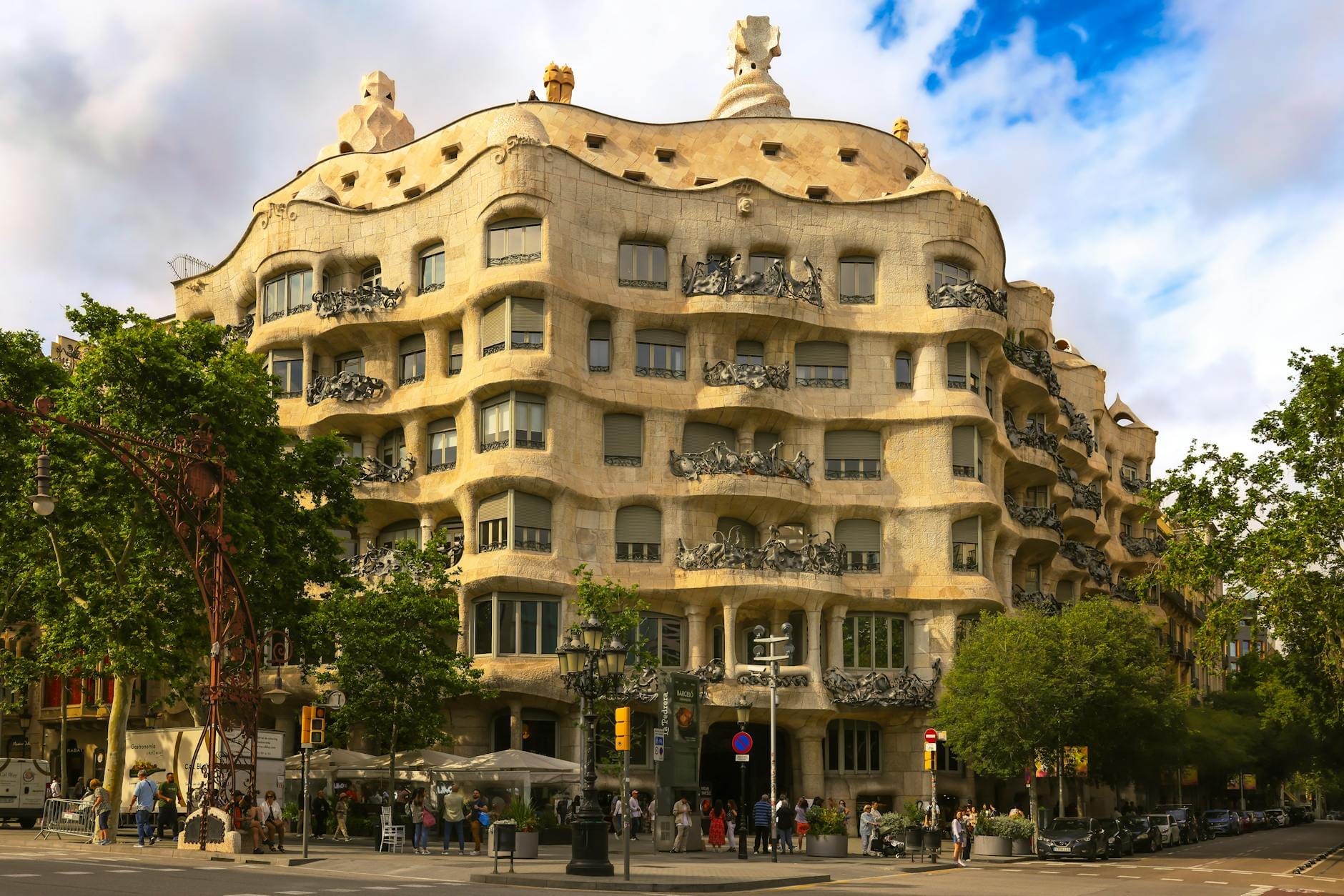
What Casa Milà Actually Is
Casa Milà, built between 1906 and 1912 to a commission from Pere Milà and his wife Roser Segimon, is the last private residential building Antoni Gaudí designed. It sits on a prominent corner of Passeig de Gràcia at the intersection with Carrer de Provença, in Barcelona's Eixample grid. The locals who watched it rise gave it the nickname La Pedrera, meaning 'the stone quarry,' a reference to its raw, rippling limestone façade that looked nothing like any building the city had seen.
The building is not a museum in the traditional sense. It is a UNESCO World Heritage Site (designated 1984) that functions as a cultural center, event space, and partial residence. Visitors access three main areas: the rooftop with its famous sculptural chimneys, the Espai Gaudí exhibition housed in the attic, and a reconstructed period apartment that recreates bourgeois Eixample life in the early twentieth century.
If you are planning a broader Gaudí itinerary across Barcelona, the Gaudí Barcelona guide provides a practical framework for sequencing this visit alongside the Sagrada Família, Palau Güell, and Park Güell.
The Rooftop: Where Architecture Becomes Sculpture
The rooftop is the centerpiece of any visit to Casa Milà, and it genuinely earns its reputation. Gaudí designed the chimneys, ventilation towers, and staircase exits as integrated sculptural forms, not as afterthoughts. The twisted chimney stacks, clad in fragments of broken marble and ceramic in muted whites, greys, and greens, cluster in groups across the terrace. They read at first as abstract shapes, and then suddenly as warriors, monks, or helmeted figures depending on the angle. The effect is disorienting in the best possible way.
In the early morning, before organized tour groups arrive, the rooftop has an unusual quiet to it. The stone surfaces, cool from the night, absorb the soft eastern light in a way that makes the textures almost tactile. Later in the afternoon, particularly in summer, the exposed terrace can feel oppressively hot and crowded. Photography becomes difficult as visitors cluster around the most recognizable chimney groupings.
💡 Local tip
Visit the rooftop at opening time or book an evening/night ticket for far better light, cooler temperatures, and dramatically thinner crowds. The after-dark experience, offered during specific seasons, transforms the chimneys with atmospheric lighting and is consistently reviewed as the superior option.
The rooftop also provides a genuine panoramic view across Eixample's orderly grid, with the unfinished towers of the Sagrada Família visible to the northeast and the low hills of Tibidabo behind the city to the northwest. It is not the highest vantage point in Barcelona, but as a framed urban view tied directly to its architectural context, it holds its own.
Tickets & tours
Live prices and dates from our booking partner. If you book, we may earn a commission at no extra cost to you.
La Pedrera Sunrise
From 39 €Instant confirmationLa Pedrera premium behind-the-scenes tour with skip-the-line ticket
From 120 €Instant confirmationLa Pedrera skip-the-line tickets with audio guide
From 29 €Instant confirmationLa Pedrera Night Experience
From 39 €Instant confirmation
The Attic and the Espai Gaudí Exhibition
Directly beneath the rooftop sits the parabolic brick attic, now home to the Espai Gaudí, a permanent exhibition on Gaudí's architectural methods and philosophy. The space itself is architecturally striking: a sequence of catenary arches in pale brick form a series of continuous vaults that look organic rather than constructed. Gaudí derived this structural approach from the natural geometry of hanging chains, which when inverted create self-supporting arches requiring no additional reinforcement.
The exhibition uses models, drawings, photographs, and interactive displays to explain Gaudí's working processes across his major buildings. It is one of the more genuinely informative architectural exhibitions in the city, avoiding the oversimplified 'genius visionary' narrative and engaging instead with actual structural logic. Scale models of the catenary arch system are particularly effective for understanding why these buildings look the way they do.
This section suits visitors who want more than surface aesthetics. Those who are less interested in structural theory may find the exhibition more text-heavy than expected. Plan roughly 25 to 40 minutes here if you engage fully with the displays.
The Period Apartment: Daily Life on Passeig de Gràcia
The reconstructed apartment on the fourth floor offers a different kind of insight. Furnished to represent how a prosperous Eixample family would have lived in the building around 1910, it moves through rooms including a dining room, bedrooms, a kitchen, and a corridor. The furniture, decorative objects, and textiles are period-accurate and sourced carefully.
What makes this section interesting beyond the decoration is the architecture of the rooms themselves. The floor plan follows no straight walls. Load-bearing columns positioned by Gaudí allowed the interior partitions to be moved by each resident, meaning no two floors in the building had to be identical. The undulating ceilings, organic door frames, and continuous curves of the space feel genuinely different from any conventional apartment floor plan.
The surrounding Eixample district, laid out by urban planner Ildefons Cerdà in the 1850s, is worth exploring as a context for this building. The Eixample neighborhood has its own character beyond its most famous addresses, with independent bookshops, food markets, and modernist pharmacies and shops scattered across its chamfered blocks.
How to Get There and When to Go
Casa Milà sits on Passeig de Gràcia, one of Barcelona's main avenues, making it straightforward to reach. Metro Lines 3 (green) and 5 (blue) both stop at Diagonal, a two-minute walk from the building's main entrance on the corner of Passeig de Gràcia and Carrer de Provença. The building's address is Passeig de Gràcia 92.
Booking tickets in advance through the official website (lapedrera.com) is strongly recommended, particularly from April through October and during school holiday periods. Walk-in tickets are sometimes available but the queue can be substantial by mid-morning on any weekend. Prices vary depending on whether you book a standard daytime entry, an evening visit, or the after-dark experience offered in warmer months. Check the official site for current schedules and rates.
⚠️ What to skip
Avoid arriving between 11am and 3pm on weekends in summer unless you have a timed ticket. The entrance queue and interior corridors become uncomfortably crowded, which undercuts the experience significantly. Weekday mornings at opening time are the most comfortable option for daytime visits.
Casa Milà is one stop on the wider Passeig de Gràcia architectural corridor, which includes Casa Batlló a few blocks south. Both buildings are best visited on separate days to avoid Gaudí overload, but their proximity makes them easy to combine if time is short.
Photography, Accessibility, and Practical Notes
Photography is permitted throughout the public areas without tripods or professional equipment. The rooftop offers the most photogenic material, but light quality shifts dramatically with the time of day. Morning visits in spring and autumn produce soft, even light across the pale stone chimneys. The evening and night experiences use controlled atmospheric lighting that is designed for photography and produces images unlike anything you can achieve in daylight.
For accessibility, the building has elevators serving the main floors and wheelchair access to key areas. Given the building's age and curved architecture, some areas present natural obstacles. The official website and Barcelona's tourism authority (barcelonaturisme.com) can provide specific accessibility information before your visit. Contacting the venue directly ahead of time is advisable for visitors with specific mobility requirements.
ℹ️ Good to know
An audio guide is included with most ticket types and is available in multiple languages. It is genuinely useful, particularly in the attic exhibition where the architectural context requires some explanation to land properly.
If you are structuring a full day around Gaudí's work in Barcelona, the Barcelona itinerary guide outlines how to sequence Casa Milà with the city's other major sites without over-scheduling.
Who Should Reconsider This Visit
Casa Milà is not for everyone, and it is worth being honest about that. Visitors who find modernist architecture cold or overly cerebral may feel the building's interior lacks the warmth of, say, the Gothic Quarter's medieval streets or the human energy of a working market. The experience is curated and somewhat museum-like in its pacing, which suits some travelers and frustrates others.
Families with very young children may find the staircase-heavy rooftop access challenging, and the conceptual exhibition in the attic is unlikely to hold the attention of children under ten. The building itself has no café or seating areas to speak of, so it does not function well as a long-stay destination. Come with a clear interest in architecture or Gaudí's work and you will leave satisfied. Come purely because it appears on a top-ten list and you may wonder what the fuss was about.
Insider Tips
- The after-dark ticket, offered during spring and summer evenings, is not just a novelty. The combination of atmospheric lighting, near-empty terraces, and cooler temperatures makes it a fundamentally different and generally superior experience to the standard daytime visit.
- If you stand at the corner of Carrer de Provença and Passeig de Gràcia and look up at the building's façade from across the street, you get a far more complete read of Gaudí's wave-like stone composition than from the crowded pavement directly in front of the entrance.
- The Espai Gaudí attic exhibition is often rushed by visitors eager to reach the rooftop. Doing it in reverse, if the ticketing flow allows, means you arrive on the roof with a richer understanding of what you are looking at.
- Free entry to the building's ground floor and internal courtyard is sometimes possible without a ticket. The courtyards, painted in soft blues and whites, are architectural elements in their own right and give a sense of the building's scale and spatial logic.
- Combine this visit with a walk north along Passeig de Gràcia toward Diagonal to see the unbroken streetscape of Eixample modernisme, including the Palau del Baró de Quadras and other buildings by Puig i Cadafalch, Domènech i Montaner, and lesser-known contemporaries of Gaudí.
Who Is Casa Milà (La Pedrera) For?
- Architecture and design enthusiasts who want to understand Gaudí's structural logic, not just photograph the chimneys
- Photographers, particularly those visiting at opening time or booking an evening ticket for controlled light conditions
- Travelers on a Gaudí-focused itinerary who want to see his residential work alongside the Sagrada Família
- Culture-focused visitors looking for a high-quality exhibition experience within a UNESCO-listed building
- Evening visitors seeking a distinctive Barcelona experience that goes beyond the standard daytime tourist circuit
Nearby Attractions
Other things to see while in Eixample:
- Camp Nou & FC Barcelona Museum
Home to Europe's largest football stadium and one of Catalonia's most visited museums, the Camp Nou complex is a pilgrimage site for football fans worldwide. With the stadium under renovation until 2027, the Barça Immersive Experience now hosts the collection in a purpose-built 2,400 m² facility nearby.
- Casa Batlló
Casa Batlló is Antoni Gaudí's reimagining of an ordinary Eixample townhouse into something closer to a living organism. Covered in iridescent ceramic scales, crowned by a dragon-spine roof, and filled with rooms that ripple like underwater caves, it is one of Barcelona's most visually overwhelming interiors. This guide covers what to expect, when to go, and how to make the most of your visit.
- Hospital de Sant Pau
The Recinte Modernista de Sant Pau is one of Barcelona's most architecturally significant sites and yet consistently overshadowed by its famous neighbor down the road. Designed by Lluís Domènech i Montaner and declared a UNESCO World Heritage Site in 1997, this former hospital complex is a riot of color, craft, and ambition spread across 14.5 hectares of the Eixample grid.
- Passeig de Gràcia
Passeig de Gràcia is Barcelona's most architecturally significant avenue, stretching 1.5 kilometres through the Eixample district past landmark Modernista buildings including Casa Batlló and Casa Milà. The boulevard itself is free to walk at any hour, offering one of the city's great urban experiences whether you visit at dawn or after dark.
Planning a trip? Discover personalized activities with the Nomado app.