Casa Batlló: Inside Gaudí's Most Theatrical Building
Casa Batlló is Antoni Gaudí's reimagining of an ordinary Eixample townhouse into something closer to a living organism. Covered in iridescent ceramic scales, crowned by a dragon-spine roof, and filled with rooms that ripple like underwater caves, it is one of Barcelona's most visually overwhelming interiors. This guide covers what to expect, when to go, and how to make the most of your visit.
Quick Facts
- Location
- Passeig de Gràcia 43, Eixample, Barcelona
- Getting There
- Metro: Passeig de Gràcia (Lines L2, L3, L4 (note: L4 interchange at Passeig de Gràcia))
- Time Needed
- 1.5 to 2.5 hours
- Cost
- Paid entry; book online in advance for discounts and guaranteed access
- Best for
- Architecture lovers, design enthusiasts, families with curious children
- Official website
- www.casabatllo.es/en
What Is Casa Batlló and Why Does It Matter?
Casa Batlló is not a new building. It began as a conventional apartment block constructed in 1877, one of hundreds along Barcelona's orderly Eixample grid. What changed everything was the decision by textile industrialist Josep Batlló i Casanovas to commission Antoni Gaudí to renovate it between 1904 and 1906. Gaudí did not renovate it so much as transform it from the inside out and the outside up, producing something that has no real architectural precedent.
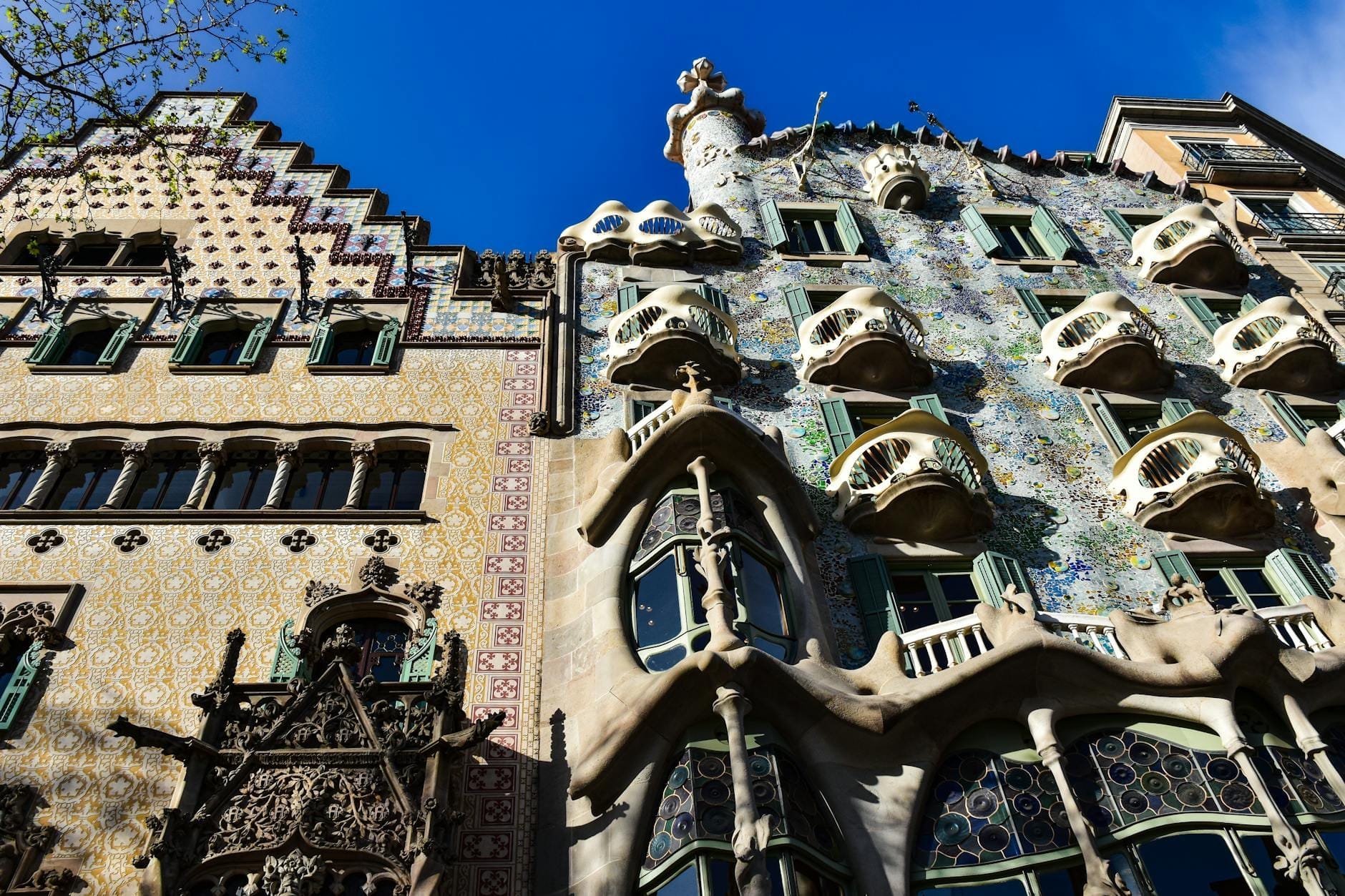
The result is now a UNESCO World Heritage Site, one of six Gaudí works in Barcelona to hold that designation. But the UNESCO label risks making it sound like a relic. Casa Batlló is anything but static. It reads differently at different hours, in different weather, and from different angles on the street. The façade of broken ceramic tiles shifts from deep blue-green to amber to silver depending on the light. Up close, you realize the balconies are shaped like skulls and bones. The roof ridge curves and shimmers like the back of a scaled reptile.
💡 Local tip
Book tickets online before you arrive. Walk-in entry is not guaranteed, and the most popular time slots, particularly weekend mornings, sell out days in advance. Online booking also typically offers a discount off the door price.
Casa Batlló sits on one of the most architecturally competitive stretches of street in the world. The block between Carrer d'Aragó and Carrer del Consell de Cent on Passeig de Gràcia is known as the Manzana de la Discordia, loosely translated as the Block of Discord, because three rival Modernista architects placed landmark buildings almost side by side. Casa Batlló, Casa Amatller by Josep Puig i Cadafalch, and Casa Lleó Morera by Lluís Domènech i Montaner all compete for attention on the same façade line. Arriving by foot along Passeig de Gràcia and seeing them emerge together is its own experience.
The Façade: Reading the Building from the Street
Most visitors stop dead on the pavement when they first see it, and that reaction is worth surrendering to. The façade of Casa Batlló is covered in fragments of ceramic tile, called trencadís, in shades of blue, green, and purple that Gaudí selected to shift color depending on the viewing angle and the position of the sun. On a bright midmorning, the surface appears almost silver-white. By late afternoon, it deepens to green and cobalt. After dark, subtle lighting makes it glow against the stone of neighbouring buildings.
The balconies, shaped to resemble skulls with bone-like supports, are most readable from across the avenue. Standing directly beneath them compresses the perspective. Cross to the central reservation of Passeig de Gràcia for the clearest view of the complete composition: the skeletal lower floors, the scaled mid-section clad in circular ceramic discs, and the roof that arches upward in a ridge of iridescent green-blue tiles. The tower, capped with a cross, rises above it all.
Photography from street level is best in the early morning before crowds gather on the pavement, or at dusk when the warm ambient light complements the blue tones of the ceramic. Direct midday sun flattens the texture and washes out the color gradation. If you plan to photograph the façade, build in time at two different points in the day.
Tickets & tours
Live prices and dates from our booking partner. If you book, we may earn a commission at no extra cost to you.
Platinum Priority Skip-The-Line Tickets to Casa Batllo
From 55 €Instant confirmationFree cancellationComplete Gaudi tour with Park Guell, Casa Batllo and Sagrada Familia
From 249 €Instant confirmationFree cancellationCasa Batllo Guided Tour with Fast Track
From 54 €Instant confirmationFree cancellationPark Guell and Casa Batllo pass with 48-hour public transport
From 94 €Instant confirmation
Inside: The Noble Floor, the Blue Patio, and the Attic
The interior is organized as a self-guided, self-paced visit. An audio-visual guide is included with entry and provides narrative commentary tied to each space. The experience begins on the Noble Floor, the principal residence that Batlló himself occupied, where Gaudí's design language becomes fully immersive. Doorways are shaped like the mouths of creatures. The ceiling of the central salon is a spiral of plaster that resembles a whirlpool viewed from below. Surfaces that appear white on first impression reveal, on closer inspection, faint color gradients applied with extraordinary care.
The Blue Patio is one of the building's structural and visual achievements. Gaudí designed an internal light well that graduates tile color from deep cobalt at the top to pale blue-white at the bottom, counteracting the way natural light diminishes as it descends. The result is an even wash of reflected light throughout all floors, a pre-electric solution to a very modern problem. Looking up from the ground level of the patio, the effect is of peering up through still water.
The attic, known as the Sala de Màquines, is a vaulted space of 60 catenary arches arranged in a row like a ribcage. It originally housed the building's mechanical systems and laundry. Today, stripped back and lit from above, it reads as one of the most beautiful interior spaces in the building: entirely structural, entirely functional in its origins, and entirely unlike anything expected. The arches are built in brick, each one parabolic, each one pressing outward into the walls rather than downward, distributing load in a way Gaudí calculated without computer assistance.
ℹ️ Good to know
The visit is self-paced, so you can spend more time in the spaces that interest you most. Architecture and design enthusiasts often spend 30 minutes in the Noble Floor alone. Allow at least 90 minutes for a thorough visit; 2.5 hours if you want to engage fully with the audio guide and photograph the interior.
The Rooftop: Where the Visit Peaks
The rooftop is the theatrical culmination of the visit, and it tends to be the moment people remember. The dragon-spine ridge, covered in green and blue ceramic tiles that catch light differently from every angle, dominates the skyline view. Gaudí's chimneys, twisted and capped in trencadís mosaic, stand in clusters that resemble helmeted soldiers. The views toward Montjuïc in one direction and the upper Eixample grid in the other provide clear spatial orientation within the city.
The rooftop can become crowded in the middle of the day. Groups tend to arrive together and cluster around the main ridge for photographs. If you visit on a weekday morning or arrive later in the afternoon approaching closing, the density drops noticeably. Rain affects the rooftop experience significantly: wet ceramic is beautiful to look at but makes surfaces slippery, and low cloud cover reduces visibility. Check weather before visiting if the rooftop is a priority.
For a broader perspective on Barcelona's rooftop architecture, the nearby Casa Milà, known as La Pedrera, designed by Gaudí in 1906-1912, offers another extraordinary rooftop experience. Comparing the two in a single day is ambitious but possible, as they are a short walk apart on the same avenue.
Practical Information: When to Go and How to Prepare
Casa Batlló is open every day from 9am to 10:30pm. The evening slots, particularly those starting from 7pm onward, are significantly less crowded than morning and midday visits. Evening lighting inside the building is carefully managed, and the rooftop at dusk has a quality that daytime visits do not replicate. If your schedule allows flexibility, an evening entry is worth serious consideration.
The building is accessible via three metro lines at Passeig de Gràcia station: L2 (purple), L3 (green), and L4 (yellow). The station exit deposits you almost directly in front of the building. From the Gothic Quarter, it is a 15 to 20 minute walk along the Eixample grid. From Barceloneta, allow 25 to 30 minutes on foot or take the metro.
Wear comfortable shoes. Although the visit is entirely indoors, you move between multiple levels, including stairs and ramps. The building is committed to accessibility and has invested in autism-friendly experiences with trained neurodiverse staff, but visitors with significant mobility limitations should check the current accessibility configuration directly with the venue before booking, as some areas may have conservation-related restrictions.
⚠️ What to skip
Temporary closures of specific rooms or areas do occur due to ongoing conservation work. The building management generally communicates these in advance on the official website. If a particular space, such as the rooftop, is critical to your visit, confirm its availability before purchasing tickets.
Casa Batlló sits within the broader context of Eixample's Modernista heritage. For a deeper understanding of this architectural movement and Gaudí's place within it, reading our guide to Gaudí's works in Barcelona before your visit will sharpen what you notice inside.
Honest Assessment: Is It Worth the Price?
Casa Batlló is not an inexpensive attraction. The ticket price reflects the immersive technology built into the visit, the audio guide, and the cost of maintaining a building of this complexity. For travelers with a genuine interest in architecture, design, or art history, the investment is straightforward to justify. The interior is genuinely unlike anything else in the city, and the rooftop alone is worth a significant portion of the entry cost.
For travelers who are visiting primarily because it appears on every Barcelona highlight list, and whose interest in architecture is limited, the experience can feel overwhelming or even tedious. The audio guide is lengthy, the spaces require engagement to appreciate, and the crowds in peak season can make the Noble Floor feel pressured. If that description fits you, consider whether the exterior view from the street, which is entirely free, might satisfy your curiosity. The façade alone is one of the most extraordinary things you will see in Europe.
If you are building a broader itinerary around Barcelona's Modernista buildings, consider also Hospital de Sant Pau, another UNESCO-listed Modernista complex that sees far fewer visitors and offers a completely different spatial scale and atmosphere.
Insider Tips
- The evening visit slots (from 7pm onward) are the least crowded and most atmospheric. The interior lighting is managed to complement Gaudí's color palette, and the rooftop at dusk is genuinely different from anything you will experience during daytime hours.
- Cross to the central reservation of Passeig de Gràcia to photograph the façade. Standing directly beneath it compresses the perspective and loses the composition. The best distance for a full-façade shot is roughly 20 to 25 metres back.
- If you are visiting with children, focus time in the Noble Floor salon and the attic. The whirlpool ceiling and the ribbed arches are immediately readable without architectural background, and children tend to respond strongly to them.
- The rooftop chimneys are the most photographed element up close, but the less-photographed view is looking back down into the building's interior courtyard from above. Few visitors seek it out, and it provides a striking downward perspective on the blue patio tile gradation.
- Combine Casa Batlló with Casa Milà on the same day only if you start early and move efficiently. Both demand real attention, and doing them back to back in under three hours risks shortchanging both experiences.
Who Is Casa Batlló For?
- Architecture and design enthusiasts who want to understand how Gaudí actually worked, not just what the results look like
- First-time visitors to Barcelona seeking a single interior that encapsulates the city's Modernista identity
- Photographers who will benefit from returning at two different times of day to capture the façade in different light conditions
- Families with children aged eight and above who can engage with audio guides and abstract spatial environments
- Travelers on a focused Gaudí itinerary pairing this visit with La Pedrera, Park Güell, or the Sagrada Família
Nearby Attractions
Other things to see while in Eixample:
- Camp Nou & FC Barcelona Museum
Home to Europe's largest football stadium and one of Catalonia's most visited museums, the Camp Nou complex is a pilgrimage site for football fans worldwide. With the stadium under renovation until 2027, the Barça Immersive Experience now hosts the collection in a purpose-built 2,400 m² facility nearby.
- Casa Milà (La Pedrera)
Casa Milà, universally known as La Pedrera, is Antoni Gaudí's most architecturally daring residential building, completed in 1912 and declared a UNESCO World Heritage Site. From its wave-like stone façade to the otherworldly rooftop of chimney warriors, it remains one of Barcelona's most rewarding cultural experiences.
- Hospital de Sant Pau
The Recinte Modernista de Sant Pau is one of Barcelona's most architecturally significant sites and yet consistently overshadowed by its famous neighbor down the road. Designed by Lluís Domènech i Montaner and declared a UNESCO World Heritage Site in 1997, this former hospital complex is a riot of color, craft, and ambition spread across 14.5 hectares of the Eixample grid.
- Passeig de Gràcia
Passeig de Gràcia is Barcelona's most architecturally significant avenue, stretching 1.5 kilometres through the Eixample district past landmark Modernista buildings including Casa Batlló and Casa Milà. The boulevard itself is free to walk at any hour, offering one of the city's great urban experiences whether you visit at dawn or after dark.
Planning a trip? Discover personalized activities with the Nomado app.