Hospital de Sant Pau: Barcelona's Forgotten Modernista Wonder
The Recinte Modernista de Sant Pau is one of Barcelona's most architecturally significant sites and yet consistently overshadowed by its famous neighbor down the road. Designed by Lluís Domènech i Montaner and declared a UNESCO World Heritage Site in 1997, this former hospital complex is a riot of color, craft, and ambition spread across 14.5 hectares of the Eixample grid.
Quick Facts
- Location
- Carrer de Sant Antoni Maria Claret, 167, 08025 Barcelona (Eixample)
- Getting There
- Metro L5 (Sant Pau – Dos de Maig) or Metro L4 (Guinardó)
- Time Needed
- 1.5 to 2.5 hours
- Cost
- Paid admission — check official website for current pricing
- Best for
- Architecture lovers, history enthusiasts, photographers, and anyone wanting a quieter alternative to the Sagrada Família crowds
- Official website
- santpaubarcelona.org/en
What Is the Recinte Modernista de Sant Pau?
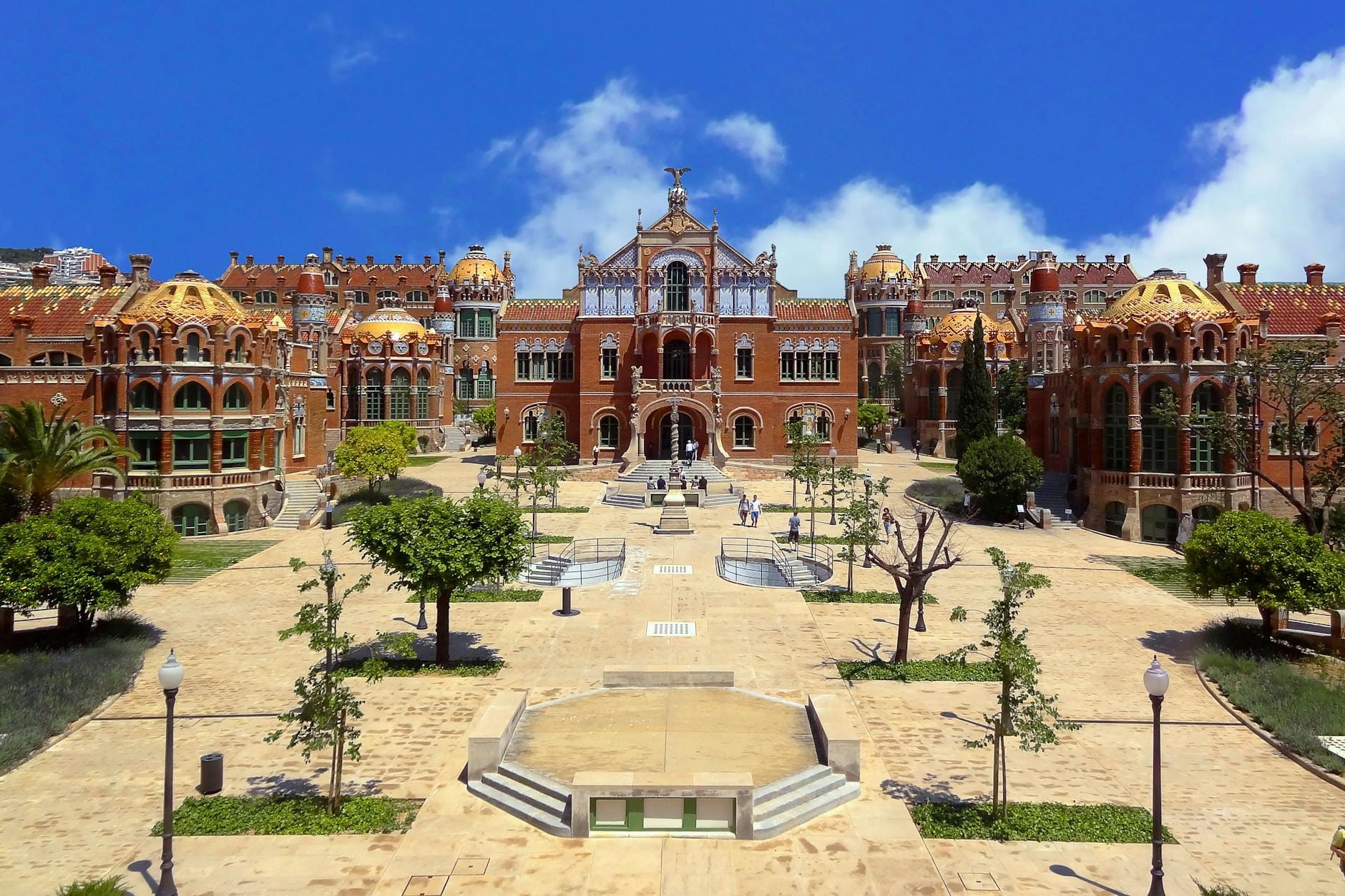
The Hospital de la Santa Creu i Sant Pau, officially known in Catalan as the Recinte Modernista de Sant Pau, is the largest Modernista complex in Europe and one of the finest examples of Catalan Art Nouveau architecture anywhere in the world. Designed by architect Lluís Domènech i Montaner, construction began in 1901 and was completed in 1930 — a timeline that spans two generations of builders and craftsmen. In 1997, UNESCO inscribed the site on its World Heritage List alongside the works of Antoni Gaudí, recognizing Domènech i Montaner's complex as an equally vital expression of the Modernisme movement.
The institution itself is older still. Its roots stretch back to 1401, making it one of the oldest hospitals in Spain. For over six centuries, the site functioned as a working medical facility serving the people of Barcelona. In 2009, hospital operations finally moved to a modern building nearby, and the historic pavilions were transformed into a cultural and educational campus. Today, the complex is open to visitors who want to understand a side of Barcelona's architectural identity that extends well beyond Gaudí.
💡 Local tip
The complex is located directly at the end of Avinguda de Gaudí, the pedestrian boulevard that connects it to the Sagrada Família. Walking this avenue links two of Barcelona's greatest Modernista works in under 10 minutes on foot.
The Architecture: What You're Actually Looking At
Domènech i Montaner rejected the utilitarian hospital design of his era in favor of something radically different: a garden city within the city. Rather than a single institutional block, he conceived 48 pavilions arranged diagonally across a 14.5-hectare plot — an area equivalent to nine full blocks of the Eixample's grid. Each pavilion was designed to hold a specific function: surgery, isolation, administration, nursing. Connecting underground tunnels allowed staff and patients to move between them without exposure to the elements.
The materials are extraordinary. Façades are clad in glazed ceramic tiles in deep greens, blues, and golds. Mosaic friezes by sculptor Pablo Gargallo wrap around building exteriors. Sculptures of saints, allegories of medicine, and heraldic motifs crowd the rooflines. The central dome of the main administration building is covered in broken ceramic in the manner of trencadís, the technique more commonly associated with Gaudí's Park Güell. Standing in the central courtyard on a clear morning, the pavilions catch sunlight and seem almost to shimmer.
Domènech i Montaner also had a medical philosophy embedded in the design. Natural light enters every pavilion from multiple angles. Gardens surround and separate the buildings, allowing patients access to green space. The orientation of each structure was calculated to maximize ventilation. In the early twentieth century, this was radical thinking — and it worked. The complex was genuinely innovative as a hospital, not just as an art object.
Tickets & tours
Live prices and dates from our booking partner. If you book, we may earn a commission at no extra cost to you.
Palau de la Musica and Sant Pau Art Nouveau Combo Ticket
From 30 €Instant confirmationFree cancellationPrivate Barcelona Highlights half-day tour
From 70 €Instant confirmationFree cancellationTickets for Sant Pau Art Nouveau Site
From 17 €Instant confirmationFree cancellationSanta Maria del Mar Guided Tour Through the Interior and Terraces
From 19 €Instant confirmationFree cancellation
How the Experience Changes Through the Day
Morning visits, particularly on weekdays, offer the closest thing to a tranquil experience. The light in the central gardens is soft and directional before 11am, which is when photographers tend to arrive deliberately early. The ceramic colors read truest in morning sun rather than the flat overhead brightness of midday. You can walk through the main entrance and often find entire sections of the courtyard to yourself for the first half hour.
By midday, tour groups arrive in clusters. This is worth noting: the complex is large enough that the crowds rarely feel overwhelming inside the individual pavilion interiors, but the central axis and main dome area can become congested. If you visit during peak tourist season, June through August, arriving at opening time is genuinely worth the extra effort.
Late afternoon brings warmer light and, typically, fewer visitors as tour buses depart. The golden hour color cast against the yellow stone and polychrome ceramics is something that photographs cannot fully capture. If you linger near closing time, the gardens become almost still, and you can appreciate the acoustic quality of the space — the low sound of the city muffled by the surrounding walls, the occasional bird call from the trees overhead.
⚠️ What to skip
Opening hours and admission prices change seasonally and are not fixed. Always verify current schedules directly at santpaubarcelona.org or call +34 93 553 71 45 before visiting. Arriving to find unexpected closures is a real risk if you rely on third-party sources.
Getting There and Moving Around the Complex
The site is straightforward to reach by metro. Take Line 2 (purple) to the Sant Pau – Dos de Maig stop, or Line 4 (yellow) to Guinardó, and walk from either point in under five minutes. The complex sits in the Eixample district, and its position at the top of Avinguda de Gaudí means it is entirely possible to walk from the Sagrada Família in approximately ten minutes. This walk along the dedicated pedestrian boulevard is genuinely pleasant and gives you a street-level sense of the Eixample grid.
Within the complex itself, the grounds are largely flat and the main pathways are paved. Some pavilion interiors have steps and are not fully accessible to wheelchair users, but the exterior gardens and central courtyard are navigable. Visitors should check current accessibility conditions with the site directly, as ongoing restoration work occasionally affects which areas are open.
Wear comfortable shoes. The visit naturally involves a good deal of walking outdoors, and the photogenic pavilions tend to draw people further than they initially plan. Budget at least 90 minutes, and two to two-and-a-half hours if you want to properly explore the interiors of the pavilions that are open for touring.
Sant Pau in Context: Why It Matters
Barcelona's Modernisme movement is typically narrated through Gaudí, but Domènech i Montaner was arguably the movement's most technically sophisticated architect. He designed the Palau de la Música Catalana in El Born — another UNESCO World Heritage Site — and Sant Pau represents the full ambition of his mature style. Understanding both buildings together gives a much more complete picture of what the Modernisme movement was actually attempting: a fusion of Catalan identity, medieval craft traditions, and progressive social ideals.
The choice to build a hospital rather than a concert hall or private palace is itself significant. The patrons who funded Sant Pau wanted to demonstrate that art and good design were not luxuries for the elite but conditions that could improve the lives of ordinary patients. Whether or not this philosophy succeeded in medical terms, it produced a building complex of extraordinary beauty that served working-class Barcelonans for over a century.
This context matters for travelers deciding how to allocate their time. If your Barcelona visit is focused on Gaudí's Barcelona, Sant Pau is the ideal counterpoint: equally impressive, rooted in the same historical moment, and consistently less crowded than the blockbuster Gaudí sites. It rewards people who want to understand, not just photograph.
Photography, Practicalities, and Who Should Skip It
The complex is one of the most photogenic sites in Barcelona, which is not a low bar. The main administration building's central dome works well as a wide-angle shot from the central garden path. The individual pavilion façades are best captured in the first two hours after opening, before the light flattens. A 24mm to 35mm lens captures the scale without distorting the proportions; longer focal lengths work well for isolating ceramic detail on upper levels.
This is not an attraction for travelers seeking an evening experience. The site closes in the afternoon or early evening depending on the season, and unlike the Magic Fountain on Montjuïc or the nightlife-oriented areas of Barcelona, Sant Pau has no compelling reason to visit after dark. It is a daytime destination, full stop.
Travelers with very limited time in Barcelona who are choosing between Sant Pau and the Sagrada Família should choose the Sagrada Família — its interior is unmatched and the scale of that single building exceeds almost anything else in the city. But travelers with two or more full days who want depth rather than just breadth will find Sant Pau rewarding in a way that many of Barcelona's more prominent attractions are not. Children below around age ten tend to find the complex less engaging without context; the architecture requires some appreciation of history and craft to land properly.
ℹ️ Good to know
The complex hosts cultural events, exhibitions, and educational programs throughout the year. Check the official site for current programming, which can make a visit richer than a standard self-guided tour.
Insider Tips
- The view down Avinguda de Gaudí from the main entrance gate of Sant Pau looking toward the Sagrada Família towers is one of the great urban vistas in Barcelona and costs nothing to enjoy even without buying a ticket.
- If you visit on a weekday morning and notice workers or researchers in the pavilions, this is normal: several cultural and academic organizations have offices within the complex. The site is a working campus, not a purely tourist venue.
- The underground tunnels used by hospital staff are partially accessible during the tour — ask about inclusion when booking, as the experience adds real depth to understanding how the complex functioned as a hospital.
- Combine Sant Pau with the Palau de la Música Catalana in El Born on the same day to see both of Domènech i Montaner's major Barcelona works. They are stylistically related but separated by more than a decade of design evolution.
- Barcelona's spring shoulder season, April to early June, is when the gardens around the pavilions look their best. Flowering plants and manageable temperatures make the outdoor portions of the visit genuinely pleasant rather than just architecturally interesting.
Who Is Hospital de Sant Pau For?
- Architecture and design enthusiasts wanting depth beyond the Gaudí canon
- Photographers looking for rich color, texture, and scale with less competition than at top-tier Gaudí sites
- History travelers interested in the evolution of medical facilities and hospital design
- Visitors on a second or third trip to Barcelona who have already covered the marquee attractions
- Travelers following the full Modernisme trail through Eixample and El Born
Nearby Attractions
Other things to see while in Eixample:
- Camp Nou & FC Barcelona Museum
Home to Europe's largest football stadium and one of Catalonia's most visited museums, the Camp Nou complex is a pilgrimage site for football fans worldwide. With the stadium under renovation until 2027, the Barça Immersive Experience now hosts the collection in a purpose-built 2,400 m² facility nearby.
- Casa Batlló
Casa Batlló is Antoni Gaudí's reimagining of an ordinary Eixample townhouse into something closer to a living organism. Covered in iridescent ceramic scales, crowned by a dragon-spine roof, and filled with rooms that ripple like underwater caves, it is one of Barcelona's most visually overwhelming interiors. This guide covers what to expect, when to go, and how to make the most of your visit.
- Casa Milà (La Pedrera)
Casa Milà, universally known as La Pedrera, is Antoni Gaudí's most architecturally daring residential building, completed in 1912 and declared a UNESCO World Heritage Site. From its wave-like stone façade to the otherworldly rooftop of chimney warriors, it remains one of Barcelona's most rewarding cultural experiences.
- Passeig de Gràcia
Passeig de Gràcia is Barcelona's most architecturally significant avenue, stretching 1.5 kilometres through the Eixample district past landmark Modernista buildings including Casa Batlló and Casa Milà. The boulevard itself is free to walk at any hour, offering one of the city's great urban experiences whether you visit at dawn or after dark.
Planning a trip? Discover personalized activities with the Nomado app.