Font Màgica de Montjuïc: Barcelona's Free Fountain Show Worth the Hype
The Font Màgica de Montjuïc is a monumental choreographed fountain at the foot of Montjuïc hill, combining jets of water reaching up to 50 metres with coloured lights and music. It's free to attend, open on select evenings year-round, and consistently draws one of Barcelona's largest spontaneous crowds.
Quick Facts
- Location
- Pl. Carles Buïgas, s/n, 08038 Barcelona (Montjuïc)
- Getting There
- Metro Espanya (L1 / L3), then a short uphill walk past the Venetian towers
- Time Needed
- 45–90 minutes (one full show plus arrival/departure)
- Cost
- Free — no tickets, no booking required
- Best for
- Families, evening strollers, first-time visitors to Barcelona
- Official website
- www.barcelonaturisme.com/wv3/en/page/592/font-magica.html
What the Font Màgica Actually Is
The Font Màgica de Montjuïc is a large choreographed fountain built for the 1929 Barcelona International Exposition, inaugurated for the 1929 Barcelona International Exposition. Its designer, Carles Buïgas, engineered a system capable of projecting water jets up to 50 metres in the air, cycling through colour combinations using submerged lighting. Music was added to the shows in 1971, transforming what had been a visual spectacle into a full audio-visual performance that runs for 10 to 20 minutes at a time, repeating at intervals throughout the evening.
The fountain sits at the base of the grand staircase leading up to the Palau Nacional, directly on the central axis of the Montjuïc exhibition grounds. This location matters: the fountain is not standalone. It's the anchor of an entire ceremonial urban composition, framed on both sides by the twin Venetian towers at Plaça d'Espanya and backed by the illuminated colonnades of the Palau Nacional above. Even before the show begins, the setting has a scale that's difficult to fully appreciate from photographs.
⚠️ What to skip
The show schedule changes seasonally and is typically suspended for maintenance for roughly 4–6 weeks per year (often in late autumn or early winter). Always check the official Barcelona Turisme page before visiting, as 2026 schedules had not been confirmed at time of writing.
The Show Itself: What You're Actually Watching
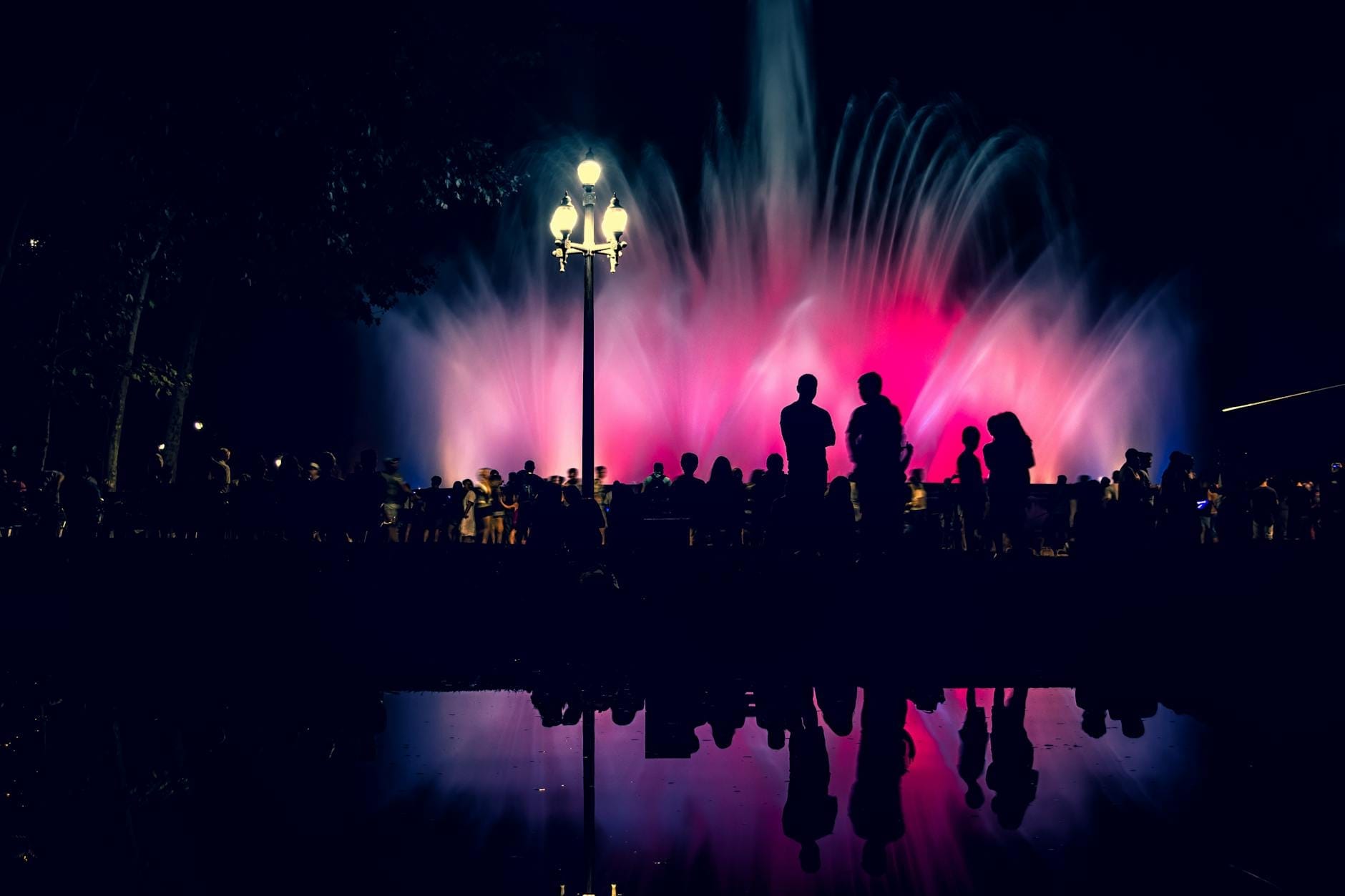
Each performance cycles the fountain through a sequence of shapes and formations: wide flat fans of water, tight vertical columns, spiralling sprays, and cascading arcs that catch the coloured light and scatter it. The colour transitions move through deep reds and oranges into blues and whites, occasionally settling on cool greens or warm ambers depending on the music. The choreography is not random — the jets respond to the soundtrack, with crescendos matched to high arcs and quieter passages dropping the water to a low shimmer.
The music selection tends toward the crowd-pleasing: operatic pieces, film scores (such as The Godfather, The Lord of the Rings, and Gladiator), and occasionally Catalan or Spanish popular music. This is not a subtle, contemplative experience. It's engineered spectacle, and there's no point pretending otherwise. That said, the sheer mechanical ambition of it — hundreds of nozzles firing in synchronised patterns at night in one of Europe's most dramatic civic plazas — lands differently in person than it does on a phone screen. The crowd reaction, the sound bouncing off the stone colonnade, the smell of cool water misting the air: these elements don't translate to video.
If you're building an evening itinerary around Montjuïc, note that the Museu Nacional d'Art de Catalunya sits directly above the fountain on the hill and is worth visiting earlier in the day for its Romanesque collection and the terrace views over Barcelona.
Tickets & tours
Live prices and dates from our booking partner. If you book, we may earn a commission at no extra cost to you.
Barcelona Cable Car, Montjuic Castle visit and Magic Fountain show
From 69 €Instant confirmationFree cancellationMagical Montjuic exploration game and tour
From 12 €Instant confirmationFree cancellationBarcelona Old Town and sky views with Montjuic Castle and cable car
From 50 €Instant confirmationFree cancellation360° Barcelona eBike with Montjuic Cable Car ticket and sailing trip
From 60 €Instant confirmationFree cancellation
When to Go: Time of Day and Seasonal Shifts
The fountain only operates after dark. In summer (May through September), shows typically run Thursday through Sunday from around 9 pm, with the last show finishing around 10:30 pm. In shoulder seasons (roughly March through April and October through November), the schedule narrows to Thursday through Saturday with start times around 8:00 pm. Winter hours are reduced further. These times shift year to year, so treat any published schedule as a starting point and verify on the official site.
Summer evenings are the most atmospheric but also the most crowded. The plaza in front of the fountain can hold several thousand people, and on a July Saturday it fills quickly from around 9:00 pm onwards. Arriving 20–30 minutes before the first show starts gives you a reasonable central position. On weeknights in spring or autumn, the crowd is noticeably thinner and the experience more relaxed. If you have any flexibility in your schedule, a Thursday or Friday evening in May or early October hits a good balance of weather, light, and crowd density.
💡 Local tip
The fountain runs multiple short shows across the evening. If you arrive at the start time and find the plaza packed, wait for the first show to end — a significant portion of the crowd leaves, and you can move forward for a better view of the next performance.
Getting There and Navigating the Area
The most straightforward approach is Metro Espanya, served by both the red and green metro lines. From the station exit, the fountain is a five-minute walk uphill along Avinguda de la Reina Maria Cristina, passing under the Venetian towers. The route is well-lit and easy to follow even at night, and the approach itself is part of the experience: the fountain comes into full view as you pass the towers and the plaza opens up.
The surrounding Montjuïc hill has considerably more to offer before or after the show. The Fundació Joan Miró and the Poble Espanyol are both within a 15-minute walk. For a full evening, combine a late afternoon visit to one of these with dinner near Plaça d'Espanya and then the fountain show.
Accessibility: The plaza itself is largely flat and paved, which makes it more manageable than many Barcelona sites. The approach from the metro exit is a gradual incline, not steps. That said, the area fills with standing crowds during shows, and there are no dedicated viewing areas for wheelchair users or visitors with limited mobility. Arriving early and positioning yourself at the sides or further back gives more space.
Photography and Practical Logistics
The fountain is well-lit enough for phone cameras, but the dynamic range challenge is real: bright white water jets against a dark sky, combined with the coloured lighting, causes most automatic settings to either blow out the water or underexpose the surroundings. A slightly elevated position, such as from the steps partway up the staircase toward the Palau Nacional, helps you compose a wider frame that includes the towers and the colonnade. Shooting from ground level at the front of the crowd puts you closer to the action but limits context.
If you're using a dedicated camera, a tripod and a shutter speed around 1/100s to 1/250s will freeze the water mid-arc without losing the colour saturation from the lights. Long exposures turn the jets into soft white blurs, which can look striking with the Palau Nacional in the background but loses the sense of movement that defines the show.
ℹ️ Good to know
The fountain is free and no tickets or registration are required. Ignore anyone who approaches you with 'tickets' to the show — this is a known tourist scam. The entire plaza is publicly accessible.
Is It Worth Your Time? An Honest Assessment
The Font Màgica is one of Barcelona's most-visited evening attractions, and for first-time visitors it genuinely delivers. The combination of free admission, a spectacular location, and a show that works on a large crowd makes it an easy recommendation for most itineraries. That said, it is unambiguously a mass-tourism experience, and the music choices and choreography are aimed at broad appeal rather than refinement.
Visitors who find large, noisy crowds draining, or who are primarily interested in Barcelona's cultural depth, may feel their time is better spent at the Palau de la Música Catalana for an evening concert, or exploring the quieter streets of El Born after dark. The fountain is best treated as a single component of a broader Montjuïc evening rather than the sole destination of a trip across town.
For a fuller picture of how the fountain fits into Barcelona's evening culture, the Barcelona at night guide covers neighbourhoods and venues worth pairing with a Montjuïc visit. If you're planning a trip around the best conditions for outdoor attractions like this, the best time to visit Barcelona breaks down seasonal trade-offs in detail.
Insider Tips
- The steps leading up to the Palau Nacional offer the best elevated view of the fountain and the full ceremonial axis — walk up about halfway before the show starts and you'll have both a superior sightline and more personal space than the packed plaza below.
- Multiple shows run each evening with short gaps between them. The second or third show of the night typically draws a smaller crowd as casual visitors leave after the first performance — use this to move into a better central position.
- On summer nights, the plaza gets cold when the mist from the fountain drifts across the crowd, particularly if you're standing at the front. A light layer is worth having even in July.
- Combine the fountain with a walk up to the Palau Nacional terrace afterward — the building stays lit well into the evening and the city view from the top of the staircase is one of the better free panoramas in Barcelona.
- The Venetian towers flanking Avinguda de la Reina Maria Cristina are themselves photogenic at night. Arriving early and framing a shot down the avenue toward the fountain, with the towers on either side and the Palau Nacional above, gives a more architecturally interesting image than a close-up of the fountain alone.
Who Is Magic Fountain (Font Màgica) For?
- First-time visitors to Barcelona wanting a memorable, no-cost evening activity
- Families with children, who tend to respond well to the light and water spectacle
- Travellers already exploring Montjuïc who want to finish the day with something atmospheric
- Architecture and urban design enthusiasts interested in the 1929 Exposition's civic scale
- Photographers looking for dramatic night compositions with monumental surroundings
Nearby Attractions
Other things to see while in Montjuïc:
- CaixaForum Barcelona
CaixaForum Barcelona occupies a meticulously restored 1911 textile factory near Plaça d'Espanya, pairing Catalan Modernista architecture with rotating international exhibitions, film cycles, and cultural programming. It is one of the most architecturally distinctive cultural spaces in the city, and admission is remarkably affordable.
- Fundació Joan Miró
Perched on the slopes of Montjuïc, Fundació Joan Miró is Barcelona's first contemporary art museum and one of the most cohesive artist foundations in Europe. The building, the collection, and the outdoor spaces combine into an experience unlike any other major art institution in the city.
- Jardí Botànic de Barcelona
Perched on the slopes of Montjuïc, the Jardí Botànic de Barcelona spreads across 14 hectares of carefully arranged Mediterranean flora from five continents. It offers a rare combination of botanical depth, architectural landscape design, and sweeping views over Barcelona, all without the crowds that dominate the city's headline attractions.
- Montjuïc Cable Car (Telefèric de Montjuïc)
The Telefèric de Montjuïc carries passengers 85 meters above sea level in just 3.5 minutes, delivering panoramic views over the port, the city grid, and the Mediterranean. Originally designed in 1926 for the International Exposition, the modernized gondola lift is as much a piece of Barcelona's urban history as it is a practical way to reach Montjuïc Castle.
Planning a trip? Discover personalized activities with the Nomado app.