Fundació Joan Miró: Barcelona's Most Distinctive Art Museum
Perched on the slopes of Montjuïc, Fundació Joan Miró is Barcelona's first contemporary art museum and one of the most cohesive artist foundations in Europe. The building, the collection, and the outdoor spaces combine into an experience unlike any other major art institution in the city.
Quick Facts
- Location
- Avinguda de Miramar, 1, Parc de Montjuïc, Barcelona
- Getting There
- Metro Paral·lel (Lines 2 & 3), then Montjuïc Funicular or bus
- Time Needed
- 2 to 3 hours
- Cost
- Paid admission; free guided tours included with entry. Check fmirobcn.org for current prices.
- Best for
- Modern art lovers, architecture enthusiasts, and anyone wanting a calmer alternative to crowded city-centre museums
- Official website
- www.fmirobcn.org/en
What Fundació Joan Miró Actually Is
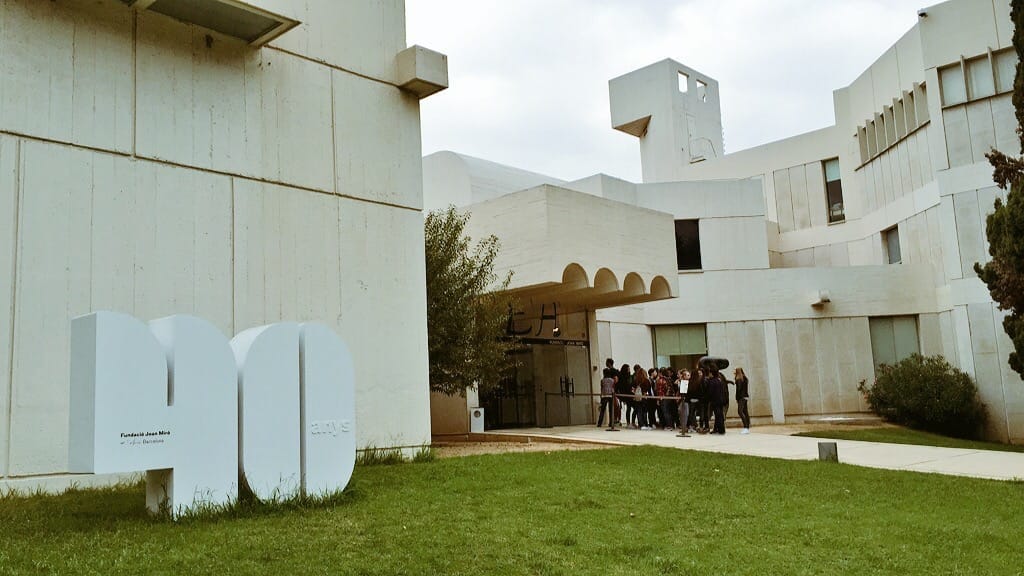
Fundació Joan Miró, officially known as the Fundació Joan Miró – CEAC (Centre for Contemporary Art Studies), opened on 10 June 1975 on the wooded slopes of Montjuïc. It was Barcelona's first dedicated contemporary art museum, and it remains one of the few institutions in the world where a single artist's vision shaped not just the collection but the building itself. Joan Miró personally commissioned his long-time friend, the Catalan-American architect Josep Lluís Sert, to design the space. That relationship matters: the building was not built to contain the art but to become part of it.
The collection runs to over 14,000 exhibits, including paintings, sculptures, textiles, and drawings. Beyond Miró's own output, the foundation holds a focused selection of contemporary works by other leading artists, donated over the decades. This is not a warehouse of everything Miró ever produced. It is a curated argument about what his work means.
The Sert Building: Why the Architecture Comes First
Before you look at a single canvas, the building earns your attention. Josep Lluís Sert, who had already designed the Spanish Pavilion for the 1937 Paris International Exposition alongside Miró and Picasso, conceived a structure that channels Mediterranean light without exposing the works to direct sun. The result is a low-profile, flat-roofed complex of interlocking white volumes, studded with cylindrical skylights and narrow clerestory windows that throw soft, shifting light onto the gallery floors throughout the day.
In the morning, when the sun is still low over the city, the interior light is cool and slightly directional, giving the bold primary colours in Miró's paintings an almost electric clarity. By mid-afternoon, the diffused overhead light flattens slightly, which works better for the sculptures and the textile pieces. If you have any flexibility, arriving when the doors open rewards you with both the best light and the thinnest crowds.
💡 Local tip
Arrive early in the morning for the calmest galleries and the sharpest light conditions on the paintings. The terraces and courtyard are also far more pleasant before the midday heat in summer.
The outdoor terraces are not an afterthought. Several of Miró's large bronze sculptures are positioned in the open air, surrounded by the pine and olive trees of Montjuïc. From the roof terrace on clear days, you can trace the outline of the city below. This layering of art, architecture, and landscape is deliberate, and it is something no photograph of the interior galleries can fully prepare you for.
Tickets & tours
Live prices and dates from our booking partner. If you book, we may earn a commission at no extra cost to you.
Tickets for KBR Fundacion Mapfre Barcelona Photo Center
From 5 €Instant confirmationFree cancellationTickets for the Tapies Museum
From 8 €Instant confirmationFree cancellationPicasso Museum guided tour
From 30 €Instant confirmationFree cancellationOlympic and Sports Museum Juan Antonio Samaranch tickets
From 6 €Instant confirmationFree cancellation
Inside the Collection: What You Will Actually See
Miró's mature style is immediately recognisable: black outlines, flat planes of red, yellow, blue, and green, and biomorphic forms that sit somewhere between a child's drawing and a surrealist hallucination. But walking through the permanent collection reveals how long it took him to get there. The early rooms include more conventional figurative work from his time in Paris, and tracing the evolution toward the spare, confident symbols of his later decades is one of the more satisfying narrative arcs any single-artist museum can offer.
The Homenatge a Joan Miró room is the emotional centre of the building, housing large-format works donated by contemporaries including Alexander Calder, Eduardo Chillida, and Antoni Tàpies. Seeing Miró's work alongside artists who clearly admired and responded to it gives the collection a dialogic quality that single-artist museums often lack.
The foundation's temporary exhibitions are worth checking before you visit. They tend toward serious contemporary art programming rather than blockbuster retrospectives, and the curation is consistently strong. You can see upcoming shows on the official website or through things to do in Barcelona planning resources.
Guided Tours and How to Use Them
Free guided tours are included with admission and run every hour. They are genuinely useful here in a way that optional audio guides at other museums often are not. Miró's iconography, once explained, becomes a key that unlocks the rest of the collection: the woman, the bird, the star, the ladder. A good guide will point out the recurring motifs and explain the political context of works made during and after the Franco dictatorship, when Miró's apparently playful imagery carried deliberate subversive intent. That context transforms the experience.
If you prefer to go at your own pace, pick up a map at the entrance and walk the permanent collection in order before doubling back to the pieces that stopped you. The galleries are well signed in Catalan, Spanish, and English.
Getting There: Montjuïc Logistics
The museum sits inside the Parc de Montjuïc, which requires a little planning to reach. The most straightforward route is Metro Paral·lel (Lines 2 or 3) followed by the Montjuïc Funicular, which departs from inside the station. From the funicular's upper station, the foundation is a short walk. Alternatively, Bus 55 runs from Plaça d'Espanya up the hill. If you are already spending time on Montjuïc, the museum fits naturally into a broader day that might include the castle, the gardens, or the national art museum.
The building is fully accessible for visitors with physical disabilities. Lifts connect all levels, and the outdoor terrace is reachable without stairs.
ℹ️ Good to know
Opening hours and ticket prices are subject to change. Always confirm directly at fmirobcn.org before your visit, particularly around public holidays and during special exhibition periods.
For context on the wider hill and what else it contains, the Montjuïc Hill guide covers the full range of sites from the Olympic Stadium to the castle and the Magic Fountain.
Practical Considerations and Honest Caveats
Fundació Joan Miró draws a steady but not overwhelming flow of visitors. It is significantly less crowded than the Sagrada Família or Park Güell, which means you can stand in front of a major work without fighting through tour groups. Even on a busy Saturday in July, the galleries rarely feel packed. That said, the café and the museum shop are popular, and the outdoor terrace fills up on warm afternoons.
Weather affects the visit in a specific way. The outdoor sculpture areas and terraces are central to the experience, and heavy rain or intense summer heat reduces the time you can comfortably spend outside. The interior is air-conditioned, but the building's best quality, that interplay between inside and outside, is partly weather-dependent. Visiting in spring or early autumn gives you the most complete version of what Sert designed.
Visitors who find Miró's style too abstract or repetitive across large quantities may want to visit the temporary exhibition first to give themselves a varied entry point. Those with a stronger interest in Catalan Modernisme or Gaudí's architecture specifically might find the Gaudí attractions a better use of limited time, though both deserve space in any serious Barcelona itinerary. The Museu Nacional d'Art de Catalunya is only a 15-minute walk away and covers Catalan art history from Romanesque through to the early 20th century, making the two institutions a logical pairing for anyone interested in Catalan visual culture as a whole.
⚠️ What to skip
The walk from the Montjuïc Funicular to the foundation involves a moderate uphill stretch of several minutes. In summer heat, this can be tiring. Wear comfortable shoes and bring water if visiting between June and September.
Insider Tips
- Free guided tours are included with your ticket and run hourly. Even if you usually skip tours, take this one: understanding Miró's symbolic language early in the visit makes the rest of the collection significantly more rewarding.
- The rooftop terrace is often overlooked by visitors who head straight through the indoor galleries. It holds large bronze sculptures and offers a framed view over the city toward the sea, worth the short detour.
- Tuesday is typically the quietest day of the week for Barcelona museums. If your schedule allows, avoid weekends and public holidays when school groups and tour buses coincide.
- The foundation shop stocks a well-curated selection of design objects, prints, and books that go beyond the standard museum gift shop fare. It is one of the better places in Barcelona to buy a considered souvenir without a Gaudí motif on it.
- If you plan to combine the visit with the Museu Nacional d'Art de Catalunya on the same day, do Fundació Joan Miró first. MNAC is larger and more exhausting, and finishing there rather than starting means you have the energy to give Miró's quieter rooms the attention they deserve.
Who Is Fundació Joan Miró For?
- Modern and contemporary art lovers who want depth over spectacle
- Architecture enthusiasts interested in how a building can be purpose-built for a single artist's work
- Travellers looking for a significant cultural experience without the extreme crowds of the city's most famous sites
- Anyone spending a full day on Montjuïc and building an itinerary around multiple sites on the hill
- Visitors interested in 20th-century Catalan culture and the political history embedded in seemingly abstract art
Nearby Attractions
Other things to see while in Montjuïc:
- CaixaForum Barcelona
CaixaForum Barcelona occupies a meticulously restored 1911 textile factory near Plaça d'Espanya, pairing Catalan Modernista architecture with rotating international exhibitions, film cycles, and cultural programming. It is one of the most architecturally distinctive cultural spaces in the city, and admission is remarkably affordable.
- Jardí Botànic de Barcelona
Perched on the slopes of Montjuïc, the Jardí Botànic de Barcelona spreads across 14 hectares of carefully arranged Mediterranean flora from five continents. It offers a rare combination of botanical depth, architectural landscape design, and sweeping views over Barcelona, all without the crowds that dominate the city's headline attractions.
- Magic Fountain (Font Màgica)
The Font Màgica de Montjuïc is a monumental choreographed fountain at the foot of Montjuïc hill, combining jets of water reaching up to 50 metres with coloured lights and music. It's free to attend, open on select evenings year-round, and consistently draws one of Barcelona's largest spontaneous crowds.
- Montjuïc Cable Car (Telefèric de Montjuïc)
The Telefèric de Montjuïc carries passengers 85 meters above sea level in just 3.5 minutes, delivering panoramic views over the port, the city grid, and the Mediterranean. Originally designed in 1926 for the International Exposition, the modernized gondola lift is as much a piece of Barcelona's urban history as it is a practical way to reach Montjuïc Castle.
Planning a trip? Discover personalized activities with the Nomado app.