Museu Nacional d'Art de Catalunya (MNAC): A Complete Visitor's Guide
Perched on Montjuïc hill inside the grand Palau Nacional, the Museu Nacional d'Art de Catalunya holds one of Europe's most significant art collections, anchored by the world's largest and best-preserved collection of Romanesque frescoes. Beyond the art, the building itself and the views from its terrace justify the climb.
Quick Facts
- Location
- Palau Nacional, Parc de Montjuïc, 08038 Barcelona
- Getting There
- Metro L1/L3 to Espanya, then walk uphill or take the escalators; or Paral·lel + Funicular de Montjuïc
- Time Needed
- 2 to 3.5 hours for the full collection; 1 hour for highlights only
- Cost
- €12 for adults; verify current pricing at mnac.cat
- Best for
- Art lovers, architecture enthusiasts, photographers, history-focused travelers
- Official website
- www.mnac.cat/en
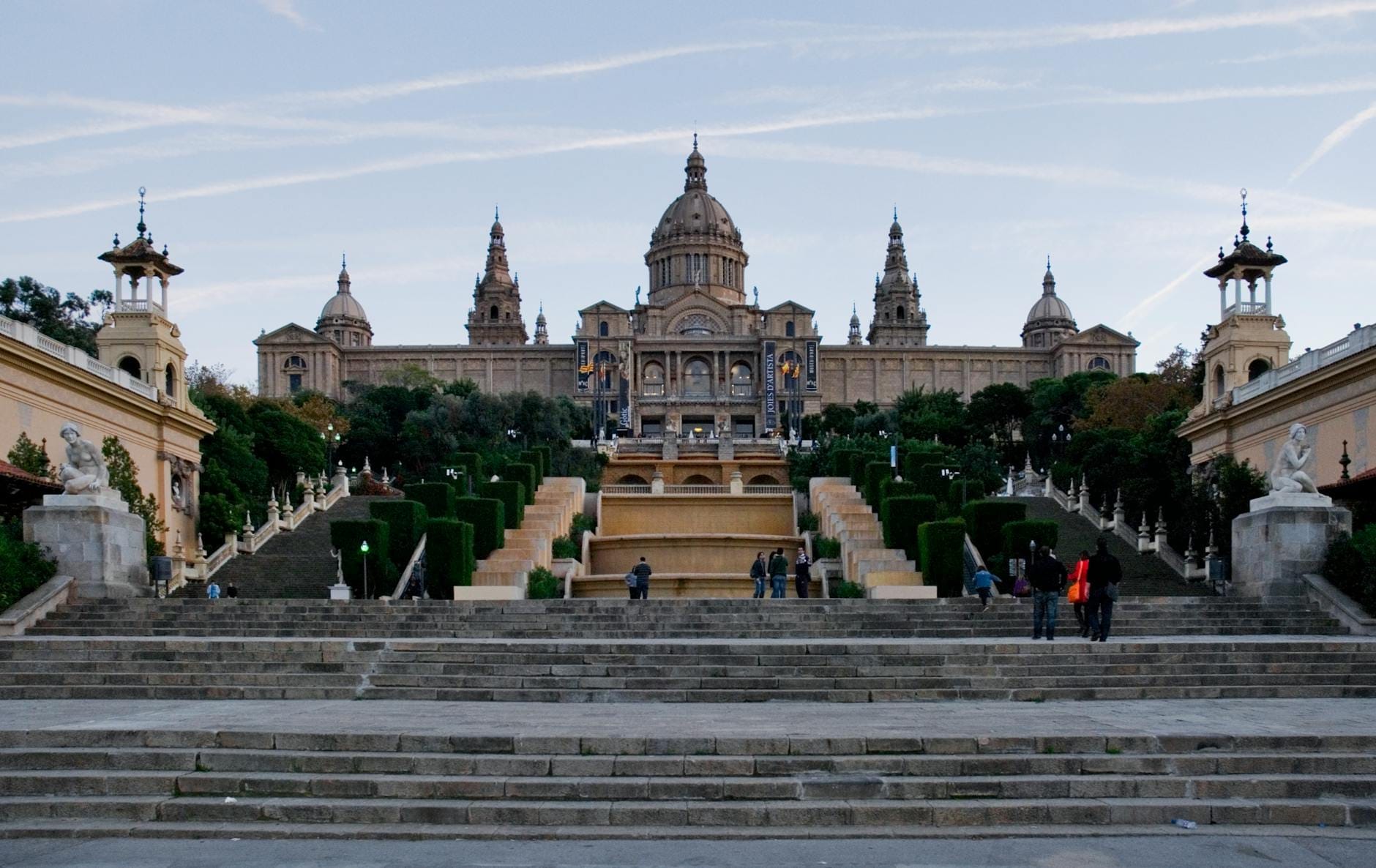
What Is MNAC and Why Does It Matter?
The Museu Nacional d'Art de Catalunya, universally abbreviated as MNAC, is Catalonia's foremost art institution. Housed in the Palau Nacional, a monumental Baroque-inflected building constructed for the 1929 International Exhibition, it holds a collection spanning nearly a thousand years of Catalan art: from 10th-century Romanesque murals to mid-20th-century modernist works. The museum as it exists today was formed in 1990 through the merger of the Museu d'Art de Catalunya (founded 1934) and the Museu d'Art Modern (founded 1945), before reopening in its current renovated form in 1997.
The headline holding is the Romanesque collection, widely considered the finest of its kind anywhere in the world. Over the early 20th century, Catalan scholars and restorers undertook a systematic effort to detach medieval frescoes from deteriorating church walls across the Pyrenean valleys of Catalonia, transferring them onto curved plaster supports that replicate the original apses and naves. The result is an immersive experience: you walk between reconstituted chapels, painted ceilings arching overhead, the figures staring down with the flat intensity that defines Romanesque religious art. This alone justifies the visit.
💡 Local tip
If your time is limited, head directly to Rooms 1 to 21 on the ground floor for the Romanesque collection. Allow at least 45 minutes here before anything else.
The Palau Nacional: Architecture as Context
The building is not a neutral container. The Palau Nacional was designed by architects Eugenio Cendoya and Enric Catà, with contributions from Pedro Cendoya, and completed in time for the 1929 exposition that transformed Montjuïc. Its scale is theatrical: the central dome rises 55 metres above the main hall, and the facade faces directly down the grand avenue of Avinguda de la Reina Maria Cristina toward the twin Venetian towers at Plaça d'Espanya. Standing at the top of the exterior steps, you get one of the most commanding views of Barcelona's lower city, with the Sagrada Família visible on clear days to the northeast.
The interior oval hall, now called the Oval Room, was restored as part of the 1992-1997 renovation overseen by Italian architect Gae Aulenti, the same architect who converted Paris's Gare d'Orsay into the Musée d'Orsay. The materials throughout are rich: marble floors, coffered ceilings, and long corridor galleries that give the collection room to breathe. The building itself is listed as a cultural asset of national interest.
Architecturally, the Palau Nacional fits into a broader story of Barcelona's reinvention through international events. The same 1929 exposition produced the Poble Espanyol, still standing nearby on the same hill, which offers a very different but complementary perspective on that era.
Tickets & tours
Live prices and dates from our booking partner. If you book, we may earn a commission at no extra cost to you.
Picasso Museum guided tour
From 30 €Instant confirmationFree cancellationOlympic and Sports Museum Juan Antonio Samaranch tickets
From 6 €Instant confirmationFree cancellationBarcelona walking tour Picasso
From 25 €Instant confirmationFree cancellationBanksy Museum Barcelona entrance ticket
From 14 €Instant confirmation
What You Will See: A Walk Through the Collection
The permanent collection is organized chronologically and divides into several distinct wings. The Romanesque collection occupies a dedicated circuit of rooms on the ground floor. Gothic art follows, covering altarpieces, panel paintings, and carved retables from the 12th through 15th centuries. The Renaissance and Baroque section is smaller but includes work by El Greco, Velázquez (represented by a portrait), and Zurbarán alongside Catalan masters of the period.
The modern art section covers the late 19th and early 20th centuries with particular strength in Catalan Modernisme and Noucentisme movements. Works by Ramon Casas and Santiago Rusiñol represent the bohemian Catalan painters who worked in Paris and brought Impressionist influence back to Barcelona. The collection also includes significant pieces by Joaquim Sunyer, Isidre Nonell, and a strong decorative arts section covering furniture, ceramics, and posters from the same era. The MNAC also holds a substantial numismatic collection and a photography archive.
Photography enthusiasts should note the museum's holding of the Arxiu Fotogràfic Nacional, a photographic archive covering Catalan visual culture from the 19th century onward. Not all of this is on permanent display, but temporary exhibitions regularly draw from it.
How the Visit Changes By Time of Day
Morning visits, particularly on weekdays shortly after opening, offer the quietest experience of the Romanesque rooms. The low natural light filtering into those galleries suits the medieval material, and without crowds, the silence adds to the atmosphere. By mid-morning, school groups begin arriving, and the children's energy, while not disruptive in most sections, does change the character of the Romanesque halls.
The outdoor terrace and steps are most rewarding in the late afternoon, when the light falls across the city from the west and the view down to Plaça d'Espanya takes on warmer tones. At this hour, the long shadows of the Venetian towers stretch toward the fountain below, and the city reads as a complete panorama rather than a flat grid. Photographers working in golden hour will find the terrace more useful than most rooftop options in the city.
ℹ️ Good to know
The MNAC terrace is accessible independently of the museum ticket. Check with staff at the entrance about current access policy, as this has varied.
For a full picture of Montjuïc's vantage points, compare the MNAC terrace with the Montjuïc Castle at the hill's summit, which offers 360-degree views but requires more effort to reach.
Getting There: Practical Logistics
The most straightforward approach is the metro to Espanya (Lines L1 and L3), followed by a walk up the avenue and the escalator series that ascends the hill in stages. The escalators are free and take you from street level to just below the museum's front steps. Walking the full distance from Espanya takes roughly 10 to 15 minutes at a moderate pace. This route also passes the Magic Fountain of Montjuïc, which operates on selected evenings and creates a very different atmosphere after dark.
An alternative route uses the Paral·lel metro station (L2/L3) and the Funicular de Montjuïc, which connects to the Montjuïc cable car network. From the funicular's upper station, it is a short walk to the museum. This route is useful if you are combining the museum with other Montjuïc attractions.
Bus lines 55 and 150 serve the Plaça d'Espanya area. Taxis and ride-hailing apps (Uber, Bolt, Cabify) can drop you at the museum entrance directly, which is worth considering if traveling with children or with mobility limitations. The museum building has elevators inside, but confirm the current status of wheelchair access at the entrance, as the external approach involves steps.
Honest Assessment: Who Will Love It and Who Won't
MNAC rewards visitors who arrive with some curiosity about medieval art or Catalan cultural history. The Romanesque collection is genuinely world-class and has no real equivalent elsewhere, not even in the major European capitals. If Romanesque art is outside your frame of reference, spend 20 minutes in those rooms anyway: the scale and preservation of the frescoes produce a reaction that goes beyond art-historical knowledge.
The modern art section is strong by regional standards but will feel thin to visitors coming from the Prado, Louvre, or Uffizi. If your primary interest is 19th-century European painting in breadth and depth, the MNAC will feel like a focused but narrower experience. That is not a criticism; it is the correct curatorial choice for a museum whose mission is Catalan art specifically.
Visitors who are primarily interested in Gaudí and Modernisme architecture, rather than fine art, may find the MNAC less central to their itinerary. The decorative arts section is worthwhile, but the great Moderniste buildings are in the Eixample, not here.
Travelers working through Barcelona's art scene should consider combining MNAC with the Fundació Joan Miró, which is also on Montjuïc and covers the 20th-century arc that MNAC leaves relatively brief. The two museums together give a coherent sweep from medieval to modern within a single afternoon.
⚠️ What to skip
The MNAC is closed on Mondays (except public holidays). Verify current opening hours and seasonal closures on the official website before visiting, as these details change.
Photography and Practical Details
Non-flash photography for personal use is permitted throughout the permanent collection. The Romanesque rooms present a challenge: the curved surfaces of the reconstructed apses create interesting but difficult lighting conditions, and the spaces are not always bright. A camera or phone with a reliable low-light mode will produce better results than a standard kit. The Gothic section, with its tall altarpieces under good overhead lighting, is easier to shoot.
The museum cafe on the upper level offers terrace seating with views across the city. It is a reasonable place to break a long visit rather than a dining destination. The museum shop carries well-produced catalogues and reproductions, including items related to the Romanesque collection that are genuinely useful if you want to read further.
The MNAC is included in the Articket BCN, a combined ticket covering six major Barcelona art institutions, which can represent good value if you plan to visit several museums during your trip. It is also covered under Barcelona's museum discount schemes for students, seniors, and EU residents, so bring relevant ID.
Insider Tips
- The first Sunday of each month offers free admission to the permanent collection. Arrive right at opening time if visiting on this day, as the museum fills by mid-morning.
- The exterior escalators from Plaça d'Espanya are free and run until late evening, making the terrace accessible even if you are not entering the museum. The nighttime view of the illuminated Palau Nacional from below is worth the walk.
- The Romanesque collection map available at the entrance desk traces which specific churches each fresco comes from, with geographical references to the Pyrenean valleys. Picking this up before you enter the collection adds considerable context.
- Coat check is available and worth using: the museum is large and carrying a bag through two hours of galleries becomes tiring. Lockers are also available near the entrance.
- If you are visiting Montjuïc across a full day, MNAC works best as a morning anchor. The Fundació Joan Miró, Montjuïc Castle, and the outdoor gardens can fill the afternoon without needing to re-enter any buildings.
Who Is Museu Nacional d'Art de Catalunya (MNAC) For?
- Art history enthusiasts, particularly those with interest in medieval European art
- Architecture-focused travelers who appreciate monumental civic buildings from the early 20th century
- Photographers looking for a high-quality panoramic viewpoint combined with interior subjects
- Travelers exploring Catalan cultural identity and regional history
- Visitors with a full day on Montjuïc who want a structured, substantial indoor anchor to their itinerary
Nearby Attractions
Other things to see while in Montjuïc:
- CaixaForum Barcelona
CaixaForum Barcelona occupies a meticulously restored 1911 textile factory near Plaça d'Espanya, pairing Catalan Modernista architecture with rotating international exhibitions, film cycles, and cultural programming. It is one of the most architecturally distinctive cultural spaces in the city, and admission is remarkably affordable.
- Fundació Joan Miró
Perched on the slopes of Montjuïc, Fundació Joan Miró is Barcelona's first contemporary art museum and one of the most cohesive artist foundations in Europe. The building, the collection, and the outdoor spaces combine into an experience unlike any other major art institution in the city.
- Jardí Botànic de Barcelona
Perched on the slopes of Montjuïc, the Jardí Botànic de Barcelona spreads across 14 hectares of carefully arranged Mediterranean flora from five continents. It offers a rare combination of botanical depth, architectural landscape design, and sweeping views over Barcelona, all without the crowds that dominate the city's headline attractions.
- Magic Fountain (Font Màgica)
The Font Màgica de Montjuïc is a monumental choreographed fountain at the foot of Montjuïc hill, combining jets of water reaching up to 50 metres with coloured lights and music. It's free to attend, open on select evenings year-round, and consistently draws one of Barcelona's largest spontaneous crowds.
Planning a trip? Discover personalized activities with the Nomado app.