Jardí Botànic de Barcelona: A Quiet Escape Above the City
Perched on the slopes of Montjuïc, the Jardí Botànic de Barcelona spreads across 14 hectares of carefully arranged Mediterranean flora from five continents. It offers a rare combination of botanical depth, architectural landscape design, and sweeping views over Barcelona, all without the crowds that dominate the city's headline attractions.
Quick Facts
- Location
- Montjuïc hill, Barcelona (41°21′42″N 2°09′31″E)
- Getting There
- Metro Espanya (L1/L3), then bus 150 or Montjuïc Cable Car; Bus Turístic stop at Fundació Joan Miró (~400 m walk)
- Time Needed
- 1.5 to 2.5 hours
- Cost
- Paid entry (check official site for current prices); free Sundays from 15:00 and first Sunday of each month; also free on Feb 12, May 18, Sep 24
- Best for
- Nature lovers, photography, escaping city heat, slow walkers, garden enthusiasts
- Official website
- bcn.cat/museucienciesnaturals/en/jardi-botanic-de-barcelona
What the Jardí Botànic de Barcelona Actually Is
The Jardí Botànic de Barcelona is a scientific and public botanical garden situated on the western slopes of Montjuïc, opened in its current form in 1999 on the site of the former 1929 International Exposition grounds. It is administered by the Botanical Institute of Barcelona, part of the city's Museum of Natural Sciences, which gives it a research function beyond pure horticulture. This is not a manicured ornamental garden with rose beds and topiary. It is a landscape of rugged, climate-adapted plants organized by geographic origin, designed to demonstrate how Mediterranean ecosystems function across the globe.
The garden covers 14 hectares and hosts between 1,300 and 2,000 plant species drawn from five distinct Mediterranean climate zones: the Mediterranean basin itself, California, Chile, South Africa, and Australia. The organizing principle is biogeographic, meaning as you walk the sloping paths, you move from one regional plant community to another. Olive trees, lavender, proteas, Chilean palms, and Australian acacias occupy different sections, each zone subtly distinct in color, texture, and scent.
💡 Local tip
Pick up the free site map at the entrance. The garden's layout is not intuitive from ground level, and zones can look similar to the untrained eye. The map's color-coded geographic sections make the botanical logic click into place.
The Experience: Walking Through Five Climates
The garden is built on a slope, so the walk is gently undulating rather than flat. Gravel and compacted earth paths wind through the sections, wide enough to walk two abreast but narrow enough that the vegetation presses in from both sides. In the Australian zone, the smell changes noticeably: eucalyptus oil hangs in the air on warm afternoons, sharp and medicinal. The South African section introduces proteas and fynbos shrubs with silvery-grey foliage that catches light differently from the green Mediterranean scrub nearby.
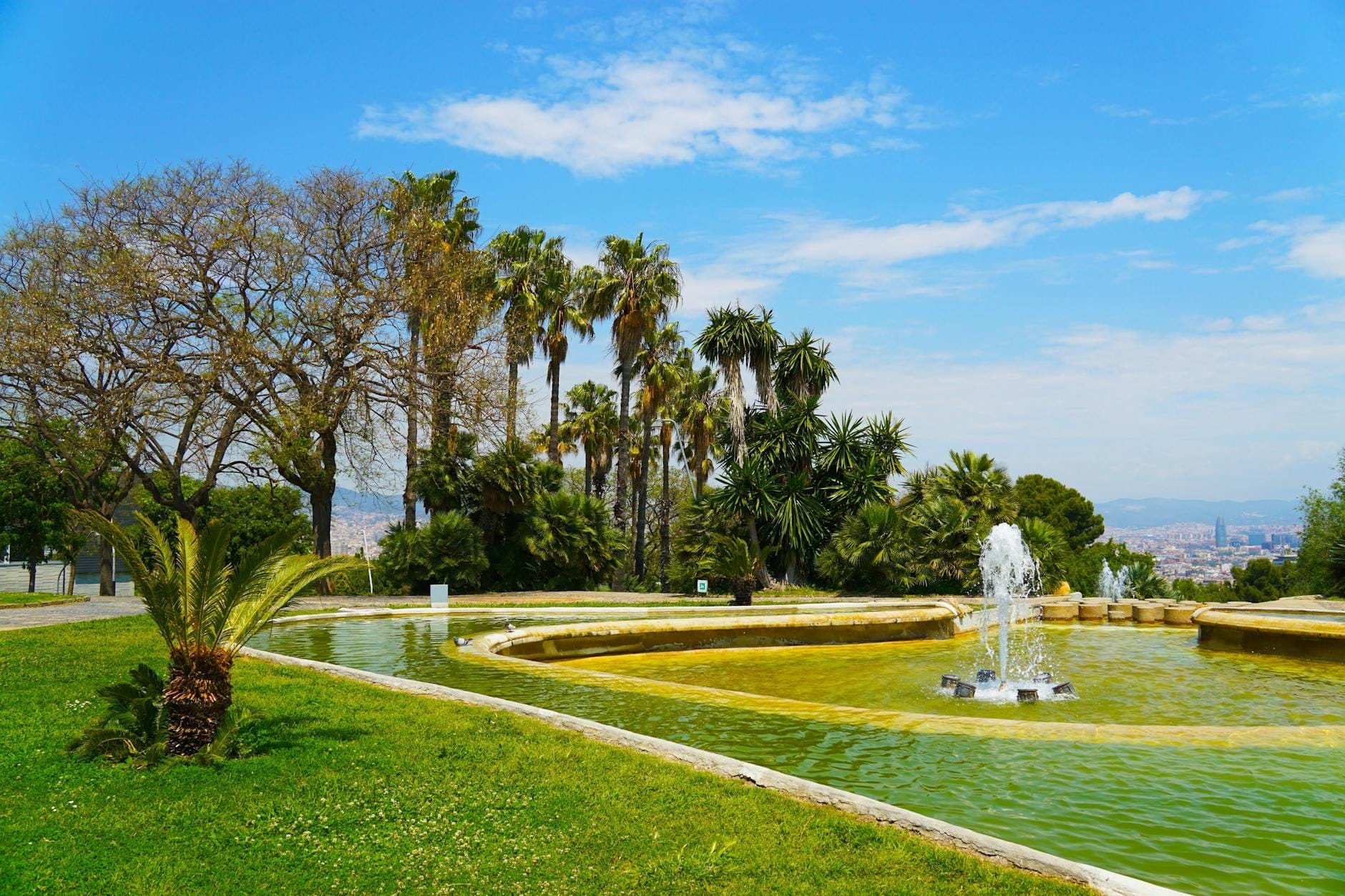
The California section is particularly striking in late spring, when dryland wildflowers add unexpected color to the otherwise earth-toned palette of the garden. The Chilean zone contains one of the more unusual visual moments: native palm species that feel incongruous against the backdrop of Barcelona rooftops visible through the vegetation below.
Sound is part of the experience too. Wind moves through the grasses and restio reeds in the South African section with a dry rustling that contrasts with the heavier, leafier silence of the Mediterranean basin zone. Birds use the garden as a quiet urban refuge, and their presence is consistent throughout the day. On weekday mornings especially, you may walk long stretches of path without encountering another visitor.
Tickets & tours
Live prices and dates from our booking partner. If you book, we may earn a commission at no extra cost to you.
Vermouth time and sailing experience in Barcelona
From 36 €Instant confirmationFree cancellationOne-day tour to Andorra and France from Barcelona
From 109 €Instant confirmationFree cancellationBest of Gaudi private walking tour in Barcelona with a local guide
From 90 €Instant confirmationFree cancellationInteractive Spanish cooking experience in Barcelona
From 65 €Instant confirmationFree cancellation
Time of Day and Seasonal Considerations
Morning visits, particularly on weekdays, offer the most peaceful experience. The garden is one of the least crowded botanical spaces in Barcelona, but even its modest weekend foot traffic feels intrusive compared to a Tuesday morning when the paths are nearly empty. The light in the first two hours after opening is softer and more directional, making plant textures and the city views sharper for photography.
Summer afternoons are genuinely hot on the exposed upper sections of the garden. The slope orientation means some areas receive unbroken sun from midday onward, and shade is limited. Bring water and consider visiting in the early evening during June through August, when the garden stays open until 20:00. Late afternoon light on the Mediterranean basin section, with the city spread below, is one of the better photography moments on Montjuïc that most visitors miss.
Spring (April and May) is the peak season for variety and color. The garden is scientifically oriented rather than maximally decorative, so it never looks like a flower show, but spring brings the widest range of things in bloom simultaneously. Autumn brings its own qualities: lower visitor numbers, cooler temperatures, and a shift in the South African and Australian sections as different species come into prominence.
⚠️ What to skip
The garden is on a slope with unpaved paths. Flat-soled shoes or trainers are suitable; sandals with poor grip or heeled shoes will be uncomfortable, especially if the ground is damp after rain.
Historical and Cultural Context
Barcelona has had a botanical garden since 1888, when the first was established in connection with the Universal Exposition. That original garden occupied a different site and was eventually replaced by the current installation, which opened in 1999. The 1999 garden was designed by landscape architects Bet Figueras and Carlos Ferrater, who won the project through a competition. Their approach was unconventional: rather than imposing classical garden geometry onto the hillside, they worked with the natural topography and used a triangular grid system for the path network, which is visible from above and gives the garden its distinctive angular layout.
The choice to focus exclusively on Mediterranean climate zones was deliberate and scientifically grounded. These five regions of the world share similar rainfall patterns, temperature ranges, and drought conditions, yet evolved plant communities in complete geographic isolation. Placing them side by side makes the concept of convergent evolution tangible in a way that no textbook fully achieves. This is why the garden functions as a research site as well as a public attraction.
Montjuïc itself has layers of history that add context to any visit. The hill has been a site of defense, an execution ground, an Olympics venue, and a cemetery. The Montjuïc Castle sits at the summit, and the Fundació Joan Miró is a short walk from the garden entrance. Understanding that the botanical garden occupies former Exposition grounds connects it to a century of Barcelona's ambition to present itself as a modern European city.
Getting There and Getting Around
The most practical approach from the city center is Metro to Espanya station (Lines 1 and 3), then Bus 150 toward Montjuïc, which stops near the garden. The Bus Turístic also serves the area, with a stop at the Fundació Joan Miró approximately 400 meters from the garden entrance. The Montjuïc Cable Car is an alternative and scenic option from the Paral·lel Metro station, though it deposits visitors closer to the castle and involves a downhill walk to the garden.
Driving is possible, with parking available nearby, but navigation on Montjuïc can be confusing on first visit. The garden sits close to the Olympic Stadium and the Museu Nacional d'Art de Catalunya, making it logical to combine multiple Montjuïc sites in a single half-day. Plan the walking order carefully: the garden, the MNAC, and the Fundació Joan Miró form a coherent triangle without excessive backtracking.
ℹ️ Good to know
Opening hours vary by season: October to March, 10:00–18:00; April, May, September, 10:00–19:00; June to August, 10:00–20:00. The garden is closed on January 1, May 1, June 24, and December 25. Entry is free every Sunday from 15:00, on the first Sunday of each month, and on February 12, May 18, and September 24.
Photography and Accessibility
The garden rewards patient photography. Wide shots work well from the upper sections where the angular path grid becomes visible and the city skyline appears beyond the vegetation. Close-up and macro work is consistently strong in the South African and Australian zones, where leaf shapes, seed pods, and bark textures are unlike anything in conventional European gardens. A polarizing filter is useful on sunny days when the silvery-leafed plants can blow out in direct sunlight.
Accessibility across the site is moderate. The paths are gently graded in most sections, but the unpaved surfaces may present difficulty for wheelchair users or those with limited mobility on certain routes. No specific accessibility infrastructure details are provided by the operator, so it is worth contacting the garden directly at +34 932 564 160 before visiting if this is a concern.
For those building a full Montjuïc itinerary, the Montjuïc hill page covers the broader hill area including transport connections and how to sequence multiple sites. Alternatively, the best views in Barcelona guide identifies several Montjuïc vantage points that pair naturally with a garden visit.
Who Should Manage Expectations
Visitors expecting a lush, colorful, manicured garden in the tradition of European palace gardens will find the Jardí Botànic de Barcelona austere by comparison. The plants are scientifically selected and managed for ecological authenticity rather than visual spectacle. In summer, large sections look dry and brown, which is accurate to the plant communities represented but can be visually disappointing if you are not expecting it. Families with young children may find the garden less engaging than the Parc de la Ciutadella, which has open lawns, a lake, and play infrastructure.
Anyone who finds slow, observational walking unrewarding will run out of interest quickly. The garden does not have a cafe, shop, or indoor space to retreat to. It is a place for people who genuinely want to spend time with plants, landscape, and quiet. For that audience, it is one of the more honest and intellectually coherent attractions on Montjuïc.
Insider Tips
- Free Sunday afternoons from 15:00 are the best value entry, but arrive close to opening time on those days as visitor numbers do pick up. Weekday mornings remain consistently quiet regardless of free-entry days.
- The upper sections of the garden offer some of the clearest views of Barcelona's skyline through a frame of Mediterranean scrub. These viewpoints are unmarked and easy to walk past; look for gaps in the vegetation on the higher paths.
- Combine the garden with the Fundació Joan Miró on the same half-day. They are within easy walking distance and the combined visit covers both the natural and artistic dimensions of Montjuïc without requiring a return trip.
- If you visit in late spring, the California and South African zones reward slow inspection: several species produce flowers for only a short window and are not labeled in a way that draws attention. Ask a staff member at the entrance if anything unusual is in bloom.
- The garden's triangular path grid, designed by architects Bet Figueras and Carlos Ferrater, is best appreciated from the upper reaches of the site. Standing at the top and looking back down gives a clearer sense of the deliberate design logic than any map.
Who Is Jardí Botànic de Barcelona For?
- Botanical and ecology enthusiasts who want more than ornamental gardens
- Photographers looking for unusual textures, forms, and city backdrops
- Visitors building a full Montjuïc half-day and wanting a quieter stop between major sites
- Travelers visiting in summer who need a less crowded outdoor space that stays open into the evening
- Anyone interested in landscape architecture and the design logic behind the 1999 garden layout
Nearby Attractions
Other things to see while in Montjuïc:
- CaixaForum Barcelona
CaixaForum Barcelona occupies a meticulously restored 1911 textile factory near Plaça d'Espanya, pairing Catalan Modernista architecture with rotating international exhibitions, film cycles, and cultural programming. It is one of the most architecturally distinctive cultural spaces in the city, and admission is remarkably affordable.
- Fundació Joan Miró
Perched on the slopes of Montjuïc, Fundació Joan Miró is Barcelona's first contemporary art museum and one of the most cohesive artist foundations in Europe. The building, the collection, and the outdoor spaces combine into an experience unlike any other major art institution in the city.
- Magic Fountain (Font Màgica)
The Font Màgica de Montjuïc is a monumental choreographed fountain at the foot of Montjuïc hill, combining jets of water reaching up to 50 metres with coloured lights and music. It's free to attend, open on select evenings year-round, and consistently draws one of Barcelona's largest spontaneous crowds.
- Montjuïc Cable Car (Telefèric de Montjuïc)
The Telefèric de Montjuïc carries passengers 85 meters above sea level in just 3.5 minutes, delivering panoramic views over the port, the city grid, and the Mediterranean. Originally designed in 1926 for the International Exposition, the modernized gondola lift is as much a piece of Barcelona's urban history as it is a practical way to reach Montjuïc Castle.
Planning a trip? Discover personalized activities with the Nomado app.