Estadi Olímpic Lluís Companys: Barcelona's Free Olympic Stadium
The Estadi Olímpic Lluís Companys on Montjuïc hill is one of Barcelona's most historically layered landmarks. Originally built for the 1929 International Exhibition, it hosted the 1992 Summer Olympics and remains open to the public free of charge, offering sweeping views, quiet grandeur, and a tangible sense of sporting history.
Quick Facts
- Location
- Av. de l'Estadi, 38, 08038 Barcelona
- Getting There
- Metro L1/L3 to Espanya, then bus V7, V9, H12, or H16 up to Montjuïc
- Time Needed
- 30 to 60 minutes
- Cost
- Free entry during opening hours
- Best for
- Sports history enthusiasts, architecture lovers, walkers exploring Montjuïc
- Official website
- estadiolimpic.barcelona/en
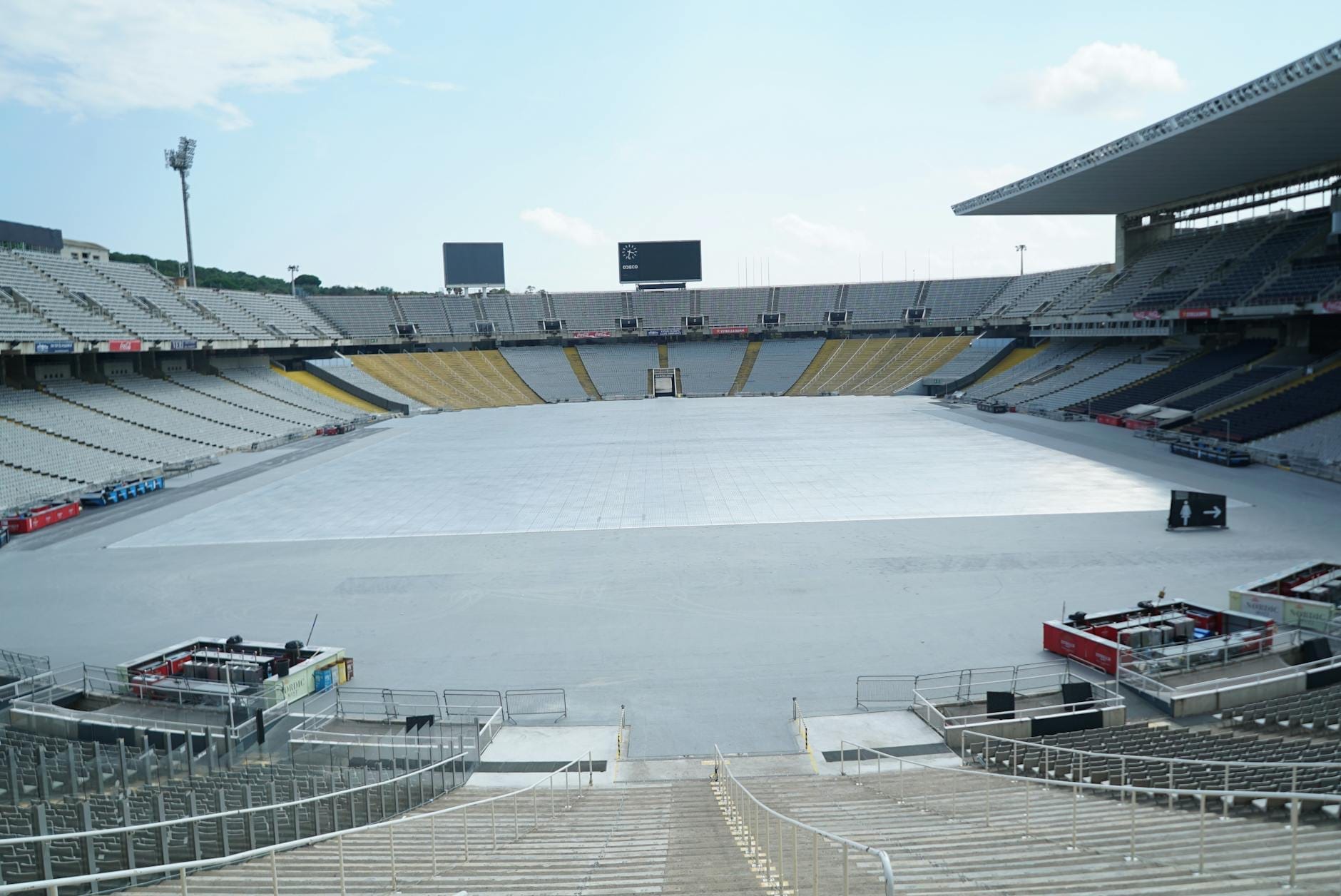
What Is the Estadi Olímpic Lluís Companys?
The Estadi Olímpic Lluís Companys is a two-tiered, elliptical stadium sitting at the heart of the Anella Olímpica, the Olympic Ring complex on Montjuïc hill. With a capacity of approximately 55,000 spectators, it is an imposing structure that reads differently depending on which angle you approach it from. The neoclassical exterior facade, with its decorative towers and stone archways, dates to 1929. Step through the entrance, though, and you encounter the thoroughly modernized interior built for the 1992 Barcelona Summer Olympics.
Entry is free during opening hours, which makes this one of the more generous attractions on Montjuïc. Summer hours run from 10 am to 7 pm (April 1 through October 31), and winter hours from 10 am to 5 pm (November 1 through March 31), though access may be restricted during events. There is no ticket booth, no queue to join, and no guided tour required. You simply walk in.
💡 Local tip
Check the official website at estadiolimpic.barcelona before visiting. The stadium hosts concerts and sporting events periodically, and on those days public access is suspended without much advance notice on local signage.
A Stadium with Two Distinct Lives
The stadium's first life began on May 20, 1929, when it was inaugurated as part of Barcelona's International Exhibition. The original structure, designed by architects Pere Domènech i Roura and Eusebi Bona, was conceived to showcase Barcelona's civic ambition on the world stage. The neoclassical facade that survives today, with its decorative reliefs, twin towers, and symmetrical arched entrance, reflects the architectural language of that era, assertive and monumental.
The stadium's second life came with the 1992 Summer Olympics. For Barcelona to use it as the main Olympic venue, the interior had to be almost entirely rebuilt. Engineers kept the historic 1929 shell but excavated downward to create the necessary capacity, expanding the seating area without altering the exterior silhouette that gave the building its protected status. The renovation, completed in 1989, was directed by Italian architect Vittorio Gregotti alongside local firm Correa and Milà. Subsequent work in 2010 and 2022 brought further upgrades.
The stadium is named after Lluís Companys, the President of the Generalitat de Catalunya who was executed by Franco's regime in 1940 after the Spanish Civil War. The naming is not incidental. On Montjuïc, where the castle above the hill was used as a Francoist prison, the dedication carries political weight that Catalans feel acutely.
Tickets & tours
Live prices and dates from our booking partner. If you book, we may earn a commission at no extra cost to you.
Barcelona Olympic Segway™ tour
From 78 €Instant confirmationFree cancellationOlympic and Sports Museum Juan Antonio Samaranch tickets
From 6 €Instant confirmationFree cancellationVermouth time and sailing experience in Barcelona
From 36 €Instant confirmationFree cancellationOne-day tour to Andorra and France from Barcelona
From 109 €Instant confirmationFree cancellation
Walking Into the Stadium: What You Actually See
Approaching from Avinguda de l'Estadi, the exterior feels grand in a way that is almost theatrical. The stone facade is warm in color, somewhere between cream and sand, and the carved ornamental details above the main gate reward close attention. On quiet mornings, pigeons occupy the upper ledges and the area is almost completely still. This is not a manicured tourist attraction with polished information panels at every turn. It feels more like a civic monument that simply happens to be open.
Inside, the athletics track is the focal point: a red synthetic oval surrounding the field, with the two-tier stand curving around it on all sides. The upper tier commands clear views across the stadium and, on the far side, out toward the city. On clear days you can see well beyond the urban grid to the sea. This is one of the quieter elevated viewpoints in Barcelona, and it costs nothing.
The space is large enough that even with a handful of other visitors present, you rarely feel crowded. Groups of local joggers occasionally use the perimeter paths. School groups appear mid-morning on weekdays. On summer afternoons the concrete seating retains heat, so arriving earlier in the day is more comfortable. By late afternoon the light shifts to a warmer tone that makes the stone facade glow, and the number of casual visitors drops off noticeably.
ℹ️ Good to know
The Olympic cauldron, which was famously lit by Paralympic archer Antonio Rebollo during the 1992 opening ceremony, stands at the stadium entrance. It is one of the few original ceremonial elements still in place and is worth pausing at before you enter.
The Anella Olímpica: Context and Surroundings
The stadium sits within the Anella Olímpica, a coordinated complex of venues built or renovated for 1992. Directly adjacent is the Palau Sant Jordi, an indoor arena designed by Japanese architect Arata Isozaki with a distinctive vaulted roof that is still considered one of the finest sports arenas in Europe. Nearby stands the Torre de Calatrava, a telecommunications tower by Santiago Calatrava that many mistake for an Olympic torch. These three structures together give this corner of Montjuïc an architectural density worth taking time to read. The broader Montjuïc hill offers a full day of exploration if you combine the stadium visit with the Fundació Joan Miró, the Museu Nacional d'Art de Catalunya, or the castle at the summit.
The Fundació Joan Miró is a ten-minute walk from the stadium and represents a very different kind of Montjuïc experience. After the open, sun-exposed spaces of the Olympic Ring, the cool, white-walled galleries offer a welcome contrast. If you are planning a half-day on the hill, the combination works well.
Getting There: Practical Routes
The most straightforward route from the city center is Metro Line 1 or Line 3 to Espanya, followed by bus lines V7, V9, H12, or H16, which climb the hill and stop near the Olympic Ring. The walk from Plaça Espanya up the main avenue lined with fountains takes roughly 25 to 30 minutes on foot and passes the Magic Fountain of Montjuïc and the Museu Nacional before reaching the stadium level. It is an uphill walk with no shade on the central avenue, so factor in the season and heat accordingly.
Alternatively, take the Montjuïc funicular from Paral·lel metro station (Lines 2 and 3), then transfer to the Montjuïc cable car or a connecting bus. If you are approaching from the port side, the cable car from Barceloneta is more scenic but deposits you near the castle rather than the Olympic Ring, adding a 15-minute walk. Cycling is possible but note that the hill roads are steep.
⚠️ What to skip
There is almost no shade inside the stadium or in the surrounding plaza. In July and August, the midday sun on the concrete seating and open athletics field makes the visit genuinely uncomfortable. Bring water, wear a hat, and aim for a morning visit between 10 am and noon.
Photography, Accessibility, and Who Should Skip This
Photography inside is unrestricted during free public access. The most useful angles are from the upper tier, looking down the length of the field with the facade towers framing the far end, and from the main entrance plaza looking back toward the city. Wide-angle lenses work well here given the scale of the structure. The light is best early morning or in the hour before closing.
Accessibility is addressed across multiple transport options: metro, bus, train, funicular, car, and bicycle all provide access. The FC Barcelona accessibility guide (available via their official site) covers specific needs. Within the stadium, the main concourse is flat, though the seating tiers involve steps.
Be honest about what this place is. The Estadi Olímpic Lluís Companys is not an interactive museum. There are no exhibits, no audio guides, and no replays of the 1992 Games. If you are expecting a Sport Museum experience, you will be disappointed. Visitors whose primary interest is sports history and athletics memorabilia may find the Camp Nou experience more satisfying, since it includes a dedicated museum. The Olympic stadium is best for those who appreciate architecture, open urban spaces, and historical context without requiring a curated experience. Travelers with limited time in Barcelona who have not yet seen the major Gaudí works or the Gothic Quarter might reasonably prioritize those first.
That said, if you are already spending time on Montjuïc, folding in a 45-minute visit to the stadium requires almost no detour and costs nothing. Paired with the Museu Nacional d'Art de Catalunya lower on the hill, it forms a coherent morning that covers both Catalan cultural history and the city's more recent identity as an Olympic host.
Insider Tips
- Walk the full perimeter of the exterior facade before entering. The back side of the stadium, away from the main entrance plaza, sees almost no foot traffic and gives you an uninterrupted view of the neoclassical stonework.
- The Olympic flame cauldron at the entrance is easy to walk past without noticing. Look for it to the right as you approach the main gate. It is the actual cauldron used during the 1992 Games.
- On weekday mornings before 11 am, the stadium is often empty enough that you can walk the athletics track itself. This is not always advertised but is generally permitted when no event is scheduled.
- The upper seating tier on the city-facing side offers one of the better elevated views of Barcelona that does not appear on most view-point lists. Combine it with binoculars on a clear day for a sweep from Tibidabo to the sea.
- If you time your visit for an evening event at Palau Sant Jordi next door, the plaza between the two venues comes alive with pre-show crowds and food stalls. Even if you are not attending, the atmosphere is worth experiencing.
Who Is Olympic Stadium (Estadi Olímpic Lluís Companys) For?
- Architecture enthusiasts interested in the tension between the 1929 neoclassical exterior and the 1992 modernized interior
- History travelers tracing Barcelona's transformation from Franco-era city to democratic, globally connected metropolis
- Montjuïc walkers looking to combine multiple landmarks in a single half-day itinerary
- Budget travelers who want meaningful sights without entry fees
- Photographers seeking wide, dramatic urban spaces with clear sightlines to the Barcelona skyline
Nearby Attractions
Other things to see while in Montjuïc:
- CaixaForum Barcelona
CaixaForum Barcelona occupies a meticulously restored 1911 textile factory near Plaça d'Espanya, pairing Catalan Modernista architecture with rotating international exhibitions, film cycles, and cultural programming. It is one of the most architecturally distinctive cultural spaces in the city, and admission is remarkably affordable.
- Fundació Joan Miró
Perched on the slopes of Montjuïc, Fundació Joan Miró is Barcelona's first contemporary art museum and one of the most cohesive artist foundations in Europe. The building, the collection, and the outdoor spaces combine into an experience unlike any other major art institution in the city.
- Jardí Botànic de Barcelona
Perched on the slopes of Montjuïc, the Jardí Botànic de Barcelona spreads across 14 hectares of carefully arranged Mediterranean flora from five continents. It offers a rare combination of botanical depth, architectural landscape design, and sweeping views over Barcelona, all without the crowds that dominate the city's headline attractions.
- Magic Fountain (Font Màgica)
The Font Màgica de Montjuïc is a monumental choreographed fountain at the foot of Montjuïc hill, combining jets of water reaching up to 50 metres with coloured lights and music. It's free to attend, open on select evenings year-round, and consistently draws one of Barcelona's largest spontaneous crowds.
Planning a trip? Discover personalized activities with the Nomado app.