Montjuïc: Barcelona's Hill of History, Art, and Panoramic Views
Montjuïc is a 173-metre hill in southern Barcelona that packs more into a single green space than most cities manage across an entire district. From a 17th-century fortress and Olympic stadium to major art museums and terraced gardens, it rewards an unhurried half-day or more.
Quick Facts
- Location
- Sants-Montjuïc district, southern Barcelona
- Getting There
- Funicular de Montjuïc from Paral·lel metro (L2/L3); Bus 150 from Plaça d'Espanya; Telefèric cable car from Barceloneta area
- Time Needed
- 3–5 hours for a thorough visit; full day if combining multiple museums
- Cost
- Hill and gardens free; individual attractions charge separately. Funicular included with T-Casual metro card.
- Best for
- City panoramas, history, art, outdoor walking, and families
- Official website
- www.telefericdemontjuic.cat/en
What Montjuïc Actually Is
Montjuïc is not a single attraction. It is a 376-hectare hill that functions as an entire destination layered with centuries of history, public gardens, and cultural institutions. At 173 metres above sea level, it rises sharply from the port side of Barcelona, offering unobstructed sight lines over the city grid, the Mediterranean, and on clear days, the distant smudge of the Balearic Islands. The name derives from the Catalan "mont dels jueus" (mountain of the Jews), a reference to a medieval Jewish necropolis established here around 1091.
Iberian tribes first settled the hill before Barcelona existed as a Roman city. It has since served as a military stronghold, the stage for two world-class international events (the 1929 International Exposition and the 1992 Summer Olympics), and for darker periods, as a military prison. Today it belongs to the city as a public park, and its identity is genuinely pluralist: joggers and families on weekends, architecture students at the Fundació Joan Miró, school groups at the Castell, and couples watching the sun set from the terraced gardens.
💡 Local tip
The Funicular de Montjuïc uses your standard TMB metro ticket or T-Casual card, making it one of the cheapest ways up the hill. Buy your card at the Paral·lel metro station before boarding.
Getting Up the Hill: Your Three Options
The Funicular de Montjuïc departs from Paral·lel station (Lines 2 and 3) and climbs to the mid-station near the Jardins de Laribal. It runs frequently and is the most practical option for most visitors. From the funicular's upper stop, you can continue by cable car (Telefèric de Montjuïc) to the summit and the Castell, or walk up through the gardens.
The Montjuïc Cable Car (Telefèric de Montjuïc) runs from the funicular's upper terminal to the castle summit and offers aerial views of the gardens and port below. It charges a separate fee from the funicular. The ride takes only a few minutes but the perspective, looking down over umbrella pines toward the sea, is worth it on a clear day.
Bus 150 departs from Plaça d'Espanya and loops the hill, stopping at the main cultural venues including the MNAC, the Olympic stadium, and the Fundació Joan Miró. This is the easiest option if you want to visit several sites without committing to a single ascent route. It also connects to the Magic Fountain of Montjuïc at the foot of the hill near Plaça d'Espanya.
Walking is viable from the Poble Sec neighbourhood, with shaded paths cutting through the lower gardens. It takes roughly 25–40 minutes to reach the main cultural plateau depending on your pace. Wear proper shoes if you plan to hike; some paths have loose gravel and steep gradients.
Tickets & tours
Live prices and dates from our booking partner. If you book, we may earn a commission at no extra cost to you.
Barcelona Old Town and sky views with Montjuic Castle and cable car
From 50 €Instant confirmationFree cancellation360° Barcelona eBike with Montjuic Cable Car ticket and sailing trip
From 60 €Instant confirmationFree cancellationBarcelona Montjuic Segway™ tour
From 138 €Instant confirmationFree cancellationMontjuic Park Walking Tour with Audio Guide App
From 7 €Instant confirmationFree cancellation
The Castell de Montjuïc: History With a View
The fortress at the summit is the most loaded site on the hill. Its origins trace to a fort built in 1641 during the Reapers' War, with the current star-shaped military structure largely rebuilt in the late 18th century. For much of Barcelona's modern history, Montjuïc Castle was a place of detention and execution. Lluís Companys, the President of Catalonia, was executed here by Franco's forces in 1940, and the site functioned as a military prison until the 1960s. The Spanish Army transferred ownership to Barcelona City Council in 2008.
Today the castle houses a permanent interpretation space covering its military and civil history. The star-shaped moat, the cannon terrace facing the sea, and the rooftop walkways are the highlights. Views from the summit reach across the entire Barcelona metropolitan area, the port, and the Llobregat delta to the south. On a clear morning, the light hits the city grid cleanly before the heat haze builds.
ℹ️ Good to know
Check current opening hours and ticket prices for the Castell de Montjuïc at the official Barcelona city portal before visiting, as they are subject to seasonal changes.
Museums and Cultural Institutions
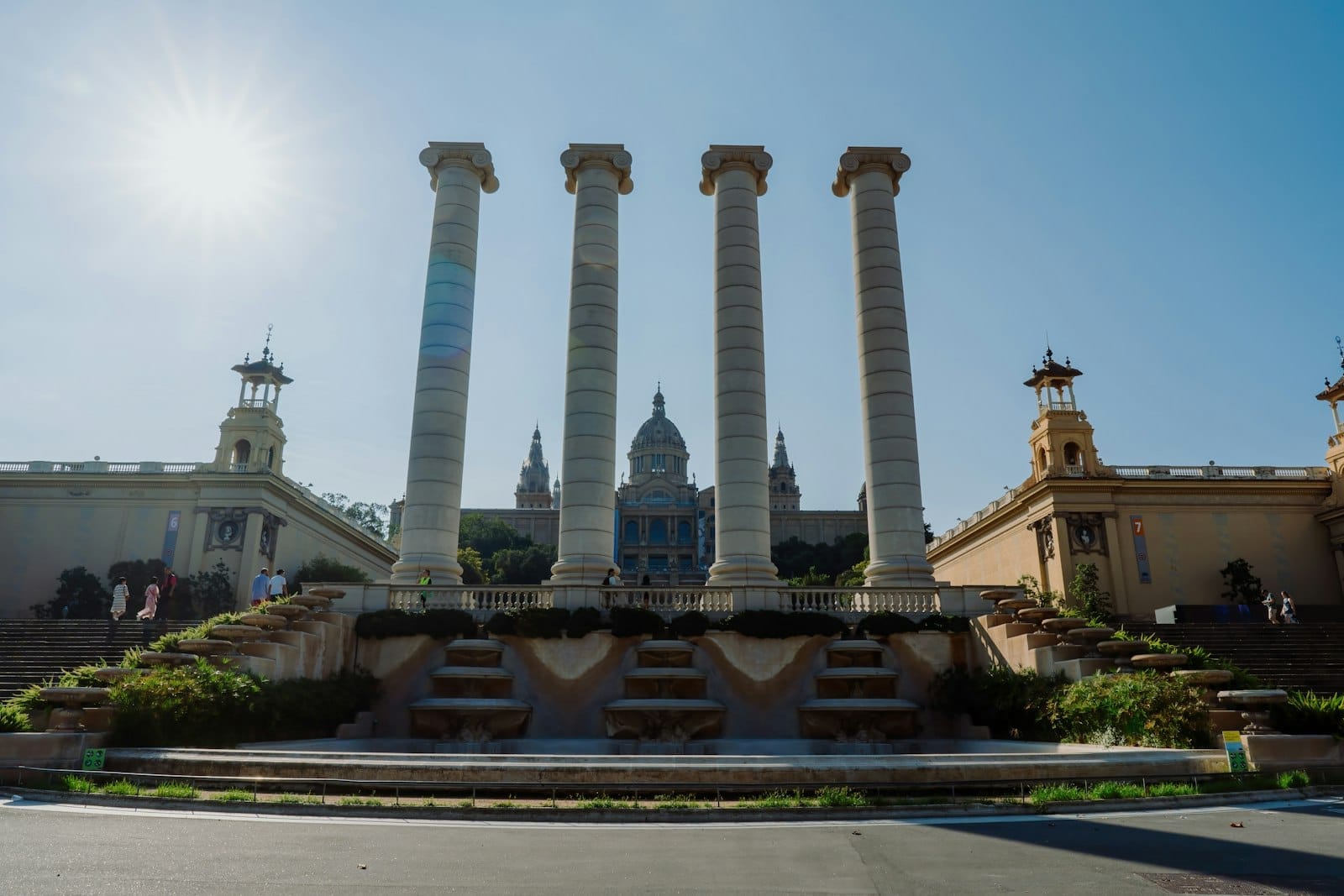
The Museu Nacional d'Art de Catalunya (MNAC) occupies the Palau Nacional, the grand domed building at the head of the Avinguda de la Reina Maria Cristina that dominates the hill's lower face. Its Romanesque art collection is one of the finest in Europe, assembled from churches across Catalonia during the 20th century to prevent deterioration and dispersal. The Gothic and Renaissance galleries are less visited but equally rewarding. The building itself dates from the 1929 Exposition and is worth entering for the oval hall alone.
The Fundació Joan Miró sits in a purpose-built rationalist building designed by Josep Lluís Sert, a close friend of the artist. The foundation holds the world's largest collection of Miró's work, including paintings, sculptures, tapestries, and drawings spanning his entire career. The building's integration of natural light, interior courtyards, and garden terraces is as carefully considered as the collection it houses. Plan at least 90 minutes here.
The Pavelló Mies van der Rohe, the reconstructed Barcelona Pavilion built for the 1929 Exposition, is located at the base of the hill near Plaça d'Espanya. It is one of the most important works of 20th-century architecture and takes about 30 minutes to visit. CaixaForum, a modernist former factory adapted by Herzog and de Meuron, is immediately adjacent and hosts rotating contemporary exhibitions.
The Olympic Legacy
Barcelona's 1992 Summer Olympics transformed Montjuïc. The Lluís Companys Olympic Stadium (Estadi Olímpic Lluís Companys) was originally built for the 1929 Exposition and then renovated to host the 1992 Games. It seats over 54,000 and remains open for visits outside event days. The exterior facade from 1929 was preserved during renovation, a detail that rewards a slow walk around the perimeter.
The Anella Olímpica (Olympic Ring) complex nearby includes the Palau Sant Jordi, an arena designed by Arata Isozaki with a distinctive retractable roof structure, and the Piscina Municipal de Montjuïc, a swimming pool whose infinity-edge visual alignment with the city below made it one of the defining television images of those Games. The pool is open to the public seasonally.
Gardens, Light, and the Best Times to Visit
Montjuïc's gardens are underused by most visitors, who tend to rush between museums and the castle. The Jardins de Laribal are a series of terraced gardens with pergolas, fountains, and rose beds that descend the hillside in a loose Italianate arrangement. In spring, the wisteria and rose flowering season transforms the upper terraces into something genuinely photogenic without the crowds of the main tourist sites.
The Jardí Botànic de Barcelona sits on the hill's western slope and holds over 1,500 species from Mediterranean climate zones around the world: California, South Africa, Chile, Australia, and the Canary Islands alongside Catalonia. It is most rewarding between March and June when the planting is densest and colour at its peak. Entry is paid but modest.
Early morning (before 9:30) is the best time to visit for photography and solitude. The light is soft, the joggers are out, and the terrace of the MNAC, which faces northeast toward the Sagrada Família, gives a clean view across the Eixample grid. Midday in summer brings heat and haze; if you are visiting in July or August, plan your summit visit for early morning or late afternoon. Sunset from the Castell or from the Mirador del Migdia on the hill's western side is genuinely exceptional.
⚠️ What to skip
In summer, temperatures on the exposed summit and Olympic plateau can exceed 35°C with minimal shade. Carry water, wear sun protection, and plan active walking for before 11:00 or after 18:00.
On Thursday through Sunday evenings in summer (and weekend evenings in winter), the Magic Fountain at the base of the hill runs free light and music shows. These are popular with families and tourists; arrive 20 minutes early for a good viewing position. The shows are genuinely spectacular at night, with the Palau Nacional illuminated behind the fountain.
Practical Walkthrough: How to Structure Your Visit
A logical sequence for a half-day visit: take the funicular from Paral·lel, walk through the Jardins de Laribal to the Fundació Joan Miró, continue uphill to the Olympic stadium and the MNAC terrace, then take the cable car to the Castell. Return by Bus 150 to Plaça d'Espanya. This covers the main points without excessive backtracking.
If you plan to visit the MNAC and Fundació Joan Miró in depth, those two institutions alone justify a full day. Both have cafés or café terraces worth using at midday. The MNAC terrace bar has arguably the best non-tourist lunch view in Barcelona.
Montjuïc connects naturally to other parts of Barcelona. The lower approach from Plaça d'Espanya passes through the Pavelló Mies van der Rohe and CaixaForum. From the port side, the Montjuïc cable car (an aerial gondola separate from the funicular) departs from the Torre de Sant Sebastià in Barceloneta, combining a beach visit with a hillside afternoon.
💡 Local tip
The Barcelona Card and the Articket Barcelona pass both cover multiple Montjuïc museums. If you plan to visit MNAC, Fundació Joan Miró, and CaixaForum in the same trip, either pass is likely to save money over individual tickets.
Who This Place Suits and Who It Doesn't
Montjuïc is one of the few places in Barcelona that genuinely rewards slow, repeated visits over a single rushed sweep. Visitors with only one day in the city and a long checklist may find it frustrating: the scale means you will either rush through multiple sites superficially or commit to one or two properly. If you are on a 24-hour Barcelona sprint, a quick funicular ride to the MNAC terrace for the view, combined with a 30-minute walk through the gardens, gives the best return on time.
Families with children will find plenty here, though the most child-friendly combination is the cable car ride, the castle, and the gardens rather than the museums. Travellers focused on Gaudí and modernisme should note that Montjuïc's architecture belongs to a different tradition entirely: rationalism, classicism, and the 1992 Olympic interventions. For Gaudí, the Gaudí landmarks in Barcelona are mostly concentrated in the Eixample and Park Güell.
Visitors with significant mobility limitations should note that while the funicular and cable car remove the steepest gradients, the paths between attractions involve moderate slopes and some uneven surfaces. The MNAC and Fundació Joan Miró are both fully accessible internally. The Castell summit involves cobblestone and irregular terrain.
Insider Tips
- The Mirador del Migdia, on the hill's western side near the Castell, faces the Llobregat delta and the sea to the southwest. It is far less visited than the Castell terrace and offers some of the clearest sunset light on the hill. A small bar operates there seasonally.
- The MNAC is free on the first Sunday of every month and on certain public holidays. Verify the current schedule on the museum's official website before planning around it.
- The Jardins de Laribal hosts occasional open-air concerts in summer. Check the Barcelona Grec Festival programme, which uses multiple Montjuïc venues including the Teatre Grec, a purpose-built Greek theatre cut into the hillside.
- If you take the aerial Montjuïc cable car from the port side (Torre de Sant Sebastià in Barceloneta), buy a one-way ticket up and return via funicular to Paral·lel. This gives you two different experiences and avoids retracing the same route.
- The Olympic swimming pool (Piscines Bernat Picornell) on the Olympic Ring is open to the public for lap swimming on most days. The fee is modest and the facility is well-maintained. Check the current session schedule before visiting.
Who Is Montjuïc For?
- Travellers wanting panoramic city and sea views without a crowded tourist summit
- Art and architecture enthusiasts: MNAC's Romanesque collection and Fundació Joan Miró are world-class
- Families combining a cable car or funicular ride with outdoor gardens and a castle
- History-focused visitors interested in Barcelona's 20th-century political history and Olympic legacy
- Anyone visiting Barcelona for more than three days who wants a genuine alternative to the Gothic Quarter circuit
Nearby Attractions
Other things to see while in Montjuïc:
- CaixaForum Barcelona
CaixaForum Barcelona occupies a meticulously restored 1911 textile factory near Plaça d'Espanya, pairing Catalan Modernista architecture with rotating international exhibitions, film cycles, and cultural programming. It is one of the most architecturally distinctive cultural spaces in the city, and admission is remarkably affordable.
- Fundació Joan Miró
Perched on the slopes of Montjuïc, Fundació Joan Miró is Barcelona's first contemporary art museum and one of the most cohesive artist foundations in Europe. The building, the collection, and the outdoor spaces combine into an experience unlike any other major art institution in the city.
- Jardí Botànic de Barcelona
Perched on the slopes of Montjuïc, the Jardí Botànic de Barcelona spreads across 14 hectares of carefully arranged Mediterranean flora from five continents. It offers a rare combination of botanical depth, architectural landscape design, and sweeping views over Barcelona, all without the crowds that dominate the city's headline attractions.
- Magic Fountain (Font Màgica)
The Font Màgica de Montjuïc is a monumental choreographed fountain at the foot of Montjuïc hill, combining jets of water reaching up to 50 metres with coloured lights and music. It's free to attend, open on select evenings year-round, and consistently draws one of Barcelona's largest spontaneous crowds.
Planning a trip? Discover personalized activities with the Nomado app.