Montjuïc Castle (Castell de Montjuïc): Views, History, and What to Expect
Perched 185 metres above Barcelona on the peak of Montjuïc hill, the Castell de Montjuïc is a 17th-century military fortress with a layered, often dark history. Today it offers some of the most commanding panoramas in the city alongside permanent exhibitions on its turbulent past. Whether you come for the views or the story, this is a place that rewards curiosity.
Quick Facts
- Location
- Carretera de Montjuïc 66, Montjuïc Hill, Barcelona
- Getting There
- Metro to Espanya (L1/L3), then Montjuïc Funicular + Bus 125, or Montjuïc Cable Car direct
- Time Needed
- 2–3 hours for castle, terraces, and views
- Cost
- General €23; Seniors (65+) €22; Juniors (8–12) €17; Under 7 free. Free entry Sundays after 3pm and first Sunday of month (verify before visiting)
- Best for
- History enthusiasts, view-seekers, photography, and half-day excursions
- Official website
- ajuntament.barcelona.cat/castelldemontjuic/en
What Montjuïc Castle Actually Is
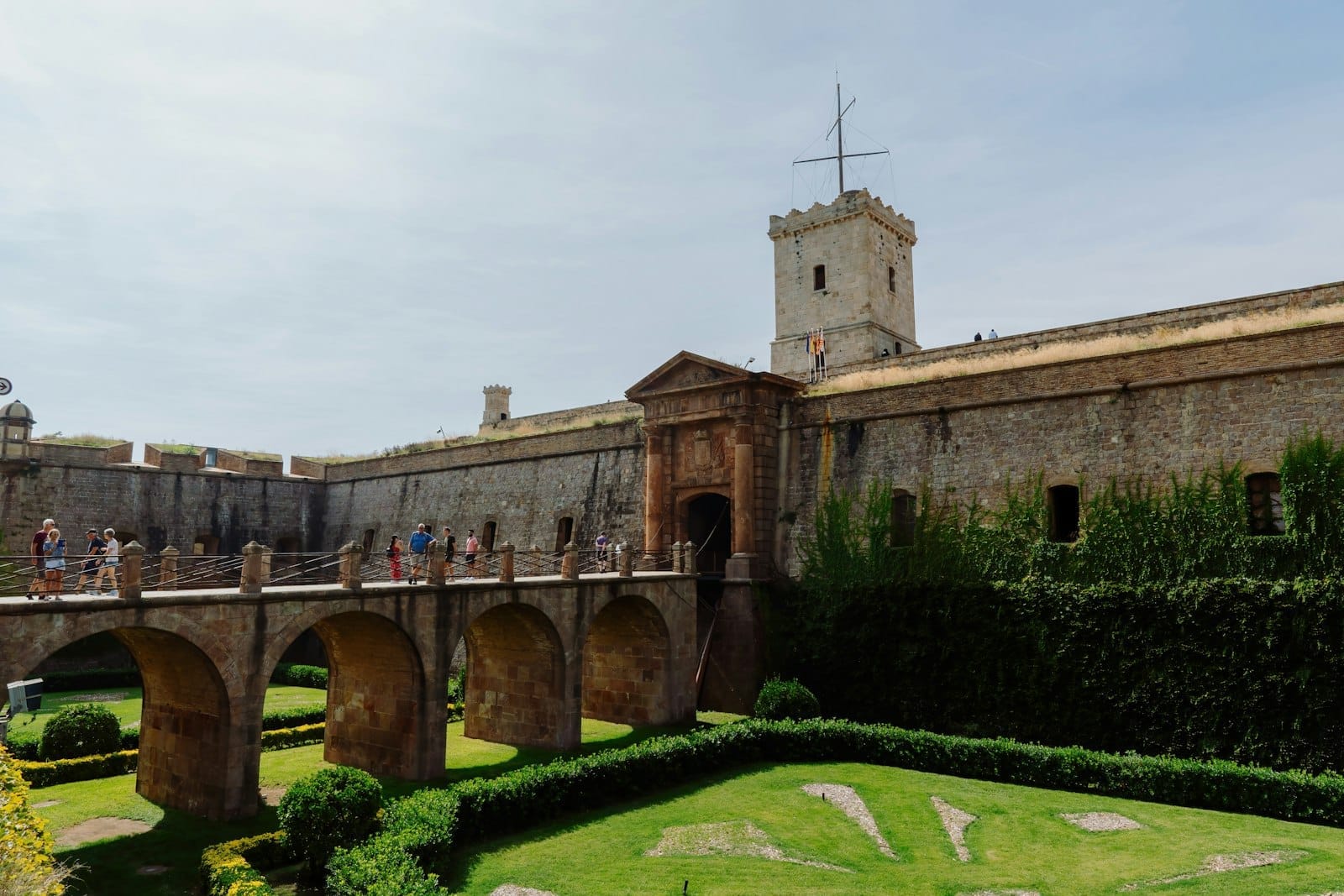
The Castell de Montjuïc is a military fortress that crowns the 185-metre summit of Montjuïc hill, southwest of Barcelona's city centre. Originally constructed in 1640 during the Reapers' War, the structure was later rebuilt in a neoclassical Vauban style by engineer Juan Martín Cermeño in the 18th century. Its star-shaped layout, thick stone ramparts, and dry moat are textbook examples of early modern European military architecture — designed to deflect cannon fire and control sightlines in every direction.
The castle passed through Spanish military control for centuries, serving at various points as a prison and a site of political executions, most notoriously during the post-Civil War Francoist repression. Barcelona's City Council took ownership in 2007, converting it into a public cultural space with permanent exhibitions on its own history. That decision to face the past rather than erase it gives the site an intellectual weight that most fortress-turned-tourist-attractions lack.
ℹ️ Good to know
Opening hours vary by season: 1 March to 31 October, 10am–8pm; 1 November to 28 February, 10am–6pm. Closed on 25 December and 1 January. Last tickets sold 30 minutes before closing.
Getting There: Routes and Trade-offs
The most atmospheric approach is the Montjuïc Cable Car, which deposits you directly at the castle gates with aerial views of the port and sea on the way up. It is the most expensive access option and queues form quickly on weekends, but the ride itself is part of the experience.
The practical default for most visitors is the metro to Espanya (Lines 1 or 3), followed by the Montjuïc Funicular to the mid-hill station, then Bus 125 to the summit. The funicular is included in standard TMB transport tickets, making it the cheapest combination. Bus 150 also connects Plaça Espanya directly to the castle without requiring a funicular transfer, which is useful if you are coming from another part of the city. The 40-minute walk from Espanya up the hill road is feasible in cooler months but demanding in summer heat — factor in the Mediterranean sun if you attempt it between June and August.
⚠️ What to skip
In high summer (July–August), midday temperatures at the exposed summit regularly exceed 30°C with little shade on the open terraces. Bring water, sunscreen, and a hat. The castle itself has shaded interior spaces, but the best viewpoints are fully exposed.
Tickets & tours
Live prices and dates from our booking partner. If you book, we may earn a commission at no extra cost to you.
Barcelona Old Town and sky views with Montjuic Castle and cable car
From 50 €Instant confirmationFree cancellationBarcelona Cable Car, Montjuic Castle visit and Magic Fountain show
From 69 €Instant confirmationFree cancellation360° Barcelona eBike with Montjuic Cable Car ticket and sailing trip
From 60 €Instant confirmationFree cancellationBarcelona Montjuic Segway™ tour
From 138 €Instant confirmationFree cancellation
The Experience: Ramparts, Rooms, and the View That Justifies Everything
Arriving at the castle, the first thing you notice is the silence relative to central Barcelona. The noise of the Ramblas and the Eixample grid is entirely absent. What replaces it is wind, the distant sound of ships in the port below, and the occasional screech of swifts that nest in the fortress walls. The stone underfoot is weathered and uneven in places — wear shoes with grip, not sandals.
The outer terraces are the visual centrepiece. From the northern ramparts, the city unfolds in extraordinary clarity on a clear day: the Eixample grid, the Sagrada Família's spires on the horizon, the Gothic Quarter's roofline, and beyond it the open Mediterranean. On mornings with good visibility, you can track the coastline northward toward the Maresme and south toward the Llobregat Delta. The southern-facing terraces look inland toward the Garraf hills and, on very clear days, the outlines of the Pyrenees.
This is consistently rated among the best viewpoints in Barcelona, and unlike the Bunkers del Carmel or Tibidabo, it combines the panorama with a substantial indoor attraction. You are not just standing on a hill — you are moving through a layered physical space.
Inside, the permanent exhibition traces the castle's history with a directness that does not soften difficult chapters. Information panels document the executions carried out here, the prisoners held in its cells during the 20th century, and the long process of returning the site to civilian use. The exhibition spaces are spread through former military rooms and a restored chapel, with period maps and archival photographs that give the fortress genuine depth. Audio guides are available for those who want narration to accompany the circuit.
How the Castle Changes by Time of Day
Morning visits, particularly on weekdays, are the clearest and least crowded. The light from the east hits the sea at an angle that turns it genuinely silver before 11am, and the city below is still in its working rhythm rather than tourist saturation. Tour groups tend to arrive between 10:30am and noon, so opening time is the optimal window for anyone who wants the terraces largely to themselves.
Midday in summer is the least comfortable time to visit and also the most crowded. The stone battlements retain heat, and the exposed walkways offer no relief. If a summer midday visit is unavoidable, spend that block inside with the exhibitions and save the terrace circuit for after 5pm, when the light turns golden and the temperature drops noticeably.
Late afternoon and early evening visits in spring and autumn are arguably the finest. The warm, low-angle light makes the sandstone glow, the crowds thin out considerably, and the city below begins to shift into its evening register. Sunset from the western terraces, with the port and the sea catching the last light, is one of the more unhurried pleasures Barcelona offers at this altitude. Winter afternoons close earlier (6pm), but the air is crisp and the visibility often exceptional.
The Dark History: What the Walls Remember
No honest account of Montjuïc Castle skips the weight of what happened here. Through the 19th century and into the 20th, the fortress served as a political prison. Anarchist leaders, Republican officers, and Catalan politicians were among those imprisoned and, in many cases, executed within or beneath its walls. Lluís Companys, the President of Catalonia who had been captured by the Gestapo and handed to Franco's regime, was shot at the castle in 1940. His execution remains one of the most resonant events in Catalan political memory.
The exhibition does not treat this as background colour — it treats it as the central story. That choice makes the castle a more serious and more valuable destination than a fortress visited purely for architecture or views. Visitors who engage with the historical content typically spend 30 to 45 minutes longer inside than those who only walk the terraces.
ℹ️ Good to know
The castle was ceded to the Barcelona City Council in 2007 after decades of negotiation. The transfer was symbolically significant: for much of the 20th century, control of this hill had represented political suppression of the city itself.
Fitting Montjuïc Castle into a Broader Montjuïc Day
The castle works well as the summit destination in a longer day on Montjuïc hill. A logical sequence starts at the Fundació Joan Miró mid-morning (one of Barcelona's strongest modern art collections), continues to the Museu Nacional d'Art de Catalunya for Romanesque art and the famous terrace view over the city, then rides the cable car to the castle for the afternoon.
On evenings where you descend from the castle by 9pm in summer, the Magic Fountain of Montjuïc runs light-and-music shows at the base of the hill (check seasonal schedules). It is a crowd-heavy experience but rounds off a full Montjuïc day in a way that feels satisfying rather than obligatory.
Comfortable walking shoes are non-negotiable for a Montjuïc day. The hill involves more uneven ground, steps, and inclines than a flat city day, and the castle's interior circuit includes stone stairs without consistent handrails in some sections. Visitors with significant mobility limitations should check the official site for current accessibility provisions before planning a visit.
Who Should Skip This
Visitors with only one or two days in Barcelona and a tight list of priorities may find the castle hard to justify against the city's first-tier attractions. If your trip centres on Gaudí's work, Gothic Quarter exploration, or beach time, the castle requires enough additional effort to reach that it can feel like a detour. It is not a quick stop — the travel time alone, each way, will take 30 to 45 minutes from central Barcelona depending on your method.
Anyone expecting a traditionally curated museum with extensive artefact collections will also be slightly surprised. The interior spaces are relatively spare, and much of the exhibition is text and photographic. The draw is architecture, atmosphere, panorama, and historical narrative — not objects behind glass.
Insider Tips
- The free entry window on Sundays after 3pm is popular with locals and can get crowded quickly in summer. If you plan to use it, arrive just before 3pm to queue at the gate rather than joining the tail end of the line.
- The moat and outer fortification walls are often overlooked by visitors who head straight to the main terrace. Walk the full perimeter of the outer ring before entering the castle proper — the angled bastion corners give a clearer sense of the Vauban military geometry than the interior does.
- Photography of the city is sharpest in the two hours after sunrise (when the air is cleanest) and the hour before sunset (when the light is directional and warm). Midday haze significantly flattens the panorama, especially in summer.
- The cable car from the port's Barceloneta end combines two experiences: a ride over the harbour and immediate access to the Montjuïc cable car from the Miramar station. It is a longer journey but avoids public transport changes entirely.
- Bring a jacket even in summer if you plan to stay for evening — the hilltop temperature can drop 5–8°C compared to the city streets below once the sun passes the horizon.
Who Is Montjuïc Castle For?
- History and politics enthusiasts who want context beyond architecture
- Photographers looking for elevated, wide-angle city and sea views
- Couples and solo travellers seeking a quieter, less commercial afternoon
- Visitors who want to combine multiple Montjuïc attractions in a single day
- Families with children aged 8 and above who can engage with the historical exhibition
Nearby Attractions
Other things to see while in Montjuïc:
- CaixaForum Barcelona
CaixaForum Barcelona occupies a meticulously restored 1911 textile factory near Plaça d'Espanya, pairing Catalan Modernista architecture with rotating international exhibitions, film cycles, and cultural programming. It is one of the most architecturally distinctive cultural spaces in the city, and admission is remarkably affordable.
- Fundació Joan Miró
Perched on the slopes of Montjuïc, Fundació Joan Miró is Barcelona's first contemporary art museum and one of the most cohesive artist foundations in Europe. The building, the collection, and the outdoor spaces combine into an experience unlike any other major art institution in the city.
- Jardí Botànic de Barcelona
Perched on the slopes of Montjuïc, the Jardí Botànic de Barcelona spreads across 14 hectares of carefully arranged Mediterranean flora from five continents. It offers a rare combination of botanical depth, architectural landscape design, and sweeping views over Barcelona, all without the crowds that dominate the city's headline attractions.
- Magic Fountain (Font Màgica)
The Font Màgica de Montjuïc is a monumental choreographed fountain at the foot of Montjuïc hill, combining jets of water reaching up to 50 metres with coloured lights and music. It's free to attend, open on select evenings year-round, and consistently draws one of Barcelona's largest spontaneous crowds.
Planning a trip? Discover personalized activities with the Nomado app.