Poble Espanyol: Barcelona's Open-Air Village of Spanish Architecture
Built for the 1929 International Exposition, Poble Espanyol is a 49,000-square-metre open-air museum on Montjuïc that recreates 117 buildings from across Spain. It operates as a living complex with craft workshops, restaurants, and nightclubs, making it genuinely different at 10am than at midnight.
Quick Facts
- Location
- Av. de Francesc Ferrer i Guàrdia, 13, Montjuïc, Barcelona
- Getting There
- Metro Espanya (L1, L3), then Bus 150 to Poble Espanyol stop
- Time Needed
- 2–3 hours for a thorough daytime visit; longer if dining or attending evening events
- Cost
- Paid admission; check the official site for current ticket prices in EUR
- Best for
- Architecture lovers, families, craft shoppers, and night-out seekers
- Official website
- poble-espanyol.com/en
What Poble Espanyol Actually Is
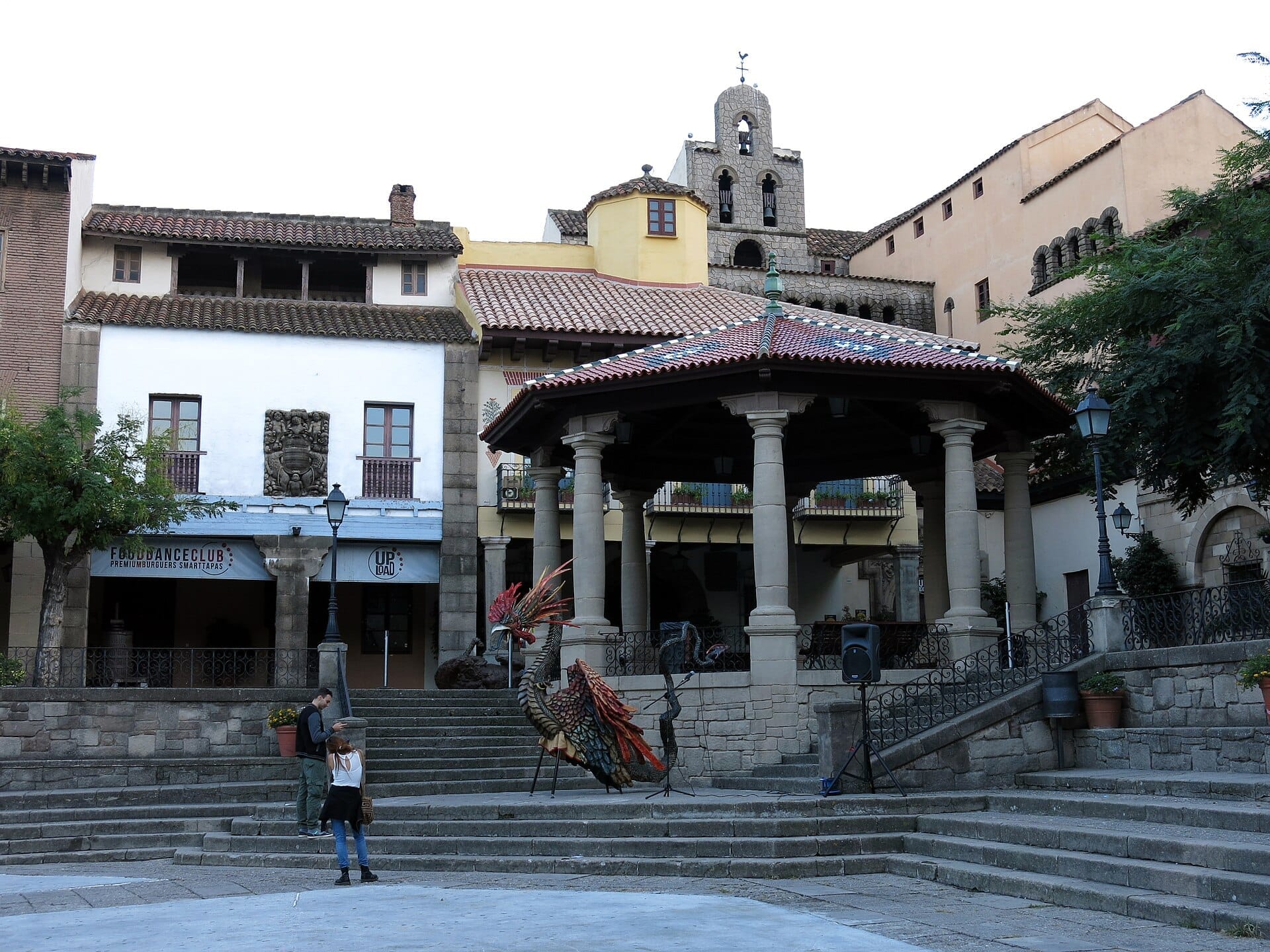
Poble Espanyol is not a theme park in the conventional sense, and it is not quite a museum either. It is a full-scale architectural village constructed on Montjuïc hill for the 1929 Barcelona International Exposition, composed of 117 buildings that reproduce regional styles from across Spain: Castilian plazas, Andalusian whitewashed alleys, Aragonese towers, Basque farmhouses, and Galician stone arcades, all arranged into a walkable, coherent street plan. The effect is genuinely strange at first, as though someone folded the entire Iberian Peninsula into a single afternoon's walk.
The architects Josep Puig i Cadafalch, Miquel Utrillo, Francesc Folguera, and Ramon Reventós oversaw the project, which was intended as a celebration of Spanish regional identity at a time when such diversity was politically significant. What they built was not a copy of any single place but a scholarly composite, each structure based on documented originals from real Spanish towns. The result covers 49,000 square metres and has outlasted its original purpose by nearly a century.
ℹ️ Good to know
Poble Espanyol opening hours vary seasonally; check the official website for the current schedule. Individual shops and craft workshops typically open 10:00–18:00 in winter and 10:00–20:00 in spring, summer, and autumn, with reduced activity in January and February.
Arriving and First Impressions
The entrance is through a reproduction of the Puerta de Ávila, a medieval gate that frames the transition from Montjuïc's wide avenues into the compressed street scale of the village. It works theatrically. The gate is tall and slightly forbidding, and the street beyond it narrows immediately, forcing you to slow down. Morning light hits the stone facade at a low angle and the shadows are long, which makes the early hours the most photogenic by a considerable margin.
The main square, Plaça Major, anchors the entire layout. It is ringed by buildings representing Castile and functions as the social centre: outdoor café tables spread across the cobblestones, and most visitors naturally gravitate here before fanning out into the surrounding streets. The acoustics of the square mean you hear conversations from across it, and in the morning, with few crowds, that openness is pleasant. By early afternoon in peak season, the same space can feel pressed.
Getting here without a car requires a small amount of planning. Take Metro Lines 1 or 3 to Espanya station, then pick up Bus 150 to the Poble Espanyol stop. The Barcelona City Tour tourist bus also stops here, making it a logical addition to a broader Montjuïc day. Allow 15–20 minutes from Espanya station on foot if you want to walk uphill through the Montjuïc gardens.
Tickets & tours
Live prices and dates from our booking partner. If you book, we may earn a commission at no extra cost to you.
The Architecture: Walking Through Spain in an Hour
The street layout is intentionally labyrinthine, designed to mimic how Spanish towns actually grow organically rather than on a grid. You will get mildly lost, particularly in the northern section where the Basque and Navarrese buildings cluster along narrow passages. This is not a flaw; it is the point. Each turn is calculated to reveal a different regional character: terracotta roof tiles give way to slate, stone changes colour from ochre to grey, and ornamental ironwork styles shift from Baroque to plain utilitarian.
A few structures stand out architecturally. The Aragonese section replicates the distinctive Mudéjar brick tower style found in towns like Teruel, with geometric patterning in fired brick that is rare outside of its source region. The Andalusian quarter centres on a courtyard with a fountain and azulejo tilework, and it smells faintly of jasmine in warm months because someone planted it properly. These sensory specifics are what separate a careful observation from a quick lap.
Visitors primarily interested in Gaudí's work should calibrate expectations here. Poble Espanyol represents mainstream Spanish regional vernacular, not Catalan Modernisme. If your focus is Gaudí specifically, the priority sites are elsewhere on and off Montjuïc.
Craft Workshops, Shopping, and the Living Village
Unlike a conventional museum, Poble Espanyol has working craft studios you can observe or buy from directly. Glassblowers, ceramicists, leather workers, and jewellers operate inside many of the building reproductions, and the crafts are generally authentic rather than purely tourist-oriented. The quality varies by vendor, but there are genuine artisan pieces among the souvenir-grade items, and the price difference usually makes itself apparent quickly.
The shopping streets are most productive in the mid-morning before tour groups arrive in volume. By 11:30am on a summer weekend, the main commercial street can feel congested and the selection feels repetitive. An early start rewards a calmer, more focused browse. Shops typically open at 10:00, so a 10:00 arrival puts you there at peak calm.
Poble Espanyol also contains several restaurants and bars, ranging from casual tapas counters to a sit-down restaurant in the main square. For a more thorough exploration of where to eat around this part of the city, the Barcelona dining guide covers options across all price points.
💡 Local tip
The craft workshops closest to the village periphery, away from the Plaça Major, tend to be less crowded and often have better prices than those on the main commercial corridor.
After Dark: A Different Place Entirely
The Friday and Saturday late closing hours (03:00 and 04:00 respectively) are not administrative quirks. The village genuinely transforms after 22:00 when nightclubs open within the old building shells. Nightlife venues occupy spaces that were craft shops six hours earlier, and the crowd demographic shifts completely. The cobblestone streets, which felt quaint and quiet at 10am, are now lit by coloured lights reflecting off stone walls while music thumps from below ground.
This dual identity is either the most interesting thing about Poble Espanyol or the most disorienting, depending on what you came for. Families with children should be aware that the atmosphere changes rapidly from early evening, particularly on weekends. Those specifically interested in Barcelona's nightlife scene may find it a convenient option given the Montjuïc location, though the main club culture in Barcelona is more concentrated in other areas.
If nightlife is a primary goal rather than an addition, the Barcelona at night guide gives a fuller picture of where different crowds tend to gather across the city.
Practical Walkthrough: Making the Most of Your Visit
A focused visit covering the architecture, the main square, and a few craft stops takes about 90 minutes. A relaxed visit with lunch, photography, and workshop browsing runs 2.5 to 3 hours. There is no need to rush, and the layout rewards doubling back through streets you already walked, because the light shifts and the composition changes.
Photography works best in the first two hours after opening on weekday mornings. Overcast days actually produce better results than harsh midday sun because the whitewashed walls in the Andalusian section blow out easily under direct light. Bring a wide-angle lens or use a phone's ultrawide if you want to capture whole facades in the tight alleyways. A 28mm equivalent is often not wide enough.
Accessibility is reasonable for a site built in 1929. The main squares and many streets are flat or gently sloped, but some of the narrower alley sections have uneven cobblestones that can be challenging for pushchairs or wheelchairs. The site is large enough that visitors with mobility considerations should plan a selective route rather than attempting a full circuit.
Poble Espanyol sits on Montjuïc, and combining it with other attractions on the hill makes practical sense. The Fundació Joan Miró is a short walk away, and the Magic Fountain operates on Thursday through Sunday evenings near the foot of the hill, offering a natural endpoint to a Montjuïc day.
⚠️ What to skip
Activity in January and February is significantly reduced. Many craft workshops operate limited hours or close entirely during these months. If visiting in winter, verify the current schedule on the official website before making the trip up Montjuïc.
Is It Worth Your Time?
Poble Espanyol is not for everyone, and it is worth saying so directly. Visitors with a tight itinerary and a focus on Barcelona's own architectural heritage may find it a detour from more pressing priorities. The site sits outside the city's main narrative of Gothic, Modernista, and contemporary architecture, and the admission cost is not trivial.
It delivers most clearly for people interested in Spanish regional architecture who cannot travel widely across the country, for families looking for a contained space where children can move freely, and for anyone curious about the 1929 Exposition's legacy on Montjuïc. Paired with the other Exposition-era buildings on the hill, it gains considerable context.
If you are working through a broader Barcelona itinerary and trying to prioritise, the Barcelona itinerary guide breaks down how to sequence the city's main sites by neighbourhood and travel time.
Insider Tips
- Arrive at 10:00 on a weekday morning to have the craft workshops and the Plaça Major almost entirely to yourself. The quality of the light and the absence of crowds make this the single best window for both photography and unhurried browsing.
- The Andalusian courtyard section is easy to miss because the entrance is not marked prominently. Look for the whitewashed walls in the southeastern part of the village and follow the narrowing lane through an arch. It smells different from the rest of the site in warm weather.
- If you are visiting Montjuïc more broadly, buy a combined or reduced ticket if the site offers them. Check the official website before you go, as promotional combinations with other Montjuïc attractions sometimes appear seasonally.
- The peripheral streets away from the main commercial corridor have working studios where artisans are more likely to be actively working rather than waiting for customers. These are the spots for genuine craft observation rather than retail browsing.
- Late evening visits on Fridays in summer offer a genuinely odd experience: the village is lit warmly and far less crowded than a Saturday night, but the nightlife is already operating. The contrast between the architectural setting and the electronic music is, at minimum, memorable.
Who Is Poble Espanyol For?
- Architecture enthusiasts wanting to compare Spanish regional building traditions in a single visit
- Families with children who need a contained, walkable space with varied visual interest
- Shoppers looking for Spanish craft goods with a higher chance of finding authentic artisan work than at Las Ramblas
- Night-out visitors who want a Montjuïc evening combining architecture, dinner, and nightlife in one location
- Travellers with limited time in Spain who want a condensed survey of regional architectural styles
Nearby Attractions
Other things to see while in Montjuïc:
- CaixaForum Barcelona
CaixaForum Barcelona occupies a meticulously restored 1911 textile factory near Plaça d'Espanya, pairing Catalan Modernista architecture with rotating international exhibitions, film cycles, and cultural programming. It is one of the most architecturally distinctive cultural spaces in the city, and admission is remarkably affordable.
- Fundació Joan Miró
Perched on the slopes of Montjuïc, Fundació Joan Miró is Barcelona's first contemporary art museum and one of the most cohesive artist foundations in Europe. The building, the collection, and the outdoor spaces combine into an experience unlike any other major art institution in the city.
- Jardí Botànic de Barcelona
Perched on the slopes of Montjuïc, the Jardí Botànic de Barcelona spreads across 14 hectares of carefully arranged Mediterranean flora from five continents. It offers a rare combination of botanical depth, architectural landscape design, and sweeping views over Barcelona, all without the crowds that dominate the city's headline attractions.
- Magic Fountain (Font Màgica)
The Font Màgica de Montjuïc is a monumental choreographed fountain at the foot of Montjuïc hill, combining jets of water reaching up to 50 metres with coloured lights and music. It's free to attend, open on select evenings year-round, and consistently draws one of Barcelona's largest spontaneous crowds.
Planning a trip? Discover personalized activities with the Nomado app.