Park Güell: Gaudí's Mosaic World Above Barcelona
Perched on the southern slope of Turó del Carmel hill in the Gràcia district, Park Güell is Antoni Gaudí's most whimsical large-scale work. A UNESCO World Heritage Site since 1984, the park combines Catalan Modernisme architecture with sculpted nature across 19 hectares of terraces, viaducts, and ceramic-tiled plazas. This guide covers what you'll actually see, how to time your visit, and how to book the timed-entry tickets you'll need to get past the gate.
Quick Facts
- Location
- La Salut, Gràcia district, Barcelona (Turó del Carmel hill)
- Getting There
- Bus Turístic (blue line) or Barcelona Bus Turístic (East/green route) to Park Güell stop
- Time Needed
- 2–3 hours for monument zone plus park paths
- Cost
- Paid entry to monument zone; tickets sold online only. Barcelona residents free (Passi Verd). Check parkguell.barcelona for current prices.
- Best for
- Architecture lovers, photography, Gaudí fans, panoramic city views
- Official website
- parkguell.barcelona/en
What Park Güell Actually Is
Park Güell began not as a public park but as a failed real estate project. In 1900, the Catalan industrialist Eusebi Güell commissioned Antoni Gaudí to design a garden city on the slopes above Barcelona, intended to attract wealthy residents who would buy plots within a landscaped community. Construction ran from 1900 to 1914, and by the time it was complete, only two houses had sold. Güell's vision of an English-style residential park never took root. Barcelona's city government eventually took ownership, and the park opened to the public in 1926, the year Gaudí died. In 1984, it was inscribed as a UNESCO World Heritage Site alongside other Gaudí works in Barcelona.
That backstory matters for how you experience the place. The infrastructure you walk through, the colonnaded market hall, the viaducts, the gatehouses, these were all designed to serve a private residential community. Gaudí wasn't decorating a park. He was engineering an entire landscape: drainage systems hidden inside columns, paths that follow natural contours to avoid blasting the rock, and retaining viaducts that look like they grew from the hillside rather than were built on it.
ℹ️ Good to know
The park divides into two zones: the free outer park (open access, wooded paths and viaducts) and the paid monument zone, which includes the Dragon Stairway, the Hypostyle Hall, and the main terrace. Timed tickets for the monument zone must be purchased in advance at parkguell.barcelona — walk-up entry is not available, and capacity is limited.
The Monument Zone: What You're Paying to See
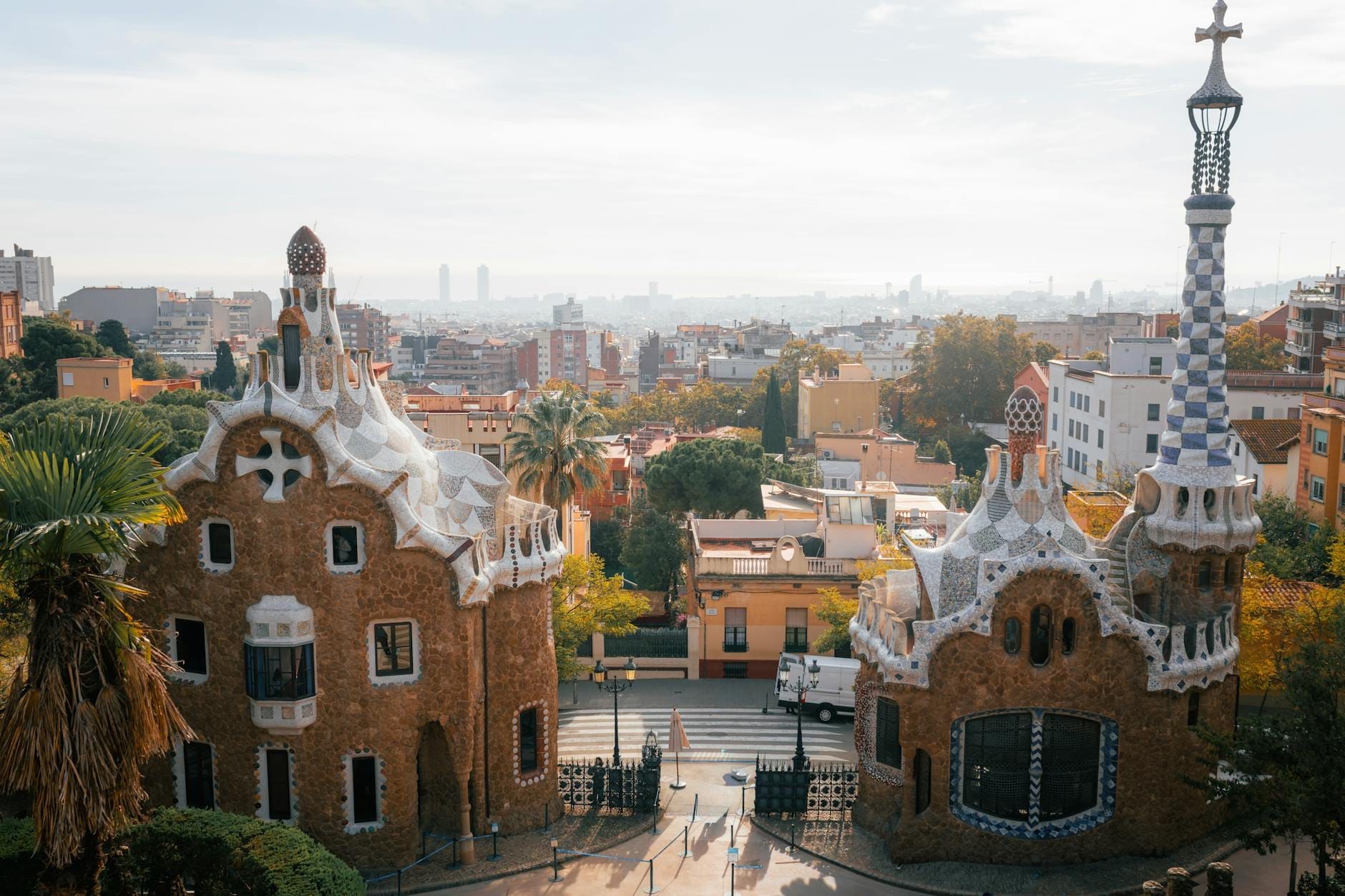
The entrance to the paid zone is framed by two gingerbread-style gatehouses covered in white render and ceramic tile, their rooftops curving like the caps of chess pieces. These now house the Park Güell Interpretation Centre, with exhibits explaining the park's history and Gaudí's design methodology. The gatehouses alone are worth pausing at: the surface textures are dense with detail up close, shapes that look uniform from a distance reveal irregular handmade fragments when you step nearer.
From the entrance, the Dragon Stairway ascends through a series of stepped terraces, bisected by a central fountain shaped as a salamander, though it is commonly called a dragon, covered in fragments of ceramic tile in yellows, oranges, and greens. The trencadís technique Gaudí used here, broken ceramic pieces set in mortar, was partly practical: irregular fragments conform to curved surfaces more easily than whole tiles. The result is a skin of color that catches and scatters light differently depending on the angle and the time of day.
At the top of the stairway sits the Hypostyle Hall, a covered space of 86 Doric columns originally intended as a market for park residents. The ceiling between the columns is a mosaic of circular medallions, each one unique, assembled by Gaudí's longtime collaborator Josep Maria Jujol. Many visitors walk through quickly, but the ceiling rewards those who stop and look up: no two sections are identical, and some medallions incorporate found objects pressed into the ceramic before firing.
Tickets & tours
Live prices and dates from our booking partner. If you book, we may earn a commission at no extra cost to you.
Complete Gaudi tour with Park Guell, Casa Batllo and Sagrada Familia
From 249 €Instant confirmationFree cancellationColonia Guell Combinat entrance with audio guide + train ticket from Barcelona
From 15 €Instant confirmationPark Guell guided tour with skip-the-line access
From 24 €Instant confirmationGuided tour of Sagrada Familia and park Guell
From 89 €Instant confirmationFree cancellation
The Main Terrace and the View Over Barcelona
Above the Hypostyle Hall opens the park's most photographed space: a wide undulating terrace edged by a continuous ceramic bench. This sinuous bench, also covered in trencadís, was ergonomically shaped using casts of seated workers to create a seating surface that fits the human back. It is both sculpture and functional furniture, and on a clear morning, with the city spread out below and the Mediterranean glinting in the distance, it is genuinely one of the better places to sit in Barcelona.
The terrace faces southeast, which means it receives full sun from mid-morning onward. By noon in summer, the exposed stone radiates heat and the terrace is packed. Early morning slots, typically the first entry window of the day, offer softer light for photography and noticeably fewer people. If panoramic views are your priority, note that the terrace at Park Güell competes with the Bunkers del Carmel on the adjacent hill, which is free, requires no booking, and delivers a 360-degree panorama rather than a directed view.
💡 Local tip
Photography tip: The bench mosaic photographs best in the first two hours after opening, when the angle of light hits the ceramic fragments obliquely and brings out the color depth. Midday sun flattens the texture and washes out the tiles.
The Viaducts and the Free Park: The Underrated Half
Beyond the monument zone, most visitors leave. That is a mistake. The outer park's network of viaducts, built from rough-hewn local stone with leaning columns that look organically grown rather than constructed, connects several levels of the hillside through shaded walkways. These were designed as the street infrastructure for Güell's proposed residential community. Walking them now feels like moving through a space that never quite became what it was supposed to be, which gives the paths a quiet, melancholy quality unlike anything in the monument zone.
The Gaudí House Museum, the pink house that stands within the park where Gaudí himself lived from 1906 to 1925, is a separate ticketed attraction. The museum contains original furniture Gaudí designed, personal objects, and architectural drawings. It reopened after restoration and requires a separate admission. Combined tickets are available and worth considering if you want the full picture of how Gaudí lived alongside his work.
How the Experience Changes Through the Day
First entry slots are the clearest choice for most visitors. The air is cooler, the light is directional rather than flat, and the monument zone, while never truly empty, is noticeably less dense. The smell of pine resin from the park's trees is strongest in the morning before foot traffic disturbs the ground. By 11am, tour groups begin arriving in volume and the Dragon Stairway becomes a bottleneck for photographs.
Late afternoon slots have their own appeal. As the direct sun drops toward the southwest, the terrace falls into partial shade and temperatures ease. The light turns warm and golden around an hour before sunset, which brings out the reds and golds in the mosaic work in a way midday light cannot match. The tradeoff is that the most popular slots often sell out days in advance, particularly in summer. Check availability and book as early as possible, ideally the moment your travel dates are confirmed.
⚠️ What to skip
The hillside approach is steep. There is a significant uphill walk from the nearest bus stops to the entrance, with uneven stone paths continuing inside the park. Visitors with limited mobility should check accessibility details directly on the official website before visiting. Comfortable, flat-soled shoes are essential regardless of fitness level.
Is Park Güell Worth It? An Honest Assessment
Park Güell is not overhyped in terms of architectural quality, it genuinely delivers. What it sometimes fails to deliver is the feeling of discovery, because with 1,400 people per hour passing through, the monument zone can feel more like a ticketed corridor than a park. Visitors who arrive expecting a calm, meditative garden will be disappointed during peak season. Those who treat it as a serious piece of architecture, studying the structural logic of the columns, the geometry of the bench, the drainage systems embedded in the landscape, will leave with a much stronger experience. Pair the visit with time in the surrounding Gràcia neighborhood below: the district has good independent cafes and a pace entirely different from the tourist pressure at the park gate.
If you are building an itinerary around Gaudí's work, Park Güell fits naturally with Sagrada Família and Casa Batlló on Passeig de Gràcia. All three require advance tickets; plan the logistics before you arrive in Barcelona, not after.
Families with young children will find the park manageable provided they book early slots and come prepared for the uphill walk. The visual spectacle of the Dragon Stairway and the mosaic surfaces tends to hold children's attention well, and the outer park paths offer space to move more freely than the monument zone. Travelers who have no particular interest in architecture and primarily want a city view should consider the Bunkers del Carmel instead: free, no booking, and with a broader panorama.
Insider Tips
- Book the first available entry slot of the day. Not just for smaller crowds, but because the ceramic tilework on the bench and salamander catches the low morning light at angles that disappear by 10am.
- The free outer park, the viaducts and wooded paths outside the monument zone, requires no ticket and no booking. If you miss your ticket window or sell-out is total, you can still walk these paths and see genuine Gaudí engineering work.
- Combine your visit with the Gaudí House Museum using a combined ticket. The house gives context to Gaudí as a person rather than just an architect, and the interiors are unexpectedly intimate.
- Avoid approaching the park via the steep residential streets from Vallcarca metro unless you enjoy a sustained uphill climb. The Bus Turístic stop deposits you much closer to the entrance and saves meaningful energy for the park itself.
- Barcelona residents can enter the monument zone free through the Passi Verd system, which requires official ID verification through the park's online portal. Process this well before your visit if you qualify.
Who Is Park Güell For?
- Architecture and design enthusiasts who want to study Gaudí's structural and decorative techniques in a single large-scale site
- Photographers, particularly those who can secure early morning or late afternoon entry slots for the best light on the mosaics
- Gaudí-focused itinerary visitors combining Park Güell with Casa Batlló and Sagrada Família
- Families with older children who can handle uphill walking and will engage with the visual spectacle of the terraces and Dragon Stairway
- Travelers spending time in Gràcia who want to combine the park visit with the neighborhood's squares and independent restaurants
Nearby Attractions
Other things to see while in Gràcia:
- Bunkers del Carmel
Perched atop Turó de la Rovira in the El Carmel neighbourhood, the Bunkers del Carmel are the ruins of a Spanish Civil War anti-aircraft battery that now serve as Barcelona's most sweeping free viewpoint. The 360-degree panorama stretches from the sea to Tibidabo, with the Sagrada Família rising unmistakably from the Eixample grid below.
- Casa-Museu Gaudí
Tucked inside Park Güell in the Gràcia district, Casa-Museu Gaudí is the pink Neo-Gothic house where Antoni Gaudí lived from 1906 until 1925. Today it functions as an intimate museum preserving his furniture, personal objects, and architectural drawings — offering something no cathedral or apartment building can: a sense of the man behind the monuments.
- Casa Vicens
Built between 1883 and 1885, Casa Vicens was the project that announced Antoni Gaudí to the world. Long overlooked in favor of his later masterpieces, this UNESCO World Heritage Site in the Gràcia neighborhood rewards visitors who seek it out with intricate tilework, Moorish-influenced interiors, and a rare glimpse at the origins of one of architecture's most singular minds.
Planning a trip? Discover personalized activities with the Nomado app.