Casa-Museu Gaudí: A Rare Look Inside the Mind of Barcelona's Greatest Architect
Tucked inside Park Güell in the Gràcia district, Casa-Museu Gaudí is the pink Neo-Gothic house where Antoni Gaudí lived from 1906 until 1925. Today it functions as an intimate museum preserving his furniture, personal objects, and architectural drawings — offering something no cathedral or apartment building can: a sense of the man behind the monuments.
Quick Facts
- Location
- Carretera del Carmel, 23, Parc Güell, Gràcia, Barcelona
- Getting There
- Metro Lesseps (L3) or Vallcarca (L3), approx. 15-20 min walk to the museum; El Coll - La Teixonera (L5) is further with 25-30 min walk
- Time Needed
- 45 to 75 minutes
- Cost
- Ticketed entry; purchase in advance via the official website at sagradafamilia.org/en/gaudi-house-museum
- Best for
- Architecture enthusiasts, Gaudí devotees, design history lovers
- Official website
- sagradafamilia.org/en/gaudi-house-museum
What Is Casa-Museu Gaudí?
Casa-Museu Gaudí is a small but historically dense museum occupying the house where Antoni Gaudí chose to live during the most productive decades of his life. The building itself was not designed by Gaudí but by his close collaborator Francesc d'Assís Berenguer i Mestres, originally constructed as a show house for Park Güell's prospective buyers. When the real estate development failed to attract residents, Gaudí moved in around 1906 and stayed until the end of 1925 — spending his final years sleeping in this house and walking to the Sagrada Família every day.
The museum opened on September 28, 1963, and since 1992 has been owned by the Fundació Junta Constructora del Temple Expiatori de la Sagrada Família. Its collection spans Gaudí's furniture designs, religious objects, personal photographs, architectural models, and drawings. None of these are reproductions. You are standing in rooms where Gaudí actually slept, prayed, and worked, surrounded by objects he touched.
💡 Local tip
Book your ticket in advance on sagradafamilia.org/en/gaudi-house-museum. On-site tickets are not always available, and the museum is often at capacity by late morning, especially during summer and on weekends.
The Building: A Neo-Gothic House in a Modernista Park
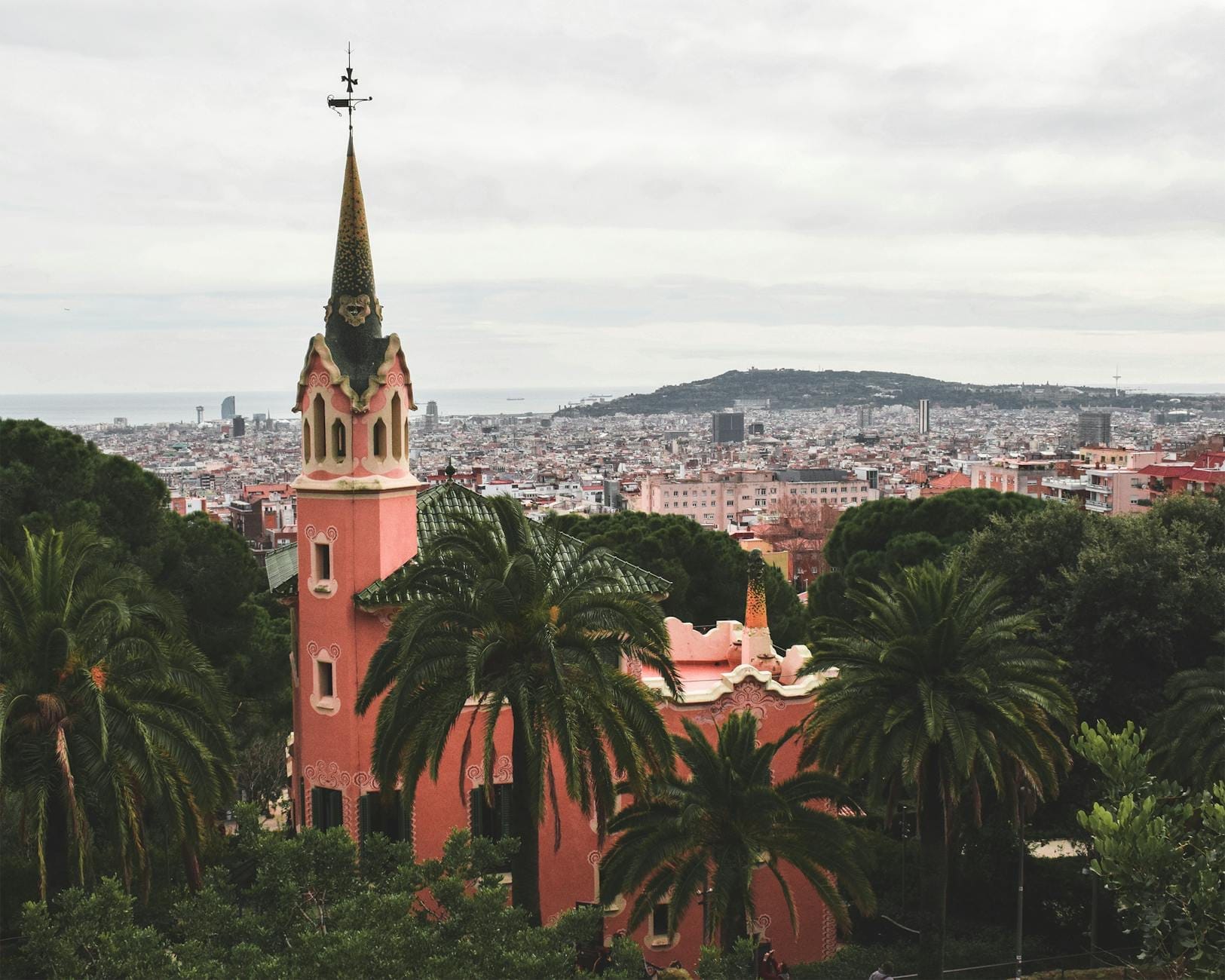
The house is painted a dusty rose-pink that stands out sharply against the stone mosaic walls and organic curves of Park Güell surrounding it. Its silhouette is pointed and upright, with neo-Gothic turrets and steep pitched rooflines that feel more Central European than Catalan. From the outside, it reads almost like a fairy-tale cottage placed improbably into Gaudí's wildly organic park landscape.
The interior is compact across multiple floors. Berenguer designed the structure with practical elegance: tall windows, modest rooms, and functional spaces rather than theatrical display. What makes it architecturally interesting is precisely this contrast. The man who designed the Sagrada Família's soaring vaults lived in a house of careful restraint.
The furniture you see inside was largely designed by Gaudí himself — chairs, tables, and prie-dieu (prayer kneelers) with organic curves and precise joinery that prefigure what he would later apply at a much larger scale in Casa Batlló and Casa Milà. Many pieces were originally designed for the crypt of the Colònia Güell or for early projects, repurposed here for daily use.
Tickets & tours
Live prices and dates from our booking partner. If you book, we may earn a commission at no extra cost to you.
Complete Gaudi tour with Park Guell, Casa Batllo and Sagrada Familia
From 249 €Instant confirmationFree cancellationGuided Tour of Gaudi's Houses, Casa Batllo, Casa Mila and Casa Vicens
From 78 €Instant confirmationFree cancellationGaudi Casa Vicens skip-the-line tickets
From 21 €Instant confirmationFree cancellationPicasso Museum guided tour
From 30 €Instant confirmationFree cancellation
What You'll See Room by Room
The museum is organized across three floors. The ground floor is dedicated to contextual exhibits: photographs of Gaudí, documents related to Park Güell's construction, and background on his relationship with patron Eusebi Güell. There is enough here to orient visitors who are coming to Gaudí for the first time, though serious students of his work will move through this level quickly.
The upper floors are where the visit earns its weight. Gaudí's bedroom is preserved with austerity that surprises most visitors. His personal religious objects are displayed near the bed: a crucifix, a prayer book, items reflecting the deep Catholic faith that shaped his architecture and his ascetic personal life. He reportedly fasted frequently and, by the 1920s, had largely withdrawn from social life to focus on the Sagrada Família.
In the studio and working spaces, you can see drawings and scale models that bridge the personal and the professional. These are not the grand presentation models you find at the Sagrada Família visitor center. These are working tools, modest in size, marked with practical notes. They give a more immediate sense of how Gaudí thought through problems at human scale before projecting them into the monumental.
ℹ️ Good to know
The museum is small — roughly 7 rooms across three floors. Do not rush. Read the panel texts carefully; without context, many objects appear ordinary. With context, they become direct evidence of one of the most influential architectural minds of the 20th century.
How the Experience Changes by Time of Day
Arriving at opening time, around 9:30 AM, gives you the quietest experience. The light through the tall windows is cool and indirect in early morning, falling across the wooden furniture and tiled floors in a way that feels natural and untheatrical. The small rooms feel intimate rather than crowded. You can stand in Gaudí's bedroom for a full minute without anyone else in it.
By 11 AM, particularly during peak months from April through October, the museum fills. Groups arrive from Park Güell tours. The hallways on the upper floor, which are genuinely narrow, become uncomfortable at capacity. The sensory quality of the visit shifts: voices echo off stone walls, the smell of the wooden furniture competes with sunscreen and tour guides' audio equipment. The experience is still worthwhile, but it becomes more crowded than the space was designed to handle.
Late afternoon visits, from around 4 PM onward, often see the crowds thin again. The light at that hour is warmer and comes in at a lower angle through the windows, casting longer shadows across the furniture and giving the rooms a different atmospheric quality. If you are visiting in shoulder season (March-April or October-November), afternoon is genuinely peaceful.
Getting There: Park Güell Entry and Museum Location
The museum sits inside the ticketed Monumental Zone of Park Güell. If you plan to visit both, confirm whether your Park Güell ticket includes or requires a separate museum entry. They are managed separately, so do not assume one ticket covers both.
Nearest metro stops are Lesseps or Vallcarca on Line 3 (green line), involving a walk of 15-20 minutes uphill through the park; El Coll - La Teixonera (L5) is further away. Bus lines 24 and 92 also serve the area. For a broader overview of getting around the city, the Barcelona transport guide covers all major options including T-Casual cards and single-fare pricing.
Wear shoes suitable for walking on uneven stone surfaces. The approach through Park Güell involves inclines, mosaic steps, and terraced paths that are scenic but physically demanding in summer heat. Bring water if visiting between June and September, when temperatures regularly reach 28-32°C and the park provides little shade on the main routes.
Context: Why This Museum Matters Beyond Gaudí Tourism
Park Güell was originally conceived as a residential development for 60 houses targeting Barcelona's wealthy bourgeoisie. It failed commercially: only two plots were ever sold. Gaudí himself bought one and moved in. The park was donated to the city of Barcelona in 1922 and became public in 1926, the same year Gaudí died after being struck by a tram. It was designated a UNESCO World Heritage Site as part of the Park Güell complex. The museum is one of the only places in Barcelona where Gaudí's domestic life, rather than his public architecture, is the subject.
For visitors who have already seen the Sagrada Família, Casa Batlló, and Casa Milà, this museum completes a different kind of picture. Those buildings are public spectacles, designed to overwhelm. This house was designed to be lived in. It reframes the monuments by showing the scale at which their creator actually chose to exist.
If you are planning a broader immersion in Gaudí's Barcelona, the complete Gaudí guide maps all his major works across the city and suggests an itinerary that makes geographic sense.
Who Should Skip This Museum
Visitors primarily interested in spectacular architecture or Instagrammable spaces will find this museum underwhelming. There are no dramatic vaulted ceilings, no ceramic mosaics at scale, no sweeping views. The rooms are small and the objects are quiet. If your interest in Gaudí is primarily visual and formal, your time is better spent at the facades and interiors of his commercial commissions.
Families with young children should consider carefully. The museum is not set up for child engagement, the rooms are cramped, and there is nothing interactive or tactile. Children under 10 are unlikely to get much from the visit, and the combination of narrow spaces and fragile objects makes it a stressful experience with small kids in tow.
Insider Tips
- If you are visiting Park Güell on the same trip, enter the park from the Carretera del Carmel lower entrance rather than the main staircase entrance. It deposits you closer to the museum and avoids the most congested routes through the Monumental Zone.
- The museum gift shop stocks a small selection of books on Gaudí's furniture and design work that are not widely available elsewhere in Barcelona. If you have a serious interest in his applied design rather than just his architecture, it is worth browsing.
- Photography is permitted in most areas of the museum, but flash is discouraged and tripods are not allowed. The rooms are small and the light is limited, so a phone or mirrorless camera performs better than a large DSLR in this space.
- Opening hours shift seasonally. Opening hours shift seasonally; always verify on sagradafamilia.org/en/gaudi-house-museum before visiting. Hours extend in summer months. Always verify on sagradafamilia.org before visiting, especially if planning around a specific arrival time.
- The Gràcia neighborhood immediately below Park Güell is one of the most pleasant areas in Barcelona for an unhurried afternoon. After the museum, descend into the neighborhood for coffee or lunch before the afternoon crowds return from the park.
Who Is Casa-Museu Gaudí For?
- Serious Gaudí enthusiasts who want biographical and creative context beyond the buildings
- Architecture students and design professionals interested in Gaudí's furniture and object design
- Slow travelers who prefer intimate, human-scale cultural experiences over large visitor attractions
- Visitors combining the museum with a full morning at Park Güell
- Photographers seeking interiors with period furniture, natural light, and historical character
Nearby Attractions
Other things to see while in Gràcia:
- Bunkers del Carmel
Perched atop Turó de la Rovira in the El Carmel neighbourhood, the Bunkers del Carmel are the ruins of a Spanish Civil War anti-aircraft battery that now serve as Barcelona's most sweeping free viewpoint. The 360-degree panorama stretches from the sea to Tibidabo, with the Sagrada Família rising unmistakably from the Eixample grid below.
- Casa Vicens
Built between 1883 and 1885, Casa Vicens was the project that announced Antoni Gaudí to the world. Long overlooked in favor of his later masterpieces, this UNESCO World Heritage Site in the Gràcia neighborhood rewards visitors who seek it out with intricate tilework, Moorish-influenced interiors, and a rare glimpse at the origins of one of architecture's most singular minds.
- Park Güell
Perched on the southern slope of Turó del Carmel hill in the Gràcia district, Park Güell is Antoni Gaudí's most whimsical large-scale work. A UNESCO World Heritage Site since 1984, the park combines Catalan Modernisme architecture with sculpted nature across 19 hectares of terraces, viaducts, and ceramic-tiled plazas. This guide covers what you'll actually see, how to time your visit, and how to book the timed-entry tickets you'll need to get past the gate.
Planning a trip? Discover personalized activities with the Nomado app.