Casa Vicens: Where Gaudí's Genius First Took Shape
Built between 1883 and 1885, Casa Vicens was the project that announced Antoni Gaudí to the world. Long overlooked in favor of his later masterpieces, this UNESCO World Heritage Site in the Gràcia neighborhood rewards visitors who seek it out with intricate tilework, Moorish-influenced interiors, and a rare glimpse at the origins of one of architecture's most singular minds.
Quick Facts
- Location
- Carrer de les Carolines 20–26, Gràcia, Barcelona
- Getting There
- Metro L3 Fontana or L7 Plaça Molina; buses 22, 24, 27, 87, 114
- Time Needed
- 1.5 to 2 hours
- Cost
- Adults €22; reduced €19–20; free under 12. Online tickets include audio guide.
- Best for
- Architecture enthusiasts, Gaudí completists, design-focused travelers
- Official website
- casavicens.org
What Is Casa Vicens?
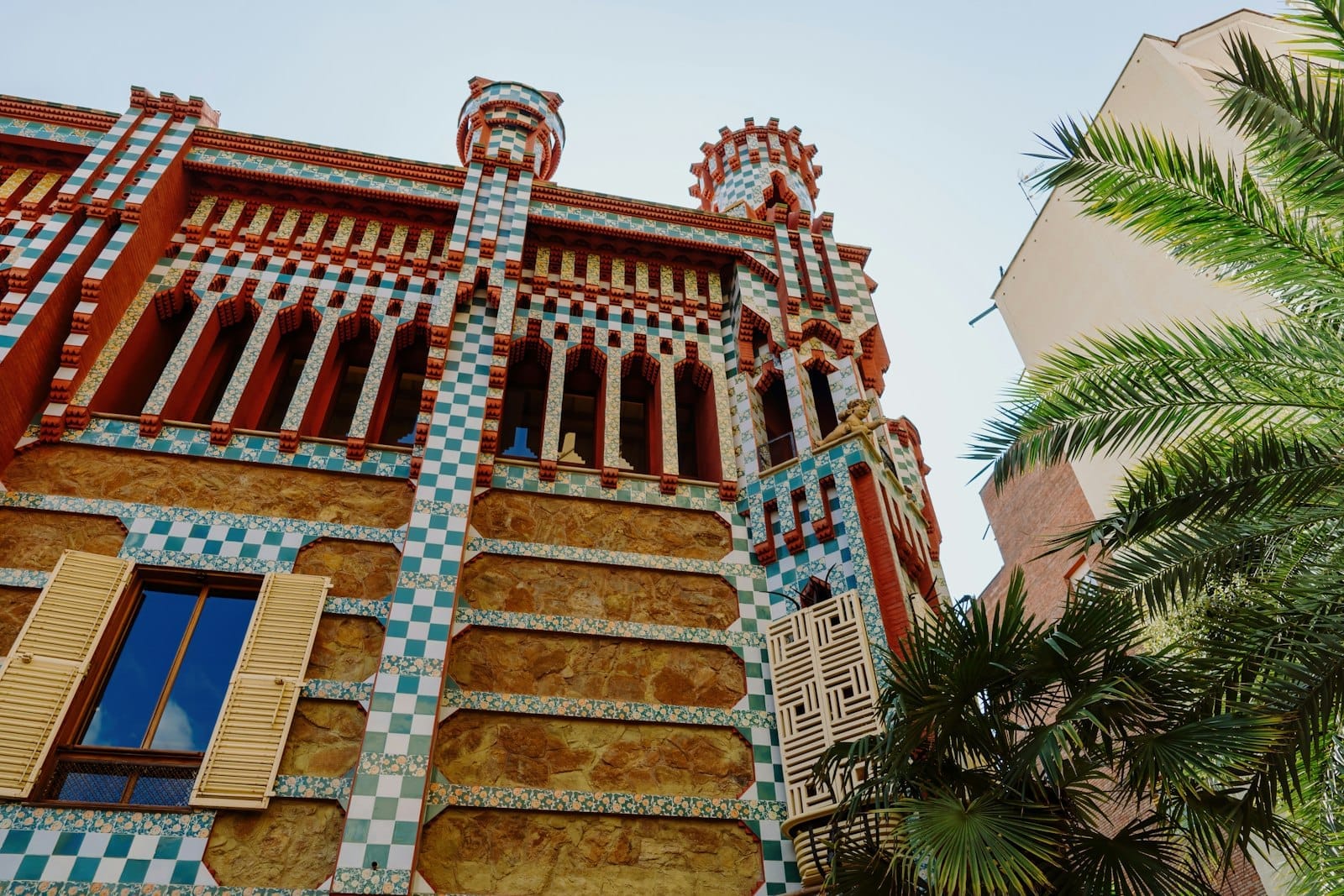
Casa Vicens is a residential building in Barcelona's Gràcia neighborhood, designed by Antoni Gaudí between 1883 and 1885 as a summer house for tile merchant Manuel Vicens i Montaner. It was Gaudí's first significant architectural commission and has been a UNESCO World Heritage Site since 2005 as part of the collective recognition of his works across Barcelona. After spending most of the 20th century as a private residence, the house opened to the public as a museum in 2017, and it has only recently begun to attract the attention it deserves.
If you've spent time with Sagrada Família or Casa Batlló, visiting Casa Vicens offers something genuinely different: the chance to see where Gaudí's ideas began, before they fully crystallized into the organic, fluid language of his mature period. The house is smaller and quieter, and that intimacy is its strength.
💡 Local tip
Book tickets online in advance at casavicens.org. The online price (around €22) includes a digital audio guide, and you'll skip any queue at the entrance — especially useful on weekends and during summer.
The Architecture: Orientalism Meets Catalan Modernisme
Casa Vicens is a product of its moment. Gaudí was in his mid-thirties, recently graduated from the Barcelona School of Architecture, and saturated with the visual languages competing for influence in late 19th-century Catalonia: Moorish revival, Japanese decorative arts, and the emerging Catalan Modernisme movement that would define his career. The result is a building that feels unlike anything else he produced.
The facade is the first thing that stops people in their tracks. It is covered in green-and-white ceramic tiles featuring a marigold motif, interspersed with larger checkered tiles in yellow and green. The pattern is not ornamental in a conventional sense: the tiles were reportedly inspired by the wild marigolds Gaudí found growing on the site when he first visited. The ironwork on the gates and railings mimics palm fronds, a motif that runs through the whole property and anticipates his later obsession with natural forms translated into structure.
The minarets, arched overhangs, and horseshoe arcade visible from the street owe a clear debt to Mudejar architecture, the Spanish-Islamic hybrid style Gaudí studied in depth. Yet the building never reads as pastiche. The way color, texture, and geometry are layered suggests a designer already working out a personal syntax rather than borrowing someone else's.
Tickets & tours
Live prices and dates from our booking partner. If you book, we may earn a commission at no extra cost to you.
Inside the House: Room by Room
The interior tour moves through five floors, including a basement and a rooftop terrace. The circulation is logical and well-signed, and the space is compact enough that even visitors without a guide can piece together the sequence without confusion.
The smoking room on the ground floor is the most theatrical space inside the house. Its ceiling is covered in papier-mâché stalactites, painted in warm amber and gold tones, creating an effect that reads as both cave and lantern. The room was designed for Manuel Vicens and his male guests, and the North African and Ottoman references in its decoration were deliberate markers of cosmopolitan taste in bourgeois Barcelona. Stand still for a moment and let your eyes adjust to the detail overhead. Most visitors rush through without looking up.
The upper floors feel lighter, with tiled friezes, painted ceilings depicting birds and plant life, and windows framed in ceramic moldings. Exhibition panels on each level provide contextual information about Gaudí's influences, his early career, and the specific design decisions visible in the room you're standing in. The audio guide, included with online tickets, adds further depth without becoming repetitive.
The rooftop terrace offers a clear view of the building's roofline, where Gaudí layered different tile textures and heights to create a skyline that reads as almost sculptural from above. It also gives a sense of how the house sits within the Gràcia street grid, surrounded by residential buildings that make its extravagance feel even more unexpected.
When to Go and What to Expect
Casa Vicens sees far fewer visitors than Gaudí's other Barcelona buildings. On a typical weekday morning in spring or autumn, the rooms feel genuinely quiet, and it's possible to spend time in front of a single tile panel without anyone standing behind you. Weekend afternoons in summer are the exception: the house fills up and the smoking room in particular can feel cramped with a large group inside.
The best window is weekday mornings between 10 a.m. and noon, when light enters the upper floors from the east-facing windows and the crowd hasn't yet built. Late afternoon works well in the quieter months, though note that last admission is one to one and a half hours before closing, so plan accordingly.
April through October the house is open daily from 9:30 a.m. to 8 p.m. (last admission 7 p.m.). November through March hours shorten to 9:30 a.m. to 6 p.m. (last admission 4 p.m.). The house is closed on December 25, January 1, and January 6. Guided tours are available for €24 and are worth considering if architectural detail is your main interest.
⚠️ What to skip
Do not confuse Casa Vicens with Casa Milà (La Pedrera) or Casa Batlló on Passeig de Gràcia. They are different buildings, in different neighborhoods, at different price points. Casa Vicens is in Gràcia, a 10–15 minute walk north of the main Gaudí corridor on Eixample.
Getting There and Getting Around the Neighborhood
Casa Vicens is at Carrer de les Carolines 20–26 in the Gràcia neighborhood. The closest metro stop is Fontana on Line 3 (green line), a five-minute walk from the house. Line 7 Plaça Molina is slightly further but also walkable. Several bus routes stop nearby, including lines 22, 24, 27, 87, and 114.
The Gràcia neighborhood itself rewards time before or after the visit. The area has a distinct character compared to the tourist-heavy zones lower in the city: independent bookshops, local cafes, and squares like Plaça de la Vila de Gràcia that function as genuine neighborhood gathering points rather than tourist infrastructure. If you're combining Casa Vicens with other Gaudí sites, Park Güell is a 20-minute walk uphill from here, making it a logical pairing for a half-day itinerary.
The house is wheelchair accessible. The modern internal staircase connects all floors, and the surfaces throughout the building are suitable for wheelchair users. For specific accessibility queries, the visitor services team can be reached at +34 93 547 59 80.
Honest Assessment: Is It Worth the Ticket Price?
At €21–22, Casa Vicens sits at a comparable price point to Barcelona's other major Gaudí attractions. Whether it justifies the cost depends entirely on what you're looking for. If you're primarily interested in dramatic scale or the kind of sensory overload that Sagrada Família delivers, this house will feel modest. The spaces are small, the building is residential in proportion, and the exterior, while striking, is easily visible from the street for free.
For anyone interested in architectural history, the genesis of a major artistic career, or simply a space that rewards close looking rather than spectacle, Casa Vicens is genuinely excellent. It's also one of the few Gaudí sites where you can move at your own pace without feeling swept along by crowd logistics. For context on how this building fits within his broader output, the complete guide to Gaudí's Barcelona is a useful planning resource.
People who find architectural tourism tedious in general, or who are visiting Barcelona primarily for the beach, food, or nightlife, will likely not find enough here to justify the time and cost. The exhibition panels are detailed and assume a degree of interest in design history. Children under 12 enter free, but the content is aimed squarely at adults.
Insider Tips
- The smoking room ceiling is the single most photographed interior detail in the house. Visit early in the day when the room is less crowded and you have space to position yourself properly for a clear upward shot without other visitors in frame.
- The exterior facade can be studied in full from the pavement at no cost. If budget is tight, this is one of the few Gaudí buildings where the street view genuinely delivers much of the visual reward.
- Guided tours (€24) include access to areas not always open to self-guided visitors. If Gaudí is a major reason for your trip to Barcelona, the tour is worth the small premium.
- Combine the visit with a walk through Gràcia's squares afterward. Plaça de la Virreina and Plaça del Diamant are both within a five-minute walk and give a real sense of neighborhood life away from the tourist circuit.
- The house gift shop stocks a focused selection of Gaudí-related architecture books and ceramic reproductions that are more specific to Casa Vicens than what you'll find in general Barcelona souvenir shops.
Who Is Casa Vicens For?
- Architecture and design enthusiasts who want to understand Gaudí's development as a designer
- Travelers who have already seen the major Gaudí sites and want to complete the picture
- Visitors looking for a quieter, more contemplative museum experience compared to Sagrada Família or Park Güell
- Families with children under 12, who enter free
- Photographers interested in decorative tilework, ornamental ironwork, and interior ceilings
Nearby Attractions
Other things to see while in Gràcia:
- Bunkers del Carmel
Perched atop Turó de la Rovira in the El Carmel neighbourhood, the Bunkers del Carmel are the ruins of a Spanish Civil War anti-aircraft battery that now serve as Barcelona's most sweeping free viewpoint. The 360-degree panorama stretches from the sea to Tibidabo, with the Sagrada Família rising unmistakably from the Eixample grid below.
- Casa-Museu Gaudí
Tucked inside Park Güell in the Gràcia district, Casa-Museu Gaudí is the pink Neo-Gothic house where Antoni Gaudí lived from 1906 until 1925. Today it functions as an intimate museum preserving his furniture, personal objects, and architectural drawings — offering something no cathedral or apartment building can: a sense of the man behind the monuments.
- Park Güell
Perched on the southern slope of Turó del Carmel hill in the Gràcia district, Park Güell is Antoni Gaudí's most whimsical large-scale work. A UNESCO World Heritage Site since 1984, the park combines Catalan Modernisme architecture with sculpted nature across 19 hectares of terraces, viaducts, and ceramic-tiled plazas. This guide covers what you'll actually see, how to time your visit, and how to book the timed-entry tickets you'll need to get past the gate.
Planning a trip? Discover personalized activities with the Nomado app.