Palau de la Música Catalana: Barcelona's Most Spectacular Concert Hall
Built between 1905 and 1908 by Lluís Domènech i Montaner, the Palau de la Música Catalana is not merely a performance venue — it is one of the most extraordinary works of Catalan Modernisme in existence. A UNESCO World Heritage Site tucked into the dense streets of El Born, it rewards both music lovers and architecture enthusiasts equally.
Quick Facts
- Location
- Carrer Palau de la Música, 4-6, Sant Pere, El Born, Barcelona
- Getting There
- Metro L4 (Jaume I) or L1 (Urquinaona), both within 5-10 min walk
- Time Needed
- 1 hour for guided tour; longer if attending a concert
- Cost
- Guided tours are ticketed; check official site for current prices
- Best for
- Architecture lovers, classical music fans, photography, cultural history
- Official website
- www.palaumusica.cat/en
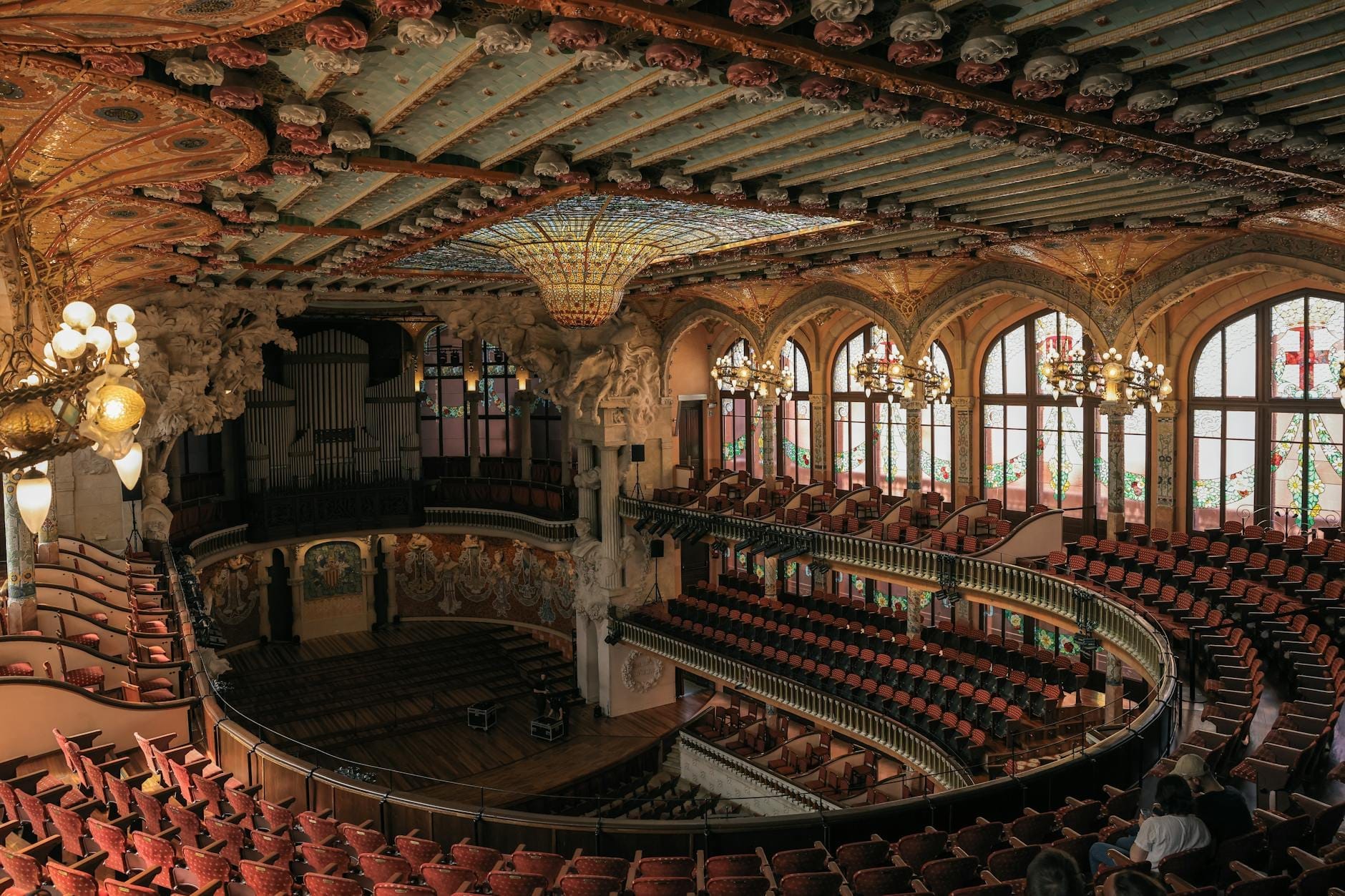
What the Palau de la Música Catalana Actually Is
The Palau de la Música Catalana is a working concert hall and a classified UNESCO World Heritage Site, completed in 1908. It was commissioned by the Orfeó Català, a choral society founded to promote Catalan cultural identity through music, and designed by architect Lluís Domènech i Montaner. It remains one of the finest examples of Catalan Modernisme anywhere in the world — a movement that ran parallel to Art Nouveau but drew more heavily on floral ornamentation, exposed brick, and the integration of mosaic, stained glass, and sculpture into structural elements.
Unlike the Sagrada Família or Casa Batlló, which attract colossal visitor numbers as pure tourist attractions, the Palau still functions primarily as a concert venue. Every element of the building was designed to serve both beauty and acoustics. The main hall seats around 2,000 people. That combination of civic purpose and visual excess is what makes it singular: this is a place that takes music seriously and dresses accordingly.
💡 Local tip
Book your guided tour or concert ticket well in advance, especially between April and October. The morning tours tend to be quieter and better lit — natural light floods the main hall at its best before midday.
The Architecture: What You're Actually Looking At
The exterior announces itself before you're ready. The facade on Carrer Sant Pere Més Alt is covered in ceramic mosaics, arched windows, and an allegorical sculptural group representing Catalan popular song. Exposed red brick sits alongside polychrome tile work in a combination that shouldn't work but absolutely does. The building was constructed on a tight urban plot, and Domènech i Montaner's solution to the constraints was to push decoration outward in every direction.
The entrance foyer sets the tone: columns wrapped in floral ceramics, vaulted ceilings, and a staircase that feels ceremonial even when empty. Then comes the concert hall itself, which is the reason to come. The ceiling is a massive stained-glass inverted dome, backlit by natural light, in shades of amber, gold, and deep blue. The walls are glass, not stone. Domènech i Montaner built the hall to be flooded with daylight rather than enclosed from it — a radical move for its era. During a daytime tour, the effect is close to overwhelming.
On the stage, a sculptural proscenium arch frames busts of Bach, Beethoven, and Wagner on one side, and Catalan folk music figures on the other. The balconies are supported by columns wrapped in mosaics of female musicians. Every surface carries meaning. It takes time to absorb it all, and most visitors need to pause and simply stand still for a few minutes after entering.
If you're building context before your visit, the Gaudí Barcelona guide gives useful background on Catalan Modernisme as a whole, including how Domènech i Montaner fits alongside Gaudí and Puig i Cadafalch in the movement's legacy.
Tickets & tours
Live prices and dates from our booking partner. If you book, we may earn a commission at no extra cost to you.
Visiting by Day: The Guided Tour Experience
Guided tours run daily and typically last around one hour. The route takes you through the foyer, the concert hall, and several ancillary spaces including the rehearsal room and the Lluís Millet Hall, a smaller reception space with horseshoe arches and more of the building's ornamental detail. Guides explain the historical context, the building's relationship to Catalan cultural politics, and the technical decisions behind the acoustics.
Tours operate in multiple languages. The morning slots, particularly those between 9 and 11am, are noticeably less crowded and benefit from the strongest natural light in the main hall. By midday, group tours from larger agencies tend to converge, and the hall becomes noisier and harder to photograph without other visitors in frame.
Photography is permitted during guided tours. The stained-glass dome and the mosaic columns are the most compelling subjects, but the challenge is exposure: the contrast between the bright ceiling and the darker lower hall is significant. If photography matters to you, a morning visit with a camera that handles high dynamic range well will produce far better results than an afternoon slot on a smartphone.
ℹ️ Good to know
The Palau sits in the Sant Pere district within the broader El Born area. It's a short walk from the Basílica de Santa Maria del Mar and the El Born Cultural Centre, making it easy to combine all three in a single half-day itinerary.
Attending a Concert: A Different Order of Experience
For visitors who can align their trip with a performance, attending a concert at the Palau de la Música Catalana elevates the experience entirely. The building was designed to be heard as much as seen, and the acoustics in the main hall are exceptional. The program ranges from classical orchestral performances and chamber music to flamenco, jazz, and choral concerts. The Orfeó Català, the choir for whom the building was created, still performs here regularly.
Evening concerts change the atmosphere completely. The stained-glass dome, which glows with natural light during the day, is lit artificially at night, and the effect is more theatrical and less ethereal. The audience is local as much as tourist. Dress codes are relaxed by international concert hall standards, but most attendees dress smartly.
Check the performance calendar on the official website well ahead of your travel dates. For a broader picture of evening options across the city, the Barcelona at night guide covers the full range from opera to late-night options across different neighborhoods.
Historical Context: Why This Building Exists
The Palau was not built for a state institution or a wealthy private patron in the conventional sense. It was built by a civil society organization, the Orfeó Català, as a statement of Catalan cultural identity at a moment when that identity was politically contested. The late 19th and early 20th centuries saw a cultural and nationalist revival in Catalonia known as the Renaixença, and music was central to that project. The building is therefore not just architecture: it is a political and cultural document in brick and glass.
Domènech i Montaner completed the structure in 1908, with the building inaugurated on 9 February 1908. UNESCO added it to the World Heritage List in 1997, alongside the Hospital de Sant Pau, another of the architect's major Barcelona works. The Palau underwent significant restoration in the late 20th century and an extension was added in 2003, designed by Oscar Tusquets Blanca, which added a new rehearsal space and improved access without compromising the historic building's integrity.
The Hospital de Sant Pau is the other Domènech i Montaner UNESCO site in Barcelona. It's located in the Eixample district and takes around 30 minutes to reach by metro, making it a logical second stop for anyone interested in the architect's work.
Getting There and Practical Logistics
The Palau is located in the Sant Pere district, at the northern edge of the El Born neighborhood in Ciutat Vella. The nearest metro stations are Urquinaona on Line 1 (L1, red line) and Jaume I on Line 4 (L4, yellow line). Both are roughly a 5 to 10-minute walk. From Jaume I, you pass through the heart of El Born, which is worth the slightly longer route. From Urquinaona, the walk is shorter but less interesting.
The main public entrance is via a small plaza, completed in 1989, which opened up the building's facade after decades of being partially obscured by surrounding structures. The plaza gives you the best unobstructed view of the exterior before entering. There is no significant slope or staircase at the main entrance, though the building's interior involves stairs to upper levels. For detailed accessibility information, contact the venue directly before visiting.
The surrounding El Born neighborhood is one of the most walkable and rewarding areas in the city. The El Born neighborhood guide covers the area's galleries, independent restaurants, and medieval street layout in detail.
⚠️ What to skip
The Palau is a functioning concert hall, and parts of the building may be inaccessible during rehearsals or event setup. If you have a specific space or view in mind, confirm availability when booking your tour.
Who Should Skip the Guided Tour
If you have no particular interest in architecture or Catalan cultural history, the guided tour may feel slow. The building's interior is extraordinary, but a one-hour structured visit with a group is a specific format that doesn't suit every traveler. Those traveling with young children may find the combination of fragile surroundings, enforced quiet, and limited physical movement difficult to manage.
If budget is a constraint, attending a lower-cost or subsidized concert offers better value than the tour alone. You get more time inside the building, in the environment it was designed for, at comparable or lower cost. Check the official site for any open rehearsals or reduced-price performances, which are occasionally available.
Insider Tips
- Book the first tour slot of the day. The hall is emptier, staff are less rushed, and the stained-glass dome catches the morning light at its most vivid.
- The Lluís Millet Hall on the first floor is often overlooked by visitors focused on the main concert hall. Its carved columns and ceramic detail are worth the extra five minutes.
- If you're visiting El Born anyway, walk past the exterior in the evening even if you don't have tickets. The facade is lit and the plaza is quiet after the day-tour crowds have gone.
- The gift shop sells a well-produced architectural guide to the building that is more detailed than anything available online. It's worth purchasing if you want context beyond the tour.
- Concerts listed as 'Petit Palau' take place in the smaller rehearsal hall rather than the main concert hall. Both spaces are architecturally interesting, but they are different experiences. Check which venue applies to your ticket before attending.
Who Is Palau de la Música Catalana For?
- Architecture enthusiasts interested in Catalan Modernisme and the work of Lluís Domènech i Montaner
- Classical music and choral music fans who want to hear a performance in an acoustically exceptional setting
- Photographers looking for interior stained glass and mosaic detail not found anywhere else in Barcelona
- Travelers interested in Catalan cultural history and the political context of the Renaixença
- Anyone combining El Born's main attractions into a single half-day cultural itinerary
Nearby Attractions
Other things to see while in El Born (Sant Pere):
- Arc de Triomf
Built as the ceremonial entrance to Barcelona's 1888 Universal Exhibition, the Arc de Triomf stands at the top of a wide pedestrian promenade leading to Parc de la Ciutadella. It's free, always accessible, and one of the few grand monuments in the city where you can simply stop and look without queuing or paying.
- Barcelona Zoo
Occupying over 14 hectares inside the historic Parc de la Ciutadella, Barcelona Zoo is one of Europe's oldest urban zoos, open since 1892. It balances conservation work with family-friendly programming, though the setting inside a 19th-century park gives it a character quite different from modern safari-style zoos.
- Basilica of Santa Maria del Mar
Built entirely between 1329 and 1383, the Basílica de Santa Maria del Mar stands as the finest example of Catalan Gothic architecture in existence. Funded and constructed by the waterfront workers of the Ribera district, it carries a human story that its stone geometry quietly amplifies. Fewer crowds, better proportions, and a profound atmosphere make it one of the most rewarding stops in Barcelona.
- Cascada Monumental
The Cascada Monumental is a sweeping neoclassical waterfall fountain inside Parc de la Ciutadella, designed in 1875 by Josep Fontserè and partially shaped by a young Antoni Gaudí. Free to visit and open daily, it rewards early morning visitors with calm light and empty paths, and makes for a striking photography subject at any hour.
Planning a trip? Discover personalized activities with the Nomado app.