Barcelona Cathedral (La Seu): The Gothic Quarter's Ancient Heart
The Cathedral of the Holy Cross and Saint Eulalia, known locally as La Seu, is the medieval backbone of Barcelona's Gothic Quarter. Built over seven centuries on Roman foundations, it combines soaring Gothic architecture, a tranquil cloister, and the crypt of Barcelona's patron saint into one of the city's most historically layered sites.
Quick Facts
- Location
- Pla de la Seu, 3, Barri Gòtic, Barcelona
- Getting There
- Metro: Jaume I (L4) or Liceu (L3), both under 10 min walk
- Time Needed
- 45 minutes to 1.5 hours depending on depth of visit
- Cost
- Free entry at certain hours; paid access to choir, rooftop, and crypt at others. Check catedralbcn.org for current rates.
- Best for
- Medieval history, Gothic architecture, quiet contemplation, photography
- Official website
- catedralbcn.org
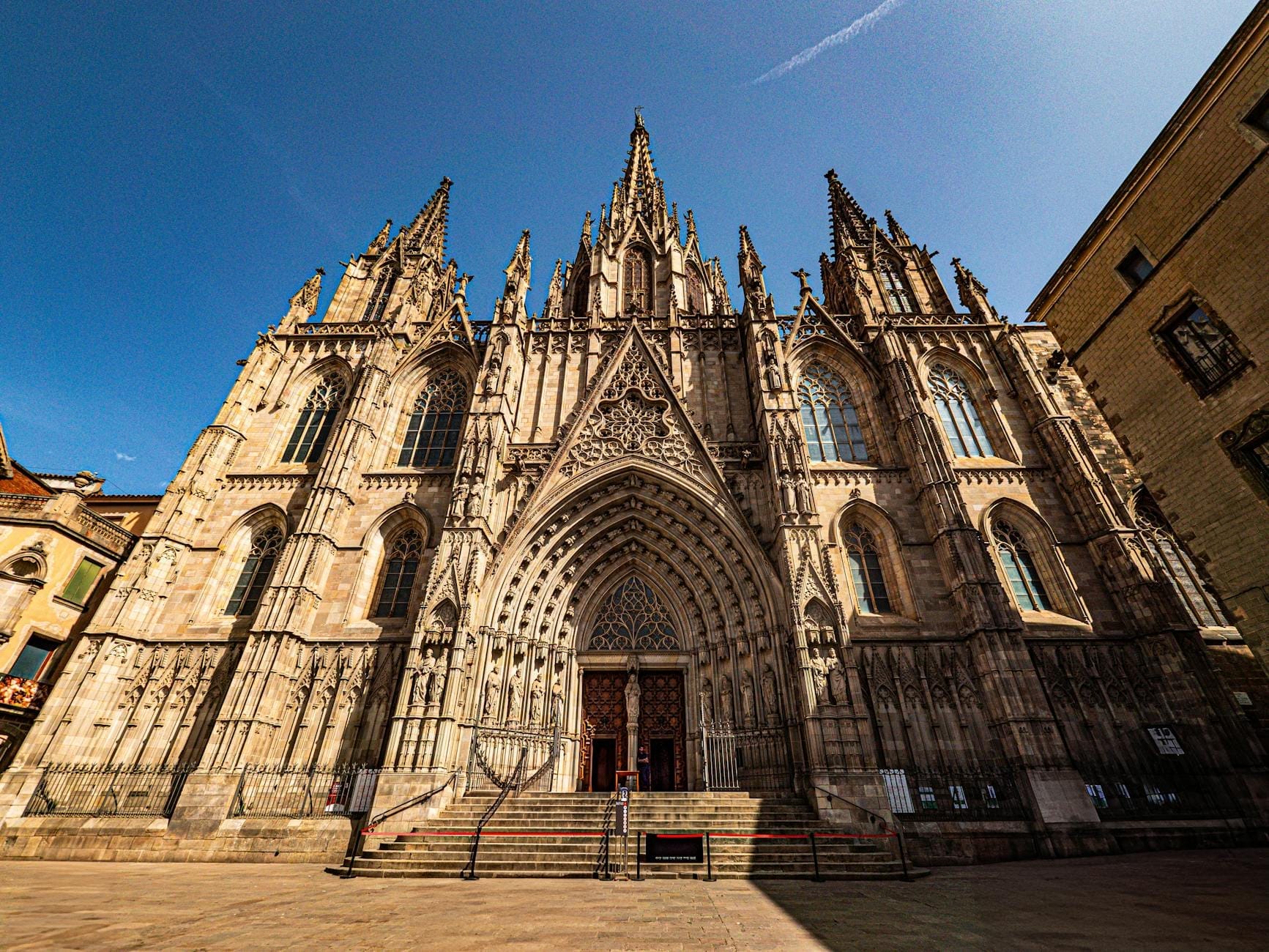
What You're Actually Looking At
The Barcelona Cathedral, officially the Catedral de la Santa Creu i Santa Eulàlia (Cathedral of the Holy Cross and Saint Eulalia), rises above the tangle of narrow medieval lanes in the Gothic Quarter with an authority that no photograph quite prepares you for. Locals call it La Seu, a Catalan term meaning 'the seat,' a reference to its status as the seat of the Archbishop of Barcelona. That distinction matters: this is not a ceremonial showpiece built for tourists. It is a functioning cathedral with daily services, a resident canonry, and over seven centuries of continuous religious life embedded in its stone.
Construction on the current Gothic structure began on May 1, 1298, though the ground it stands on has held Christian worship since at least the 4th century. A Roman basilica stood here first, followed by a Romanesque cathedral consecrated in 1058. The Gothic rebuilding took roughly 150 years, with the cloister finished in 1448. The neo-Gothic facade you see from the square, with its ornate pinnacles and rose window, was completed only in 1913, giving the building a slightly deceptive appearance of uniformity that dissolves the moment you start examining the layers up close.
💡 Local tip
Arrive before 9 AM on a weekday to walk the nave in near-silence. The quality of early morning light through the stained glass is exceptional, and the space feels genuinely contemplative before tour groups begin arriving around 10 AM.
The Architecture: Five Aisles and 700 Years of Decisions
The interior is structured around five aisles in a pseudo-basilica vaulted arrangement, with the outer two aisles subdivided into chapels. The central nave reaches 28 meters at its vault, flanked by bell towers that climb to 54 meters each. The cimborio, the octagonal lantern tower above the crossing, rises to 70 meters at its peak. These numbers matter less than the spatial experience: the nave feels tall and narrow in the distinctly Catalan Gothic tradition, designed to create vertical compression rather than the horizontal breadth you find in French Gothic cathedrals.
The chapels along both aisles hold centuries of accumulated devotional art: altarpieces, reliquaries, and funerary monuments in varying states of scholarly attention. Some are masterworks; others are modest. The Chapel of the Holy Sacrament, in the ambulatory behind the high altar, warrants particular attention for its altar frontal. If you move through the cathedral methodically rather than heading straight for the cloister, you will find details that most visitors walk past entirely.
The choir stalls in the center of the nave are among the finest late-medieval woodwork in Catalonia, carved with intricate figures and topped with the painted shields of the knights of the Order of the Golden Fleece, whose chapter met here in 1519. The placement of the choir in the center of the nave rather than behind the altar is a medieval convention that Barcelona preserves, and it creates an unusual spatial dynamic that forces visitors to navigate around it.
Tickets & tours
Live prices and dates from our booking partner. If you book, we may earn a commission at no extra cost to you.
The Crypt and Saint Eulalia
Descend the stairs beneath the high altar and you reach the crypt where Barcelona's co-patron saint rests. Saint Eulalia, a young Christian martyr executed by Roman authorities in the early 4th century, is entombed in a polychromed marble sarcophagus created by a Pisan sculptor and inaugurated in 1339. The crypt is small, softly lit by candles and votive lamps, and often has a handful of worshippers rather than the shuffling crowds upstairs.
Eulalia's legend is woven deeply into the city's identity. According to hagiographic accounts, she endured thirteen tortures before her death, and the thirteen white geese kept in the cloister are traditionally said to represent her age at martyrdom. Whether that legend is historically accurate is secondary to its cultural persistence: the geese have been here for centuries, and they remain one of the most quietly strange features of any cathedral in Europe.
The Cloister: Geese, Gardens, and Unexpected Calm
The cloister is entered from inside the cathedral and is, for many visitors, the most memorable part of the visit. Completed in 1448, it encloses a garden courtyard with magnolia trees, palm trees, and a central fountain known as the Font de les Oques (Fountain of the Geese). Thirteen white geese live here year-round, moving between the pond and the shaded walkways with a proprietary air. The sound is distinctive: soft water, birdsong from the garden canopy, and the occasional honk of a goose echoing off Gothic arcades.
The cloister arcade is lined with small chapels, each dedicated to guild patrons in the medieval tradition. The chapel of Sant Jordi (Saint George), patron of Catalonia, is among the most frequently visited. The overall atmosphere is closer to a monastery garden than a cathedral annex, and on weekday mornings especially, it provides a genuine counterpoint to the noise of the Gothic Quarter's streets just beyond the walls.
ℹ️ Good to know
The cloister has a small museum room accessible from the arcade containing medieval religious artifacts, including an altarpiece attributed to the Catalan painter Bernat Martorell. It is easy to miss but worth five minutes of attention.
How the Experience Changes by Time of Day
Early morning, before 9 AM, the plaza in front of the cathedral is quiet enough that you can hear your own footsteps on the stone. The facade catches the low eastern light in a way that emphasizes the carved detail around the portal. This is the best time for exterior photography without crowds or vendor stalls in frame.
Midday brings the highest foot traffic. Tour groups arrive in rotation from Las Ramblas and the broader Gothic Quarter circuit. The nave becomes a slow-moving stream of visitors, and the cloister can feel more zoo than sanctuary. If you are visiting between noon and 3 PM, adjust expectations accordingly. The cathedral remains impressive, but the contemplative quality evaporates.
Late afternoon, from around 4 PM onward, the light shifts to a warmer tone and the groups thin out. Evening mass creates a natural boundary that clears the nave entirely. The plaza itself becomes a gathering point for locals in the early evening, and the illuminated facade after dark is genuinely striking, though the interior is closed to tourists at that point.
The surrounding streets of the Gothic Quarter Gothic Quarter reward exploration before or after your cathedral visit. The Roman walls and temple fragments visible nearby add archaeological context to what you have just seen inside the building.
Getting There and Practical Logistics
The cathedral is located at Pla de la Seu, 3, in the Barri Gòtic district of Ciutat Vella. The most convenient metro stop is Jaume I on Line 4 (yellow), a short walk through the medieval lanes. Liceu on Line 3 (green) is a slightly longer walk but deposits you near Las Ramblas if you are combining visits. Buses also serve the area, though the narrow streets of the Gothic Quarter make walking faster than any vehicle for the final approach.
Access arrangements can change: some entry zones are free during certain hours, while the choir, rooftop elevator, and crypt areas may require a paid ticket at other times. Rooftop access provides views across the Gothic Quarter's roofline toward the sea, a perspective that rewards the modest additional fee. Verify current hours and pricing at catedralbcn.org or by calling +34 933 428 260 before your visit, as schedules shift around religious holidays and cathedral events.
⚠️ What to skip
Religious services take priority over tourist access at all times. Visiting during a mass or service means reduced access to parts of the interior and an expectation of silence and respectful behavior. Dress code is enforced: shoulders and knees must be covered. Scarves available to borrow at the entrance in some cases, but bring your own to be safe.
If you are building a full day in the medieval center, the nearby Basilica of Santa Maria del Mar in El Born makes a natural companion visit. Built slightly later than the cathedral and in a purer Catalan Gothic style, it offers a useful architectural comparison and is typically less crowded.
Honest Assessment: Is It Worth Your Time?
Barcelona Cathedral is frequently overshadowed in travel conversations by Gaudí's work, and that comparison is worth addressing directly. If you are visiting Barcelona primarily for Modernisme architecture, the cathedral may feel like a detour from your main thread of interest. It will not compete for sheer spectacle with the Sagrada Família.
What it offers instead is depth of a different kind: genuine medieval atmosphere, a continuous history stretching back to Roman Barcelona, and a scale that the human eye can fully comprehend. For travelers interested in pre-modern European history, religious architecture, or the texture of everyday Barcelona life beyond the Gaudí circuit, La Seu is irreplaceable. It also connects naturally to the El Born Centre de Cultura i Memòria and the broader archaeological layers visible throughout the Gothic Quarter.
Travelers with very limited time who have already prioritized the Sagrada Família and one or two other major sites might give the cathedral a shorter visit: 30 focused minutes covering the nave, crypt, and cloister is enough to understand why it matters. Those with a genuine interest in medieval architecture should allow at least 90 minutes.
For context on fitting this into a broader itinerary, see the Barcelona itinerary guide which maps out logical routes through the historic center without doubling back.
Insider Tips
- The rooftop elevator access, when available for a separate fee, delivers views of the Gothic Quarter that most visitors never see. The gargoyles and pinnacles at close range are architecturally fascinating and far less crowded than the Sagrada Família's towers.
- Weekday mornings between 8:30 and 9:30 AM are the single best window for an uncrowded visit. By 10 AM, guided tour groups begin arriving in volume.
- The small museum room off the cloister arcade holds Bernat Martorell's altarpiece, one of the finest pieces of 15th-century Catalan painting in the city. It receives almost no attention despite being steps from the main tourist flow.
- On La Mercè (around September 24), the cathedral plaza hosts traditional Catalan celebrations including human towers (castellers) and fire-running (correfoc). The building itself serves as a backdrop for some of the year's most atmospheric city festivities.
- If you want to hear the cathedral organ during a service rather than just viewing the instrument, check the weekly mass schedule on the official website. Sunday morning high mass typically features full organ accompaniment and is open to respectful visitors who observe silence.
Who Is Barcelona Cathedral For?
- Travelers interested in medieval European history and Gothic architecture beyond Modernisme
- Photography enthusiasts seeking dramatic stone interiors and early-morning facade shots
- Visitors who want to understand Barcelona's pre-Gaudí identity and Roman-to-medieval continuity
- Those looking for a quiet, contemplative space within walking distance of Las Ramblas
- Families with older children interested in history, saints' legends, and the peculiarity of cathedral geese
Nearby Attractions
Other things to see while in Gothic Quarter (Barri Gòtic):
- Basilica of Santa Maria del Pi
Standing at the heart of the Gothic Quarter since the 14th century, the Basilica of Santa Maria del Pi is one of Barcelona's finest examples of Catalan Gothic architecture. Its 10-metre rose window, austere single nave, and sun-dappled plaza make it a genuine counterweight to the city's more crowded landmarks.
- Carrer del Bisbe
Carrer del Bisbe is a narrow medieval street in Barcelona's Gothic Quarter connecting the Barcelona Cathedral to Plaça Sant Jaume. Its centerpiece is the Pont del Bisbe, a dramatic neo-Gothic covered bridge built in 1928 that spans the street between two government buildings. Free to walk through at any hour, it rewards visitors who linger beyond the first glance.
- Plaça Reial
Tucked just off La Rambla in the Gothic Quarter, Plaça Reial is a grand neoclassical square ringed by arcaded buildings, palm trees, and restaurants. Free to enter at any hour, it shifts from a relaxed morning coffee spot to one of the city's most atmospheric nightlife hubs after dark.
Planning a trip? Discover personalized activities with the Nomado app.