Carrer del Bisbe: Barcelona's Most Photogenic Gothic Quarter Street
Carrer del Bisbe is a narrow medieval street in Barcelona's Gothic Quarter connecting the Barcelona Cathedral to Plaça Sant Jaume. Its centerpiece is the Pont del Bisbe, a dramatic neo-Gothic covered bridge built in 1928 that spans the street between two government buildings. Free to walk through at any hour, it rewards visitors who linger beyond the first glance.
Quick Facts
- Location
- Carrer del Bisbe, 08002 Barcelona – Gothic Quarter, between Barcelona Cathedral (Plaça Nova) and Plaça Sant Jaume
- Getting There
- Metro L3 – Liceu or L4 – Jaume I (5-min walk)
- Time Needed
- 15–30 minutes to walk and photograph; longer if combined with nearby sights
- Cost
- Free – open public street, no admission
- Best for
- Architecture lovers, photographers, history walkers, evening strollers
What Is Carrer del Bisbe?
Carrer del Bisbe – Bishop's Street in English – is one of the most historically loaded streets in the Gothic Quarter. It runs roughly north to south, linking the open square in front of the Barcelona Cathedral at one end to the political heart of the city at Plaça Sant Jaume at the other. In between, it passes beneath a soaring neo-Gothic bridge that most visitors mistake for something genuinely medieval. It is not, which is part of what makes it so interesting.
The street sits inside the Gothic Quarter, a district whose narrow lanes follow the layout of ancient Roman Barcino. Walking Carrer del Bisbe from end to end takes under five minutes at a stroll. But the compressed scale of the space, the carved stone overhead, and the constant interplay of light and shadow are worth far more than a hurried passage.
💡 Local tip
Approach from the Plaça Nova end (near the Cathedral) heading south toward Plaça Sant Jaume. This direction gives you the best frontal view of the Pont del Bisbe as you walk toward it.
The Pont del Bisbe: What You're Actually Looking At
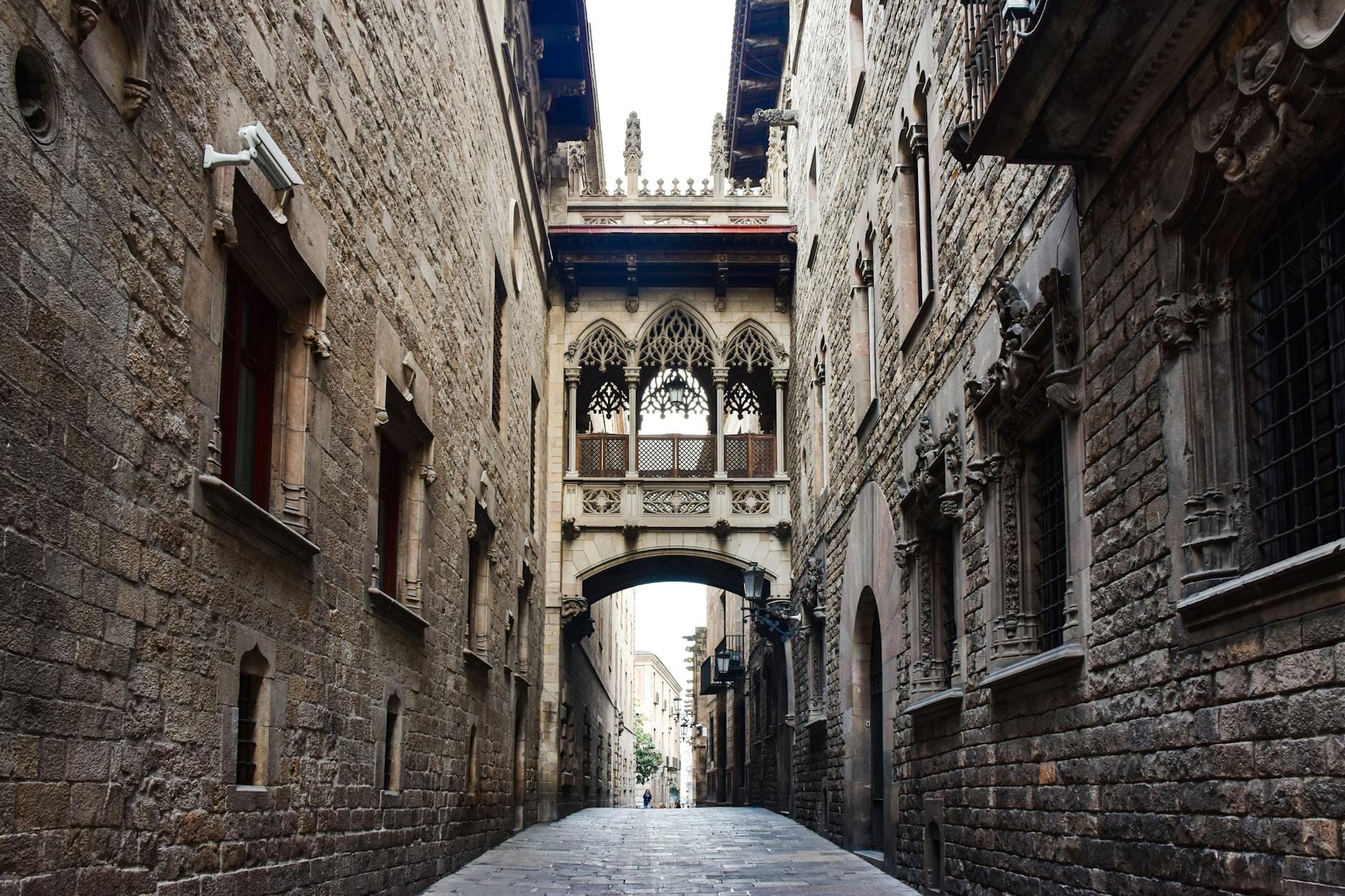
The undeniable focal point of Carrer del Bisbe is the Pont del Bisbe, a covered neo-Gothic walkway that arches dramatically between two stone buildings above the street. It was designed in 1928 by architect Joan Rubió i Bellver, a close associate of Antoni Gaudí, and built in 1928 ahead of the 1929 Barcelona International Exposition. The bridge connects the Casa dels Canonges, the official residence of the President of the Generalitat de Catalunya, with the Palau de la Generalitat, the seat of Catalonia's regional government.
Rubió i Bellver gave the bridge the visual language of the Gothic style: pointed arches, intricate stone tracery, and a carved skull with a serpent at its center keystone. This skull detail has attracted several local legends, the most persistent being that the architect hid it as a protest against being forced to demolish an older medieval gallery to build the bridge. No primary sources confirm this story, but the skull is very much real and worth looking for.
The bridge is not open to the public. It functions as a working government passage between two active official buildings. You can photograph it from below on the street, and on clear days the carved detail reads clearly from ground level. Bring a lens that can compress the narrow street or a phone that handles tight framing well. The arch spans the street at roughly three stories up.
ℹ️ Good to know
The neo-Gothic bridge was built in 1928 – it is not a medieval original. Rubió i Bellver designed it to blend with the surrounding historic architecture, and it succeeds convincingly.
Tickets & tours
Live prices and dates from our booking partner. If you book, we may earn a commission at no extra cost to you.
Santa Maria del Mar Guided Tour Through the Interior and Terraces
From 19 €Instant confirmationFree cancellationBarcelona Highlights tour
From 50 €Instant confirmationFree cancellationBohemian neighbourhoods eBike tour
From 40 €Instant confirmationFree cancellationGaudi highlights eBike tour
From 40 €Instant confirmationFree cancellation
How the Street Changes Through the Day
In the early morning, before 9am, Carrer del Bisbe belongs almost entirely to locals heading to work and delivery workers restocking nearby shops. The stone pavement, damp with overnight humidity in cooler months, reflects what little light filters between the buildings. This is the quietest window for photography: no tour groups, no traffic, and the carved detail on the bridge catches the low-angle light sharply.
By mid-morning, the street fills steadily. Tour groups arriving from the Cathedral or from Plaça de Catalunya tend to move through in short bursts, clustered around guides, pausing briefly at the bridge and then moving on. From late morning through late afternoon, expect to share the street with dozens of other visitors at any given moment. The street is narrow enough that even moderate foot traffic creates a sense of crowding.
Evening is the most rewarding time to visit. After 7pm in summer and after 6pm in winter, the tour groups have largely dispersed. The Gothic Quarter's stone walls hold the warmth of the day even as the light turns golden and then fades. Small restaurants along the adjacent lanes fill up, and the ambient noise shifts from tourist chatter to the lower register of people actually eating dinner. The bridge is subtly lit at night, and the stone carvings take on a different quality under artificial light – sharper shadows, more texture.
The Street's Medieval Roots and Political Geography
Carrer del Bisbe has functioned as a key artery in Barcelona's urban core for centuries. The street's alignment follows the street grid of Roman Barcino, though the current fabric of buildings dates mostly from medieval and early modern periods. At its southern end, Plaça Sant Jaume has been the civic center of Barcelona since at least the Roman era, when the forum occupied the same ground. Today it holds both the Generalitat and the Ajuntament (City Hall), facing each other across the square.
At the northern end, Plaça Nova opens onto the front of the Barcelona Cathedral, a Gothic masterpiece built between the 13th and 15th centuries on the site of an early Christian basilica. The Cathedral's cloisters, visible through iron gates, contain a small pond with white geese that have been kept there by tradition for centuries. Walking Carrer del Bisbe connects these two poles of medieval Barcelona – the ecclesiastical north and the civic south – in about 150 meters.
Practical Walkthrough: How to Visit
There is nothing to book, no ticket to buy, and no opening hours to check. Carrer del Bisbe is a public street and is accessible at any time. The simplest approach is to combine it with a walk around the Gothic Quarter that takes in the Cathedral, Plaça Sant Jaume, and the narrower lanes branching off both.
From Metro Jaume I (Line 4), walk west along Carrer de la Argenteria, turn right at El Born, cross Via Laietana, and you enter the Gothic Quarter. Alternatively, from Metro Liceu (Line 3), walk east through the Plaça Reial area and approach from Plaça Sant Jaume. From Las Ramblas, Carrer Ferran provides a direct east-west route into Plaça Sant Jaume, where you can pick up Carrer del Bisbe heading north.
The cobblestones are uneven. Flat-soled shoes handle them better than heels. The street has no curbs to speak of, and in wet weather some sections collect water in small hollows. There are no public restrooms on the street itself; the nearest facilities are inside the Cathedral (accessible during visiting hours) or at the cafes on Plaça Sant Jaume.
⚠️ What to skip
Pickpocketing is a known issue in the Gothic Quarter, particularly in areas with tourists stopping to look up at architectural features. Keep bags in front of you when stopping to photograph the bridge.
What Surrounds It: Extending Your Visit
Carrer del Bisbe on its own is a short stop. Its value multiplies when treated as part of a broader Gothic Quarter walk. The Basilica de Santa Maria del Pi is a 10-minute walk away, and its facade square is one of the quieter spots in the area. The Roman columns of the Temple of Augustus – embedded inside a medieval courtyard off Carrer del Paradís – are another two-minute detour that most visitors walk straight past.
For a longer exploration, the El Born neighborhood is directly east of the Gothic Quarter and offers a complementary mix of medieval architecture, independent shops, and the excellent El Born Cultural Centre. If you are navigating the wider area for the first time, a clear sense of how these neighborhoods connect will save significant time.
Visitors who want very little foot traffic and a more contemplative pace should avoid July and August peak midday hours. The street is narrow enough that it can feel claustrophobic when crowded. If you are visiting in summer, the early morning window before 9am is not an exaggeration as advice. It genuinely transforms the experience.
Photography Notes
The bridge is the obvious subject, but the street as a whole frames well. Stand at the Cathedral end and shoot south: the bridge forms a mid-frame element, with the lane narrowing to a vanishing point at Plaça Sant Jaume beyond. At night, the stone glows warmly under the street lamps and the bridge becomes almost theatrical. A tripod is impractical given foot traffic, but any modern camera with a stabilized lens handles the low light reasonably well at higher ISO.
Wide-angle lenses exaggerate the narrowness of the street in ways that are compelling but somewhat misleading about scale. A moderate focal length in the 35–50mm range gives a more accurate sense of how the space actually feels. Morning blue-hour light, in the 20 minutes before sunrise, produces flat even illumination that renders the carved stone detail without harsh contrast.
Insider Tips
- Look for the carved skull with a serpent at the keystone of the Pont del Bisbe arch. It is easy to miss if you are not actively searching for it. Stand directly beneath the bridge and look up.
- The gate on the eastern side of Carrer del Bisbe, leading into the courtyard of the Palau de la Generalitat, is occasionally open on Catalan public holidays when the building runs guided open-day visits. Check the Generalitat's official website before your trip if you are visiting around those dates.
- Adjacent to the Cathedral entrance on Plaça Nova, a small antiques and artisan market runs on Thursday mornings. Combining it with a Carrer del Bisbe visit makes for a productive morning in the Gothic Quarter.
- The nougat shop Vicens 1775, near the Cathedral end of the street, is one of the oldest confectionery brands in Catalonia. Their turron makes a more interesting and genuinely local purchase than anything sold in the souvenir shops on Las Ramblas.
- If you are here on a Sunday morning, the area around Plaça Nova attracts Sardana dancers – a traditional Catalan circle dance – in an informal gathering. Timing varies and it is not guaranteed, but worth knowing.
Who Is Carrer del Bisbe For?
- Architecture enthusiasts who want to understand the difference between genuine Gothic and neo-Gothic revival styles
- Photographers looking for a dramatically framed medieval street that is accessible at all hours
- Walkers building a self-guided Gothic Quarter itinerary who want historical context beyond the Cathedral
- Travelers visiting Barcelona with limited time who need high-impact sights that require no booking or admission
- Evening strollers who want a quieter stretch of the Gothic Quarter after the day-tour crowds have cleared
Nearby Attractions
Other things to see while in Gothic Quarter (Barri Gòtic):
- Barcelona Cathedral
The Cathedral of the Holy Cross and Saint Eulalia, known locally as La Seu, is the medieval backbone of Barcelona's Gothic Quarter. Built over seven centuries on Roman foundations, it combines soaring Gothic architecture, a tranquil cloister, and the crypt of Barcelona's patron saint into one of the city's most historically layered sites.
- Basilica of Santa Maria del Pi
Standing at the heart of the Gothic Quarter since the 14th century, the Basilica of Santa Maria del Pi is one of Barcelona's finest examples of Catalan Gothic architecture. Its 10-metre rose window, austere single nave, and sun-dappled plaza make it a genuine counterweight to the city's more crowded landmarks.
- Plaça Reial
Tucked just off La Rambla in the Gothic Quarter, Plaça Reial is a grand neoclassical square ringed by arcaded buildings, palm trees, and restaurants. Free to enter at any hour, it shifts from a relaxed morning coffee spot to one of the city's most atmospheric nightlife hubs after dark.
Planning a trip? Discover personalized activities with the Nomado app.