Basilica of Santa Maria del Pi: Barcelona's Quiet Gothic Masterpiece
Standing at the heart of the Gothic Quarter since the 14th century, the Basilica of Santa Maria del Pi is one of Barcelona's finest examples of Catalan Gothic architecture. Its 10-metre rose window, austere single nave, and sun-dappled plaza make it a genuine counterweight to the city's more crowded landmarks.
Quick Facts
- Location
- Plaça del Pi, 7, 08002 Barcelona (Gothic Quarter)
- Getting There
- Metro L3 Liceu or L4 Jaume I (5–10 min walk)
- Time Needed
- 30–60 minutes for the church; 1.5–2 hours with bell tower and museum
- Cost
- Free entry to main church; paid access to bell tower, treasury, crypt, and museum (exact prices vary — check on site)
- Best for
- Architecture lovers, medieval history, quiet moments away from La Rambla crowds
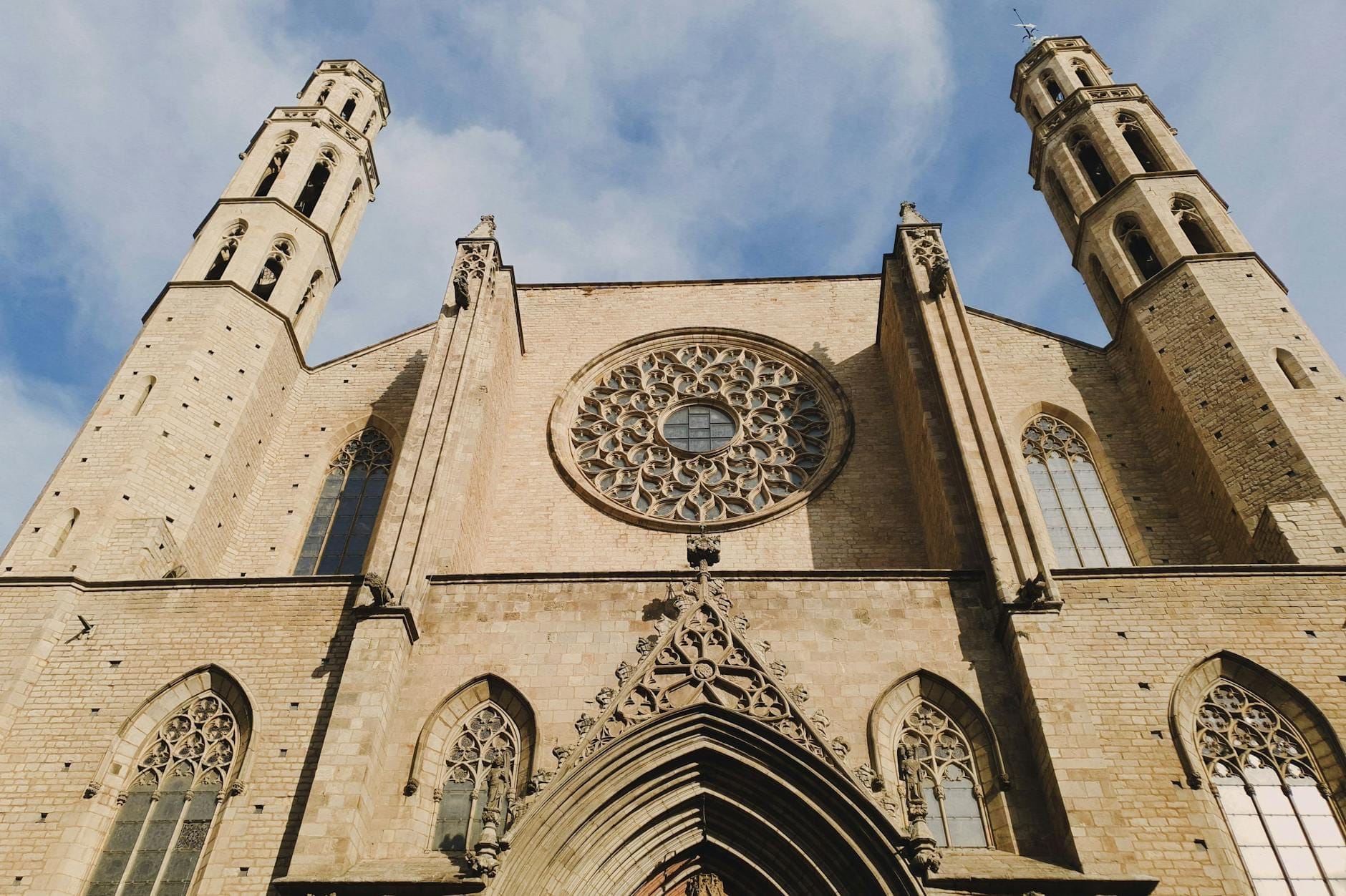
What Is the Basilica of Santa Maria del Pi?
The Basilica of Santa Maria del Pi (formally Església de Santa Maria del Pi in Catalan) is a 14th-century Gothic church occupying a handsome plaza in the heart of Barcelona's Gothic Quarter. Construction began in 1319 and stretched over seven decades, with the building consecrated in 1453. The name comes from the Catalan word for pine tree: records suggest a large pine once stood on this site before the church was built.
In a city where Gaudí's organic forms dominate the architectural conversation, Santa Maria del Pi offers something quietly different. It is rigorously medieval: thick stone walls, a single nave with side chapels, and an interior stripped of decorative excess. The effect is spatial rather than ornamental. You feel the weight of the stone and the height of the vault before you notice any detail.
The church sits between three connected plazas: Plaça del Pi, Plaça de Sant Josep Oriol, and Placeta del Pi. This triangular pocket of the Gothic Quarter is one of the more atmospheric corners in central Barcelona, ringed by cafés and small galleries, and largely free of the souvenir shop density that characterises nearby streets.
The Architecture: Scale, Restraint, and One Extraordinary Window
Catalan Gothic is a distinct regional style, and Santa Maria del Pi is one of its best-preserved examples. Unlike the French or English Gothic tradition, which pushes height through clustered piers and flying buttresses, Catalan Gothic emphasises width. The nave at Santa Maria del Pi is unusually broad for a single-aisle church, and the walls are solid enough to stand without external buttressing. The result is an interior that reads as one continuous, uninterrupted space.
The rose window on the west facade is the building's most discussed feature. At 10 metres in diameter, it is considered the largest in Catalonia. The current window is a modern reconstruction: the original was destroyed during the Spanish Civil War (1936-1939). The restored version follows the medieval design closely enough that its loss is not immediately obvious, but it is worth knowing that what you see today is a 20th-century copy rather than a 600-year-old original.
The bell tower rises 54 metres and contains six bells. It is accessible via a paid ticket, and the climb rewards visitors with rooftop views across the Gothic Quarter's tiled rooftops toward the harbour. The tower exterior, visible from the plaza below, has an almost fortress-like quality: wide at the base, minimally decorated, and built to last rather than to impress.
ℹ️ Good to know
The basilica received the title of Papal Minor Basilica in 1928, a designation that places it among a select group of churches with special liturgical privileges, distinct from cathedral status.
Tickets & tours
Live prices and dates from our booking partner. If you book, we may earn a commission at no extra cost to you.
Santa Maria del Mar Guided Tour Through the Interior and Terraces
From 19 €Instant confirmationFree cancellationPrivate Gothic tour with visit to Santa Maria del Mar
From 70 €Instant confirmationFree cancellationSanta Maria del Mar guided tour with terrace access and local treat
From 22 €Instant confirmationFree cancellationIdelfonso Falcones's Santa Maria del Mar guided tour
From 12 €Instant confirmationFree cancellation
Inside the Church: Light, Stone, and Silence
Entering through the main portal, the first thing that registers is the scale. The nave is wide and tall, and the absence of side aisles or columns means the eye travels uninterrupted to the apse. The floor is pale stone worn smooth by centuries of foot traffic. Chapels line the walls on both sides, each containing altarpieces in varying states of restoration.
Light enters primarily through the rose window and the lateral windows set high in the nave walls. In the late morning, when sunlight passes through the west-facing rose window, the light projects a wash of color across the interior floor. This is the best single visual moment the church offers, and it lasts roughly 30 to 45 minutes depending on the season. Visitors who arrive mid-morning on a clear day will catch it; those arriving after noon largely will not.
The interior is quieter than most major Gothic Quarter churches, partly because Santa Maria del Pi does not appear on every tour group itinerary, and partly because the plaza outside acts as a social gathering point, drawing casual visitors who never step inside. If you want genuine quiet, arrive at opening time (9:30 AM) on a weekday. The church is in active liturgical use, so masses are held regularly; schedules are posted at the entrance.
💡 Local tip
For the best light through the rose window, visit on a clear morning between 10:00 and 11:00 AM. The effect on an overcast day is considerably reduced.
The Plazas: Why You Should Stay Longer Than the Church Warrants
The three plazas surrounding the basilica function as a single extended public room. Plaça del Pi and Plaça de Sant Josep Oriol are paved in stone and edged with terraces that fill up by mid-morning. Locals use them as meeting points; artists occasionally set up easels here on weekends. The combination of café tables, the church facade, and the relatively human scale of the surrounding medieval buildings creates a sense of enclosure that the wider Gothic Quarter's narrow streets do not always provide.
On weekends, the plazas host small artisan markets focused on food products (Plaça del Pi) and art and crafts (Plaça de Sant Josep Oriol). The food market is particularly good for Catalan cheeses, honey, and local preserves. These markets attract locals as much as tourists, and the atmosphere is noticeably different from the commercial noise of La Rambla two blocks west.
The plazas connect naturally to a wider Gothic Quarter walk that can take in the Barcelona Cathedral to the north and the Plaça Reial to the south. Both are within 10 minutes on foot.
Paid Access: Bell Tower, Museum, Treasury, and Crypt
Beyond the free main church, a combined ticket provides access to the bell tower, museum, treasury, crypt, and garden. The museum covers the church's history through objects related to its liturgical life and the 1936 fire damage. The treasury holds ecclesiastical silverwork and vestments. None of these spaces are large or deeply immersive, but together they add context that the bare interior alone does not provide.
The bell tower climb is the most physically demanding element and the most visually rewarding. The staircase is narrow and steep, so anyone with mobility limitations should skip it. At the top, the view extends across rooftops that have changed little in outline since the medieval period, even if the interiors behind them have been modernised beyond recognition. The harbour is visible on a clear day.
⚠️ What to skip
Ticket prices for paid spaces are not listed on all external booking platforms. Check pricing directly at the church entrance or through Barcelona Turisme before budgeting your visit.
When to Visit and How to Get There
The church is open daily from 9:30 AM to 8:30 PM. There are no seasonal closures noted, though the church observes Catholic feast days with modified schedules. Weekday mornings between 9:30 and 11:00 AM offer the thinnest crowds and the best natural light. Weekend afternoons see the highest foot traffic, both inside the church and in the surrounding plazas.
By metro, the two closest stations are Liceu (Line 3, green) on La Rambla, a five-minute walk east through the Gothic Quarter streets, and Jaume I (Line 4, yellow), roughly the same distance from the other direction. Both walks pass through medieval street grids that are worth slowing down for rather than rushing through.
If you are already exploring Las Ramblas or the Palau Güell nearby, Santa Maria del Pi slots naturally into a half-day Gothic Quarter circuit without requiring a dedicated journey.
Comfortable shoes matter here. The Gothic Quarter's stone streets are uneven, and the interior floor is similarly irregular in places. Photography is generally permitted inside, but flash and tripods are discouraged during services. The space is dark enough that a phone camera will struggle without good natural light; visit in the morning for better results.
Who Might Not Find This Worth Their Time
If your primary interest in Barcelona's religious architecture is Gaudí's Sagrada Família, Santa Maria del Pi will feel almost aggressively different: plain, static, and without the theatrical biomechanical interior that makes the Sagrada Família unlike anything else. That contrast is precisely what makes it interesting to architecture enthusiasts, but visitors seeking spectacle may leave feeling the detour was unnecessary.
Families with young children may find the interior offers limited engagement beyond a brief look. The plazas, however, are child-friendly spaces with room to move. For a more structured family experience combining outdoor space and interactive elements, Parc de la Ciutadella nearby offers more variety.
Visitors on a first trip to Barcelona who are prioritising the major Gaudí sites and the waterfront may reasonably leave this for a second visit. It is not the city's most essential single attraction. What it is: one of the most convincing places in the city to understand what Barcelona looked and felt like before the 19th century remade it.
Insider Tips
- The artisan food market in Plaça del Pi typically runs on the first and third Friday, Saturday, and Sunday of each month. Timing your visit to coincide with it turns a church visit into a longer morning.
- The northwest corner of Plaça de Sant Josep Oriol offers the cleanest sightline to the church's rose window from outside. At dusk, the stone facade takes on a warm amber tone that is worth photographing even if the light inside is gone.
- If the church is hosting a mass or service when you arrive, wait 20 to 30 minutes rather than leaving. Services typically last under an hour, and the post-service quiet is the best time to explore the chapels without competition.
- The bell tower stairs are genuinely tight. Anyone carrying a large backpack should leave it with a companion or check if lockers are available at the entrance before attempting the climb.
- Santa Maria del Pi was badly damaged during the Spanish Civil War in 1936, when it was set on fire. Much of what you see today, including the rose window, has been restored. This context changes how you read the interior: its austerity is partly historical and partly the result of reconstruction.
Who Is Basilica of Santa Maria del Pi For?
- Architecture enthusiasts interested in Catalan Gothic as a distinct tradition separate from French or English Gothic
- Travellers wanting a quieter alternative to the Barcelona Cathedral on a Gothic Quarter walking route
- Photographers seeking natural-light interior shots in the morning hours
- Weekend visitors who can combine the church visit with the artisan markets in the surrounding plazas
- History-focused travellers who want to understand medieval Barcelona beyond its Roman-era remains
Nearby Attractions
Other things to see while in Gothic Quarter (Barri Gòtic):
- Barcelona Cathedral
The Cathedral of the Holy Cross and Saint Eulalia, known locally as La Seu, is the medieval backbone of Barcelona's Gothic Quarter. Built over seven centuries on Roman foundations, it combines soaring Gothic architecture, a tranquil cloister, and the crypt of Barcelona's patron saint into one of the city's most historically layered sites.
- Carrer del Bisbe
Carrer del Bisbe is a narrow medieval street in Barcelona's Gothic Quarter connecting the Barcelona Cathedral to Plaça Sant Jaume. Its centerpiece is the Pont del Bisbe, a dramatic neo-Gothic covered bridge built in 1928 that spans the street between two government buildings. Free to walk through at any hour, it rewards visitors who linger beyond the first glance.
- Plaça Reial
Tucked just off La Rambla in the Gothic Quarter, Plaça Reial is a grand neoclassical square ringed by arcaded buildings, palm trees, and restaurants. Free to enter at any hour, it shifts from a relaxed morning coffee spot to one of the city's most atmospheric nightlife hubs after dark.
Planning a trip? Discover personalized activities with the Nomado app.