Las Ramblas, Barcelona: The Complete Visitor Guide
Las Ramblas is Barcelona's most famous street, a 1.2 km tree-lined boulevard connecting Plaça de Catalunya to the waterfront. Free to walk, open around the clock, and flanked by markets, theatres, and historic facades, it anchors every first visit to the city. Go in knowing what you're getting and you'll enjoy it far more.
Quick Facts
- Location
- Ciutat Vella, Barcelona — from Plaça de Catalunya to Port Vell
- Getting There
- Liceu (L3) for the midpoint; Drassanes (L3) for the southern end; Catalunya (L1, L3) for the north
- Time Needed
- 45–90 minutes for a full walk; longer if you stop at the market or side streets
- Cost
- Free public access. Side attractions (Mercat de la Boqueria, Gran Teatre del Liceu) have separate admission
- Best for
- First-time visitors, people-watching, reaching the waterfront on foot
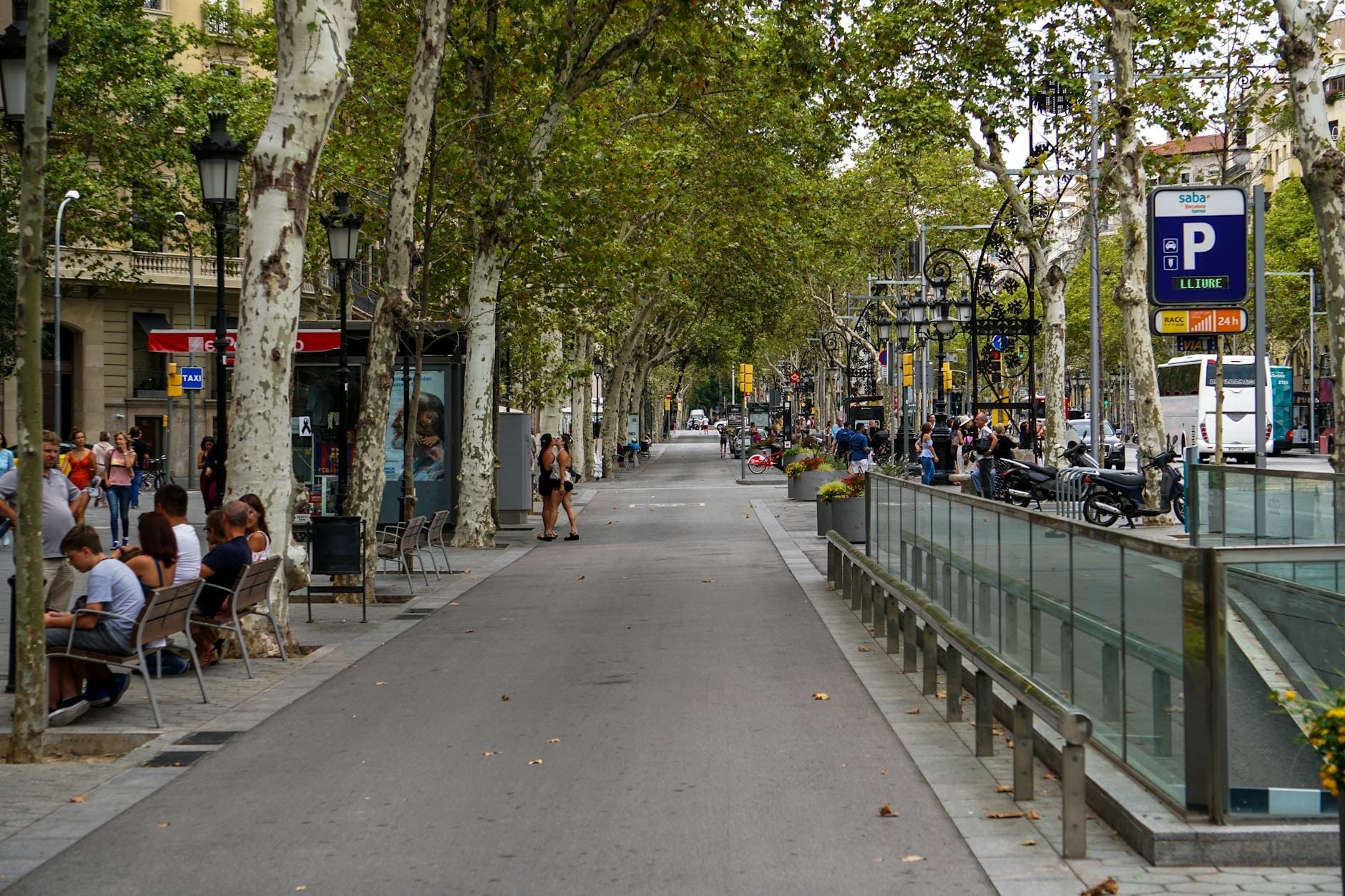
What Las Ramblas Actually Is
La Rambla, known in plural form as Las Ramblas or Les Rambles, is a 1.2-kilometre pedestrian boulevard that bisects the old city of Barcelona. It runs due south from Plaça de Catalunya to the Christopher Columbus Monument at the harbour, dividing the Gothic Quarter on the east from the El Raval district on the west. The street is a public thoroughfare, open 24 hours a day with no admission charge, and is made up of five named sections: Rambla de Canaletes, Rambla dels Estudis (Rambla dels Ocells), Rambla de Sant Josep (known as Rambla de les Flors), Rambla dels Caputxins, and Rambla de Santa Mònica.
The central strip, shaded by mature plane trees, is reserved for pedestrians. Narrow vehicle lanes run along each side. Most of the foot traffic, the stalls, the street performers, and the cafe terraces all occupy the wide, mosaic-tiled central walkway. The tree canopy is dense enough to provide real shade in summer, and in autumn the fallen leaves turn the pale tiles amber.
⚠️ What to skip
Pickpocketing is a persistent problem along Las Ramblas, especially in crowds around the Boqueria entrance and near the Liceu metro stop. Keep phones in front pockets or zipped bags. Avoid anyone who bumps into you deliberately or creates a distraction.
A Brief History of the Boulevard
The name derives from the Arabic word 'ramla', meaning a sandy riverbed, which describes exactly what this was: a seasonal stream that ran outside Barcelona's medieval city walls. By the 15th century the stream had been converted into a sewer, and the surrounding land developed gradually with convents, hospitals, and university buildings along its banks.
The boulevard took its recognisable form between 1849 and 1856, following the demolition of the old city walls. The central promenade was laid out and the plane trees were planted in 1851. What you walk today is largely a 19th-century creation, though several of the buildings flanking it are considerably older. The Liceu opera house, which opened in 1847 (rebuilt after a fire in 1994), and the Palau de la Virreina from 1777 both predate the modern layout.
For context on the buildings, squares, and layers of history on either side of the boulevard, the Gothic Quarter to the east rewards even a short detour off the main strip.
Tickets & tours
Live prices and dates from our booking partner. If you book, we may earn a commission at no extra cost to you.
Cocktails masterclass with tapas in Barcelona
From 50 €Instant confirmationFree cancellationLas Golondrinas 40-minute cruise in Barcelona
From 8 €Instant confirmationFree cancellationSagrada Familia and Pedrera small-group tour with glass of cava
From 139 €Instant confirmationFree cancellationLas Golondrinas in Barcelona 60-minute boat trip tickets
From 12 €Instant confirmationFree cancellation
Walking Las Ramblas: Section by Section
Starting from the top at Plaça de Catalunya, the first section (Rambla de Canaletes) contains the Font de Canaletes, a 19th-century iron drinking fountain with a well-known local legend attached: anyone who drinks from it will return to Barcelona. It is a modest structure that most tourists walk past without noticing, which is worth keeping in mind as a measure of how expectation and reality can diverge on this street.
The Font de Canaletes also serves as a traditional meeting point for FC Barcelona fans after major victories. On match nights the area can fill rapidly with celebrating supporters.
Moving south, the Rambla dels Estudis section once hosted bird and animal stalls, hence the alternate name Rambla dels Ocells. These stalls no longer trade there. The Rambla de Sant Josep, roughly in the middle of the route, is where the flower stalls are concentrated, and where the entrance to the Mercat de la Boqueria sits. This is the most photographed section and the most crowded.
The Mercat de la Boqueria is worth entering for the architecture and the visual spectacle of the stalls, but it has become heavily geared toward tourist sales rather than local food shopping. Expect high prices and long lines at the popular counters. Serious food shopping happens elsewhere in the city.
Further south, the Rambla dels Caputxins holds the Gran Teatre del Liceu on the west side and the entrance to Plaça Reial tucked behind a narrow arcade on the east. The final section, Rambla de Santa Mònica, is the most open and least crowded, ending at the Mirador de Colom roundabout and the beginning of Port Vell.
From the southern end, the Mirador de Colom offers a lift to a small viewing platform at the top of the Columbus column for views over the port and city rooftops.
How the Street Changes Through the Day
Early morning, before 9am, Las Ramblas belongs to delivery workers, joggers, and the occasional tourist who has figured out that this is the only time the pavement is truly clear. The flower stalls are being set up, the smell of cut stems and wet stone is strong, and the cafe chairs are still stacked. This is the most atmospheric window of the day.
By mid-morning the crowds build quickly. Between 10am and 2pm the boulevard reaches near-gridlock levels during peak season (July and August). Navigating it becomes a slow shuffle. Street performers set up their pitches, the Boqueria queue spills onto the pavement, and the central walkway loses any sense of space.
Late afternoon sees a temporary thinning as many tourists retreat for lunch or a siesta, but by early evening the street fills again with a different energy: locals heading to the theatre district, couples on terraces, and the illuminated shopfronts of the side streets. After midnight, Las Ramblas takes on a different character entirely, with the remaining crowds skewing toward late-night bar-goers and the atmosphere becoming less comfortable for solo travellers or families.
💡 Local tip
Visit between 7am and 9am for the cleanest experience of the boulevard itself. If you're visiting with children or spending time at the Boqueria, aim for a weekday morning rather than weekend afternoons.
Photography and Practical Notes
The plane trees make the central walkway photogenic in almost every season. Morning light comes in from the east, catching the mosaic tiles and the tree trunks well. By midday the canopy creates strong dappled shadows that suit contrast-heavy photography but can flatten faces in portraits. The flower stalls photograph best in morning light before the petals begin to wilt.
For elevated views looking down the length of the boulevard, the upper floors of several hotels offer good vantage points, though these are not publicly accessible without a booking. The Columbus monument at the southern end gives a moderate elevation with the harbour as a backdrop rather than the boulevard itself.
The street is largely wheelchair-accessible along the central promenade, though the mosaic tiles have uneven joints in some sections and the crowds create their own navigational challenges. Side streets off the Ramblas range from fully smooth to noticeably cobbled.
Visitors with limited time in Barcelona should treat Las Ramblas as a transit corridor between other destinations rather than a destination in itself. Combine a morning walk with a visit to the Gran Teatre del Liceu if you have an interest in opera architecture, or use the route to connect to the waterfront and Barceloneta beyond.
Honest Assessment: Is It Worth Your Time?
Las Ramblas is not a secret, and it does not pretend to be. It is heavily trafficked, aggressively targeted by petty thieves, lined with overpriced tourist cafes, and in summer it can feel more like crowd management than sightseeing. Anyone who tells you otherwise is glossing over a significant part of the visitor experience.
That said, dismissing it entirely misses the point. The boulevard is genuinely handsome under its tree canopy, the flower stalls add real colour, the Liceu facade is imposing, and walking from the city's central square to the sea in a straight, pleasant line is a satisfying thing to do. The issue is expectation management. Come expecting a grand 19th-century promenade with a circus atmosphere attached, and you will appreciate it accurately.
Those who want the spirit of the old Ramblas without the crowds should explore the side streets in El Born, or walk the Rambla del Poblenou in the Poblenou district, which offers a similar tree-lined pedestrian layout at a fraction of the foot traffic.
Travellers who should consider skipping Las Ramblas: those returning to Barcelona for the second or third time who have already done it, anyone with a strong aversion to crowds in summer, and those whose itinerary is tight and who would get more from the quieter historic streets one block to either side.
ℹ️ Good to know
Las Ramblas is free and open 24 hours a day with no ticketing or entry requirements. The nearest metro stations are Catalunya (Lines 1, 3) at the north end, Liceu (Line 3) at the midpoint near the Boqueria, and Drassanes (Line 3) at the southern end near the Columbus monument.
Insider Tips
- The mosaic pavement on the central walkway was designed by Joan Miró. His large circular design is embedded in the tiles near the Liceu metro entrance. Most people walk over it without realising what it is.
- Plaça Reial is reached through a narrow, easy-to-miss arcade on the east side of the boulevard near the Liceu section. The square itself, with its palm trees and Neo-Classical colonnades, is far calmer and more photogenic than the main street.
- The flower stalls along the Rambla de les Flors section are licensed city vendors and have been operating in some form since the 19th century. Prices are reasonable for cut flowers and potted plants — better value than the food stalls nearby.
- If you are using the Liceu metro station, the exit closest to the boulevard emerges directly onto the main strip next to the Boqueria entrance, putting you immediately in the most crowded section. Use the Catalunya exit instead and walk down at your own pace.
- Street performer spots are permitted and regulated. The performers in silver and gold body paint work for tips. There is no obligation to pay simply for photographing them from a distance, regardless of what gestures they make toward you.
Who Is Las Ramblas For?
- First-time visitors to Barcelona who want to understand the city's geography by foot
- Travellers combining a morning walk with a visit to the Boqueria market or the Liceu opera house
- Evening strollers heading from the city centre to the waterfront at Port Vell
- Visitors with children who need a flat, wide, easy walking route with constant visual interest
- Photography enthusiasts working early morning light before the crowds arrive
Nearby Attractions
Other things to see while in Las Ramblas & El Raval:
- Font de Canaletes
A cast-iron fountain near Plaça de Catalunya, Font de Canaletes has stood at the top of La Rambla since 1892. It is where FC Barcelona fans flood the street after major victories, where a local legend promises you will return to the city if you drink its water, and where the everyday rhythm of Barcelona plays out in miniature.
- Gran Teatre del Liceu
The Gran Teatre del Liceu is one of Europe's largest and most storied opera houses, rising from La Rambla since 1847. With a gilded six-tier auditorium, a dramatic history of fire and rebirth, and a packed season running from September to July, it offers visitors far more than a night at the opera.
- MACBA – Museu d'Art Contemporani de Barcelona
MACBA is Barcelona's leading contemporary art museum, housed in Richard Meier's landmark white building in El Raval. From rotating collections to one of the city's most photogenic plazas, here's what to expect before you visit.
- Mercat de la Boqueria
The Mercat de Sant Josep de la Boqueria is Barcelona's largest and most storied food market, sitting squarely on La Rambla since its official inauguration in 1840. Free to enter and open six days a week, it offers 300-plus stalls of fresh produce, seafood, charcuterie, and prepared foods. But timing your visit right makes the difference between a genuine market experience and an overpriced tourist trap.
Planning a trip? Discover personalized activities with the Nomado app.