Font de Canaletes: The Fountain That Defines Barcelona's Soul
A cast-iron fountain near Plaça de Catalunya, Font de Canaletes has stood at the top of La Rambla since 1892. It is where FC Barcelona fans flood the street after major victories, where a local legend promises you will return to the city if you drink its water, and where the everyday rhythm of Barcelona plays out in miniature.
Quick Facts
- Location
- Rambla de Canaletes, upper La Rambla, near Plaça de Catalunya
- Getting There
- Catalunya station, Metro L1 (red), L3 (green), and L2 (purple)
- Time Needed
- 10–20 minutes to pause, photograph, and soak in the atmosphere
- Cost
- Free, accessible 24 hours a day
- Best for
- First-time visitors, FC Barcelona fans, history enthusiasts, photographers
What Is Font de Canaletes?
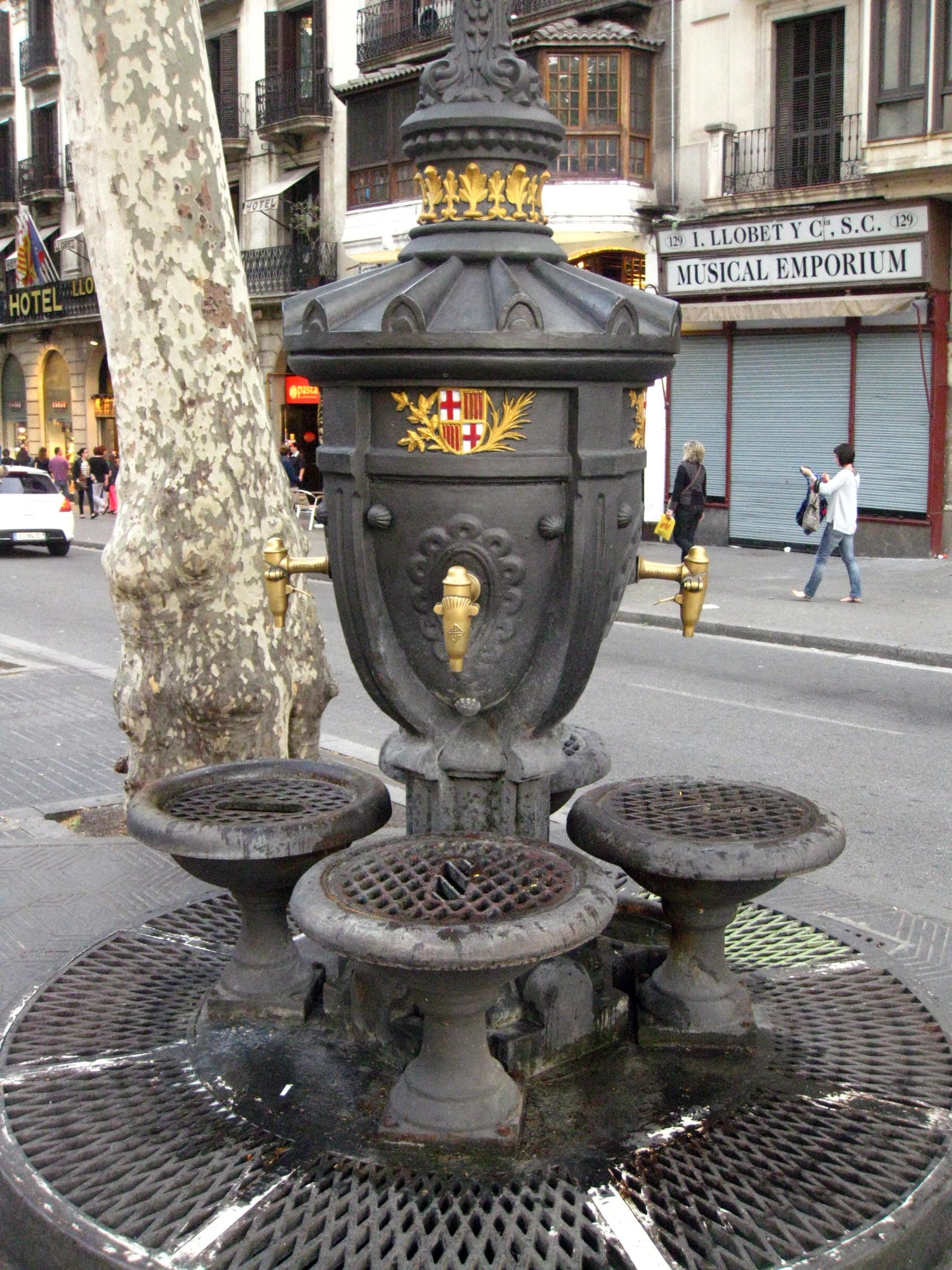
Font de Canaletes is a 19th-century cast-iron drinking fountain positioned at the very top of La Rambla, the long pedestrian boulevard that cuts through central Barcelona from Plaça de Catalunya down to the waterfront. It is small by any architectural measure: a dark iron column about two meters tall, topped by a four-armed lamppost bearing the Barcelona city shield, with four water spouts arranged around its base. And yet it is one of the most recognisable structures in the city.
The fountain was built in 1892, designed under the supervision of city architect Pere Falqués and constructed by Jaume Rodelles. It replaced an older 18th-century fountain that had itself occupied a site with deep roots in Barcelona's urban history. The name 'Canaletes' traces back to the medieval water channels (canaletes) that once carried water from Collserola hill into the city, passing through this point near the old city walls.
ℹ️ Good to know
The fountain is open and accessible 24 hours a day, every day of the year. There is no fee, no ticket, and no queue. You can simply walk up and drink from one of its four spouts.
The Legend and the Football Connection
Barcelona folklore holds that anyone who drinks from Font de Canaletes will inevitably return to the city. It is a legend told in tourist brochures and by locals alike, and it has enough currency that visitors deliberately seek out the fountain to drink from it. Whether or not you put stock in such things, the act of drinking from an iron spout on a warm afternoon while the crowds of La Rambla flow past has a certain quiet appeal.
The fountain's more recent claim to cultural significance comes from FC Barcelona. For decades, this corner of La Rambla has been the spontaneous gathering point for Barça supporters after major victories. The tradition dates to the early 20th century, when the area around Font de Canaletes was home to newspaper kiosks where football results were posted and fans would congregate to read the scores. The fountain became the natural anchor for those celebrations. Today, when Barcelona win a league title or a Champions League, thousands of supporters converge here, turning the upper Rambla into a wall of red and blue. If you are planning a trip around a major Barça match, the Camp Nou stadium is the destination for the game, but Font de Canaletes is where the city celebrates.
Tickets & tours
Live prices and dates from our booking partner. If you book, we may earn a commission at no extra cost to you.
Picasso Museum guided tour
From 30 €Instant confirmationFree cancellationOlympic and Sports Museum Juan Antonio Samaranch tickets
From 6 €Instant confirmationFree cancellationCasa Vicens skip-the-line tickets and guided visit in small groups
From 21 €Instant confirmationSunset Sailing Experience with Spanish Tapas and Premium Open Bar
From 69 €Instant confirmationFree cancellation
The Fountain Itself: Details Worth Noticing
Up close, Font de Canaletes rewards a slow look. The cast-iron column is ornate in the way that late-19th-century civic ironwork tended to be: fluted surfaces, decorative mouldings, and a solidity that reads as permanence. The four spouts are arranged at waist height, each one a small curved fixture worn smooth by over a century of palms cupping water beneath them. The lamppost above carries a globe light that illuminates the surrounding pavement at night, giving the fountain a warm presence after dark.
The Barcelona city shield appears on the lamp column, a detail that anchors the fountain firmly in the civic landscape rather than treating it as mere infrastructure. It is functional and symbolic at once, which is part of what makes it representative of a certain era of city design.
How the Experience Changes by Time of Day
Early morning, from around 7:00 to 9:00, the fountain sits in relative quiet. The pavement around it is occasionally damp from overnight cleaning, newspaper kiosks are just opening, and the only people nearby tend to be joggers, locals heading toward Plaça de Catalunya, and the occasional early tourist. This is the best time to photograph the fountain without crowds and to get a sense of its actual scale, which the daytime throngs can obscure.
By mid-morning the density builds steadily. La Rambla becomes one of Barcelona's most trafficked pedestrian corridors by late morning, and the fountain sits at its busiest access point, the entry from the large transport hub of Plaça de Catalunya. By noon, especially in summer, the pavement around Font de Canaletes is rarely empty. Tour groups pause here for explanations. Families stop to drink. Tourists photograph it from multiple angles. The atmosphere is good-natured but genuinely crowded.
At night, the fountain takes on a different character. The lamp above it glows and the foot traffic shifts from tourist families to a more mixed crowd. The upper section of La Rambla near Canaletes remains lively well into the evening, particularly on weekends. For context on how the whole boulevard transforms after sunset, see the broader La Ramblas boulevard guide, which covers the full length of the promenade.
Getting There and Fitting It Into Your Day
Font de Canaletes is effectively impossible to miss if you arrive at Barcelona's central transport node. Catalunya Metro station (served by Lines 1, 3, and also L2 (purple) among others) exits directly onto Plaça de Catalunya, and the fountain is visible from the top of La Rambla within a few dozen metres of the square. If you are staying anywhere in the Eixample or the Gothic Quarter, Font de Canaletes is almost certainly on a natural walking route.
Because it is free and takes almost no dedicated time to visit, it makes sense to incorporate it into a broader walk down La Rambla rather than treating it as a standalone destination. A useful route: start at Font de Canaletes, walk the full length of La Rambla toward the port, taking in the flower stalls and market entrance along the way, and finish at the waterfront. Allow at least 45 minutes for the full walk if you intend to stop and look.
💡 Local tip
Pickpocketing is a documented problem along La Rambla, concentrated in the densest crowd sections. Keep bags zipped and in front of your body, especially in the area immediately around Font de Canaletes where tourist density peaks. This is a practical reality, not a reason to avoid the area.
Photography and Practical Notes
The fountain photographs best from the east side of La Rambla, where the morning light falls on its face and the lamppost is silhouetted cleanly against the sky. A wide-angle lens or phone at mid-distance captures both the fountain and enough of its promenade context to convey the setting. If you want the fountain without crowds, arrive before 9:00 on a weekday. In July and August, even 8:00 can feel late.
The surrounding pavement is flat and fully wheelchair accessible. The water from the spouts is safe to drink, coming from the Barcelona municipal supply. Some visitors dislike the slightly mineral taste; there is a café with outdoor seating within thirty metres if you prefer something else.
If you are building a full day around this part of the city, the nearby Mercat de la Boqueria is a short walk south along La Rambla, and Plaça de Catalunya is immediately north. For a wider itinerary covering this area and beyond, the complete Barcelona attractions guide is a useful reference.
Who Should Skip It (and Who Should Not)
Font de Canaletes is not a destination in the way that a museum or a Gaudí building is a destination. If your time in Barcelona is short and your list is long, there is no reason to make a dedicated trip here. The fountain rewards visitors who are already walking La Rambla, not those who are planning a journey specifically to see it.
That said, for anyone interested in the cultural and sporting identity of Barcelona, or for first-time visitors who want to feel oriented at the city's central axis, pausing at Font de Canaletes for ten minutes is time well used. FC Barcelona supporters in particular often treat it as something close to obligatory. The emotional weight the fountain carries in the city's collective memory is out of all proportion to its modest physical presence, which is, in its own way, a very Barcelona kind of thing.
Insider Tips
- Arrive before 9:00 on weekdays if you want a quiet moment at the fountain and a clear photograph. Even small crowds make the pavement around it feel tight.
- The four spouts each work independently. On hot summer days, locals use them to wet their wrists and necks, not just their palms. The water runs cold year-round.
- If you are visiting during or after a major FC Barcelona match, check the fixture schedule before walking La Rambla in the evening. Post-victory crowds near the fountain are festive but genuinely dense, and the surrounding streets fill rapidly.
- The lamppost bears the Barcelona city shield on all four faces. It is one of the cleaner examples of 19th-century civic ironwork in the city and worth examining closely before the crowds arrive.
- The fountain sits at the precise boundary between Rambla de Canaletes (the topmost section of La Rambla) and the rest of the boulevard. Locals use it as a casual landmark: 'meet me at Canaletes' is a shorthand understood across the city.
Who Is Font de Canaletes For?
- First-time visitors to Barcelona wanting to orient themselves at the city's central pedestrian axis
- FC Barcelona supporters for whom the fountain carries specific cultural and emotional meaning
- Walkers and flaneurs building a leisurely route down La Rambla toward the waterfront
- History enthusiasts interested in 19th-century civic infrastructure and the evolution of Barcelona's public spaces
- Photographers seeking an iconic but achievable early-morning shot before the crowds arrive
Nearby Attractions
Other things to see while in Las Ramblas & El Raval:
- Gran Teatre del Liceu
The Gran Teatre del Liceu is one of Europe's largest and most storied opera houses, rising from La Rambla since 1847. With a gilded six-tier auditorium, a dramatic history of fire and rebirth, and a packed season running from September to July, it offers visitors far more than a night at the opera.
- Las Ramblas
Las Ramblas is Barcelona's most famous street, a 1.2 km tree-lined boulevard connecting Plaça de Catalunya to the waterfront. Free to walk, open around the clock, and flanked by markets, theatres, and historic facades, it anchors every first visit to the city. Go in knowing what you're getting and you'll enjoy it far more.
- MACBA – Museu d'Art Contemporani de Barcelona
MACBA is Barcelona's leading contemporary art museum, housed in Richard Meier's landmark white building in El Raval. From rotating collections to one of the city's most photogenic plazas, here's what to expect before you visit.
- Mercat de la Boqueria
The Mercat de Sant Josep de la Boqueria is Barcelona's largest and most storied food market, sitting squarely on La Rambla since its official inauguration in 1840. Free to enter and open six days a week, it offers 300-plus stalls of fresh produce, seafood, charcuterie, and prepared foods. But timing your visit right makes the difference between a genuine market experience and an overpriced tourist trap.
Planning a trip? Discover personalized activities with the Nomado app.