Plaça de Catalunya: Barcelona's Living Crossroads
At roughly 50,000 square metres, Plaça de Catalunya is the geographic and symbolic heart of Barcelona. Free to enter at any hour, it connects the medieval old town with the Eixample grid and anchors the top of Las Ramblas, making it the city's single most useful orientation point.
Quick Facts
- Location
- Plaça de Catalunya, 08002 Barcelona — between Las Ramblas and Passeig de Gràcia
- Getting There
- Metro: Plaça de Catalunya station (L1, L2, L3, L6, L7, S1, S2, S5, S55). AeroBus to/from El Prat airport also stops here.
- Time Needed
- 15–45 minutes to walk and absorb; allow longer if combining with the Tourist Information Office
- Cost
- Free. No ticket required.
- Best for
- Orientation, people-watching, sculpture, transport connections, and photography
What Is Plaça de Catalunya, and Why Does It Matter?
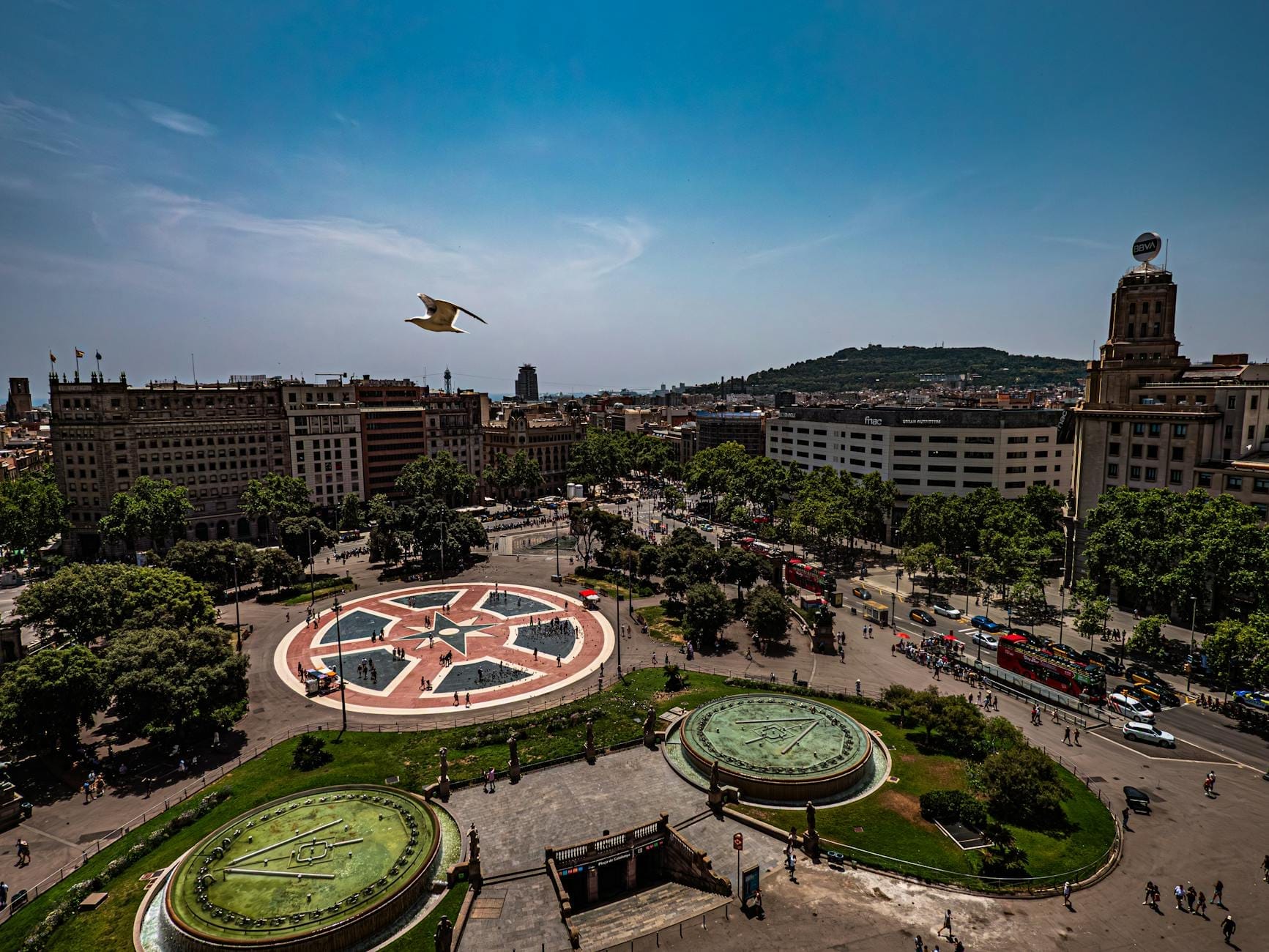
Plaça de Catalunya is Barcelona's central square, officially opened on 2 November 1927 by King Alfonso XIII. At approximately 50,000 square metres, five hectares in total, it sits at the precise hinge between the city's two dominant urban identities: the tightly packed medieval streets of the Gothic Quarter to the south, and the orderly 19th-century grid of the Eixample to the north. Las Ramblas descends from its southern edge toward the waterfront; Passeig de Gràcia rises from its northeastern corner toward the Modernista buildings of the upper city.
In practical terms, this makes Plaça de Catalunya the city's most consistent landmark. Whether you arrive by metro, airport bus, or on foot from the port, you will almost certainly pass through or near it. That transit function, however, tends to overshadow its other qualities: genuine architectural interest, a generous set of fountains and green space, and a layered history that stretches back to the edge of Barcelona's medieval walls.
ℹ️ Good to know
The Tourist Information Office at street level within the square (typically open daily 9:30 AM to 9:30 PM in high season) offers free maps, transport cards, and booking services. Public toilets are available on the top floor of the adjacent El Corte Inglés department store.
History and Urban Context
The site occupied by today's square was, until the late 19th century, an open lot just beyond the edge of Barcelona's medieval walls. As the city expanded outward with the Eixample plan from the 1860s onward, planners recognized the need for a large public square to stitch old and new together. Development formally began in 1902, but the project moved slowly and was completed in two phases, the second timed for the 1929 Universal Exposition.
The sculptural program is more deliberate than most visitors notice. Six sculptural groups represent the four Catalan provincial capitals, plus allegorical figures of wisdom and labour. Works by Josep Clarà and Robert Llimona give the square a coherent aesthetic that sits between academic classicism and early Modernisme. The monument to Francesc Macià, who served as president of the Government of Catalonia between 1931 and 1933, occupies a prominent position and carries obvious political weight in a city where questions of Catalan identity remain part of daily conversation.
The square does not exist in isolation. It connects directly to Las Ramblas, Barcelona's most famous promenade, and sits at the threshold of the Gothic Quarter to the southeast and the Eixample to the north. Understanding this geography makes the square far more useful as a base for exploring the city.
Tickets & tours
Live prices and dates from our booking partner. If you book, we may earn a commission at no extra cost to you.
Mirador Torre Glories admission tickets
From 18 €Instant confirmationGuided tour to Barcelona's photogenic places with a local
From 62 €Instant confirmationFree cancellationPicasso Museum guided tour
From 30 €Instant confirmationFree cancellationOlympic and Sports Museum Juan Antonio Samaranch tickets
From 6 €Instant confirmationFree cancellation
What the Square Actually Looks and Feels Like
The surface of Plaça de Catalunya is a broad expanse of stone paving interrupted by formal garden beds, several fountains of varying sizes, and wide pedestrian paths lined with benches. Pigeons are everywhere, drawn by the constant presence of people and the open ground around the fountain basins. The sound at midday is a particular mix: the low hum of the metro ventilation shafts beneath the paving, the splash of the central fountain, and the layered noise of conversations in Catalan, Spanish, English, and whatever other languages the current mix of residents and visitors happens to produce.
The central fountain, sometimes called the Plaça Catalunya Fountain, is the natural gathering point. On warm evenings, the surrounding benches fill with people eating takeaway food from nearby shops, charging phones, checking maps, or simply sitting. It is not a quiet, intimate square in the manner of some of Barcelona's smaller plazas. The scale is civic and slightly monumental, which suits its role as a public meeting place for demonstrations, celebrations, and everyday crossings.
Photography works best in the early morning, roughly between 7:00 and 9:00 AM, when the light comes from the east and the crowd is thin enough to frame the sculptures and fountains without dozens of bystanders in shot. By 10:00 AM in summer, tour groups and commuters merge into a single dense flow across the paving, and the square takes on its characteristic daytime character: energetic, slightly chaotic, and thoroughly representative of Barcelona at work and at leisure simultaneously.
Visiting by Time of Day
Morning: Calm and Practical
Early morning is the most photogenic and least crowded window. Locals walk dogs along the perimeter paths, joggers cut across the paving, and the pigeons have the fountain areas largely to themselves. The light in summer months can be excellent from about 7:30 AM onward, catching the stone surfaces of the sculptures with warm, directional light.
Midday and Afternoon: Peak Activity
From 10:00 AM to 6:00 PM, the square operates at full capacity. Tour groups assemble, families cross between metro exits and Las Ramblas, and the AeroBus stop on the western edge sees a steady rotation of luggage-laden travellers. This is also when pickpocketing risk is highest. Keep bags in front of your body and be alert around the metro exits, where crowds compress.
⚠️ What to skip
Plaça de Catalunya is one of the highest-risk areas in Barcelona for pickpocketing. Use a front-facing bag or money belt, and keep phones in a zipped pocket, particularly around the metro station exits and the AeroBus stop.
Evening: Social and Open
After 7:00 PM in summer, the square shifts register. Families with children take over the fountain areas, street musicians sometimes play near the central paths, and the light softens into something more pleasant for photographs. The square stays open around the clock and remains reasonably populated until late, particularly on weekends when the area around Las Ramblas extends its activity well past midnight.
Practical Walkthrough: Navigating the Square
Plaça de Catalunya has multiple metro exits distributed across its surface. The main exits for the square's central area come from Line 3 (the green line), which is the most useful for connections to Las Ramblas, the Gothic Quarter, and Barceloneta. Line 1 (red) and Line 2 (purple) exits tend to emerge toward the eastern and western edges of the square. FGC suburban rail lines also pass through the station below, serving destinations like Tibidabo and the Collserola hills.
The AeroBus to and from Josep Tarradellas Barcelona–El Prat Airport stops on Carrer de Pelai, on the western side of the square. Journey time to the airport is typically 35–40 minutes depending on traffic. For more detail on transport options across the city, see the guide to getting around Barcelona.
Walking the perimeter of the square takes about ten minutes at a slow pace. The sculptural groups are distributed around the inner garden areas, and each one rewards a few minutes of close attention. The Macià monument is on the northeastern side, toward Passeig de Gràcia. The El Corte Inglés building on the eastern edge is useful not just for its toilets but for its rooftop café, which offers one of the more underrated elevated views over the square and the surrounding rooftops.
Is It Worth Your Time?
Plaça de Catalunya is not a destination that requires a deliberate visit in the way that a museum or Gaudí building does. Most people pass through it simply because Barcelona's layout makes avoidance impractical. The square earns its place on any itinerary not because of a single spectacular feature but because it helps you understand how the city is structured and provides a reliable, central platform for moving efficiently between neighborhoods.
Travellers who want the highest concentration of architectural spectacle should move quickly through the square toward Passeig de Gràcia or down Las Ramblas. Those building a broader picture of Barcelona's urban identity, however, will find that spending twenty minutes walking the interior paths and reading the monuments gives the rest of the city considerably more context.
Travellers who primarily want quiet, intimate atmosphere or traditional Barcelona neighborhood character may find the scale and noise of the square underwhelming. The smaller plazas of Gràcia or the courtyard spaces of the Gothic Quarter offer a more textured, less hectic experience of public space in the city.
If you are planning your time carefully, a structured Barcelona itinerary can help you allocate the square its appropriate fifteen to twenty minutes without letting transit time eat into visits that genuinely require advance booking.
Insider Tips
- The rooftop café of the El Corte Inglés department store on the eastern edge of the square gives you an elevated view over the paving and surrounding rooftops without requiring any metro journey or ticket purchase. It is open during store hours and rarely crowded compared to more famous viewpoints.
- The FGC suburban rail lines at the Plaça de Catalunya station go directly to the base of Tibidabo hill, a faster and cheaper route than most visitors realize. Look for the FGC signs inside the station, which are separate from the TMB metro exits.
- If you are arriving from the airport by AeroBus and plan to stay in the Gothic Quarter or El Born, Plaça de Catalunya is the correct stop. Do not continue on the bus to Passeig de Gràcia, which takes you further from the old town despite being a familiar name.
- The Tourist Information Office within the square sells the T-Casual and other multi-journey metro cards at face value, which saves you queuing at the automated machines during peak hours.
- On 11 September, Catalonia's National Day (La Diada), the square becomes the focal point for large public gatherings. If your visit coincides with this date, expect significant crowds, potential transport disruption, and a vivid window into Catalan civic life.
Who Is Plaça de Catalunya For?
- First-time visitors needing a reliable orientation point and transport hub
- Travellers arriving from or departing to the airport via AeroBus
- Photography enthusiasts who want to capture the square's scale and sculpture in early morning light
- Those combining Las Ramblas and the Gothic Quarter in a single half-day walk
- Anyone who wants to understand Barcelona's urban layout before striking out into individual neighborhoods
Nearby Attractions
Other things to see while in Las Ramblas & El Raval:
- Font de Canaletes
A cast-iron fountain near Plaça de Catalunya, Font de Canaletes has stood at the top of La Rambla since 1892. It is where FC Barcelona fans flood the street after major victories, where a local legend promises you will return to the city if you drink its water, and where the everyday rhythm of Barcelona plays out in miniature.
- Gran Teatre del Liceu
The Gran Teatre del Liceu is one of Europe's largest and most storied opera houses, rising from La Rambla since 1847. With a gilded six-tier auditorium, a dramatic history of fire and rebirth, and a packed season running from September to July, it offers visitors far more than a night at the opera.
- Las Ramblas
Las Ramblas is Barcelona's most famous street, a 1.2 km tree-lined boulevard connecting Plaça de Catalunya to the waterfront. Free to walk, open around the clock, and flanked by markets, theatres, and historic facades, it anchors every first visit to the city. Go in knowing what you're getting and you'll enjoy it far more.
- MACBA – Museu d'Art Contemporani de Barcelona
MACBA is Barcelona's leading contemporary art museum, housed in Richard Meier's landmark white building in El Raval. From rotating collections to one of the city's most photogenic plazas, here's what to expect before you visit.
Planning a trip? Discover personalized activities with the Nomado app.