MACBA – Museu d'Art Contemporani de Barcelona: The Complete Visitor Guide
MACBA is Barcelona's leading contemporary art museum, housed in Richard Meier's landmark white building in El Raval. From rotating collections to one of the city's most photogenic plazas, here's what to expect before you visit.
Quick Facts
- Location
- Plaça dels Àngels, 1, El Raval, Barcelona
- Getting There
- Metro L1/L2 Universitat or L3/L4 Liceu (10-min walk)
- Time Needed
- 1.5 to 3 hours
- Cost
- €12 general (€10.80 online); closed Tuesdays
- Best for
- Contemporary art fans, architecture lovers, skate culture observers
- Official website
- www.macba.cat/en
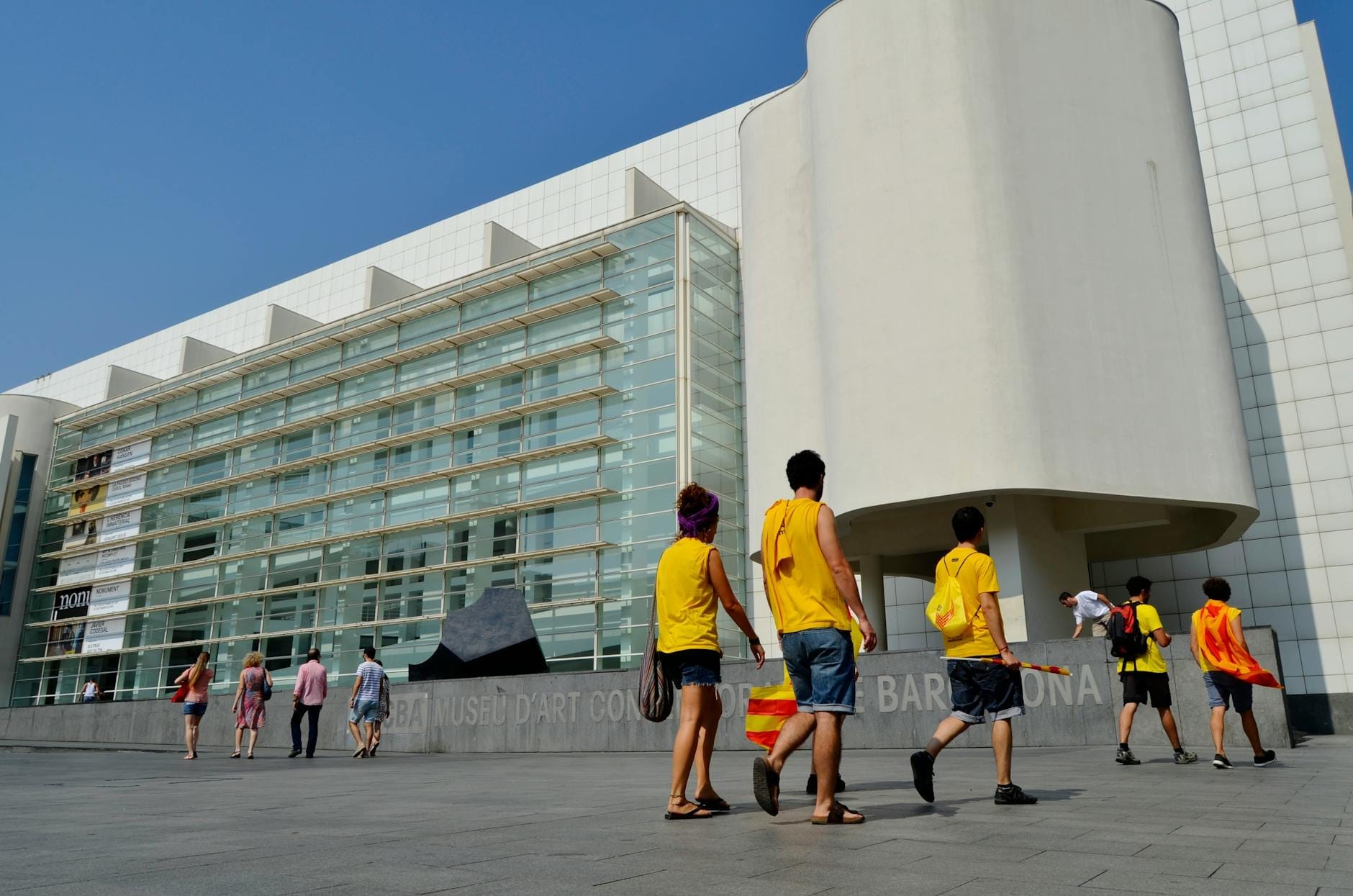
What MACBA Actually Is
The Museu d'Art Contemporani de Barcelona, known universally as MACBA, is the city's primary institution dedicated to art from the second half of the 20th century through to today. It sits at Plaça dels Àngels in the Las Ramblas corridor adjacent to El Raval, a neighborhood that spent decades as Barcelona's most overlooked district before a wave of cultural investment transformed it during the 1990s.
The building itself opened in 1995, designed by American architect Richard Meier, who had won the Pritzker Prize in 1984. Meier's signature is hard to miss: pure white geometric volumes, enormous glass curtain walls, and an emphasis on natural light flooding interior ramps and galleries. The structure was intentionally monumental, placed in a neighborhood that had no shortage of grit, and the contrast was part of the point. MACBA was urban regeneration as cultural statement.
The permanent collection covers roughly 5,000 works, with particular depth in Catalan and Spanish art from the 1950s onward, alongside international figures in conceptual art, performance, and installation. But MACBA is not primarily a collection museum in the way the Prado is. Its reputation is built on ambitious temporary exhibitions, critical programming, and a willingness to present work that other institutions find uncomfortable.
The Plaza Before You Even Enter
The experience of MACBA begins before you reach the ticket desk. Plaça dels Àngels, the wide open square fronting the museum, has become one of the most recognized skate plazas in Europe. The smooth marble paving, the long low ledges, and the gentle ramps that Meier designed for pedestrian circulation turned out to be ideal for skateboarding, and the skate community claimed the space almost immediately after the museum opened. On any afternoon, you will find a mix of local regulars and visiting skaters working lines across the plaza.
This creates an atmosphere unlike almost any other major museum entrance in Europe. The white building behind, the sound of wheels on stone, the occasional group of students eating lunch on the steps: it feels less like an approach to a cultural institution and more like a neighborhood square that happens to have extraordinary architecture at one end. Late morning on a weekday is the quietest time to appreciate the building's facade without crowds.
💡 Local tip
Buy tickets online in advance at macba.cat to save around €1.20 and avoid the queue at the desk. On busy Saturdays, the entrance line can stretch outside.
Tickets & tours
Live prices and dates from our booking partner. If you book, we may earn a commission at no extra cost to you.
Inside the Building: Architecture and Light
Once inside, Meier's design becomes even more legible. The entry atrium is a tall, daylit space with a sweeping ramp that carries visitors upward through multiple levels. The ramp is not just circulation: it is the organizing spine of the interior experience, offering diagonal views across gallery floors and glimpses of the city through the glass walls. On a sunny morning, the white walls catch the Mediterranean light in a way that feels almost theatrical.
The gallery rooms themselves are largely rectilinear and finished in clean white. This works well for work that demands space and neutrality, though some visitors find the interiors austere. The architecture consistently rewards looking up and looking across, not just at the art on the walls. The building is worth a visit as an architectural experience even if contemporary art is not your primary interest.
For those building a broader picture of Barcelona's architectural heritage, MACBA pairs naturally with a visit to the Palau de la Música Catalana or the Hospital de Sant Pau, both of which represent an entirely different strand of the city's design history: Catalan Modernisme versus late-20th-century rationalism.
The Collection and Exhibitions: What You'll Actually See
The permanent collection is organized thematically and rotates regularly, so repeat visits rarely offer the same experience. Expect work from artists associated with post-war European and American movements: Arte Povera, Fluxus, minimalism, conceptualism, and later video art and installation. Catalan artists including Antoni Tàpies, whose influence over Spanish abstract art was enormous, are well represented. There is also significant work from Latin American artists, reflecting Spain's broader cultural connections.
Temporary exhibitions occupy a substantial portion of the museum and tend to be the primary draw for regular visitors. MACBA programs around three to four major temporary shows per year, often featuring artists who are critically significant but not yet household names. The curatorial stance leans toward political and social engagement: shows frequently address migration, memory, gender, and postcolonialism. This is not a museum that plays it safe.
ℹ️ Good to know
MACBA's bookshop is one of the best in the city for critical theory, art history, and design. Worth browsing even if you are not buying, particularly for Catalan-language publications that are difficult to find elsewhere.
If contemporary art is not already a language you speak, MACBA can feel demanding. Wall texts are substantive rather than accessible, and some exhibitions assume prior familiarity with the discourse. Families with young children or visitors primarily interested in painting and sculpture in the traditional sense may find the CCCB (Centre de Cultura Contemporània de Barcelona), located in the adjacent building, more immediately engaging.
Opening Hours, Tickets, and Getting There
MACBA is open Monday and Wednesday through Friday from 11:00 am to 7:30 pm, Saturday from 10:00 am to 8:00 pm, and Sunday from 10:00 am to 3:00 pm. The museum is closed on Tuesdays, on 1 January, and on 25 December. Hours can vary on other public holidays, so checking the official site before visiting on a holiday weekend is worth the two minutes it takes.
General admission is €12 at the door or €10.80 online. An off-peak rate of €10.20 applies at certain times. Friends of MACBA enter free. The museum also participates in the Articket Barcelona, a combined pass covering six major art institutions that represents significant savings if you plan to visit multiple museums during your stay.
The nearest metro stations are Universitat on Lines 1 and 2, and Liceu on Lines 3 and 4, both roughly a 10-minute walk. The museum is also highly walkable from Las Ramblas in under five minutes heading west into El Raval. There is no dedicated car parking at the museum; cycling to MACBA is straightforward as the area has good bike infrastructure.
Best Times to Visit and Practical Notes
Saturday mornings between 10:00 am and noon are consistently the most pleasant time to visit: the galleries are not yet crowded, the natural light in the atrium is at its best, and you have the full afternoon to explore the surrounding neighborhood. Sunday visits are necessarily shorter given the 3:00 pm closing time, and the last hour sees a rush toward the exit that can feel rushed in smaller gallery rooms.
Weekday afternoons between 2:00 pm and 4:00 pm tend to be the quietest, particularly from October through April when tourist numbers across the city are lower. Summer weekday mornings can be busy, especially in July and August when school groups are replaced by tour groups. The plaza itself is liveliest on warm evenings when locals use it as a meeting point, though the museum is closed by then.
The El Raval neighborhood around MACBA rewards exploration before or after your visit. The area has a dense concentration of independent bookshops, North African bakeries, and small bars that reflect the neighborhood's genuinely multicultural character. For a broader picture of the city's cultural life, the things to do in Barcelona guide covers how MACBA fits within a fuller itinerary.
⚠️ What to skip
Bag and jacket storage is available at the entrance and is effectively required for larger bags. Plan an extra five minutes for this on busy days. Pickpocketing is a known issue in the surrounding streets of El Raval; keep bags closed and in front of you.
Accessibility and Photography
The plaza is fully flat and obstacle-free, making it one of the more accessible outdoor spaces in central Barcelona. The museum itself has lift access to all gallery floors. Wheelchair users and those with pushchairs can navigate the building without significant difficulty, though the entrance ramp has a modest incline.
Photography is generally permitted in permanent collection galleries without flash, but temporary exhibition photography policies vary and are posted at each entrance. The exterior of the building is one of the most photogenic museum facades in the city, particularly in the late morning when the white walls are illuminated from the south. The glass curtain wall also creates interesting reflections of the older Gothic and Baroque buildings across the plaza.
If you are planning a photography-focused visit to Barcelona's architecture, the best views in Barcelona guide has additional context on how to build a route around the city's most visually distinctive spots.
Insider Tips
- The MACBA library and study center (CRAI Biblioteca) is open to the public and free to use. It holds one of the most comprehensive collections of contemporary art documentation in Spain, and it is almost never crowded.
- Check the MACBA website for free guided tours, which are offered on selected weekends and often included with admission. These provide curatorial context that wall texts alone do not give you.
- The CCCB (Centre de Cultura Contemporània de Barcelona) shares the same block and sometimes coordinates programming with MACBA. Visiting both in one afternoon is entirely feasible and often provides a richer experience than either alone.
- The plaza faces southwest, meaning the afternoon sun hits the building's glass facade directly. If you want the cleanest exterior photographs, come in the late morning before midday.
- MACBA's café is small and unremarkable. For a better lunch, walk two minutes to Carrer del Carme or deeper into El Raval, where you will find a range of affordable menú del día options that are a significant step up.
Who Is MACBA – Museu d'Art Contemporani de Barcelona For?
- Contemporary art enthusiasts who want curatorial ambition rather than crowd-pleasing blockbusters
- Architecture lovers interested in late-20th-century rationalist design by Richard Meier
- Photographers looking for graphic, light-filled interior and exterior shots
- Travelers following a cultural itinerary through Barcelona who want to move beyond Gaudí
- Repeat visitors to Barcelona who have already covered the major historical sites
Nearby Attractions
Other things to see while in Las Ramblas & El Raval:
- Font de Canaletes
A cast-iron fountain near Plaça de Catalunya, Font de Canaletes has stood at the top of La Rambla since 1892. It is where FC Barcelona fans flood the street after major victories, where a local legend promises you will return to the city if you drink its water, and where the everyday rhythm of Barcelona plays out in miniature.
- Gran Teatre del Liceu
The Gran Teatre del Liceu is one of Europe's largest and most storied opera houses, rising from La Rambla since 1847. With a gilded six-tier auditorium, a dramatic history of fire and rebirth, and a packed season running from September to July, it offers visitors far more than a night at the opera.
- Las Ramblas
Las Ramblas is Barcelona's most famous street, a 1.2 km tree-lined boulevard connecting Plaça de Catalunya to the waterfront. Free to walk, open around the clock, and flanked by markets, theatres, and historic facades, it anchors every first visit to the city. Go in knowing what you're getting and you'll enjoy it far more.
- Mercat de la Boqueria
The Mercat de Sant Josep de la Boqueria is Barcelona's largest and most storied food market, sitting squarely on La Rambla since its official inauguration in 1840. Free to enter and open six days a week, it offers 300-plus stalls of fresh produce, seafood, charcuterie, and prepared foods. But timing your visit right makes the difference between a genuine market experience and an overpriced tourist trap.
Planning a trip? Discover personalized activities with the Nomado app.