Plaça Reial: Barcelona's Most Dramatic Square
Tucked just off La Rambla in the Gothic Quarter, Plaça Reial is a grand neoclassical square ringed by arcaded buildings, palm trees, and restaurants. Free to enter at any hour, it shifts from a relaxed morning coffee spot to one of the city's most atmospheric nightlife hubs after dark.
Quick Facts
- Location
- Gothic Quarter, off La Rambla, Barcelona
- Getting There
- Liceu (L3) — under 2 minutes walk
- Time Needed
- 30–60 minutes to explore; longer if dining or at a venue
- Cost
- Free entry (public square, open 24/7)
- Best for
- Architecture lovers, nightlife seekers, and afternoon coffee breaks
What Is Plaça Reial?
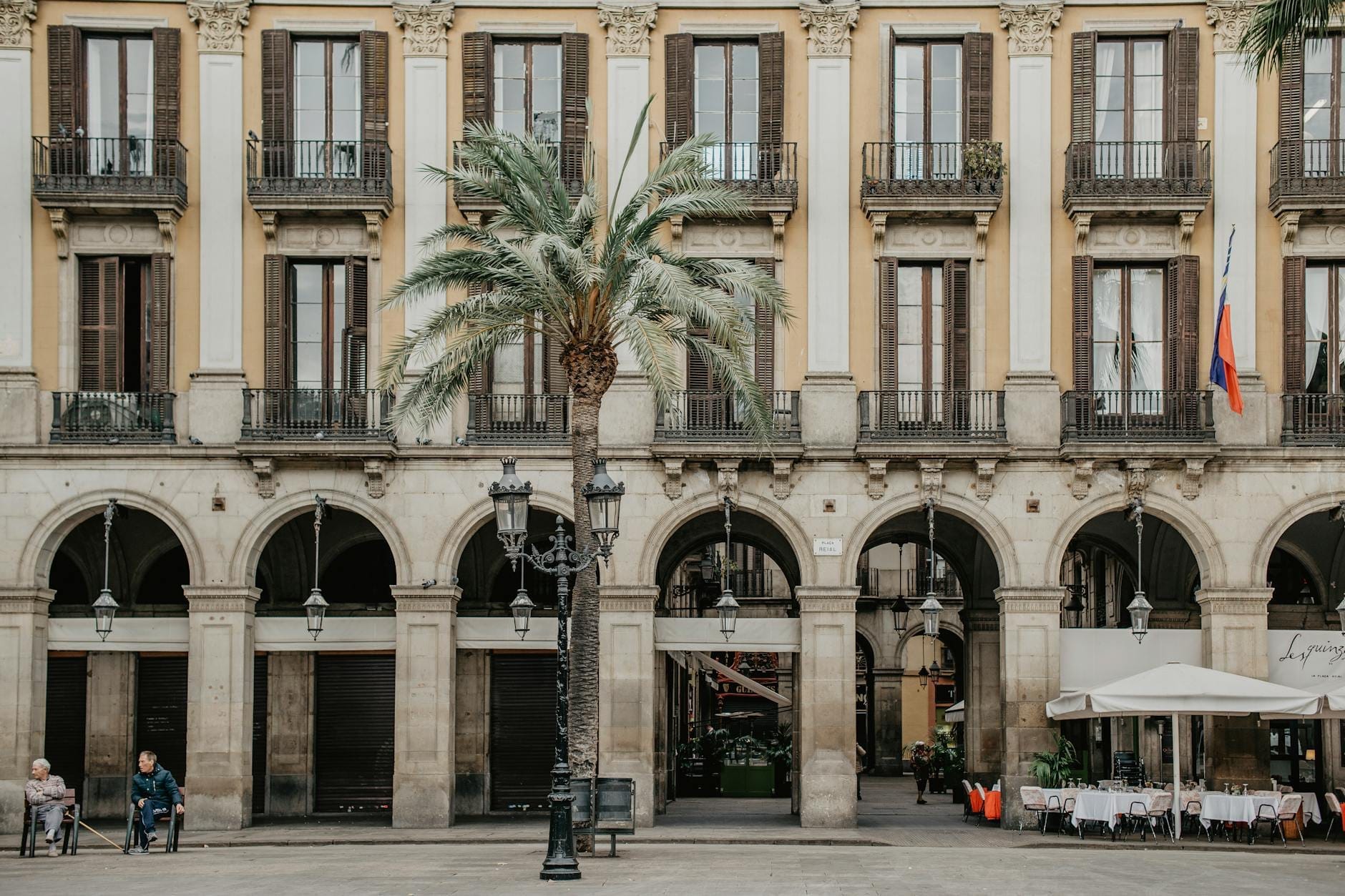
Plaça Reial (Royal Square in Catalan, also known in Spanish as Plaza Real) is one of Barcelona's most recognizable public spaces. A large, formally planned neoclassical square, it sits tucked behind La Rambla in the Gothic Quarter, hidden from the street noise until you pass through one of its narrow entrance arches and find yourself in an entirely different atmosphere. The square is roughly rectangular, enclosed on all four sides by uniform arcaded buildings with ochre facades, and centered on a fountain called the Three Graces.
What makes Plaça Reial worth a visit is not just its looks but the range of things happening within it at different hours of the day. It also holds a small but genuinely interesting piece of architectural history: the ornate lampposts flanking the central fountain are among the earliest known public commissions by a then-unknown Antoni Gaudí, completed around 1878. For more context on Gaudí's presence across the city, the Gaudí Barcelona guide provides a solid overview of his work from early pieces like these to the Sagrada Família.
💡 Local tip
The square's main entrance arch from La Rambla is easy to miss. Look for the gap in the buildings on the east side of La Rambla, roughly level with Carrer de Ferran, marked by a small sign. First-time visitors often walk past it twice.
History: From Convent to Civic Centerpiece
The ground beneath Plaça Reial was once occupied by a Capuchin convent, demolished around 1835-1836 during a period of church property reforms across Spain. The cleared land offered an opportunity to build something that reflected the civic aspirations of mid-19th century Barcelona, and architect Francesc Daniel Molina was commissioned to design a formal urban square in honor of King Ferdinand VII.
Construction ran from 1848 to 1859. Molina drew on French neoclassical influences, creating a uniformly arcaded perimeter that gave the square a sense of enclosure and grandeur unusual for Barcelona at the time. The colonnaded walkways (known locally as the porxos) were designed to shelter residents and commerce from both rain and summer heat, a practical feature that still functions perfectly today.
In the 1980s, architects Frederic de Correa and Alfons Milà oversaw a significant remodel that pedestrianized the square, added the rows of tall palm trees that now define its skyline, and reorganized the restaurant terraces. This intervention gave Plaça Reial much of the visual character it has today.
Tickets & tours
Live prices and dates from our booking partner. If you book, we may earn a commission at no extra cost to you.
Mirador Torre Glories admission tickets
From 18 €Instant confirmationGuided tour to Barcelona's photogenic places with a local
From 62 €Instant confirmationFree cancellationPicasso Museum guided tour
From 30 €Instant confirmationFree cancellationOlympic and Sports Museum Juan Antonio Samaranch tickets
From 6 €Instant confirmationFree cancellation
The Square Through the Day: How the Mood Shifts
Early morning is the most overlooked time to visit. Before 9am, the square is quiet enough that you can actually hear the fountain. The light falls at a low angle across the facades, picking out the texture of the stone arcades, and the restaurant staff are setting up chairs without any crowd pressure. If you want to photograph the Gaudí lampposts without fifteen people in the frame, this is your window.
From mid-morning through early afternoon, a different crowd settles in: tourists stopping for coffee under the arcades, locals cutting through on their way between the Gothic Quarter's narrow streets and La Rambla, and occasional street artists beginning to set up. The restaurants open their terraces, and the square takes on the role of a relaxed outdoor sitting room.
By evening, the energy shifts decisively. Plaça Reial is home to several live music venues, including Jamboree, which has hosted jazz and blues performances since the 1960s, and Sidecar, a long-running rock and indie club. The restaurant terraces fill up, the palm trees catch the glow of the lampposts, and the square becomes one of the most atmospheric spots in the city for a pre-dinner drink. After midnight, it is fully nocturnal in character.
⚠️ What to skip
Like many central Barcelona squares, Plaça Reial attracts pickpockets, particularly in evening crowds around the bar terraces. Keep bags in front of you and avoid placing phones on tables.
The Gaudí Lampposts: What to Actually Look For
The two lampposts flanking the Three Graces fountain are worth a careful look rather than a passing glance. Designed by Gaudí in 1878, when he was a young architecture student, they feature a six-armed candelabra-style structure topped by a winged helmet, a reference to the caduceus of Mercury, the god of commerce. The choice of Mercury was intentional: the square was originally conceived as a commercial hub.
The lampposts are detailed in a way that rewards close inspection: the ironwork has organic, almost biological curves that already point toward the direction Gaudí's later work would take. They are not roped off or placed behind glass. You can walk directly up to them, which is a rare thing for work of this age and significance in a city where Gaudí's buildings now require advance ticket reservations months ahead.
If these lampposts spark an interest in Gaudí's lesser-known early work, Casa Vicens in the Gràcia neighborhood is his first major building and is often overlooked by visitors focused on the Sagrada Família and Park Güell.
Getting There and Getting Around
The simplest approach is Metro Line 3 (green) to Liceu station, which deposits you directly onto La Rambla. From there, the walk to Plaça Reial takes under two minutes. The square sits at the heart of the Gothic Quarter, so combining a visit with a walk through the surrounding medieval streets is easy and worthwhile. Jaume I (L4) is also walkable in about 10 minutes through the quarter's narrow lanes.
Bus lines 59, 91, 120, D20, H14, and V13 all serve the area. The Bus Turístic stops at Colom, near the waterfront, a 5-minute walk away. There is no parking adjacent to the square; the Gothic Quarter is largely inaccessible by car.
The square is pedestrianized and flat, making it straightforward for mobility-limited visitors to navigate within the space itself. However, the surrounding Gothic Quarter streets are narrow, often cobblestoned, and can be challenging with a wheelchair.
Photography Notes and Practical Tips
The square photographs well in both directions along its longer axis. Shooting from the fountain toward the main La Rambla arch gives you the symmetrical facade with the arcade framing the shot. Shooting from the opposite end, with the palm trees in the foreground, creates more of a tropical-meets-neoclassical contrast that is harder to predict from pictures but works well in person.
Golden hour here falls across the western facade in late afternoon, roughly an hour before sunset. At that point, the stone glows noticeably warmer and the shadows thrown by the arcade columns become very defined. Night photography is also rewarding: the Gaudí lampposts and the restaurant lights create a warm, layered effect that the daytime light does not capture.
ℹ️ Good to know
Restaurant terrace prices at Plaça Reial are noticeably higher than at cafés a few streets away in the Gothic Quarter. If you want the atmosphere without the premium, order a coffee and take your time with it.
For a broader sense of how Plaça Reial fits into a Barcelona day, it pairs naturally with a walk along Las Ramblas and a stop at the Mercat de la Boqueria before heading south to the waterfront at Barceloneta.
Who Might Skip It
If you have already seen major European neoclassical squares (think Rue de Rivoli in Paris or similar arcaded piazzas in Italian cities), the architecture here will feel familiar rather than revelatory. Plaça Reial is impressive by Barcelona's standards but not by European square standards broadly. It also has no museum, no climbing, and no guided experience structure; visitors who prefer more active or curated attractions may find it underwhelming in the daytime. At night, its character changes substantially and the draw becomes the bars and venues, not the architecture.
Insider Tips
- The best tables on the terrace for people-watching are under the arcades on the north and south sides, not the exposed central tables. They are shaded, have slightly more space, and catch a breeze in summer.
- Jamboree club at the square's ground level runs jazz sessions on certain weeknights at a significantly lower cover charge than the weekend DJ nights. Check their schedule in advance if jazz is your preference.
- The side streets immediately east of the square, around Carrer d'En Escudellers, have several bars and tapas spots that are noticeably cheaper than the square's own restaurants and serve the same neighborhood crowd.
- If you are visiting in the evening, arrive between 7pm and 8pm rather than later. This is when the terrace atmosphere is best: warm enough to sit outside, not yet crowded enough to feel chaotic.
- The Three Graces fountain at the center of the square is the formal focal point, but most visitors overlook the detailed ironwork on the smaller lamp fixtures mounted along the arcade columns, which share design vocabulary with the main Gaudí lampposts.
Who Is Plaça Reial For?
- Architecture and design enthusiasts, particularly those interested in early Gaudí
- Nightlife visitors looking for a central, atmospheric starting point with live music venues
- Photographers working in golden hour or night conditions
- Travelers building a Gothic Quarter walking itinerary and wanting a pause point
- Anyone traveling on a tight budget who wants a genuinely impressive Barcelona experience for free
Nearby Attractions
Other things to see while in Gothic Quarter (Barri Gòtic):
- Barcelona Cathedral
The Cathedral of the Holy Cross and Saint Eulalia, known locally as La Seu, is the medieval backbone of Barcelona's Gothic Quarter. Built over seven centuries on Roman foundations, it combines soaring Gothic architecture, a tranquil cloister, and the crypt of Barcelona's patron saint into one of the city's most historically layered sites.
- Basilica of Santa Maria del Pi
Standing at the heart of the Gothic Quarter since the 14th century, the Basilica of Santa Maria del Pi is one of Barcelona's finest examples of Catalan Gothic architecture. Its 10-metre rose window, austere single nave, and sun-dappled plaza make it a genuine counterweight to the city's more crowded landmarks.
- Carrer del Bisbe
Carrer del Bisbe is a narrow medieval street in Barcelona's Gothic Quarter connecting the Barcelona Cathedral to Plaça Sant Jaume. Its centerpiece is the Pont del Bisbe, a dramatic neo-Gothic covered bridge built in 1928 that spans the street between two government buildings. Free to walk through at any hour, it rewards visitors who linger beyond the first glance.
Planning a trip? Discover personalized activities with the Nomado app.