Palau Güell: Where Gaudí's Vision Was Born
Built between 1886 and 1891 for industrial magnate Eusebi Güell, Palau Güell is the work that established Antoni Gaudí as one of architecture's great originals. Less visited than his later buildings, this UNESCO World Heritage palace rewards those willing to look beyond the obvious.
Quick Facts
- Location
- Nou de la Rambla, 3-5, El Raval, Ciutat Vella, Barcelona
- Getting There
- Metro Liceu (L3); Bus lines 14, 59, 91, 120
- Time Needed
- 1.5 to 2 hours
- Cost
- Check palauguell.cat for current ticket prices
- Best for
- Architecture lovers, Gaudí enthusiasts, culture seekers
- Official website
- palauguell.cat
What Palau Güell Actually Is
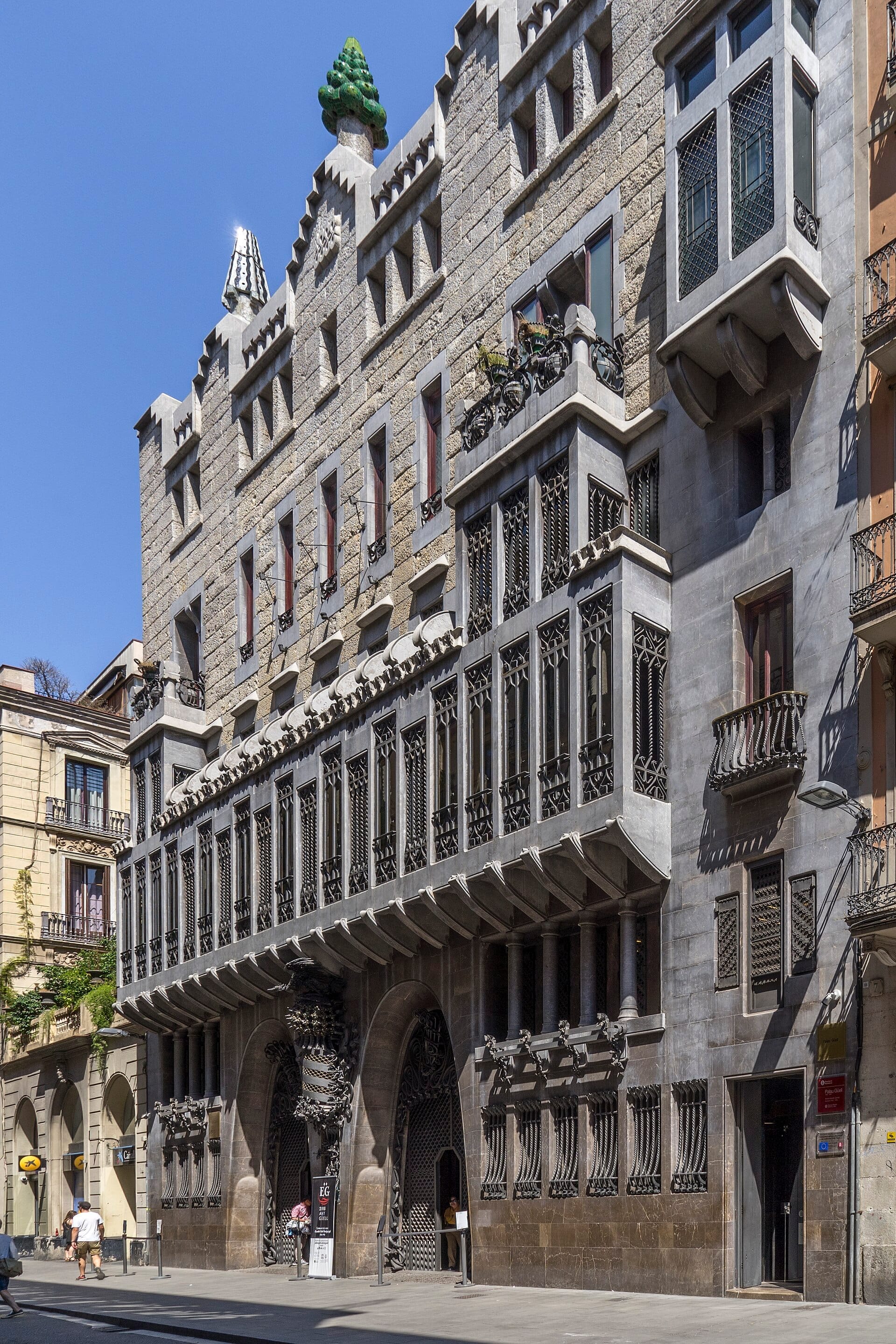
Palau Güell is a private mansion commissioned in 1886 by the textile industrialist Eusebi Güell for his family's use during Barcelona's Restoration-era social season. Gaudí, still in his late twenties, was given extraordinary creative latitude and an almost unlimited budget. The result was a building unlike anything else in the city: a six-floor structure on a narrow Raval street, completed in 1891 in time to receive dignitaries visiting the 1888 Universal Exhibition, and recognized as a UNESCO World Heritage Site as part of 'Works of Antoni Gaudí' in 1984.
This is not Gaudí in full flight the way Sagrada Família or Casa Batlló represent him. Palau Güell is Gaudí at the beginning of his mature thinking, still in conversation with Moorish, Venetian Gothic, and Catalan craft traditions, but already pushing each of them into something that belongs only to him. The building sits on a site of just 0.17 hectares, yet manages to contain elaborate reception halls, private chapels, servant quarters, stabling, and one of the most unusual roofscape terraces in European architecture.
💡 Local tip
Book tickets in advance through palauguell.cat. Palau Güell gets fewer visitors than Casa Batlló or La Pedrera, but timed-entry slots still fill up during spring and summer weekends.
The Approach and Entrance Facade
The building announces itself from the street with two parabolic iron gates set into a stone facade of pale Garraf limestone. The ironwork is extraordinary up close: wrought into organic, interlocking forms that look almost biological rather than forged. In the morning, the low Raval streetlight catches the texture of the stone and the curves of the gates in a way that afternoon flat light flattens completely. If you have any flexibility, aim to arrive before 11:00.
The entrance portal was designed to admit horse-drawn carriages directly into the ground-floor stables. You can still see the ramp that leads to the basement stable level, where brick mushroom columns support the floor above. The smell of old stone and the cool, slightly damp air down there is markedly different from the street, and the acoustic changes immediately, absorbing sound in a way that makes you instinctively speak more quietly.
The street itself, Nou de la Rambla, runs off the lower end of La Rambla. It is calmer than its famous neighbor but still sees consistent foot traffic. The building sits among ordinary residential blocks, which makes its facade all the more striking by contrast.
Tickets & tours
Live prices and dates from our booking partner. If you book, we may earn a commission at no extra cost to you.
Barcelona small group walking tour with boat ride
From 55 €Instant confirmationFree cancellationGoCar Barcelona discovering Gaudi
From 50 €Instant confirmationComplete Gaudi tour with Park Guell, Casa Batllo and Sagrada Familia
From 249 €Instant confirmationFree cancellationColonia Guell Combinat entrance with audio guide + train ticket from Barcelona
From 15 €Instant confirmation
The Central Hall and Interior Spaces
The heart of Palau Güell is the central hall, a double-height space covered by a parabolic dome perforated with small circular openings. When sunlight enters through these apertures, it creates a shifting pattern of light discs on the walls and floor, an effect that changes character every hour as the sun moves. In early afternoon the effect is at its most theatrical. By late afternoon in winter, with the building closing at 17:30, the interior feels almost chapel-like.
The materials throughout are deliberately rich: Eusèbi Güell wanted the house to communicate cultural ambition as much as wealth. Marble floors, carved wooden ceilings, forged iron balustrades, and ornate tilework accumulate floor by floor. The reception rooms on the principal floor retain their original configuration, and the spatial sequence from entrance to hall to private apartments gives a clear sense of how the Güell family lived and entertained.
The chapel on the upper floor is small but significant. It was used for daily family prayer and contains original fixtures. Gaudí paid unusual attention to its acoustics, and guides often point out that voices carry between floors through the dome structure in ways that were intentional rather than accidental.
The Rooftop Terrace and the Famous Chimneys
The rooftop is where most visitors spend the longest time, and it is genuinely one of the more unusual urban terraces in Barcelona. Twenty chimneys and ventilation towers emerge from the flat roof, each covered in trencadís, the smashed ceramic mosaic technique that Gaudí would develop much further in later works. The chimneys were added after 1890, after the main building was complete, and they are sometimes described as a prototype for the later roofscape experiments on Casa Milà.
The surface textures are worth examining closely. The ceramic fragments include tiles in deep greens, whites, and ochres, some spiral-wrapped, others faceted into geometric patterns. The effect is less polished than Park Güell's famous terrace but more experimental, as though Gaudí was still working out what the technique could become.
The views from the rooftop are partial rather than panoramic. You can see across the Raval roofscape toward the Gothic Quarter and catch glimpses of Montjuïc to the southwest, but this is not a viewpoint in the conventional sense. The terrace's interest lies in the sculptural objects themselves rather than what lies beyond them.
ℹ️ Good to know
Photography on the rooftop works best on overcast days. Direct midday sun in summer creates harsh shadows on the chimneys and blows out the white ceramic surfaces. Diffuse light shows the trencadís textures far more faithfully.
Opening Hours, Tickets, and Getting There
Palau Güell is open April through October from 10:00 to 20:00, and November through March from 10:00 to 17:30. Last admission is one hour before closing in both periods. The building closes on Mondays, except when Monday falls on a public holiday. It also closes on 1 and 6 January, 25 and 26 December, and during the last week of January for annual maintenance. Always confirm current hours and admission fees at palauguell.cat before visiting, as these details change seasonally.
Metro Line 3 (the green line) to Liceu station drops you almost at the building's doorstep. From the station exit, walk south along La Rambla for about 50 meters, then turn right onto Nou de la Rambla. Palau Güell is on the left within 30 meters. Several bus lines also stop nearby: lines 14, 59, 91, and 120 all serve the area, as does the Barcelona Bus Turístic at the Colom/Museu Marítim stop.
If you are planning a Gaudí-focused day in the city, consider pairing this with Sagrada Família or Casa Batlló to trace the arc of his career from early restraint to full expressionism. A dedicated Gaudí itinerary for Barcelona can help structure this across a single day.
Context: Why This Building Matters
Gaudí was 33 years old when he began work on Palau Güell. He had already completed Casa Vicens, a more overtly Moorish exercise in the Gràcia neighborhood, but the Güell commission was categorically more demanding: a large urban palace with formal social functions, technical complexity, and an owner sophisticated enough to both challenge and trust him.
The building was declared a Spanish Historical Artistic Monument in 1969, and its UNESCO inscription in 1984 came as part of the broader recognition of Gaudí's works. After decades of use by the Barcelona Provincial Council and a long renovation process, it reopened to the public in 2011 with restored interiors and improved visitor access. The renovation work was careful and largely unobtrusive, though some rooms carry interpretation panels that are more dutiful than inspiring.
For visitors with a wider interest in the neighborhood's architectural and cultural heritage, the nearby Gran Teatre del Liceu on La Rambla offers a very different but equally serious example of late 19th-century Catalan ambition.
Honest Assessment: Is It Worth Your Time?
Palau Güell is not the most immediately spectacular of Gaudí's buildings. Visitors expecting the color and drama of Casa Batlló's facade or the sheer scale of Sagrada Família may find it somewhat austere on first impression. The interior palette is darker, the spaces more formal, and the building's logic more legible once you understand the context it was created in. That context takes some engagement to absorb.
What Palau Güell offers that the more popular buildings do not is relative calm and genuine depth. Crowds are manageable for most of the year. The building is small enough that you can orient yourself quickly and spend time on details rather than being swept through on a tour. The rooftop is rarely congested. And the experience of tracing a single architect's development from this building to his later work adds a dimension that no single building can offer on its own.
⚠️ What to skip
Visitors with limited mobility should note that Palau Güell's historic structure means some areas may not be fully accessible. Check directly with the building via palauguell.cat before your visit if accessibility is a priority.
If you have already seen Sagrada Família and want to understand where it came from, Palau Güell is essential. If you have only a day in Barcelona and are choosing between major attractions, it belongs in the second tier, worth prioritizing once the headline sites are covered.
Insider Tips
- The basement stable level, with its mushroom-cap brick columns, is often overlooked by visitors rushing to the upper floors. Spend five minutes there before heading up — the structural logic is quietly remarkable.
- Audio guides are available and genuinely improve the experience here more than at many attractions. The building's symbolism (Catalan nationalist references, Masonic geometry debates, religious motifs) is not obvious from looking alone.
- The last hour before closing tends to be the quietest period for the rooftop terrace in summer. Most visitors front-load their time and the terrace clears considerably after 19:00 in the April-October season.
- Nou de la Rambla is calmer than La Rambla but still attracts petty theft. Keep bags secure, particularly when standing on the narrow pavement outside the entrance where street attention is concentrated.
- If you visit on a weekday morning in November or February, you may find the main hall almost entirely to yourself — a completely different experience from a Saturday in July.
Who Is Palau Güell For?
- Architecture enthusiasts wanting to understand Gaudí's development beyond the headline works
- Visitors on a second or third trip to Barcelona who have already covered the major sites
- Travelers who prefer depth over spectacle and are willing to engage with historical context
- Anyone interested in 19th-century Catalan cultural history and the relationship between industrialist patronage and artistic innovation
- Photographers looking for textural, detail-oriented subjects rather than wide-angle panoramas
Nearby Attractions
Other things to see while in Las Ramblas & El Raval:
- Font de Canaletes
A cast-iron fountain near Plaça de Catalunya, Font de Canaletes has stood at the top of La Rambla since 1892. It is where FC Barcelona fans flood the street after major victories, where a local legend promises you will return to the city if you drink its water, and where the everyday rhythm of Barcelona plays out in miniature.
- Gran Teatre del Liceu
The Gran Teatre del Liceu is one of Europe's largest and most storied opera houses, rising from La Rambla since 1847. With a gilded six-tier auditorium, a dramatic history of fire and rebirth, and a packed season running from September to July, it offers visitors far more than a night at the opera.
- Las Ramblas
Las Ramblas is Barcelona's most famous street, a 1.2 km tree-lined boulevard connecting Plaça de Catalunya to the waterfront. Free to walk, open around the clock, and flanked by markets, theatres, and historic facades, it anchors every first visit to the city. Go in knowing what you're getting and you'll enjoy it far more.
- MACBA – Museu d'Art Contemporani de Barcelona
MACBA is Barcelona's leading contemporary art museum, housed in Richard Meier's landmark white building in El Raval. From rotating collections to one of the city's most photogenic plazas, here's what to expect before you visit.
Planning a trip? Discover personalized activities with the Nomado app.