Museu Picasso Barcelona: What to Expect Before You Go
Spread across five medieval palaces on Carrer Montcada, the Museu Picasso holds 4,251 works that trace Pablo Picasso's artistic development from childhood sketches to his radical reinventions. It is one of the most visited museums in Spain, and for good reason.
Quick Facts
- Location
- Carrer Montcada 15-23, El Born, Barcelona
- Getting There
- Metro L4, Jaume I station (5-min walk)
- Time Needed
- 1.5 to 3 hours
- Cost
- Permanent collection: €12; temporary exhibitions extra (prices vary); check official site for concessions and free-entry days; check official site for concessions and free-entry days
- Best for
- Art lovers, history enthusiasts, architecture fans, first-time visitors to Barcelona
- Official website
- museupicassobcn.cat/en
What the Museu Picasso Actually Is
The Museu Picasso is not a sweeping survey of Picasso's entire career. That distinction matters before you arrive. The collection focuses tightly on his formative years, the periods he spent in Barcelona, Málaga, Madrid, and La Coruña before he decamped to Paris and rewrote modern art. If you come expecting Guernica or the most recognizable Cubist works, you will be surprised. What you find instead is arguably more interesting: the evidence of how an extraordinary mind developed, stumbled, experimented, and ultimately broke free of everything it had learned.
The museum opened in 1963, making it one of the first museums dedicated to Picasso during the artist's lifetime. It was established largely through the efforts of Jaume Sabartés, Picasso's personal secretary and lifelong friend, who donated his own private collection to the city of Barcelona. Picasso himself later contributed a major body of work, including the complete series of 58 paintings known as Las Meninas (1957), his radical reinterpretation of Velázquez's masterpiece. This series alone justifies the visit for anyone with a serious interest in art.
💡 Local tip
Book tickets online in advance via the official site. The museum regularly sells out, especially on weekends and during temporary exhibitions. On-site ticket purchases are not guaranteed.
The Building: Five Medieval Palaces Stitched Together
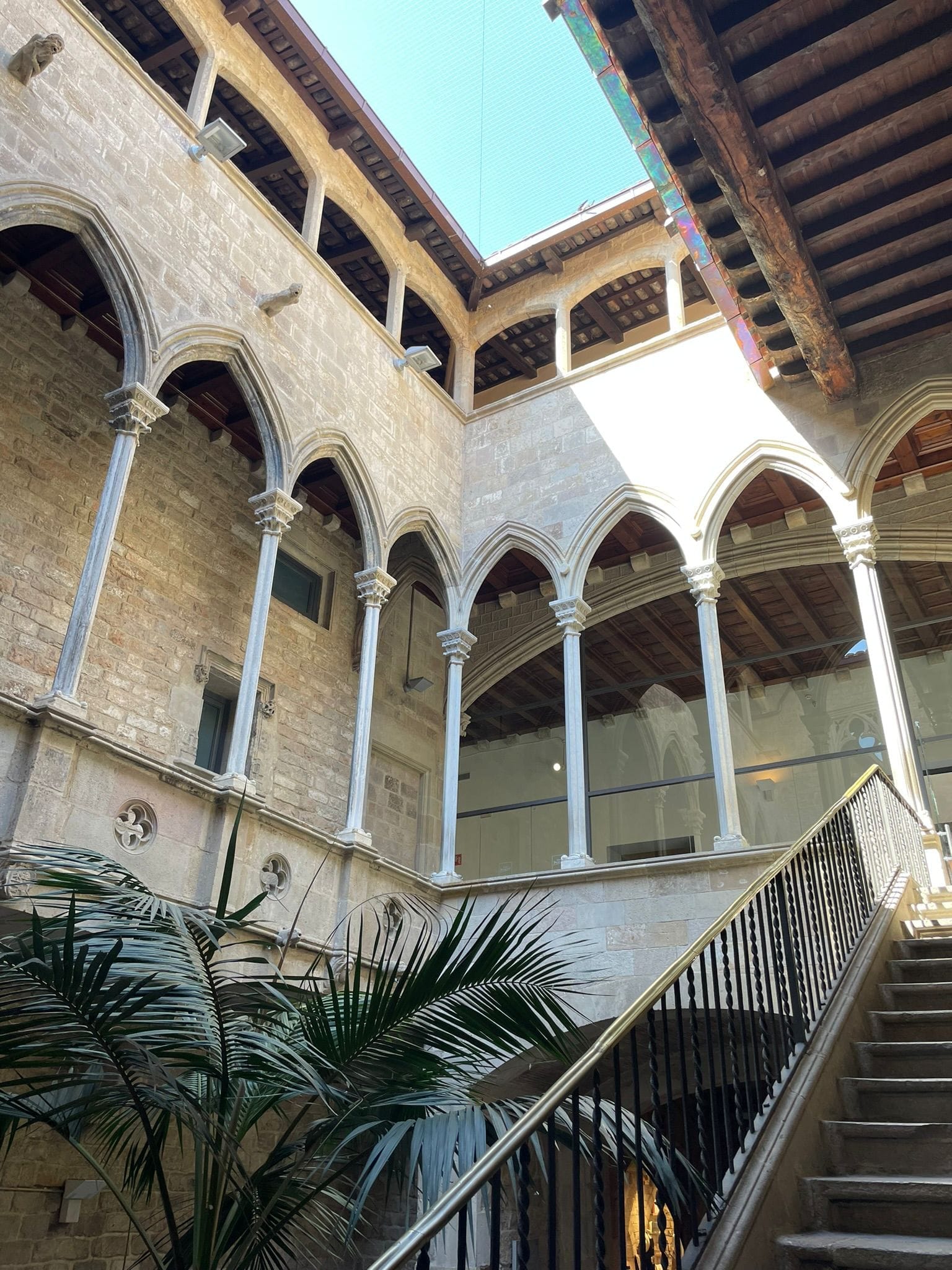
The physical setting is exceptional in its own right. The Museu Picasso occupies five contiguous Gothic and Renaissance palaces along Carrer Montcada: Palau Berenguer d'Aguilar, Palau del Baró de Castellet, Palau Meca, Casa Mauri, and Palau Finestres. Construction on some of these structures dates to the 13th and 15th centuries, and walking through them involves passing through stone courtyards with exterior staircases, low vaulted ceilings, and rooms where the proportions feel designed for an entirely different pace of life.
Carrer Montcada itself is one of the most architecturally coherent medieval streets in Barcelona. In the 15th century it was the address of choice for the city's merchant elite, and the palaces that line it were built to display wealth and civic ambition. Today the street is narrow enough that the upper floors of the buildings seem to lean toward each other overhead, and the stone underfoot is worn smooth by centuries of foot traffic. Arriving here from the wider streets of the surrounding neighborhood, the tonal shift is immediate.
The museum sits at the heart of El Born, a neighborhood that combines medieval streetscapes with one of the city's densest concentrations of independent bars, restaurants, and boutiques. Before or after your visit, the area rewards slow walking.
Tickets & tours
Live prices and dates from our booking partner. If you book, we may earn a commission at no extra cost to you.
Barcelona walking tour Picasso
From 25 €Instant confirmationFree cancellationBarcelona Picasso walking tour in French
From 35 €Instant confirmationFree cancellationBarcelona and Picasso Museum Tour
From 39 €Instant confirmationFree cancellationPicasso Museum Barcelona entry ticket and in-app audio tour
From 0 €Instant confirmation
The Collection: What You Will Actually See
The permanent collection of 4,251 works is organized chronologically, beginning with Picasso's earliest surviving pieces from around 1890, when he was not yet ten years old. The progression through his academic training, his Barcelona period, the Blue Period, and into the Las Meninas series follows a logical arc that makes the development of his style legible in a way that's rare in major museum collections.
The early academic paintings are surprisingly accomplished and occasionally surprising. Picasso at thirteen painted with the facility of someone three times his age. Seeing these works alongside the radical departures he made just a decade later reframes the narrative: this was not an artist who broke rules because he couldn't follow them. The contrast is one of the most instructive things the museum offers.
The Las Meninas series, displayed in a dedicated gallery, is where most serious visitors spend the most time. Picasso produced the 58 canvases in the summer of 1957 in concentrated bursts, and the series ranges from near-literal reinterpretation to near-total abstraction. Hanging together in sequence, the paintings work like a visual argument about what representation is and what it can be.
ℹ️ Good to know
The museum also holds an exceptional ceramics collection donated by Picasso's widow, Jacqueline Roque, in 1982. These pieces are frequently overlooked by visitors in a hurry but reward attention, especially for those interested in the later periods of his work.
Visiting by Time of Day: What Changes and When
The museum opens in the morning, and the first hour after opening tends to be the calmest. The medieval rooms are cool and relatively quiet at this hour, and the quality of natural light entering through the original windows is at its most flattering for looking at the older works. By late morning the crowd density increases substantially, and in the most popular galleries, particularly the Las Meninas room, maintaining comfortable viewing distance becomes harder.
Midday brings the peak of tourist traffic, which overlaps with school and tour groups. If your schedule allows, returning in the late afternoon, roughly the final two hours before closing, offers noticeably more space. The courtyards, which are easy to rush through in a crowd, become genuinely pleasant places to pause and look up at the medieval stonework.
The museum is closed on Mondays, which is standard for many Barcelona museums. Tuesday through Sunday it operates regular hours, though these do vary by season. Verify current times on the official site before planning your day.
⚠️ What to skip
Monday closures apply to the Museu Picasso. Arriving on a Monday is a common and avoidable mistake, particularly if you are following a tight itinerary.
Getting There and Practical Logistics
The most direct transit option is the Metro Line 4 (yellow line) to Jaume I station. From there, the walk to the museum entrance on Carrer Montcada takes approximately five minutes through the Gothic Quarter fringe and into El Born. The route passes along Carrer de l'Argenteria, which is a pleasant walk in its own right.
Several bus lines also serve the area, and the neighbourhood is walkable from many central Barcelona hotels. The Gothic Quarter is immediately adjacent, so combining a visit to the Museu Picasso with time in the Gothic Quarter or a stop at the nearby Basílica de Santa Maria del Mar makes good logistical sense.
If you are planning a broader art itinerary across Barcelona, the Gaudí sites guide and the nearby Basílica de Santa Maria del Mar pair well with a Museu Picasso visit, as all three are within a short walk of each other in the medieval city.
The museum entrance is on Carrer Montcada, a narrow street that does not accommodate vehicle drop-offs easily. If you are travelling with anyone who has mobility concerns, note that the medieval palaces have some uneven stone flooring and historic staircases. The museum does offer accessibility provisions, but it is worth checking directly with the museum in advance for specific requirements.
Who Should Reconsider This Visit
The Museu Picasso is not the right choice if you are primarily interested in Picasso's mature Cubist work or the large-scale political paintings. The collection deliberately focuses on his early development and specific later projects rather than offering a comprehensive retrospective. Visitors expecting the full scope of his career, or coming primarily because Picasso is a famous name, sometimes find the experience underwhelming. That is not a flaw in the museum; it reflects a precise curatorial choice. Going in with accurate expectations makes the difference.
Families with young children may find the content intellectually demanding for smaller kids, though the medieval architecture and courtyards tend to hold children's attention in ways the galleries sometimes don't. The museum is not particularly interactive, and there are limited amenities for very young visitors.
For families looking for more interactive options, the Barcelona with kids guide covers attractions better suited to younger visitors.
Photography and What to Bring
Photography is permitted in the permanent collection without flash. The medieval courtyard interiors photograph well in morning light when shadows are still long and the stone takes on a warm tone. The narrowness of Carrer Montcada outside makes exterior shots challenging from street level but gives the building's facade an impressive compressed quality.
The museum has a café and a well-stocked bookshop near the entrance. The bookshop carries a serious selection of Picasso publications, including out-of-print titles that are difficult to find elsewhere. It is worth leaving time at the end of your visit to browse there without rushing.
For context on the surrounding neighbourhood before you visit, the guide to El Born covers the area's history, best streets, and current restaurant scene. The neighbourhood has changed significantly over the past two decades and now combines its medieval bones with a contemporary cultural life that makes it one of the most interesting areas in the city to spend an afternoon.
Insider Tips
- The combined ticket covering the permanent collection and temporary exhibitions represents significantly better value than separate tickets if any temporary show is on during your visit. Check the museum website before booking.
- The first room of the permanent collection, displaying childhood sketches and school notebooks, is often rushed by visitors eager to reach the famous works. Spending time here makes everything that follows more meaningful.
- Carrer Montcada has several excellent small museums and galleries beyond the Museu Picasso, including the Museu de Cultures del Món. If you are already paying for transit and entry, extending your time on the street costs nothing.
- The museum courtyard areas between the palace buildings are sometimes less crowded than the galleries and offer a quiet place to sit and reorient between sections. They are architecturally remarkable and easy to overlook when moving quickly.
- Free admission is available every Thursday afternoon (5–8 pm) and the first Sunday of each month. These slots fill fast and often require advance booking; check the official site for current policies and availability.
Who Is Museu Picasso For?
- Art lovers interested in how great artists develop, not just the finished work
- Architecture enthusiasts who want to see authentic Gothic and Renaissance palace interiors
- First-time visitors to Barcelona looking for cultural grounding alongside the city's more famous landmarks
- Travellers following a Picasso-specific itinerary through Spain
- Visitors to El Born who want to combine a museum visit with the neighbourhood's food and bar scene
Nearby Attractions
Other things to see while in El Born (Sant Pere):
- Arc de Triomf
Built as the ceremonial entrance to Barcelona's 1888 Universal Exhibition, the Arc de Triomf stands at the top of a wide pedestrian promenade leading to Parc de la Ciutadella. It's free, always accessible, and one of the few grand monuments in the city where you can simply stop and look without queuing or paying.
- Barcelona Zoo
Occupying over 14 hectares inside the historic Parc de la Ciutadella, Barcelona Zoo is one of Europe's oldest urban zoos, open since 1892. It balances conservation work with family-friendly programming, though the setting inside a 19th-century park gives it a character quite different from modern safari-style zoos.
- Basilica of Santa Maria del Mar
Built entirely between 1329 and 1383, the Basílica de Santa Maria del Mar stands as the finest example of Catalan Gothic architecture in existence. Funded and constructed by the waterfront workers of the Ribera district, it carries a human story that its stone geometry quietly amplifies. Fewer crowds, better proportions, and a profound atmosphere make it one of the most rewarding stops in Barcelona.
- Cascada Monumental
The Cascada Monumental is a sweeping neoclassical waterfall fountain inside Parc de la Ciutadella, designed in 1875 by Josep Fontserè and partially shaped by a young Antoni Gaudí. Free to visit and open daily, it rewards early morning visitors with calm light and empty paths, and makes for a striking photography subject at any hour.
Planning a trip? Discover personalized activities with the Nomado app.