Maruhubi Palace Ruins: A Sultan's Forgotten Retreat North of Stone Town
Built for Sultan Barghash in 1882 and destroyed by fire just seventeen years later, Maruhubi Palace Ruins stand quietly along the northern coast road out of Stone Town. What survives, a Persian-style bathhouse, rows of coral-stone pillars, and a large freshwater pool, tells a fragmented but compelling story about Zanzibar's sultanate at the height of its power. This is a low-key, largely unvisited site that rewards the historically curious without demanding much of your day.
Quick Facts
- Location
- Approx. 4 km north of Stone Town, on the coastal road toward Bububu, Unguja
- Getting There
- Taxi from Stone Town, or board a Bububu-bound dala-dala and alight near the palace entrance
- Time Needed
- 45–90 minutes
- Cost
- Entry may be free or a small fee may apply — confirm locally before visiting, as reports conflict
- Best for
- History enthusiasts, architecture lovers, travelers who want to step off the tourist circuit
- Official website
- utaliismz.go.tz/sites
What Maruhubi Palace Ruins Actually Are
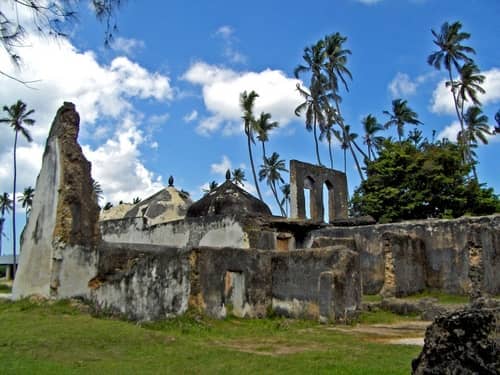
The Maruhubi Palace Ruins are the remains of a substantial royal residence commissioned by Sultan Barghash bin Said in 1882, roughly four kilometers north of what is now Stone Town. Built to house the sultan's large harem, the palace was one of several grand estates the Busaidi dynasty constructed around Unguja during the late nineteenth century. In 1899, fire destroyed the main building. What remains today are coral-stone columns, a colonnaded veranda structure, an ornate Persian-influenced bathhouse, and the original water tanks, now overgrown with lilies.
Unlike the heavily interpreted heritage sites in Stone Town's historic core, Maruhubi is a raw ruin. There are no exhibit panels explaining the frescoes or floor plans, no audio guides, and on most days, no crowds. You are largely left to read the place yourself, which is either its appeal or its limitation depending on what you are looking for.
ℹ️ Good to know
Admission: Visitor reports conflict between free entry and a small fee. Bring a small amount of Tanzanian shillings and be prepared to pay. Confirm the current situation when you arrive.
The Architecture: Reading What Survived the Fire
The most striking feature of the ruins is the colonnade: rows of tall, slender pillars that once supported the palace’s upper storey and balcony. Their proportions are distinctly Indo-Arab, reflecting the hybrid architectural tradition that shaped Zanzibar's built environment across the nineteenth century. The coral-stone construction is rough-textured and pitted, and climbing plants have worked their way into many of the joints, blurring the line between ruin and landscape.
The Persian-style bathhouse is the most architecturally intact structure on the site. Its design reflects the strong Persian influence that ran through Omani court culture, the sultans of Zanzibar being descendants of the Busaidi dynasty of Oman. The bathhouse features separate bathing areas that stand in notable contrast to the surrounding decay.
For travelers interested in how this fits into Zanzibar's broader built heritage, the Stone Town architecture guide provides useful comparative context, covering the Indian, Arab, and European layers that define the island's historic streetscapes.
The water tanks and garden pond remain among the grounds’ features, now overgrown with lilies and vegetation. Today it sits green and still, surrounded by vegetation, and gives the site a slightly melancholic quality that many visitors find more evocative than any polished museum display.
Tickets & tours
Live prices and dates from our booking partner. If you book, we may earn a commission at no extra cost to you.
Zanzibar catamaran and snorkelling tour to Mnemba Marine Park
From 114 €Instant confirmationFree cancellationNyerere National Park two-day safari with two game drives
From 866 €Instant confirmationFree cancellationSerengeti National Park private three-day safari from Zanzibar
From 2.144 €Instant confirmationFree cancellationZanzibar north coast sunset dhow cruise
From 42 €Instant confirmationFree cancellation
The Historical Context: Sultan Barghash and the Sultanate's Peak
Sultan Barghash bin Said ruled Zanzibar from 1870 to 1888, a period that coincided with the island's greatest economic and political reach, and also the beginning of its decline under sustained British pressure to end the slave trade. He was an ambitious builder: Maruhubi was one of several palaces associated with his era, alongside Chukwani and Mtoni. Mtoni Palace, another ruin slightly further up the same coastal road, predates Maruhubi by several decades and is associated with the generation before Barghash.
Barghash's Zanzibar was both a trading empire and a pressure point in the broader politics of East Africa. If you want to understand the full moral weight of this era, the Slave Trade Museum in Stone Town is essential context, covering the mechanisms of the trade that funded these palaces in uncomfortable detail.
The fire of 1899 came eleven years after Barghash's death, by which point the British Protectorate was firmly established and the political world that had produced Maruhubi had effectively ended. The ruins were never rebuilt.
What a Visit Feels Like at Different Times of Day
Morning is the most agreeable time to visit. The coastal breeze comes off the channel, the light is soft and low enough to pick out the texture in the coral-stone columns, and the site is usually empty except for local residents who cut through on foot. The smell is a mix of sea salt, vegetation, and the faintly damp stone that characterizes open ruins in a tropical climate.
By midday the site bakes. There is limited shade in the open sections around the pool, and the pale stone and bleached ground reflect heat upward. If you visit in the middle of the day, the bathhouse interior at least offers some shelter. Wear light clothing and bring water; there are no vendors inside the ruins.
In the late afternoon, particularly in the dry season from June to October, the light turns golden and the contrast between the standing pillars and the surrounding greenery becomes photogenic in a straightforward way. The site is rarely busy at any hour, but late afternoon draws the occasional small tour group completing a northern Stone Town circuit. Even then, the scale of the ruins absorbs visitors without feeling crowded.
⚠️ What to skip
During the rainy seasons (typically November and March–May), the ground around the ruins and pool becomes slippery and uneven underfoot. Sturdy footwear is strongly recommended, and some areas may be muddy enough to discourage exploration.
Getting There and Combining with Nearby Sites
The straightforward option is a taxi from Stone Town. The drive is short; the site is recognizable from the road. Agree the fare before departure; negotiate a return trip with the driver if needed.
Budget travelers can take a dala-dala bound for Bububu from Stone Town and ask to be let off at the Maruhubi Palace entrance. The dala-dala network is the primary local transport on Unguja, and the Bububu route is well established. Confirm the stop name with the driver before boarding.
Maruhubi fits naturally into a half-day loop that also takes in the Mtoni Palace Ruins (a short distance further north) and, on the return to Stone Town, a stop at the Old Dispensary on the Stone Town waterfront. If you are spending multiple days in the city, the Stone Town walking guide maps out how these northern ruins connect to the city's historic core.
Photography and Practical Notes
The colonnade photographs best from the west side in morning light, when shadows fall between the pillars and the texture of the coral stone is most visible. The pool, despite its neglected appearance, produces strong reflections in calm conditions and makes for a more interesting composition than the straightforwardly ruined structures. A wide-angle lens is more useful than a telephoto here; the ruins reward environmental framing.
Accessibility is limited. The site has uneven ground throughout, with rubble, tree roots, and patches of bare earth between sections. Wheelchair access or step-free movement is not feasible across most of the site based on current descriptions. Visitors with limited mobility should factor this in before making the journey.
There are no toilet facilities, food vendors, or water points at the site. Stock up in Stone Town before leaving.
Who Should Visit, and Who Should Not
Maruhubi rewards travelers who find value in quiet, context-dependent ruins: people who have already read something about the Busaidi sultanate, or who are building a picture of Zanzibar beyond the beach. It is not a polished attraction. If you are expecting signage, a visitor center, or a dramatic ruin on the scale of a European castle, the reality will disappoint.
Travelers with only a day or two on Unguja should weigh Maruhubi against the more layered experiences inside Stone Town itself. The House of Wonders and the Hamamni Persian Baths both offer more interpretive depth in a shorter visit. Maruhubi makes most sense as an add-on to a longer Stone Town day, not as a destination in its own right unless history is your primary interest.
Families with young children may find the uneven terrain and lack of facilities frustrating. The site has genuine atmosphere but nothing specifically child-oriented. Couples, solo travelers, and small groups with an interest in history or architectural photography are the natural audience.
Insider Tips
- Combine Maruhubi with Mtoni Palace Ruins in a single taxi run: both are on the same coastal road heading north, and the driver can loop you back to Stone Town. The total time for both sites is rarely more than two hours.
- Ask your taxi driver to take the coastal road rather than the inland route. The sea views on the approach add context to the site's original position as a coastal retreat.
- The bathhouse interior provides the best shelter from midday sun and is also the most detailed surviving structure. Spend time there before moving to the exposed colonnade and pool.
- If the entrance appears unattended, look for a caretaker nearby before assuming entry is free. A small voluntary or nominal fee may be expected and is worth paying to support basic site maintenance.
- Morning light between roughly 7am and 9am gives the best conditions for photographing the pillars. By 10am the sun is high enough to flatten the texture in the stone.
Who Is Maruhubi Palace Ruins For?
- History travelers building a picture of Zanzibar's sultanate era
- Architecture enthusiasts interested in Indo-Arab and Persian-influenced design
- Photographers looking for quiet, atmospheric ruins without tourist crowds
- Visitors who want to step away from Stone Town's busy streets for an hour or two
- Those pairing a cultural itinerary with the nearby Mtoni Palace Ruins
Nearby Attractions
Combine your visit with:
- Bwejuu Beach
Bwejuu Beach sits on Unguja's southeast coast, about 50 km from Stone Town, and delivers something increasingly rare on Zanzibar: a long stretch of sand without the resort crowds. The water is calm, the village is small, and the pace is slow. It suits travelers who want a beach day that feels like an escape rather than a performance.
- Cheetah's Rock Wildlife Sanctuary
Cheetah's Rock Wildlife Sanctuary is a small, guided wildlife experience on Unguja where visitors walk alongside rescued cheetahs, interact with servals, and meet a rotating cast of African species in semi-natural enclosures. It is expensive, deliberately exclusive, and unlike anything else on the island.
- Chumbe Island Coral Park
Chumbe Island Coral Park sits off Zanzibar's southwest coast and protects one of the Indian Ocean's most intact coral reef ecosystems. Reaching it requires advance planning, a boat transfer, and a genuine interest in marine conservation — but for the right traveler, nothing on the island compares.
- Kidichi Spice Farm & Persian Baths
A few kilometers inland from Zanzibar's northern coast road, the Kidichi Persian Baths preserve a rare piece of Omani sultanate architecture, complete with decorative plasterwork and domed ceilings. Paired with a working spice farm, this site offers a quieter, more considered alternative to the busier spice tours closer to Stone Town.
Planning a trip? Discover personalized activities with the Nomado app.