Mardi Gras World: Inside the Float Factory That Keeps Mardi Gras Alive
Mardi Gras World is a working float-building warehouse on the Mississippi River where you can walk among giant parade sculptures in progress. It operates year-round and offers a behind-the-scenes look at the craftsmanship behind New Orleans' most famous celebration.
Quick Facts
- Location
- 1380 Port of New Orleans Place, CBD / Warehouse District, New Orleans, LA 70130
- Getting There
- Free shuttle from central New Orleans; walkable from Warehouse District and Convention Center
- Time Needed
- 1 to 1.5 hours
- Cost
- Admission is paid; check mardigrasworld.com for current pricing.
- Best for
- Families, first-time visitors, culture and history lovers, photography
- Official website
- www.mardigrasworld.com
What Mardi Gras World Actually Is
Mardi Gras World is not a museum in the conventional sense. It is an active, working float-building facility covering roughly 300,000 square feet along the Mississippi River, where the props and parade floats for New Orleans' Mardi Gras krewes are designed and constructed year-round. The attraction opens its warehouse doors to the public daily, so tours move through spaces where sculptors, painters, and fabricators are often still at work on the next season's floats.
The facility is operated by Kern Studios, a family business with roots going back to 1947 when Blaine Kern Sr., later nicknamed 'Mr. Mardi Gras,' began building floats for local krewes. Kern passed away in 2020, and the operation remains family-run. The public-facing attraction opened in 1984 and moved to its current riverside location in 2008. What makes this place unusual is precisely that it is not frozen in time: the floats you see are in various states of construction or retirement, and the smell of fresh paint, foam dust, and sawdust is real.
💡 Local tip
First admission is at 9:30am and last admission is at 4:30pm. The facility closes at 5:30pm daily. Plan roughly 60 minutes for the full guided tour experience.
The Tour: What You Walk Through
Tours are guided and last roughly 45 to 60 minutes, followed by free time to explore the main float storage areas and photo opportunities. The guide introduces you to the history of Mardi Gras, the krewe system, and the Kern family's role in shaping the modern parade aesthetic. You learn, for example, that the same papier-mache and sculpting traditions used in the 1940s still inform how many figures are made today, even as fiberglass and foam have taken over for structural components.
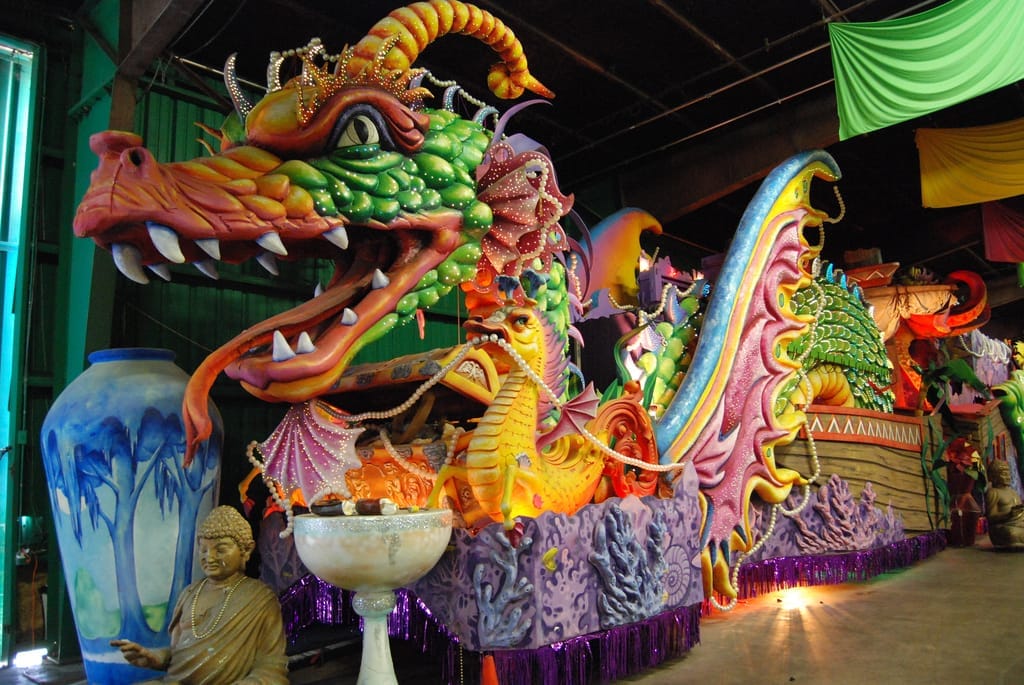
The scale of the warehouse is the first thing that registers. Floats are enormous up close in a way that television coverage does not convey. A standard parade float can stand 20 feet or taller, and the figures mounted on them, cartoon kings, mythological creatures, giant food items, satirical politicians, are detailed and technically impressive. Some older figures are kept as display pieces, their paint faded but their craftsmanship still legible. Others are clearly mid-project, wire armatures half-covered in foam or primed but unpainted.
After the guided portion, visitors typically have access to costume pieces: feathered headwear, capes, and beads that can be worn for photos. This section is predictably popular with families and groups. If you are not interested in costume photography, you can use the free time to walk the outer aisles and look more closely at individual floats.
Tickets & tours
Hand-picked options from our booking partner. Prices are indicative; availability and final rates are confirmed when you complete your booking.
Spooky kid-friendly family ghost tour
From 32 €Instant confirmationFree cancellationWalking the Devil's Empire tour with HELLVISION™ in New Orleans
From 32 €Instant confirmationFree cancellationThe New Orleans haunted cemetery city bus tour
From 43 €Instant confirmationFree cancellationWhitney Plantation Tour
From 72 €Instant confirmationFree cancellation
Morning vs. Afternoon: When to Visit
The first tours of the day, starting around 9:30am, move through a quieter warehouse. Fewer tour groups overlap, workers are more likely to be actively on-site rather than on break, and the light in the warehouse feels more workmanlike and honest. If you are interested in the craftsmanship rather than the spectacle, morning is the better choice.
Midday and early afternoon tours tend to be busier, especially when cruise ships are docked at the nearby terminal or when convention groups are in town. The experience does not change meaningfully, but the guided portion can feel more rushed when groups are large. By mid-afternoon the facility can take on more of a theme-park cadence, with a steady procession of tour groups cycling through. If you are visiting on a weekday outside of peak convention season, this is less of an issue.
ℹ️ Good to know
Mardi Gras World operates year-round, including during actual Mardi Gras season. However, in the weeks immediately before Mardi Gras (typically February), float production is at peak intensity and the warehouse atmosphere is noticeably more charged. Book ahead if visiting in January or February.
The History Behind the Spectacle
New Orleans Mardi Gras is one of the longest-running public celebrations in North America, with French colonial roots dating to the early 18th century. The parade tradition, with elaborate floats organized by private social clubs called krewes, developed significantly in the 19th century. Kern Studios entered this ecosystem in 1947 and eventually became the dominant supplier of parade floats, producing work for dozens of krewes across Louisiana and beyond.
Understanding the krewe system helps contextualize what you see in the warehouse. Each krewe has its own theme, aesthetic, and annual parade concept, and Kern Studios builds to those specifications. The tour touches on some of this history, though visitors who want a deeper cultural and historical dive should consider pairing the visit with the New Orleans Jazz Museum or consulting a dedicated New Orleans history guide before arriving.
The facility also holds pieces built for events well beyond New Orleans, including work for Super Bowl halftime shows and large-scale entertainment productions. This breadth is mentioned on the tour and gives a sense of how the fabrication skills developed for Mardi Gras have broader commercial applications.
Practical Details: Getting There and Getting Around
Mardi Gras World sits at 1380 Port of New Orleans Place, adjacent to the New Orleans Morial Convention Center on the river side. It is walkable from most of the Warehouse District and the lower end of the Central Business District, typically a 10 to 15 minute walk from the edge of the French Quarter along the riverfront.
A free shuttle operates from a central New Orleans pickup point (verify current pickup location directly with the venue before your visit). Onsite parking is available for $20. The St. Charles Streetcar does not run directly to the facility, but the Canal Street streetcar and RTA bus routes serve nearby stops. Ride-hailing via Uber or Lyft is straightforward from anywhere in the city.
The warehouse spaces are large and open, which makes them physically manageable for most visitors. Floors are concrete throughout, so comfortable closed-toe shoes are practical. Because this is a working facility, some areas involve uneven surfaces or equipment. Visitors with mobility concerns should contact the venue directly to confirm current accessibility provisions before booking.
💡 Local tip
Photography is actively encouraged throughout the tour. Bring a wide-angle lens or use your phone's ultra-wide mode: the floats are genuinely large and difficult to capture in a single frame in the tighter warehouse aisles.
Honest Assessment: Is It Worth Your Time?
Mardi Gras World is a more substantive experience than its tourist-attraction framing suggests, but it is not without limitations. The guided tour leans toward accessibility over depth, and visitors with serious interest in folk art, parade history, or fabrication techniques may find the information surface-level. The costume photo opportunity at the end of the tour is cheerful but leans into the souvenir-experience mold.
For first-time visitors to New Orleans, especially those visiting outside of Mardi Gras season, this attraction provides genuine context for one of the city's defining cultural events. It answers a question that the parades themselves do not: how does all of this actually get made? If you are already deep into New Orleans culture, have attended multiple parades, or are on a tight schedule, your time might be better spent at Preservation Hall or exploring Frenchmen Street in the evening.
Travelers with children tend to get strong value here. The scale of the floats, the spectacle of the costume area, and the accessible storytelling of the tour hold attention well for kids roughly six and up. Visitors primarily motivated by nightlife or food will find this a daytime filler rather than a highlight.
If you are building a first itinerary for New Orleans, see our 3-day New Orleans itinerary for suggested sequencing, or check the Mardi Gras guide for context on how the parade season actually works.
Insider Tips
- The free shuttle is convenient but not always perfectly timed. If you are on a schedule, take a rideshare and use the $20 parking fee as a benchmark: it is rarely worth renting a car just for this stop.
- Ask your guide specifically about the older retired figures stored in the back sections of the warehouse. These tend to get less tour time but often show the most interesting craft history, including work from decades-old parades.
- If you visit in January or February, float construction is at its annual peak. The working areas are more active, noisier, and more visually interesting than during off-peak months. It is the closest you can get to the actual production environment.
- The costume photo area uses communal pieces handled by many visitors daily. If that is a concern, skip it and spend the free time in the aisles with the large floats instead, where you will have more space and better photo angles.
- Book tickets online in advance during convention season or school holiday weeks. Walk-up admission is usually available, but large convention groups can fill morning tours without much notice.
Who Is Mardi Gras World For?
- First-time New Orleans visitors wanting cultural context beyond the French Quarter
- Families with children aged 6 and up
- Visitors traveling outside Mardi Gras season who want to understand the parade tradition
- Photography enthusiasts interested in large-scale folk art and fabrication
- Travelers with a half-day to fill in the Warehouse District or CBD
Nearby Attractions
Other things to see while in Central Business District & Warehouse Arts District:
- Aquarium of the Americas
Sitting at the edge of the French Quarter along the Mississippi River, Audubon Aquarium draws visitors with its white alligators, African penguin colony, and immersive exhibits spanning the aquatic ecosystems of the Americas. Reopened in 2023 after a $41 million renovation that merged it with the former Insectarium, the facility is sharper and more focused than ever.
- Caesars Superdome
The Caesars Superdome is one of the most recognizable structures on the New Orleans skyline, a 73,208-seat domed arena that has hosted Super Bowls, Sugar Bowls, Essence Festival, and legendary concerts. Whether you're catching a Saints game or attending a major event, here's what you actually need to know before you go.
- Creole Queen
The Paddlewheeler Creole Queen is a 190-foot, three-deck sternwheeler that takes passengers out onto the Mississippi River for jazz dinner cruises and historical tours. Departing from the Poydras Street dock in the Central Business District, it offers one of the few ways to experience New Orleans from the water rather than from its streets.
- The National WWII Museum
Designated by Congress as the official WWII museum of the United States, The National WWII Museum in New Orleans is one of the most comprehensive war history institutions in the world. Spread across a six-acre campus with six pavilions, immersive exhibits, and a period dinner theater, it demands serious time and rewards serious attention.