Lost Lagoon: Stanley Park's Quiet Heart
Lost Lagoon is a 16.6-hectare freshwater lake sitting at the gateway to Stanley Park in Vancouver's West End. Free to visit at any hour, it draws birdwatchers, joggers, and anyone needing a few minutes of calm at the edge of a major city. The 1.75 km perimeter trail is one of the more underrated walks in Vancouver.
Quick Facts
- Location
- Stanley Park entrance, West Georgia Street, West End, Vancouver, BC
- Getting There
- Multiple bus routes along West Georgia St to Stanley Park entrance; short walk to the lagoon
- Time Needed
- 30–90 minutes (one full circuit is 1.75 km)
- Cost
- Free. No tickets or permits required.
- Best for
- Morning walkers, birdwatchers, couples, and anyone wanting calm green space near downtown
- Official website
- www.destinationvancouver.com/things-to-do/listings/lost-lagoon
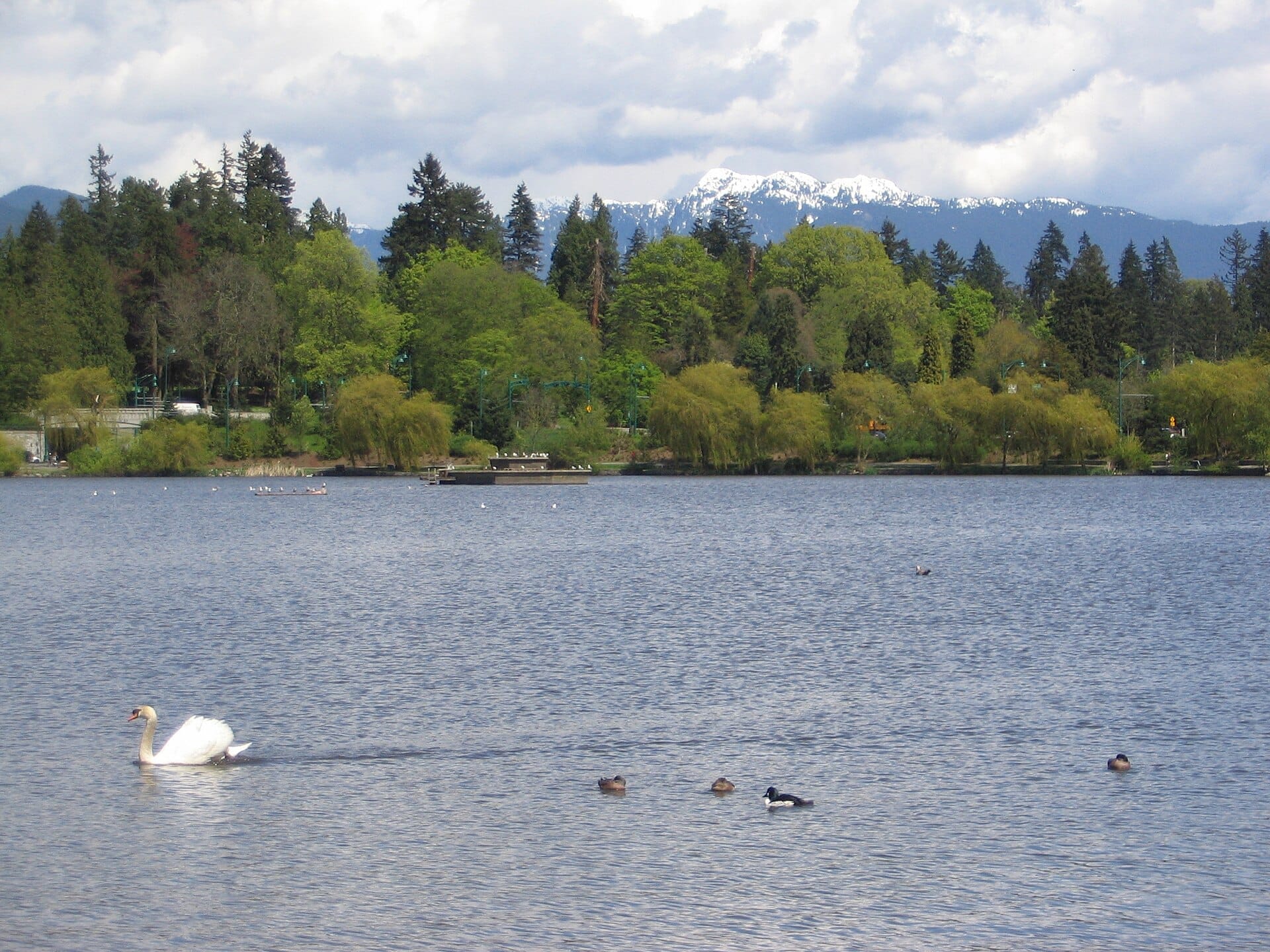
Lost Lagoon: an overview
Lost Lagoon is a 16.6-hectare (41-acre) freshwater lake at the southern entrance to Stanley Park, separated from the rest of the park's forests by a gentle trail and from the city by nothing more than the width of West Georgia Street. It is open around the clock as part of Stanley Park, and entry costs nothing.
The lagoon is technically artificial in its current form. Before 1916, this water was a tidal inlet connected to Coal Harbour. When the Stanley Park Causeway was constructed that year, the inlet was cut off, slowly transitioned to freshwater, and became the enclosed lake visitors see today. The name came later, officially adopted in 1922, drawn from a poem by E. Pauline Johnson, the Mohawk-English poet who spent her final years in Vancouver. In the Squamish language, the site is known as Ch'echxwa'7lech, meaning "gets dry at times," a reference to its tidal past.
💡 Local tip
The perimeter trail is 1.75 km and mostly flat, making it one of the most accessible walks in Stanley Park. A single loop takes about 25 to 35 minutes at an easy pace.
The Experience: Walking the Lagoon at Different Hours
Early mornings, usually before 8 a.m., are when Lost Lagoon is at its most atmospheric. The city noise from Georgia Street fades behind the treeline. The water is often still enough to mirror the surrounding Douglas firs, and the only sounds are the calls of Canada geese, the occasional splash of a diving duck, and the distant hum of the causeway. The light, especially in summer when the sun rises early and catches the water at an angle, turns the surface into a sheet of copper. This is also when you are most likely to spot migrating trumpeter swans in winter.
By mid-morning the trail picks up noticeably. Dog walkers, joggers, and cyclists (cycling is permitted on portions of the path) arrive in waves. The atmosphere shifts from contemplative to lively but never feels overwhelmed, partly because the 1.75 km loop keeps people moving rather than clustering. The fountain at the center of the lake, erected in 1936 to mark Vancouver's 50th anniversary, is easier to photograph once the sun climbs and the mist burns off.
Late afternoon in summer brings golden light across the western end of the lagoon, and the waterfowl become more active as feeding time approaches. In autumn, the surrounding canopy turns amber and rust, and the shorter days push the light lower and warmer. Winter mornings after frost are rare but striking: the edges of the lagoon occasionally ice over in a cold snap, and the usual crowds are thin enough that you can walk a full loop in near-silence.
Tickets & tours
Hand-picked options from our booking partner. Prices are indicative; availability and final rates are confirmed when you complete your booking.
The Lost Souls of Gastown tour
From 26 €Instant confirmationFree cancellationGrouse Mountain and Capilano Suspension Bridge Park tour
From 252 €Instant confirmationFree cancellationVancouver Art Gallery Tickets
From 19 €Instant confirmationFree cancellationVancouver Stanley Park cycling tour
From 56 €Instant confirmationFree cancellation
Wildlife: More Than Just Ducks
Lost Lagoon is a designated bird sanctuary, and the wildlife here is the main reason many visitors return repeatedly. The lagoon hosts Canada geese, mallards, great blue herons, double-crested cormorants, buffleheads, and coots, among many others. Trumpeter swans occasionally visit in winter — mute swans were removed from the lagoon in 2016 — and have become something of an unofficial symbol when they appear. Birders with binoculars will find the western shore's reedy edges particularly productive.
Raccoons are common at dusk and after dark, particularly near the south shore where visitors have historically (and against posted guidelines) fed the wildlife. Coyotes are occasionally spotted at the lagoon's edges in early morning; they are part of Stanley Park's established coyote population and should be observed from a distance.
⚠️ What to skip
Feeding the waterfowl is not permitted and is actively discouraged by park staff. It disrupts the birds' natural diet and contributes to poor water quality in the lagoon.
The History Behind the Name
E. Pauline Johnson, born Tekahionwake, was one of Canada's most celebrated poets of the late 19th and early 20th centuries. She moved to Vancouver in 1909 and spent her last years paddling Coal Harbour and the inlet that would become Lost Lagoon. Her poem of the same name described the eerie experience of returning to the inlet at low tide and finding the water gone, the inlet temporarily dry and strange. The name she gave it caught on informally, and the city made it official in 1922, two years after her death. A bronze monument to Johnson stands nearby in Stanley Park.
The illuminated fountain at the center of the lagoon was a gift from Robert Harold Williams to mark Vancouver's Golden Jubilee in 1936, when the landmark cast-iron centerpiece was installed; the fountain itself was later rebuilt in 1995 with new nozzles and a submerged light fixture atop the original base. It operates seasonally and is lit at night, casting soft color across the water's surface. The fountain is most visible from the south and east sides of the trail, and at night with the surrounding trees darkened, it becomes the focal point of the entire scene.
For a deeper understanding of Lost Lagoon's ecological and historical context, the Stanley Park article covers the broader park history, and the nearby Coal Harbour waterfront shows what the tidal connection once looked like.
Walking the Trail: A Practical Walkthrough
The perimeter trail is 1.75 km and essentially flat the entire way around, with compacted gravel and paved sections. It is well-marked and requires no map. Most people enter from the south side near the Stanley Park entrance off West Georgia Street, where there is a small parking area and bus stops. From there, you can go clockwise or counterclockwise; the western side of the trail tends to be quieter and offers the best views across the open water toward the fountain.
The Nature House, located on the lagoon's south shore, is run by the Stanley Park Ecology Society and offers interpretive information about the lagoon's wildlife and ecosystem. Check their schedule in advance, as it is not open every day.
Many visitors extend a lagoon loop into a longer outing by continuing onto the Stanley Park Seawall, which begins just beyond the causeway. The full seawall circuit is 9 km; even doing a partial stretch toward Second Beach adds meaningful variety to the walk.
Getting There and Practical Notes
Lost Lagoon sits at the edge of the West End, one of Vancouver's most densely populated residential neighborhoods, which means transit access is straightforward. Multiple bus routes run along West Georgia Street toward the Stanley Park entrance, and from the bus stop at the causeway junction, the lagoon is visible within a two-minute walk. There is limited street parking near the entrance, and the park operates paid parking lots nearby.
If you are staying in the West End, Lost Lagoon is within walking distance of most accommodations on Robson or Denman Street, typically 10 to 15 minutes on foot. For a broader overview of getting around the city, getting around Vancouver covers all transit options in detail.
The trail surface handles light rain well, but in sustained winter downpours some sections near the waterline can collect standing water. Waterproof footwear is worth packing from October through March. Summer visits require little preparation beyond sun protection on hot afternoons.
ℹ️ Good to know
Accessibility: The trail is largely flat and suitable for strollers and most mobility aids, though surface conditions vary by season. Dedicated wheelchair accessibility details are best confirmed with the Vancouver Park Board or Stanley Park Ecology Society before visiting.
Photography Tips
The fountain is the obvious focal point, and it photographs best in the evening when the lights activate and the sky has transitioned to deep blue. For wildlife, the eastern shore near the reeds offers close sightings of herons and ducks without much effort, and a telephoto lens (or a phone camera with optical zoom) is sufficient. Overcast days, which are common in Vancouver from November to April, produce flat, even light that works particularly well for bird portraits.
If you want the mirror reflection of the trees and fountain, visit at dawn before any wind picks up. Even a light breeze breaks the surface. The south shore near the Nature House offers the widest view across the lagoon with the fountain centered in the frame.
Insider Tips
- The western stretch of the trail, between the causeway underpass and the northwest corner of the lagoon, is consistently the quietest section regardless of time of day. If you want to stand and watch waterfowl without other visitors in the frame, start here.
- The fountain is illuminated after dark and the colors cycle through the evening. Access from the street is straightforward at night and the lagoon is well enough lit by the fountain to feel safe for a short walk, though the full perimeter trail is darker the further you get from the south entrance.
- The Stanley Park Ecology Society runs guided nature walks and birdwatching events from the Nature House on the south shore. These are low-key and worth checking if you have an interest in the lagoon's ecosystem beyond a casual stroll.
- Parking inside Stanley Park gets congested on summer weekends and holiday afternoons. Bus access along Georgia Street is fast and avoids this entirely. The walk from the bus stop to the lagoon is negligible.
- If you visit in late October or November, the surrounding deciduous trees are at peak color and the lower sun angle means warm light hits the water for most of the afternoon, not just at sunrise. Autumn is genuinely one of the better times to visit even with the increased chance of rain.
Who Is Lost Lagoon For?
- Birdwatchers and wildlife observers looking for easily accessible urban habitat
- Couples wanting a quiet walk close to downtown without committing to a long hike
- Families with young children who want a flat, safe trail with guaranteed animal sightings
- Photographers after dawn reflections, evening fountain shots, or waterfowl close-ups
- Anyone who wants a calm 30-minute reset within walking distance of the West End
Nearby Attractions
Other things to see while in West End:
- Brockton Point Totem Poles
The Brockton Point Totem Poles are an outdoor collection of nine First Nations poles carved by artists from the Squamish, Kwakwaka'wakw, Haida, Nisga'a, and Nuxalk Nations. Set in a meadow at the edge of Burrard Inlet inside Stanley Park, the site is free, open around the clock, and reachable on foot from Coal Harbour in about 20 minutes.
- Davie Village
Davie Village is the cultural and social centre of Vancouver's queer community, stretching along Davie Street between Burrard and Jervis in the West End. Free to explore at any hour, it offers a mix of LGBTQ+ history, independent cafés and bars, the iconic rainbow crosswalk at Davie and Bute, and Jim Deva Plaza, a public gathering space that doubles as a community memorial.
- English Bay Beach
English Bay Beach, also known as First Beach, has served as Vancouver's primary urban beach for over a century. Stretching along Beach Avenue in the West End, it offers free access to a sandy shoreline with mountain backdrops, reliable sunsets, and a lively summer atmosphere that fades into quiet morning solitude the rest of the year.
- Prospect Point
Perched at the northern tip of Stanley Park, Prospect Point offers some of Vancouver's most recognizable views: Lions Gate Bridge stretching across the First Narrows, freighters moving through Burrard Inlet, and the North Shore mountains beyond. Entry to the viewpoint is free, and the area has been welcoming visitors since 1889.