Brockton Point Totem Poles: Stanley Park's Most Photographed Cultural Site
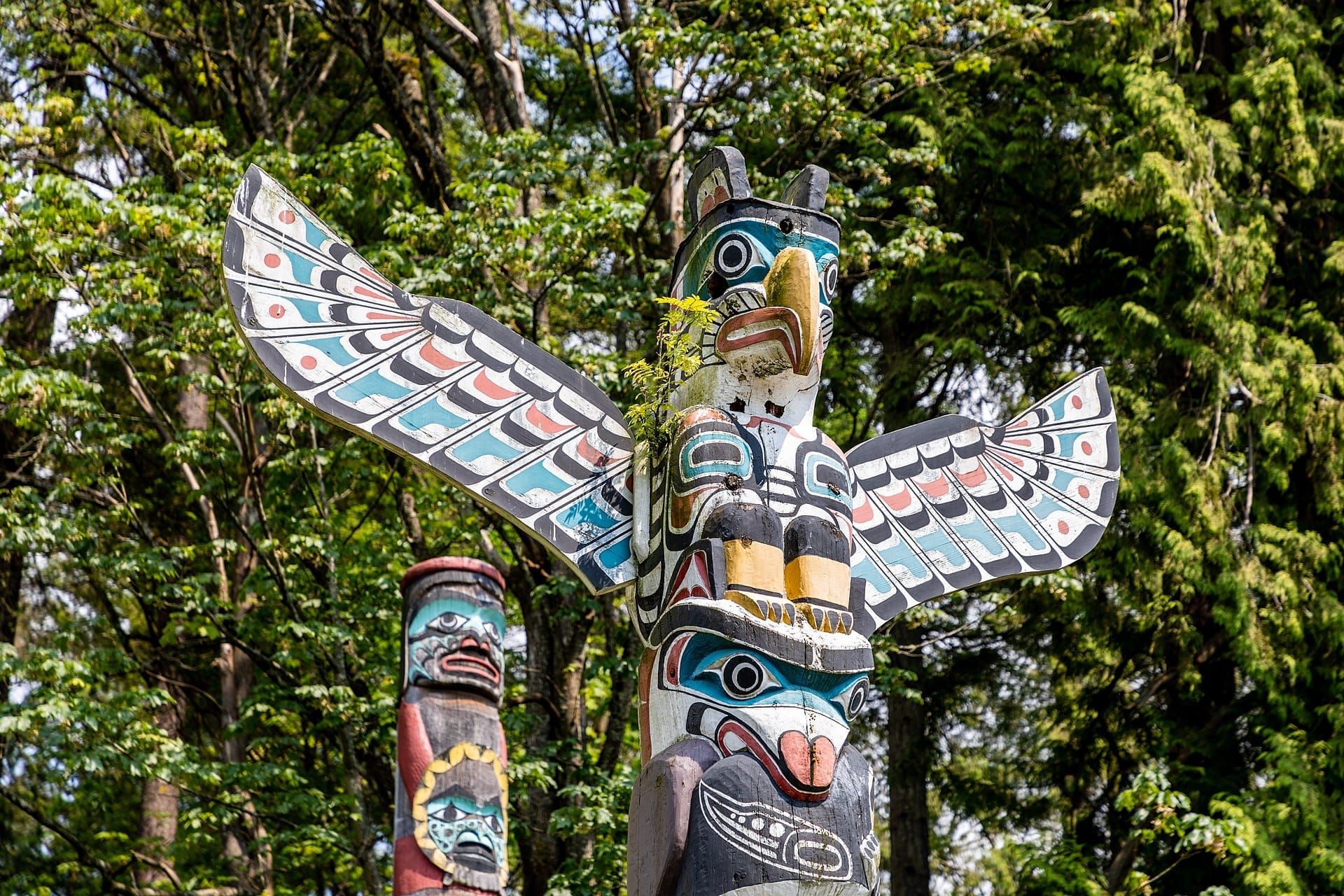
The Brockton Point Totem Poles are an outdoor collection of nine First Nations poles carved by artists from the Squamish, Kwakwaka'wakw, Haida, Nisga'a, and Nuxalk Nations. Set in a meadow at the edge of Burrard Inlet inside Stanley Park, the site is free, open around the clock, and reachable on foot from Coal Harbour in about 20 minutes.
Quick Facts
- Location
- Brockton Point, Stanley Park, Vancouver, BC
- Getting There
- Walk or cycle the Stanley Park Seawall from Coal Harbour (~20 min on foot, ~10 min by bike)
- Time Needed
- 20–40 minutes at the poles; longer if combined with a seawall walk
- Cost
- Free. No ticket required.
- Best for
- Cultural history, photography, family visits, and first-time Vancouver travelers
- Official website
- vancouver.ca/parks-recreation-culture/stanley-park.aspx
Understanding the totem poles
The Brockton Point Totem Poles are a collection of nine monumental carved poles standing in a grassy meadow on the northeastern tip of Stanley Park, overlooking Burrard Inlet. The poles were carved by artists from several distinct Indigenous nations: Squamish, Kwakwaka'wakw, Haida, Nisga'a, and Nuxalk. Each pole tells a different story through its figures, and no two are from the same tradition or visual language.
Totem poles are not religious icons in the Western sense. They are narrative and heraldic objects: records of lineage, crests, events, or ceremonial agreements. Some commemorate specific ancestors. Others tell origin stories. Standing in front of them without that context, they can appear as striking carvings. With even a basic understanding of what each figure represents, they become something considerably more interesting.
💡 Local tip
The interpretive signs at the site give some background on individual poles, but they vary in detail. If you want to understand what you're looking at before you arrive, search for the specific nations represented: Haida, Kwakwaka'wakw, and Squamish carving traditions each have distinct visual conventions that help distinguish one pole from another.
How the Site Came Together
The Vancouver Park Board began collecting totem poles for Stanley Park in the 1920s, a period when many Indigenous cultural objects across British Columbia were being removed from their original communities, sometimes by purchase, sometimes through other means. The context of that collection process is important: these poles were not originally created for a public park. They were created for specific communities, longhouses, and ceremonies.
The current arrangement at Brockton Point dates to the early 1960s, when the collection was consolidated and moved to this site from its earlier location in the park. Since then, the collection has been maintained and some poles have been replicated when originals deteriorated. The originals of several poles are now held in museum collections to prevent further weather damage, and the versions standing outdoors today are accurate carved replicas.
This history is worth knowing before you visit, not because it diminishes the site, but because it shapes what you're seeing. These are not poles that have stood in this meadow for generations. They are a curated display assembled by a city park authority, a fact that some visitors find changes how they experience the place. That said, the carving quality is genuine, the cultural traditions represented are real, and for many travelers this is their first direct encounter with Northwest Coast Indigenous art at this scale.
Tickets & tours
Hand-picked options from our booking partner. Prices are indicative; availability and final rates are confirmed when you complete your booking.
Grouse Mountain and Capilano Suspension Bridge Park tour
From 252 €Instant confirmationFree cancellationVancouver Art Gallery Tickets
From 19 €Instant confirmationFree cancellationVancouver Stanley Park cycling tour
From 56 €Instant confirmationFree cancellationWhistler, Shannon Falls and Sky Gondola tour from Vancouver
From 135 €Instant confirmationFree cancellation
The Experience at Different Times of Day
Early morning, before 8 AM, the meadow at Brockton Point is quiet. The inlet light at that hour is flat and cool, particularly on overcast days, which means the carved figures read clearly without harsh shadows. You can walk the row of poles slowly without navigating around tour groups, and the only sounds are seabirds and the distant hum of traffic on the Lions Gate Bridge to the west. This is the best time for unhurried observation and photography.
By mid-morning, particularly between 10 AM and noon in summer, the site draws its largest crowds. Tour buses park along Stanley Park Drive and groups of 20 to 40 people arrive in waves. The space itself is open enough that it rarely feels truly congested, but the experience shifts from contemplative to social. Families, school groups, and international visitors are all taking photographs, and it can be difficult to frame a shot without other people in it.
Late afternoon light in summer, roughly between 4 PM and 6 PM, hits the poles from the southwest and brings out the depth of the carvings well. The meadow grass and the inlet behind the poles take on a warmer tone. Crowds have typically thinned by this point as day-trippers move on. For photography, this window competes with early morning as the best of the day.
ℹ️ Good to know
Stanley Park is open 24 hours. The totem poles have no fence or barrier, so they are technically accessible at any hour. That said, the site has no overnight lighting, and visiting after dark offers little visibility of the carvings themselves.
Getting There and Getting Around
The most direct and enjoyable approach is on foot or by bicycle along the Stanley Park Seawall from the Coal Harbour entrance. On foot, plan for approximately 20 minutes from the park entrance at the bottom of Denman Street. By bike, the same route takes roughly 10 minutes. The path runs along the water's edge with views across Burrard Inlet toward the North Shore mountains.
By car, the poles are accessible via Stanley Park Drive, and there is pay parking in the immediate vicinity as well as at Brockton Oval nearby if the closer lot is full. Parking within Stanley Park fills quickly on summer weekends, so arriving before 9 AM or after 4 PM reduces the chance of a long search.
The terrain at Brockton Point is flat. The poles stand in an open meadow adjacent to the paved road and the seawall path, and the whole area is accessible by wheelchair and stroller without significant obstacles. Public washrooms are located at the site, which is worth noting given that the nearest alternatives along this stretch of the seawall are some distance away.
💡 Local tip
If you are combining this stop with a seawall walk, note that the full Stanley Park Seawall loop is approximately 9 km. Brockton Point sits roughly 2 km from the Coal Harbour entrance, so you can visit the poles and return the same way as a simple 4 km round trip without committing to the full loop.
Photography: What Works and What Doesn't
The poles are tall, and photographing them in full requires stepping back further than most visitors expect. The meadow gives you that space. A wide-angle lens or a phone in portrait orientation captures individual poles well; fitting the entire row in a single frame requires standing well back and accepting that some poles will be partially obscured by others.
The backdrop changes significantly depending on where you stand. From the seawall side, the inlet and North Shore mountains frame the poles behind them. From the inland side, the poles read against the forest canopy. On overcast days, the colours in the carved and painted surfaces are more saturated than in direct sun. Bring a polarizing filter if you shoot with a camera, as it cuts glare from painted surfaces on bright days.
One honest note: the site is heavily photographed, and the images that circulate online tend to be shot on clear summer days with empty foregrounds. Replicating that framing mid-day in July requires patience. If the photograph matters to you, the early morning visit is the reliable path.
Is it worth your time?
The Brockton Point Totem Poles are free, flat, and easy to incorporate into a broader Stanley Park visit. For first-time visitors to Vancouver, they represent a tangible and accessible introduction to Northwest Coast Indigenous carving traditions. The scale of the poles is genuinely impressive in person, and the inlet setting adds to the experience.
For travelers who have already spent significant time in British Columbia or who have visited institutions with deeper collections, this outdoor display may feel limited. The interpretive material on site is informative but brief, and without a guided tour or independent research beforehand, it is easy to walk away having looked at impressive carvings without understanding much about them.
Visitors with a serious interest in Northwest Coast Indigenous art will find more depth at the Museum of Anthropology at UBC, which holds one of the most significant collections in the world and provides extensive cultural context alongside the works. The Brockton Point site and the MOA are not competitors; they are different things, and both have value depending on what you're looking for.
⚠️ What to skip
This is not a site that rewards a long visit on its own. If you are driving specifically to see only the totem poles, a 20-30 minute stop is realistic. The site works best as part of a seawall walk or a broader Stanley Park itinerary.
Weather and Seasonal Considerations
Vancouver's climate is oceanic: mild winters, relatively dry summers, and significant rainfall from October through March. The totem poles are outdoors and uncovered, so a wet visit means wet ground and overcast skies. That is not necessarily a bad thing for photography, but if you are visiting in the rainy season, dress accordingly. For a broader picture of what to expect month by month, the Vancouver weather guide covers seasonal patterns in detail.
Summer (June through August) brings the driest conditions and the warmest temperatures, with July averaging around 18°C (64°F). This is peak visitor season across Stanley Park, and Brockton Point reflects that. Spring and autumn offer smaller crowds and softer light. Winter visits are quiet and atmospheric, with morning fog sometimes sitting low over the inlet behind the poles.
Insider Tips
- Arrive before 8:30 AM on summer days. The difference in crowd density between 8 AM and 10 AM is significant, and the morning light on the inlet is noticeably better for photographs.
- Walk past all nine poles before stopping to photograph any of them. Getting a sense of the full range before you start lets you prioritize the carvings that interest you most rather than spending all your time at the first pole you encounter.
- The gift shop near the site stocks books on Northwest Coast Indigenous art and carving traditions. Buying one here means your money stays closer to the site than purchasing online, and the better titles provide far more context than the interpretive signs.
- If you are cycling the seawall, the poles are easy to miss at speed because they sit slightly inland from the path. There is a small paved pullout area near the site where you can lock your bike and walk to the meadow.
- Combine the stop with a look at the view from Brockton Point itself, just a short walk east of the poles. On clear days you get a direct sightline toward the North Shore mountains across the inlet, with almost no urban infrastructure in the frame.
Who Is Brockton Point Totem Poles For?
- First-time visitors to Vancouver wanting a cultural landmark that doesn't require a ticket
- Families with children, given the flat terrain, nearby washrooms, and visually engaging scale of the poles
- Photographers looking for a well-known subject with genuine compositional variety
- Anyone already planning a seawall walk who wants to add a purposeful cultural stop
- Travelers interested in Northwest Coast Indigenous art as a starting point before visiting deeper collections elsewhere
Nearby Attractions
Other things to see while in West End:
- Davie Village
Davie Village is the cultural and social centre of Vancouver's queer community, stretching along Davie Street between Burrard and Jervis in the West End. Free to explore at any hour, it offers a mix of LGBTQ+ history, independent cafés and bars, the iconic rainbow crosswalk at Davie and Bute, and Jim Deva Plaza, a public gathering space that doubles as a community memorial.
- English Bay Beach
English Bay Beach, also known as First Beach, has served as Vancouver's primary urban beach for over a century. Stretching along Beach Avenue in the West End, it offers free access to a sandy shoreline with mountain backdrops, reliable sunsets, and a lively summer atmosphere that fades into quiet morning solitude the rest of the year.
- Lost Lagoon
Lost Lagoon is a 16.6-hectare freshwater lake sitting at the gateway to Stanley Park in Vancouver's West End. Free to visit at any hour, it draws birdwatchers, joggers, and anyone needing a few minutes of calm at the edge of a major city. The 1.75 km perimeter trail is one of the more underrated walks in Vancouver.
- Prospect Point
Perched at the northern tip of Stanley Park, Prospect Point offers some of Vancouver's most recognizable views: Lions Gate Bridge stretching across the First Narrows, freighters moving through Burrard Inlet, and the North Shore mountains beyond. Entry to the viewpoint is free, and the area has been welcoming visitors since 1889.