English Bay Beach (First Beach): Vancouver's Urban Shoreline at Its Best
English Bay Beach, also known as First Beach, has served as Vancouver's primary urban beach for over a century. Stretching along Beach Avenue in the West End, it offers free access to a sandy shoreline with mountain backdrops, reliable sunsets, and a lively summer atmosphere that fades into quiet morning solitude the rest of the year.
Quick Facts
- Location
- Beach Avenue & Denman Street, West End, Vancouver, BC
- Getting There
- Bus routes along Davie/Denman and Beach/Pacific streets; short walk from downtown core
- Time Needed
- 1–3 hours depending on season and activity
- Cost
- Free; beach area accessible 24/7, amenities seasonal
- Best for
- Sunset watching, summer swimming, West End walks, people-watching
About English Bay Beach
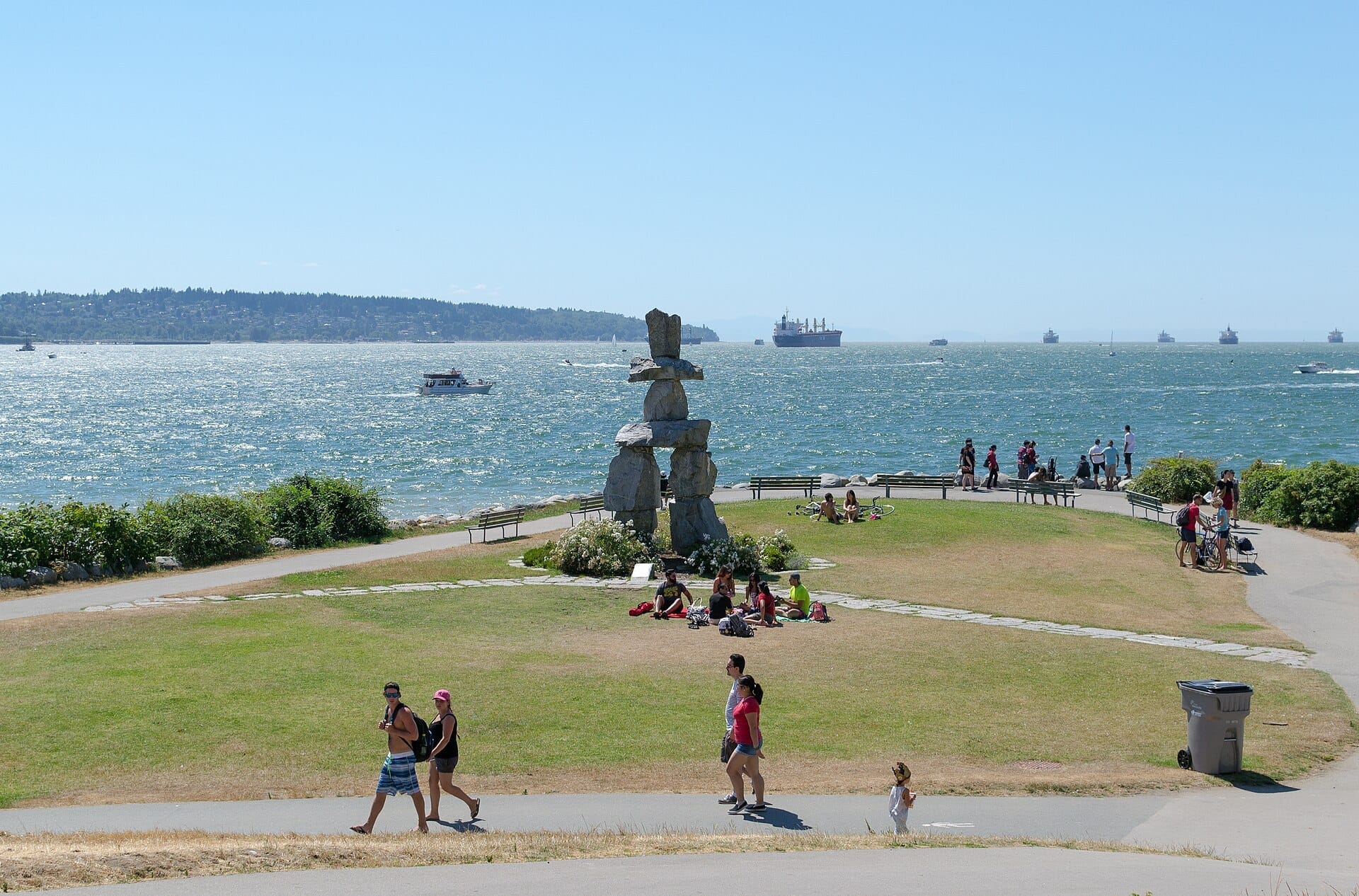
English Bay Beach, officially also called First Beach, sits at the western edge of Vancouver's West End neighborhood, where Beach Avenue curves south toward the entrance of Stanley Park. It is a broad, gently sloping sandy beach facing roughly west-southwest across English Bay toward the mountains of the North Shore and, on clear days, the distant outline of Vancouver Island. No admission fee, no barriers, no reservation required. It is simply there, and has been one of the city's primary public beaches for more than a century.
The beach itself stretches roughly 400 meters of open sand. At the north end, it transitions into the seawall path leading into Stanley Park. At the south end, a concession, the historic bathhouse, and the famous Inukshuk sculpture along Beach Avenue mark the transition before the path continues toward Sunset Beach. Denman Street, running one block inland, is the service spine: coffee shops, convenience stores, and restaurants that feed the steady flow of people moving between the beach and the neighborhood.
💡 Local tip
Arrive before 8 AM on a summer weekday if you want the beach largely to yourself. The light hits the water at a low angle, the sand is freshly raked, and the mountain backdrop across the bay is often reflected in the glassy surface near the shore.
The Experience by Time of Day
Early morning is a different beach entirely. Dog walkers, solo joggers, and open-water swimmers share the shore with almost no one else. The sound is mostly seagulls and the faint hiss of small waves on packed sand. The air carries that particular salt-and-seaweed smell of low tide, and the mountains across the bay are often sharply defined against a pale sky before the coastal haze builds.
By mid-morning on a summer weekend, the transformation is rapid. Families claim spots near the lifeguard stations, volleyball players take the nets, and the benches along Beach Avenue fill with people watching the water. Kayakers and paddleboarders launch from the northern end. It gets loud in the best possible way: children, music from someone's speaker, the occasional seaplane passing overhead on descent into Coal Harbour.
Sunset is when the beach performs. English Bay Beach faces almost directly west, which makes it one of the best places in Vancouver to watch the sun drop toward the water. On clear summer evenings, crowds gather along the seawall and across the sand starting around 7 PM. The Inukshuk sculpture near the south end becomes a focal point for photographs. The sky shifts from blue to amber to deep pink over the North Shore mountains. On the most spectacular evenings, the light reflects off the water in a way that makes even reluctant photographers reach for their phones. Bring something to sit on; the seawall benches fill fast.
ℹ️ Good to know
The Celebration of Light fireworks competition, typically held in late July and early August, uses English Bay as its launch point. English Bay Beach is the closest viewing area and draws very large crowds. If you plan to attend, arrive at least two hours early to secure a position on the sand.
Tickets & tours
Hand-picked options from our booking partner. Prices are indicative; availability and final rates are confirmed when you complete your booking.
Grouse Mountain and Capilano Suspension Bridge Park tour
From 252 €Instant confirmationFree cancellationVancouver Art Gallery Tickets
From 19 €Instant confirmationFree cancellationVancouver Stanley Park cycling tour
From 56 €Instant confirmationFree cancellationWhistler, Shannon Falls and Sky Gondola tour from Vancouver
From 135 €Instant confirmationFree cancellation
Historical Context: Over a Century as Vancouver's Beach
English Bay Beach has been a major Vancouver public beach since the late 19th century, when the Vancouver Park Board began developing the West End's waterfront. The first substantial concrete bathhouse at English Bay opened in 1905, and the beach quickly became a social anchor for a city that was still just a couple of decades old. Photographs from the early 1900s show crowds in full Victorian dress gathering at the shore, a pattern that has continued in very different attire ever since.
The surrounding West End neighborhood grew up around this shoreline. What was once a district of Victorian houses gradually densified into one of North America's most densely populated residential neighborhoods, a compact grid of apartment towers and low-rise buildings that still maintains a walkable, human-scaled street life. The beach has remained the neighborhood's living room throughout that transformation.
English Bay sits at the natural boundary between the West End and the beginning of Stanley Park, which means a visit here can easily extend into a longer walk along the Stanley Park Seawall without backtracking.
Swimming, Amenities, and Practical Details
The water temperature in English Bay peaks in July and August, typically reaching the mid-to-high teens Celsius (low to mid‑60s Fahrenheit). That is cold by most beach standards but tolerable for short swims, and regulars treat it as entirely comfortable. Lifeguards are on duty during summer months at designated stations; outside those hours and seasons, swimming is unsupervised.
Facilities at English Bay Beach include public washrooms, outdoor showers for rinsing off after swimming, a concession stand that operates in the warmer months, and a seasonal restaurant at the historic English Bay Bathhouse building near the north end of the beach. Bike rentals and rental boards are available nearby along Denman Street. There is no on-site parking lot directly at the beach; street parking on Beach Avenue and surrounding streets is metered and competitive on summer weekends.
Accessibility is good relative to most Vancouver beaches. A beach accessibility mat extends over the sand to the water's edge, and a beach wheelchair is available for loan during summer months. The seawall path itself is fully paved and flat, suitable for wheelchairs and strollers.
⚠️ What to skip
Summer weekend parking near English Bay is genuinely difficult. The practical solution is to arrive by bus or on foot from downtown (roughly 15–20 minutes walking from the core). Driving and circling for parking for 30 minutes to reach a free beach defeats the purpose.
Weather: When It Works and When It Doesn't
Vancouver's climate is temperate oceanic, which means summers are warm and relatively dry while the rest of the year tends toward overcast skies and frequent rain. The beach experience at English Bay is heavily weather-dependent. From late June through early September, clear days bring out the full version: warm sand, open water swimming, the sunset crowds, and the West End's outdoor cafe culture spilling down toward the shore.
Outside that window, the beach takes on a different character. A rainy November morning at English Bay, with grey water and low clouds obscuring the mountains, has its own atmosphere: solitary, quiet, and distinctly Pacific Northwest. The seawall is still walkable in rain if you're dressed for it, and the view toward the water has a particular brooding quality that photographs well in black and white. But if you're traveling to Vancouver specifically for a beach experience, the July-to-August window is the reliable bet, with June and September offering good odds but less certainty.
For a full picture of when to plan your visit around weather patterns, the best time to visit Vancouver guide covers seasonal conditions in detail.
Getting There and Getting Around
English Bay Beach is located at approximately 1795–1800 Beach Avenue, at the intersection of Beach Avenue and Denman Street in the West End. Several TransLink bus routes run along Davie Street and Denman Street within a short walk of the beach. From downtown Vancouver, it is about a 15 to 20 minute walk west through the West End grid, or a shorter walk if you are already in the neighborhood.
The beach connects directly to the seawall path, making it a natural start or end point for a longer coastal walk. Heading north along the seawall takes you into Stanley Park and eventually to Prospect Point. Heading south takes you through Sunset Beach and False Creek Ferries toward Granville Island, making it possible to string together a substantial half-day route entirely on foot or by bike.
Uber and Lyft both operate in Vancouver, making drop-off and pickup straightforward if you prefer not to walk. Taxis are also available. Cycling is an excellent option since the seawall path is dedicated and flat; bike rental shops operate on Denman Street within a block of the beach.
Photography Notes
English Bay Beach is one of the most photographed locations in Vancouver, which means standing out requires either timing or composition. The obvious shot is the sunset, and it is obvious for good reason: the west-facing orientation, the island silhouettes, and the mountain ridgeline combine reliably. Use the Inukshuk sculpture as a foreground anchor, but be prepared to compete with dozens of other photographers on clear summer evenings.
For something less conventional, the pre-dawn light in summer creates a soft, blue-toned atmosphere on the nearly empty beach. Wide-angle shots from low on the sand during incoming tide, with the West End apartment towers framing the right side, capture the urban-coastal juxtaposition that defines English Bay. The seawall benches and the bathhouse building also offer strong mid-century architectural details worth a closer look.
If you are building a day around photography, consider pairing English Bay with Coal Harbour to the northeast, which offers seaplane traffic, mountain reflections, and a very different urban waterfront character within easy walking distance.
Insider Tips
- The benches along Beach Avenue directly above the sand fill within minutes on clear summer evenings. The retaining wall itself, though less comfortable, offers an elevated sightline that is actually better for watching the sunset and is usually available even when benches are taken.
- The English Bay Bathhouse building (the small heritage structure at the north end of the beach) has housed seasonal restaurants with covered patios that work well in light rain. It is easy to miss because most visitors walk straight past it toward the sand.
- If you want to see English Bay at its most dramatic, visit during a winter storm warning. The waves in English Bay during a strong Pacific storm are unusually large for an urban beach, and the seawall becomes a front-row seat to significant surf. Stay behind the barriers and watch your footing; the seawall gets spray.
- Denman Street, one block inland, has better coffee and food options than anything on Beach Avenue itself. Stock up before heading to the sand rather than relying on the summer concession stand.
- The Celebration of Light fireworks event (usually late July and early August) draws some of the largest crowds English Bay sees all year. The sand fills completely, and Beach Avenue closes to traffic. If you are not specifically there for the fireworks, avoid the area entirely on those nights.
Who Is English Bay Beach For?
- Sunset watchers looking for one of the most reliable west-facing viewpoints in Vancouver
- Casual summer beach days without the logistics of driving to a remote location
- West End locals and hotel guests wanting a walkable shoreline within minutes of downtown
- Seawall walkers using the beach as a starting point for longer coastal routes into Stanley Park or toward Granville Island
- Visitors who want a genuine neighborhood beach experience rather than a curated tourist attraction
Nearby Attractions
Other things to see while in West End:
- Brockton Point Totem Poles
The Brockton Point Totem Poles are an outdoor collection of nine First Nations poles carved by artists from the Squamish, Kwakwaka'wakw, Haida, Nisga'a, and Nuxalk Nations. Set in a meadow at the edge of Burrard Inlet inside Stanley Park, the site is free, open around the clock, and reachable on foot from Coal Harbour in about 20 minutes.
- Davie Village
Davie Village is the cultural and social centre of Vancouver's queer community, stretching along Davie Street between Burrard and Jervis in the West End. Free to explore at any hour, it offers a mix of LGBTQ+ history, independent cafés and bars, the iconic rainbow crosswalk at Davie and Bute, and Jim Deva Plaza, a public gathering space that doubles as a community memorial.
- Lost Lagoon
Lost Lagoon is a 16.6-hectare freshwater lake sitting at the gateway to Stanley Park in Vancouver's West End. Free to visit at any hour, it draws birdwatchers, joggers, and anyone needing a few minutes of calm at the edge of a major city. The 1.75 km perimeter trail is one of the more underrated walks in Vancouver.
- Prospect Point
Perched at the northern tip of Stanley Park, Prospect Point offers some of Vancouver's most recognizable views: Lions Gate Bridge stretching across the First Narrows, freighters moving through Burrard Inlet, and the North Shore mountains beyond. Entry to the viewpoint is free, and the area has been welcoming visitors since 1889.