Prospect Point: Stanley Park's Highest Viewpoint Above Lions Gate Bridge
Perched at the northern tip of Stanley Park, Prospect Point offers some of Vancouver's most recognizable views: Lions Gate Bridge stretching across the First Narrows, freighters moving through Burrard Inlet, and the North Shore mountains beyond. Entry to the viewpoint is free, and the area has been welcoming visitors since 1889.
Quick Facts
- Location
- 5601 Stanley Park Drive, Vancouver, BC — northern tip of Stanley Park
- Getting There
- Take a bus to Stanley Park, then walk or cycle along Stanley Park Drive to the northern end
- Time Needed
- 30–60 minutes for the viewpoint; longer if dining or cycling the seawall
- Cost
- Free to access the viewpoint; paid parking (CAD) in the park; café and gift shop priced separately
- Best for
- Views of Lions Gate Bridge, sunset photography, cycling breaks, history buffs
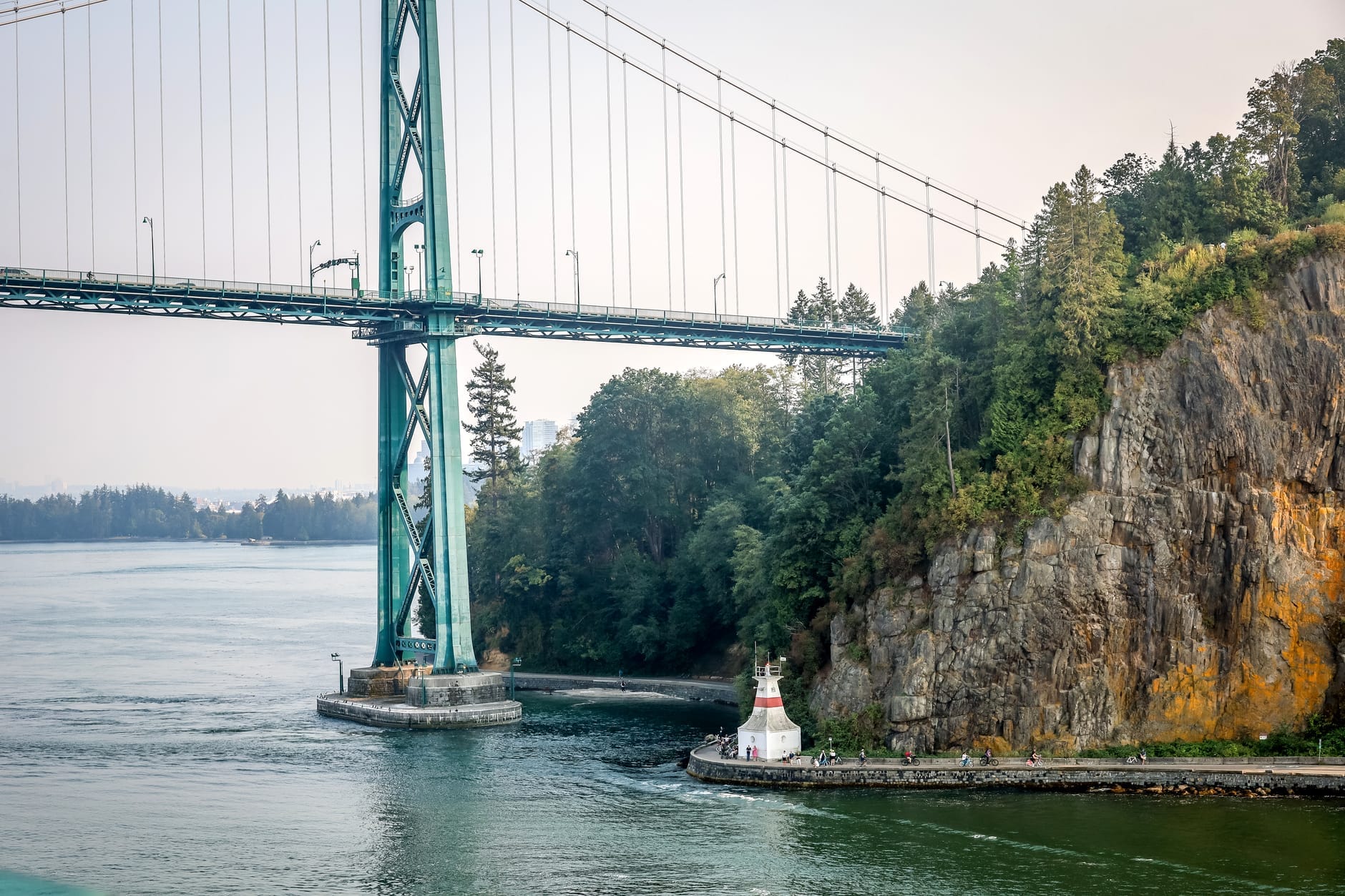
Prospect Point: an overview
Prospect Point is the highest point in Stanley Park, sitting at the northern edge of the peninsula where Stanley Park Drive curves beside the south anchorage of Lions Gate Bridge. The view from the upper railing looks directly up at the bridge's suspension cables and out across the First Narrows of Burrard Inlet toward the North Shore. It is one of the few spots in the city where you can read the true scale of the bridge, which has a main span of 472 metres and has been a defining feature of Vancouver's skyline since it opened in 1938.
The viewpoint itself is part of Stanley Park and is freely accessible at any hour. The surrounding commercial area, including a seasonal café, ice cream window, and Trading Post gift shop, operates during the warmer months. Wheelchair-accessible parking is available on-site, and the lookout platform is accessible, though some of the surrounding trails are not.
ℹ️ Good to know
The viewpoint is free and open 24 hours. The seasonal café, ice cream counter, and Trading Post gift shop operate during the warmer months (typically May through October); the former Prospect Point Bar & Grill restaurant has not reopened since the pandemic. Check prospectpoint.com for current hours before counting on food or retail on-site.
The View and What You Actually See
The signature sight from Prospect Point is Lions Gate Bridge in the foreground, with the mountains of the North Shore rising behind it. On a clear day, you can pick out the runs on Grouse Mountain to the northeast. Below the railing, the cliff face drops sharply to the water, and if you arrive at the right time you will see large container ships and tankers navigating the narrow channel with surprising precision — the First Narrows is tight enough that vessels require a local pilot on board to pass through.
Look down and to the left from the main platform and the Stanley Park Seawall is visible far below, a thin ribbon of path tracing the shoreline. Cyclists making their way around the park look miniature from this height. To the south, on a clear day, you can see across Burrard Inlet toward the downtown skyline with the white sail roofs of Canada Place visible in the distance.
For a longer engagement with these water views at ground level, the Stanley Park Seawall passes directly beneath the cliffs on its circuit around the park, and the contrast between the two perspectives — cliff-top and waterline — is worth doing both if time allows.
Tickets & tours
Hand-picked options from our booking partner. Prices are indicative; availability and final rates are confirmed when you complete your booking.
Grouse Mountain and Capilano Suspension Bridge Park tour
From 252 €Instant confirmationFree cancellationVancouver Art Gallery Tickets
From 19 €Instant confirmationFree cancellationVancouver Stanley Park cycling tour
From 56 €Instant confirmationFree cancellationWhistler, Shannon Falls and Sky Gondola tour from Vancouver
From 135 €Instant confirmationFree cancellation
How the Experience Changes by Time of Day
Morning visits, particularly on weekdays, are notably quieter. The light hits the bridge from the east and catches the suspension cables in a way that makes them easier to photograph without harsh shadows. Mist sometimes settles in the narrows during spring mornings, which can either obscure the view or create an atmospheric scene depending on your luck.
Midday and weekend afternoons bring the highest crowds, particularly from June through September. The parking area fills early on summer Saturdays, and the ice cream window typically has a queue by late morning. If the café and seating area are your goal, arriving before noon on a summer day gives you a better chance at a table.
Sunset is when Prospect Point earns its reputation most clearly. The bridge lights come on gradually as the sky darkens over the North Shore, and the combination of the illuminated span and the fading alpine glow behind the mountains draws photographers specifically for this window. Expect company during golden hour on clear evenings — this is not a secret, and the viewpoint platform can feel crowded. The light fades fast once the sun drops behind the mountains, so arriving 20–30 minutes before sunset gives you time to find a good position.
History: Vancouver's Original Viewpoint
Prospect Point has been a formal public viewpoint since 1889, making it one of the oldest continuously visited lookouts in the city. The Squamish people, who have used this peninsula for thousands of years, know this high point as Chay-thoos, meaning Thunderbolt. The site sits on the traditional, ancestral, and unceded territories of the Musqueam, Squamish, and Tsleil-Waututh Nations.
The area carries a notable maritime footnote: in 1888, just one year before the viewpoint was officially opened, the SS Beaver ran aground on the rocks directly below Prospect Point. The SS Beaver was the first steamship to operate on the Pacific Northwest coast of North America, and the wreck, which broke up over the following years, attracted curiosity-seekers from across the region. Pieces of the hull were reportedly salvaged as souvenirs.
The Prospect Point Signal Station, which informed vessels about tides, winds, and hazards in the narrows, opened on 27 July 1939. The current lighthouse on the site was completed in 1958. These operational details are easy to overlook when you are focused on the view, but they are reminders that this has always been a working point of the harbour, not just a scenic one.
Getting There: Practical Walkthrough
Prospect Point is located at 5601 Stanley Park Drive, at the park's northern end. By car, follow Stanley Park Drive as it winds around the park's perimeter; the road climbs toward the northern tip and Prospect Point is on the right, just after the overpass that crosses the Lions Gate Bridge access road. Paid parking applies throughout Stanley Park (CAD, rates set by the City of Vancouver, verify current rates on-site or through the Park Board).
By transit, buses serve the Stanley Park area from downtown Vancouver. From there, reaching Prospect Point requires walking or cycling along Stanley Park Drive or the seawall, both of which are worthwhile in their own right. The getting around Vancouver guide has current TransLink route details. Cycling the seawall from the West End or Coal Harbour and finishing at Prospect Point is one of the most natural ways to incorporate the lookout into a longer day in the park.
The viewpoint platform is wheelchair accessible, and accessible parking bays are available on-site. Some of the surrounding forested trails that lead to secondary views are unpaved and uneven, so they are not accessible for all mobility levels.
Photography tips and what to expect
The classic Prospect Point photo is a wide shot of Lions Gate Bridge from the railing, ideally with the North Shore mountains filling the background. A standard wide-angle lens or smartphone camera handles this composition well — the bridge is close enough that you do not need a telephoto. For the suspension cables in detail, a slight telephoto compression (70–100mm equivalent) isolates them more effectively against the mountain backdrop.
One honest caution: on overcast days, which are common from October through April, the mountains disappear into cloud and the view loses a significant portion of its impact. The bridge itself is still there, and the channel below remains interesting, but if you are visiting primarily for the panoramic mountain view, the summer months (June through August) give the highest probability of clear conditions. Even in summer, morning marine fog can delay clear views until mid-morning.
⚠️ What to skip
Vancouver's rainy season runs roughly October to March. During this period, Prospect Point is often clouded in, and the mountain backdrop may not be visible. The viewpoint is still accessible and free, but manage expectations for photography.
For context on what the views look like across the city's other high points, the best views in Vancouver guide compares Prospect Point with alternatives like the Vancouver Lookout and Queen Elizabeth Park.
Who May Want to Skip This
Prospect Point rewards those who appreciate landscape and harbour scenery. If you have no particular interest in bridges or coastal geography, and you are not cycling or walking the seawall, making a dedicated car trip purely for the lookout may feel underwhelming, especially on a grey day. The viewpoint itself is compact — you will see everything there is to see in a few minutes — so unless you are pairing it with a meal at the café or a longer walk in the park, it does not anchor a full half-day on its own.
Travellers with very limited time in Vancouver who are prioritizing indoor attractions or downtown neighborhoods may find other viewpoints more central. That said, if you are already cycling the Stanley Park Seawall, stopping at Prospect Point is a natural pause that costs nothing beyond the time to climb the short path from the seawall level to the lookout.
Insider Tips
- Arrive at least 20 minutes before sunset on a clear evening and position yourself on the right side of the viewing railing for the clearest sightline along the bridge span toward the North Shore mountains.
- Weekday mornings between 8am and 10am see the lowest foot traffic. The parking area is often nearly empty and the viewpoint is quiet enough to hear the traffic on Lions Gate Bridge above.
- Look down toward the waterline as large vessels pass through the First Narrows — the channel is narrow enough that watching a freighter navigate it from this height is unexpectedly dramatic.
- The seasonal ice cream window at the Prospect Point café is a local habit for cyclists finishing or resting mid-way on a seawall loop. Flavours rotate and the queue moves quickly, but the picnic tables fill fast on summer afternoons.
- A second, less-visited perspective is available from the lower trail that descends toward the seawall — the view upward at the bridge structure from near water level is a very different frame from the standard cliff-top angle.
Who Is Prospect Point For?
- Photographers seeking the classic Lions Gate Bridge composition, especially at sunset
- Cyclists using Prospect Point as a rest stop on the Stanley Park Seawall loop
- First-time Vancouver visitors wanting a free, high-impact viewpoint without hiking
- History enthusiasts interested in Vancouver's maritime and colonial-era geography
- Families looking for a quick, accessible stop with food options on summer days
Nearby Attractions
Other things to see while in West End:
- Brockton Point Totem Poles
The Brockton Point Totem Poles are an outdoor collection of nine First Nations poles carved by artists from the Squamish, Kwakwaka'wakw, Haida, Nisga'a, and Nuxalk Nations. Set in a meadow at the edge of Burrard Inlet inside Stanley Park, the site is free, open around the clock, and reachable on foot from Coal Harbour in about 20 minutes.
- Davie Village
Davie Village is the cultural and social centre of Vancouver's queer community, stretching along Davie Street between Burrard and Jervis in the West End. Free to explore at any hour, it offers a mix of LGBTQ+ history, independent cafés and bars, the iconic rainbow crosswalk at Davie and Bute, and Jim Deva Plaza, a public gathering space that doubles as a community memorial.
- English Bay Beach
English Bay Beach, also known as First Beach, has served as Vancouver's primary urban beach for over a century. Stretching along Beach Avenue in the West End, it offers free access to a sandy shoreline with mountain backdrops, reliable sunsets, and a lively summer atmosphere that fades into quiet morning solitude the rest of the year.
- Lost Lagoon
Lost Lagoon is a 16.6-hectare freshwater lake sitting at the gateway to Stanley Park in Vancouver's West End. Free to visit at any hour, it draws birdwatchers, joggers, and anyone needing a few minutes of calm at the edge of a major city. The 1.75 km perimeter trail is one of the more underrated walks in Vancouver.