Davie Village: Vancouver's LGBTQ+ Heart in the West End
Davie Village is the cultural and social centre of Vancouver's queer community, stretching along Davie Street between Burrard and Jervis in the West End. Free to explore at any hour, it offers a mix of LGBTQ+ history, independent cafés and bars, the iconic rainbow crosswalk at Davie and Bute, and Jim Deva Plaza, a public gathering space that doubles as a community memorial.
Quick Facts
- Location
- Davie Street between Burrard & Jervis, West End, Vancouver, BC
- Getting There
- Multiple bus routes along Davie St; short walk from downtown core
- Time Needed
- 1–3 hours for a leisurely walk; longer for dining and nightlife
- Cost
- Free to explore; individual venues charge their own prices
- Best for
- LGBTQ+ travelers, history walkers, evening café culture
- Official website
- davievillage.ca
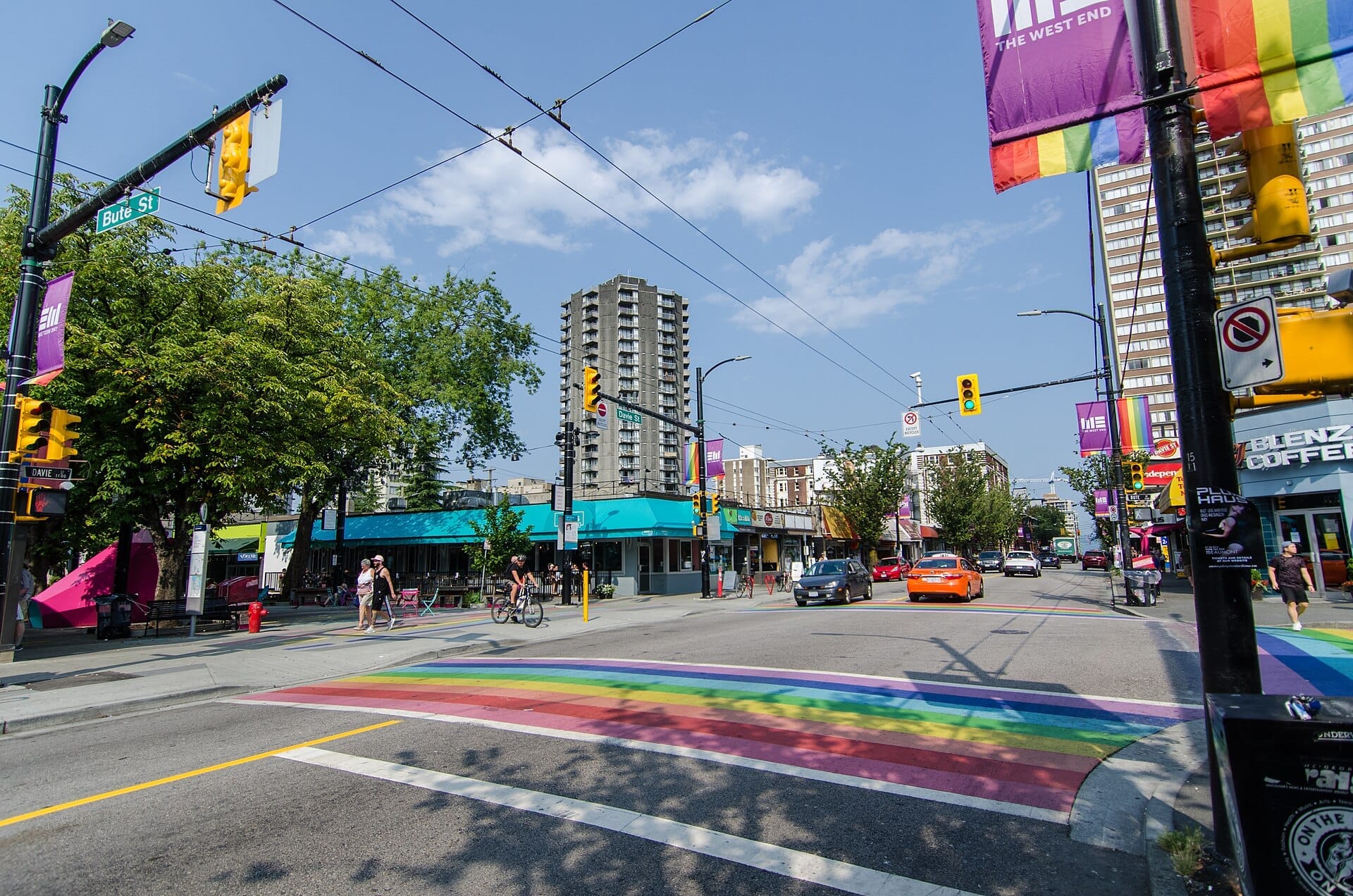
Davie Village: an overview
Davie Village is Vancouver's most recognized LGBTQ+ neighbourhood, centered on the few blocks of Davie Street running between Burrard Street and Jervis Street in the West End. It is not a fenced attraction or a paid destination. It is a living street district: sidewalk cafés, independent bars, specialty shops, community noticeboards, and the kind of foot traffic that shifts dramatically depending on the hour and the season.
The district is accessible 24 hours a day with no admission charge. What you get out of it depends entirely on when you arrive and what you are looking for. A weekday morning feels low-key, almost neighbourhood-quiet. By Friday evening, the energy shifts noticeably, with groups gathering on bar patios and at Jim Deva Plaza, the open public square at Davie and Bute that anchors the social life of the street.
💡 Local tip
The rainbow crosswalk at Davie Street and Bute Street is the most photographed spot in the neighbourhood. Morning light before 9am gives you clean angles without pedestrian traffic. At night, neon from nearby bars reflects off the painted stripes for a different kind of shot.
History: How Davie Street Became Vancouver's Queer Centre
The stretch of Davie Street between Burrard and Jervis became the gravitational centre of Vancouver's gay community during the 1970s. That decade marked a turning point in Canadian LGBTQ+ civil society: Vancouver's first gay rights demonstration took place in 1971, and the neighbourhood's first official Pride parade followed in 1981. Bars, bathhouses, and community organizations gradually clustered in the West End, and Davie Street specifically emerged as the public face of that community.
Jim Deva Plaza, the pavement-to-plaza gathering space at the corner of Davie and Bute, honours Jim Deva, a longtime activist and co-owner of Little Sister's Book & Art Emporium, an independent LGBTQ+ bookstore that became a landmark in its own right and fought a high-profile legal battle against Canada Customs over censorship of imported materials. The plaza redesign removed the standard curb-and-barrier boundary between sidewalk and road, creating a single continuous smooth surface intended to draw people together. It functions as an informal community living room.
Canada's first permanent rainbow crosswalk was installed at Davie and Bute, a detail that carries more symbolic weight than it might first appear. Rainbow crosswalks have since appeared in dozens of Canadian and international cities, but Davie Village's version preceded them all and remains the original reference point.
Tickets & tours
Hand-picked options from our booking partner. Prices are indicative; availability and final rates are confirmed when you complete your booking.
Grouse Mountain and Capilano Suspension Bridge Park tour
From 252 €Instant confirmationFree cancellationVancouver Art Gallery Tickets
From 19 €Instant confirmationFree cancellationVancouver Stanley Park cycling tour
From 56 €Instant confirmationFree cancellationWhistler, Shannon Falls and Sky Gondola tour from Vancouver
From 135 €Instant confirmationFree cancellation
Walking the Street: What You Will Actually See
The core strip is compact enough to walk end to end in under fifteen minutes, which means the experience is less about covering ground and more about lingering. Storefronts lean toward independent operators: clothing boutiques with explicit queer branding, coffee shops running Pride-themed specials year-round rather than only in June, and bars whose windows are plastered with community event posters.
The signage and street furniture throughout the district are deliberately colour-coded. Pink triangle symbols and rainbow flags appear on lampposts, shop awnings, and community boards. This is not seasonal decoration left up past its welcome: it reflects a sustained, neighbourhood-wide decision to mark the space as queer territory in a legible way for visitors and residents alike.
Davie Village sits within the broader West End neighbourhood, one of Vancouver's densest residential areas. The surrounding blocks are full of apartment towers and low-rise heritage buildings, and many residents walk through Davie Village simply as part of their daily routine. This mix of local foot traffic and tourist interest gives the street a less performative quality than some purpose-built entertainment districts.
Time of Day: Morning, Afternoon, and Night
Daytime (8am – 5pm)
Mornings are gentle. Coffee shops fill first, particularly those near Jim Deva Plaza. The rainbow crosswalk is cleaner and more visible before the day's traffic and foot wear works on the paint. Bakeries open early, and the smell of espresso and fresh pastry drifts onto Davie Street from multiple storefronts. This is the hour for a quiet walk and a coffee, not for the neighbourhood's social energy.
Afternoons bring more retail activity. Boutiques open fully, and the plaza sees a mix of residents on lunch breaks, tourists consulting phones, and the occasional community group setting up information tables. The light in summer afternoons is warm and falls directly on the painted crosswalk, which makes it more vivid to the eye and to a camera.
Evening and Night (6pm onwards)
This is when Davie Village operates at its intended register. Bar patios fill up, music becomes audible from open doors, and Jim Deva Plaza draws groups who use it as a meeting point before heading elsewhere. On weekends, the density of people on the street increases significantly from around 9pm. The district is not large enough to feel overwhelming, but it is energetic in a way that day visitors may not anticipate.
During Pride Week, typically held in late July or early August each year, Davie Village becomes the operational centre of Vancouver Pride, with street parties, vendor markets, and performances that spill across multiple blocks. Crowds during that period are substantial. If your goal is a relaxed stroll rather than festival participation, that week is the one to avoid unless the event itself is your purpose.
Getting There and Getting Around
Davie Village is walkable from much of downtown Vancouver. From Robson Street, it is roughly a ten to fifteen minute walk south and west. The Stanley Park Seawall entrance at English Bay is also within walking distance, making it easy to combine both in the same afternoon.
Several TransLink bus routes serve Davie Street directly. The street runs east-west through the West End, and the nearest SkyTrain stations are a short bus or taxi ride away. Uber and Lyft both operate in Vancouver and drop off directly on Davie Street. Street parking exists but is limited and metered; most visitors arrive on foot or by transit.
For broader transit orientation across Vancouver, the getting around Vancouver guide covers SkyTrain lines, bus passes, and fare structures in detail.
ℹ️ Good to know
Jim Deva Plaza uses a flush, step-free surface design, making it one of the more accessible public spaces in the West End. Standard city sidewalks on Davie Street have curb cuts at major intersections. Individual venue accessibility varies and is worth confirming directly with each business.
What to Manage Your Expectations About
Davie Village is sometimes listed alongside major ticketed Vancouver attractions, which sets the wrong expectation. There is nothing to enter, no exhibit to view, and no single centrepiece experience. Visitors who arrive expecting a theme park atmosphere or a defined tour route often find the district underwhelming if they do not connect with the street's social character.
The district's appeal is strongest for people who enjoy wandering, people-watching, and neighbourhood culture rather than checking off sights. Travelers looking for more structured outdoor experiences nearby might consider the English Bay Beach, a short walk west, or the broader West End neighbourhood for café hopping and local retail.
Rain is a real factor in Vancouver from October through March. Davie Village has no covered arcades or sheltered walkways along most of its length. A rainy weeknight in November is a valid time to visit for bar and café culture, but expect the street itself to be quiet between venues rather than animated.
Photography Notes
The rainbow crosswalk at Davie and Bute is the standard photograph from this neighbourhood, and it photographs best in either early morning or during golden hour before sunset. At midday in summer, the overhead light flattens the colours. The surrounding storefronts, flags, and plaza benches provide strong secondary compositions for anyone interested in street photography over landmark shots.
If you are building a broader photography itinerary through the downtown core, the best viewpoints in Vancouver guide includes several nearby vantage points that pair well with a Davie Village visit.
Insider Tips
- Jim Deva Plaza operates informally as the neighbourhood's community hub. Stop here for a few minutes rather than just walking past: community boards often list events, pop-up markets, and advocacy gatherings that do not appear on mainstream listing sites.
- Little Sister's Book & Art Emporium, the LGBTQ+ bookstore with a significant legal history in Canadian civil rights, operates nearby. It is worth a visit as a piece of living neighbourhood history, not just a retail stop.
- Davie Village is directly between Stanley Park and the broader downtown grid, which makes it a natural midpoint if you are walking the seawall west from Coal Harbour. Factor in a coffee stop rather than treating it as a destination that requires a dedicated trip.
- During Vancouver Pride in late July or early August, accommodation near Davie Village books out weeks in advance. If you want to attend Pride events centred here, plan well ahead. If you want to avoid crowds, that week is worth noting as one to reroute around.
- The neighbourhood's independent bars tend to have markedly different character from each other. A quick look at current local listings from the official Davie Village site before arriving lets you pick a venue that fits your evening rather than defaulting to whatever has the longest line.
Who Is Davie Village For?
- LGBTQ+ travelers looking for Vancouver's queer cultural centre
- History and urban culture walkers interested in Canadian civil rights geography
- Nightlife visitors who prefer an intimate street district over a large club precinct
- Photographers seeking street-level colour and community signage
- West End explorers combining a Davie Street walk with English Bay or Stanley Park
Nearby Attractions
Other things to see while in West End:
- Brockton Point Totem Poles
The Brockton Point Totem Poles are an outdoor collection of nine First Nations poles carved by artists from the Squamish, Kwakwaka'wakw, Haida, Nisga'a, and Nuxalk Nations. Set in a meadow at the edge of Burrard Inlet inside Stanley Park, the site is free, open around the clock, and reachable on foot from Coal Harbour in about 20 minutes.
- English Bay Beach
English Bay Beach, also known as First Beach, has served as Vancouver's primary urban beach for over a century. Stretching along Beach Avenue in the West End, it offers free access to a sandy shoreline with mountain backdrops, reliable sunsets, and a lively summer atmosphere that fades into quiet morning solitude the rest of the year.
- Lost Lagoon
Lost Lagoon is a 16.6-hectare freshwater lake sitting at the gateway to Stanley Park in Vancouver's West End. Free to visit at any hour, it draws birdwatchers, joggers, and anyone needing a few minutes of calm at the edge of a major city. The 1.75 km perimeter trail is one of the more underrated walks in Vancouver.
- Prospect Point
Perched at the northern tip of Stanley Park, Prospect Point offers some of Vancouver's most recognizable views: Lions Gate Bridge stretching across the First Narrows, freighters moving through Burrard Inlet, and the North Shore mountains beyond. Entry to the viewpoint is free, and the area has been welcoming visitors since 1889.