Museum of Anthropology at UBC: What to Know Before You Visit
The Museum of Anthropology at UBC is one of Canada's foremost anthropology museums, set inside Arthur Erickson's soaring concrete-and-glass landmark on the University of British Columbia's Point Grey campus. With nearly 50,000 ethnographic objects and a collection rooted in Northwest Coast Indigenous cultures, it offers a serious, rewarding experience for anyone curious about the peoples of the Pacific Northwest and beyond.
Quick Facts
- Location
- 6393 NW Marine Drive, UBC Point Grey campus, BC
- Getting There
- Multiple TransLink buses to UBC Bus Loop; short walk to NW Marine Drive (verify current routes at translink.ca)
- Time Needed
- 2–3 hours for a thorough visit; 1 hour if focused
- Cost
- Paid admission in CAD; check moa.ubc.ca for current rates
- Best for
- History enthusiasts, architecture lovers, Indigenous art, cultural travellers
- Official website
- moa.ubc.ca
Museum of Anthropology at UBC: an overview
The Museum of Anthropology at UBC, commonly known as MOA, sits at the western edge of the University of British Columbia campus, looking out over the Strait of Georgia toward the mountains of Vancouver Island. It is not a casual drop-in attraction. MOA is a research institution, a working archive, and a deeply considered cultural space, holding close to 50,000 ethnographic objects and about 535,000 archaeological objects within its walls.
The collection is strongest in Northwest Coast Indigenous art and material culture: totem poles, bentwood boxes, woven blankets, ceremonial masks, and monumental works in cedar that require high ceilings and broad sightlines to appreciate properly. MOA was established in 1949 as a department within UBC’s Faculty of Arts, though the collection's origins go back further through university acquisitions. Its current home opened in 1976.
The museum sits in the UBC Point Grey area, and a visit pairs well with a walk through the nearby Nitobe Memorial Garden or a stop at the UBC Botanical Garden. The campus itself is worth the trip independently.
ℹ️ Good to know
MOA is open daily 10:00–17:00, with extended Thursday hours until 21:00. Seasonal Monday closures apply between October 15 and May 15 — confirm your visit date on the official site at moa.ubc.ca before traveling out to campus.
The Building: Arthur Erickson's Concrete and Glass Landmark
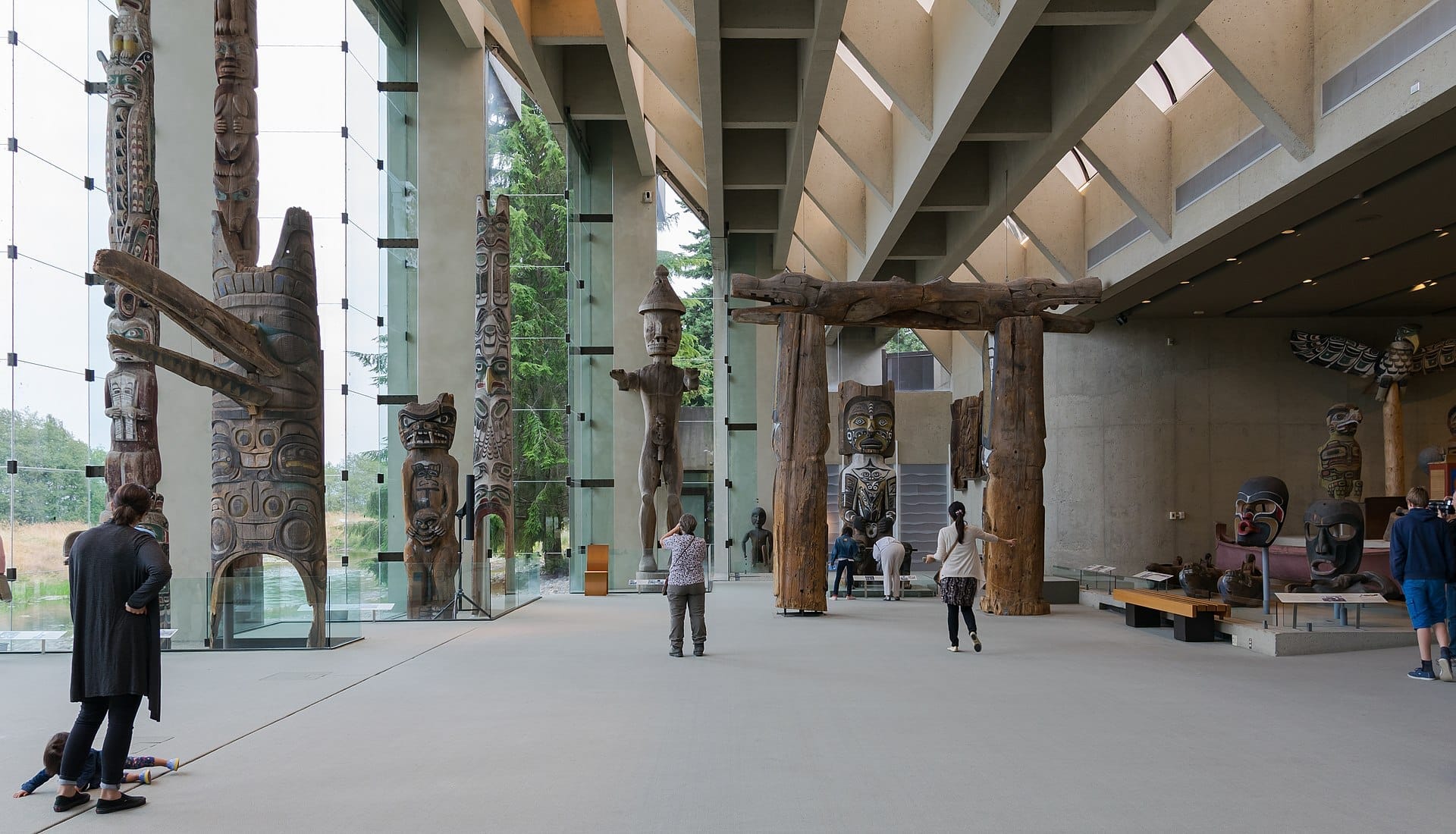
The building is itself a reason to visit. Arthur Erickson, one of Canada's most celebrated architects, designed MOA's current structure using a system of post-and-beam concrete frames that consciously echo the structural logic of Northwest Coast Indigenous longhouses. It opened in 1976 and has not dated in the way that many 1970s public buildings have. The scale is generous without feeling overblown.
The Great Hall, the museum's most dramatic interior space, is a tall-ceilinged glass-walled room that faces the water. Totem poles and large-scale carvings stand against a backdrop of mountains and sky, and the effect shifts noticeably depending on the weather and time of day. On a clear morning, light falls across carved cedar at sharp angles. On an overcast afternoon, the poles read as dark silhouettes against a grey-green landscape. Neither version is better — they are simply different experiences.
Beyond the Great Hall, the Rotunda houses the Bill Reid Gallery of Northwest Coast Art within MOA's walls, centered on Reid's monumental jade-green ceramic sculpture, The Raven and the First Men. Reid (1920–1998) was a Haida artist whose work did more than almost any other single body of work to bring Haida artistic traditions to international attention. Standing in front of this piece in person, the scale and detail are difficult to comprehend from photographs.
💡 Local tip
Thursday evenings are the quietest times to visit. The extended 21:00 closing means you can arrive after 17:00 and have the Great Hall nearly to yourself. Weekday mornings are the next best option. Weekend afternoons during summer bring tour groups and significant foot traffic.
Tickets & tours
Hand-picked options from our booking partner. Prices are indicative; availability and final rates are confirmed when you complete your booking.
Grouse Mountain and Capilano Suspension Bridge Park tour
From 252 €Instant confirmationFree cancellationVancouver Art Gallery Tickets
From 19 €Instant confirmationFree cancellationVancouver Stanley Park cycling tour
From 56 €Instant confirmationFree cancellationWhistler, Shannon Falls and Sky Gondola tour from Vancouver
From 135 €Instant confirmationFree cancellation
What You Will Actually See: A Practical Walkthrough
After entering through the main lobby, most visitors move directly toward the Great Hall. Resist the pull slightly and take time with the galleries on either side of the entrance corridor, which contain smaller works, textiles, and objects from cultures across Asia, the Pacific, Africa, and the Americas. These galleries feel undervisited relative to the Great Hall and reward careful attention.
The Multiversity Galleries, a visible storage area opened in 2010, are genuinely unusual in a museum context. Approximately 10,000 objects are accessible in open cases and drawers, organized by culture, with research touchscreens providing contextual information. It functions partly as a working study collection and partly as a display space. Families with older children often spend considerable time here, and researchers use it as a starting point for deeper inquiries.
Outside the main building, the reconstructed Haida houses and totem poles in the grounds are frequently photographed and are accessible without an admission ticket. These structures were built with the direct involvement of Haida carvers and occupy a site chosen to face the water, consistent with traditional coastal village orientation. In summer, the surrounding gardens are in full growth and the outdoor space feels complete. In winter, the poles are stark against grey skies and the experience is more austere but no less powerful.
If you are spending a full day on the UBC campus, combine MOA with the Nitobe Memorial Garden and the UBC Botanical Garden, both a short walk or drive away.
How to Get There from Downtown Vancouver
MOA is approximately 20 minutes from downtown Vancouver by car under normal traffic conditions. Paid parking is available directly in front of the museum and at the nearby Rose Garden Parkade on campus. On weekdays during the academic year, campus parking fills quickly by mid-morning, so arriving before 10:30 or using the Rose Garden Parkade as a backup is practical.
By transit, multiple TransLink buses serve the UBC Bus Loop from downtown and from Broadway-City Hall Station on the Canada Line SkyTrain. The walk from the bus loop to MOA along NW Marine Drive takes roughly 10 minutes, or you can take a campus connector shuttle. Because bus routes and schedules change, confirm your specific route at translink.ca before travel. The journey from downtown by transit typically takes 35 to 50 minutes depending on connections.
For broader orientation on getting around Vancouver, the getting around Vancouver guide covers TransLink fares, the SkyTrain network, and transit tips in detail.
⚠️ What to skip
UBC is a working university campus. During spring convocation (typically late May and early June) and during major campus events, parking near MOA can be extremely limited and transit stops can be crowded. Check the UBC events calendar if your visit falls in late spring.
Cultural Context: Why This Museum Matters
MOA operates in a complicated institutional space. The bulk of its collection comes from Northwest Coast Indigenous peoples — Haida, Musqueam, Kwakwaka'wakw, Nisga'a, and others — many of whom have ongoing relationships with the museum around repatriation, curation, and cultural access. The museum has a formal partnership with the Musqueam Nation, whose traditional territory UBC occupies, and Musqueam community members are involved in interpretation and collection stewardship.
This context shapes how the museum presents its collection. Labels and interpretive materials are more careful and more substantive than in many ethnographic museums. Several collections are designated as accessible only to members of specific Indigenous communities. This means that not everything is on open display for all visitors, which is worth knowing before you arrive. The museum is explicit about this policy and it reflects genuine collaborative agreements rather than arbitrary restriction.
Vancouver is situated on the traditional territories of the Musqueam, Squamish, and Tsleil-Waututh Nations. The Bill Reid Gallery of Northwest Coast Art in downtown Vancouver provides a complementary perspective on Haida art if you want to explore this tradition further.
Practical Notes: Accessibility, Photography, and What to Bring
MOA is step-free accessible from the main parking area and the front entrance. The museum provides elevators, accessible washrooms, and mobility aids on request. The Great Hall's floor is level and wide, making it navigable with wheelchairs and strollers. The outdoor Haida houses involve some uneven ground, so footwear with grip is useful in wet weather.
Photography for personal, non-commercial use is generally permitted in the main galleries, though restrictions apply to specific works at the request of originating communities. Look for posted notices near individual objects. The Great Hall in morning light is the most photogenic interior space in the building. Wide-angle or normal focal lengths work better than telephoto here, given the need to include both the poles and the glass backdrop.
There is a cafe on site and a well-stocked museum shop that focuses on Indigenous art, craft, and books on Northwest Coast cultures and anthropology. The shop is worth browsing independently of the galleries. Bring a layer even in summer — the Great Hall's glass walls and high ceilings mean the interior can feel cool relative to a warm day outside.
MOA is one of the stronger entries on any list of the best museums in Vancouver, sitting alongside the Vancouver Art Gallery and Science World in terms of depth and visitor satisfaction.
Who May Not Find This Worth the Trip
The journey out to UBC adds 45 to 90 minutes of transit time round-trip from downtown, and the admission cost is not trivial. Visitors with limited time in Vancouver and primary interests in waterfront scenery, nightlife, or shopping will likely find their time better spent elsewhere. The museum is also a serious cultural space rather than an entertainment venue — children under about eight years old may find the experience slow, though the Multiversity Galleries with their accessible drawers and touchscreens do hold younger attention reasonably well.
If your interest in Northwest Coast Indigenous art is passing rather than genuine, the outdoor totem poles at Brockton Point in Stanley Park are free, centrally located, and provide an accessible introduction without the trip across town. MOA's depth rewards visitors who come with curiosity and time to spend.
Insider Tips
- Thursday evenings (open until 21:00) are the least crowded time to visit by a significant margin. The Great Hall with the poles and the mountain backdrop at dusk is worth the specific timing.
- The outdoor Haida houses and poles on the museum grounds are accessible without paying admission. If budget is a constraint, you can spend meaningful time on the exterior grounds at no cost.
- The Multiversity Galleries are underrated by casual visitors. The open storage drawers contain objects rarely seen in standard display settings, and the research stations allow you to trace specific objects through catalogue records.
- Park at the Rose Garden Parkade if the main MOA lot is full. It adds roughly five minutes of walking but is almost always available and is a pleasant route along the cliff edge above the water.
- If you are visiting between October and May, confirm Monday hours directly at moa.ubc.ca before making the trip — the museum observes seasonal Monday closures during this period.
Who Is Museum of Anthropology at UBC For?
- Travellers with a serious interest in Northwest Coast Indigenous art and culture
- Architecture enthusiasts drawn to Arthur Erickson's post-and-beam concrete design
- Academic visitors and researchers: the Multiversity Galleries function as a working study collection
- Travellers combining a full UBC campus day with botanical gardens and coastal walks
- Cultural travellers who want substantive museum depth rather than surface-level highlights
Nearby Attractions
Other things to see while in UBC & Point Grey:
- Nitobe Memorial Garden
Tucked behind the UBC Asian Centre, Nitobe Memorial Garden is a 2.5-acre traditional Japanese garden consistently ranked among the most authentic outside Japan. Designed by landscape architects recommended by the Government of Japan and completed in 1960, it rewards slow, deliberate visiting at almost any time of year.
- Pacific Spirit Regional Park
Spanning roughly 860 hectares of second-growth rainforest on Vancouver's west side, Pacific Spirit Regional Park wraps around the UBC campus and offers over 55 km of free, multi-use trails through dense forest, creek ravines, coastal cliffs, and bog. It is one of the larger continuous green spaces within the city of Vancouver, and almost nobody from outside Vancouver knows it exists.
- Spanish Banks Beach
Spanish Banks Beach stretches along English Bay in Vancouver's West Point Grey neighbourhood, offering nearly 1 kilometre of tidal flats, unobstructed views of the North Shore mountains, and a noticeably quieter atmosphere than the city's more central beaches. Access is free, lifeguards patrol seasonally, and the beach connects by bike path to Jericho and Locarno.
- UBC Botanical Garden
Founded in 1916, UBC Botanical Garden is Canada's oldest university botanical garden, covering 44 hectares on the University of British Columbia campus in Vancouver. It combines serious horticultural research with a genuinely rewarding visitor experience across themed garden collections that shift dramatically with the seasons.