Lombard Street: What to Expect at San Francisco's Famous Crooked Block
Lombard Street's one-block stretch of eight hairpin turns on Russian Hill is one of San Francisco's most photographed sights. Free to visit at any hour, it rewards those who arrive early with quiet streets, soft light, and a clearer view of the hydrangea-lined curves. Here is everything you need to plan a worthwhile visit.
Quick Facts
- Location
- 1070–1099 Lombard Street, Russian Hill, San Francisco, CA 94133 (between Hyde St and Leavenworth St)
- Getting There
- Powell–Hyde cable car to Hyde & Lombard; Muni bus lines 30 and 45 also serve the area
- Time Needed
- 20–45 minutes on foot; longer if you plan to drive the block or photograph from multiple angles
- Cost
- Free (public street, no admission fee)
- Best for
- Photography, first-time visitors, architecture admirers, casual walkers
What Lombard Street Actually Is
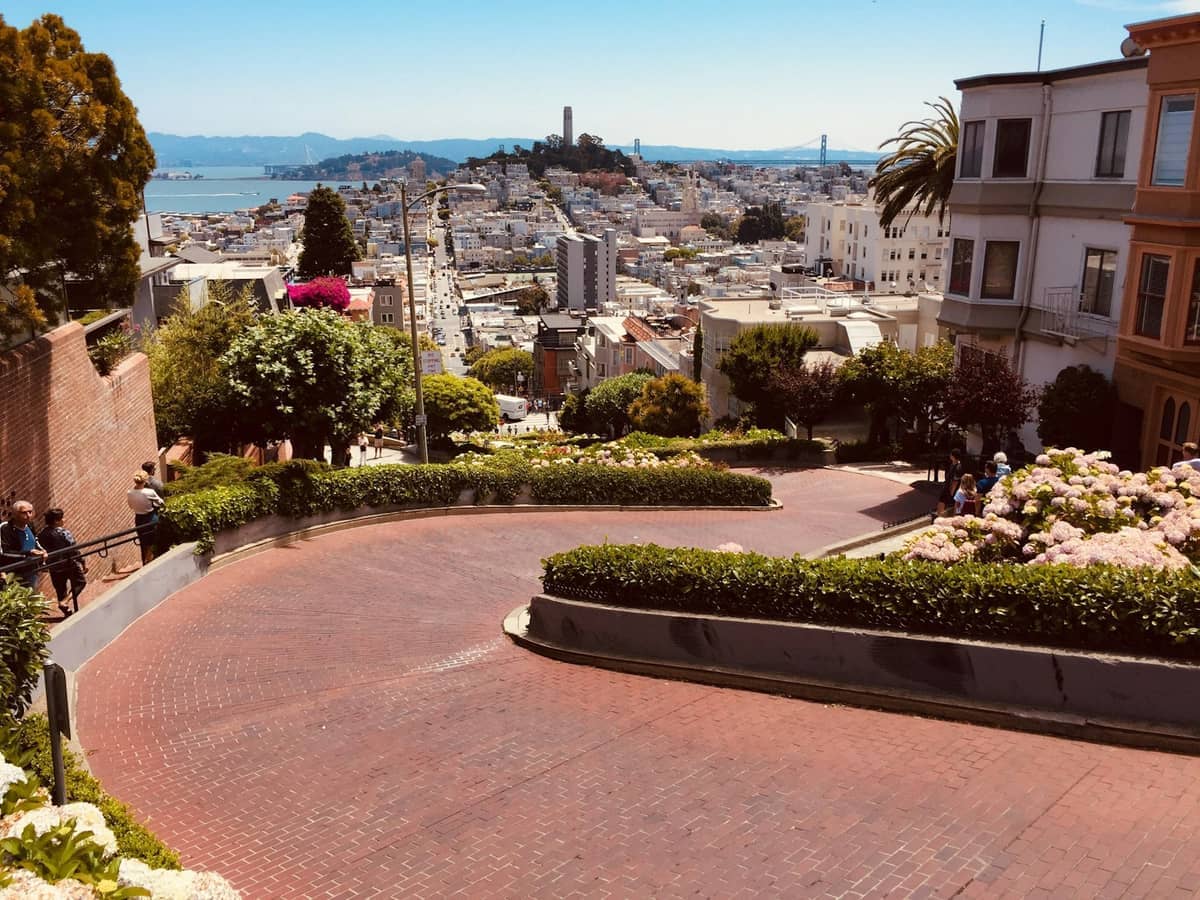
Lombard Street is a full-length east-west street running roughly 4.8 kilometers across northern San Francisco, from the Presidio to the waterfront near Telegraph Hill. The section that draws crowds is a single block: the one between Hyde Street at the top and Leavenworth Street at the bottom, on the eastern face of Russian Hill. This block descends at a steep gradient through eight tight hairpin turns, each bordered by low brick retaining walls and densely planted hydrangeas. It is that one block, not the entire street, that has become one of the most recognized streetscapes in the United States.
The street was named by San Francisco surveyor Jasper O'Farrell, who took the name from Lombard Street in Philadelphia rather than anything Italian. The crooked configuration was not original to the street's layout. The hairpin design was introduced to make the slope navigable by vehicles, reducing the effective gradient through a series of sharp turns rather than a single brutal descent. The result is a piece of functional urban engineering that became, somewhat accidentally, a photogenic landmark.
ℹ️ Good to know
Lombard Street is a functioning residential street. Cars drive it, residents receive deliveries here, and people live in the houses lining the turns. Treat it like a neighborhood, not a theme park.
How It Feels to Visit
From the top of the block at Hyde Street, looking downhill toward Leavenworth, the view is genuinely striking. The road folds back on itself in a tight ribbon of red brick pavement, flanked by flower beds thick with hydrangeas that bloom in deep blues and purples from spring through summer. Below the curves, Leavenworth Street frames a postcard view toward Coit Tower and the bay. In ideal conditions, that backdrop can include the East Bay hills on the horizon.
The sidewalks along the block are actually wide stairways that descend parallel to the road. Walking down them is manageable for most people, though the steps are uneven in places and the incline is noticeable. Walking up is a proper workout. The brick road surface itself is textured and slightly uneven, which gives the curves a tactile quality you notice if you walk it rather than drive it.
At peak times, typically late morning through early afternoon on weekends and in summer, the block fills with pedestrians on the stairs and a slow-moving line of cars waiting to drive down. The sound is a mix of car engines idling, tourists calling to each other from different levels of the stairway, and the occasional click of a camera. The smell is cut grass and damp earth from the flower beds, mixed with exhaust from the line of vehicles. It is not a peaceful scene during peak hours, but it is undeniably lively.
Tickets & tours
Hand-picked options from our booking partner. Prices are indicative; availability and final rates are confirmed when you complete your booking.
Golden Gate Bridge to Lombard Street tour in a little yellow car
From 135 €Instant confirmationFree cancellationSonoma and Napa Valley wine tour from San Francisco
From 127 €Instant confirmationFree cancellationGo City | San Francisco Explorer Pass
From 76 €Instant confirmationFree cancellationMuir Woods and Sausalito guided tour with transportation
From 82 €Instant confirmationFree cancellation
When to Visit and How Time of Day Changes Everything
The experience at Lombard Street shifts substantially by hour. Early morning arrivals before 8 a.m. find the block nearly empty. The hydrangeas catch the soft low-angle light well, the brick pavement glows rather than bakes, and you can stand on the stairway unobstructed for as long as you want. Residential life is visible: a neighbor retrieving a newspaper, a dog walker cutting across the bottom of the hill. This is the version of Lombard Street that looks closest to how it appears in clean editorial photography.
Midday in summer brings the thickest crowds and, in San Francisco's June and July, often a heavy marine layer that flattens the light and reduces visibility toward the bay. September and October, when the city's temperatures peak and fog frequency drops, produce the clearest conditions for the backdrop view. Late afternoon light from the west angles across the flower beds in a way that photographers find useful, though by then foot traffic has usually resumed.
💡 Local tip
For the cleanest photographs from the bottom of the block looking uphill, position yourself on Leavenworth Street and use a moderate telephoto focal length. This compresses the curves and makes the full serpentine shape legible in a single frame.
Getting There: By Foot, Cable Car, or Car
The Powell-Hyde cable car line stops at the intersection of Hyde and Lombard Streets, placing you directly at the top of the famous block. This is both the most scenic and the most practical way to arrive. The cable car ascends through Russian Hill before cresting the hill near this stop, and the ride itself is worth taking as a separate experience.
If you are walking from Fisherman's Wharf or North Beach, the uphill approach from the east via Leavenworth is steep but direct. From the west, coming from Van Ness Avenue along Lombard Street, the walk is longer but more gradual. Allow 15 to 20 minutes of brisk walking from either Fisherman's Wharf or Coit Tower.
Driving the famous block is a one-way experience going downhill only, from Hyde to Leavenworth. You enter the crooked section from Hyde Street and then navigate eight hairpin turns at low speed on brick pavement. Street parking at the top is limited and heavily contested, especially on weekends. If driving is the specific goal, weekday mornings offer the shortest queues. Note that SFMTA manages the street, and traffic conditions on the approaches can back up significantly during peak visitor periods.
⚠️ What to skip
Do not attempt to drive up the crooked block. It is one-way downhill, eastbound from Hyde Street to Leavenworth Street. Drivers typically reach the start of the descent via Hyde Street rather than turning directly from Van Ness onto the curvy section.
Photography Positions and Practical Angles
There are two primary photography positions that produce useful results. The first is from the top of the block at Hyde Street, shooting downhill along the curves with the bay and city skyline in the background. This requires a wide-angle lens if you want the full foreground curve plus the distant skyline in a single frame. The second position is from the base on Leavenworth Street, shooting uphill. This angle shows all eight curves layered against each other, with the hill rising steeply behind them. A slight zoom or telephoto compression makes this composition work best.
A third angle that is less obvious but worth considering: the aerial view from Leavenworth, stepping back about half a block south, gives a slightly elevated vantage point that captures the full width of the street and both stairways simultaneously. Morning fog, when present, can add atmosphere rather than ruin a shot, diffusing the background into soft grey while keeping the foreground sharp.
Smartphone cameras handle this scene adequately in good light, but the telephoto compression of the uphill shot is better achieved with a dedicated camera lens. Golden hour light arrives on the block from the west in late afternoon, and the brick surface picks up warm tones well.
Accessibility and Practical Limitations
The stairways running alongside the crooked block involve a significant number of steps with an elevation change that is not suitable for wheelchairs or strollers. There is no ramp alternative along the famous section itself. Visitors with limited mobility can view the block from either end at street level, which still provides a reasonable perspective, particularly from the base at Leavenworth looking uphill.
It is worth noting the hype. Lombard Street is striking in the right conditions, but it is a single block. Visitors who build an extended itinerary around it specifically may find the experience over in a few minutes. The real value here is in pairing it with the cable car ride to reach it, and then continuing downhill toward the waterfront, which makes the visit part of a longer movement through the city rather than a standalone destination.
Anyone who dislikes crowds should avoid summer weekends entirely. If that is your only available window, pair the visit with the Filbert Steps on Telegraph Hill nearby, which offer a comparable experience of San Francisco's stairway culture with a fraction of the foot traffic.
Fitting Lombard Street into a Broader Itinerary
Lombard Street sits in a useful geographic position for combining multiple sights without backtracking. From the top of the block at Hyde Street, you are steps from the cable car turnaround area that connects to the waterfront. Heading downhill toward Leavenworth and then continuing east on foot brings you toward Coit Tower and the North Beach neighborhood within about 15 minutes of walking. Heading west on the cable car takes you back toward Nob Hill and eventually downtown.
For a structured half-day itinerary in this part of the city, see the San Francisco one-day itinerary, which routes efficiently between Russian Hill, the waterfront, and other central sights. If you want to understand how the cable car system integrates with this area, the San Francisco cable car guide covers routes, fares, and boarding strategy in detail.
Insider Tips
- Arrive before 8 a.m. on any day of the week to have the stairways nearly to yourself. The light is better, the flower beds are undisturbed, and you can take your time at any position on the block without navigating around other visitors.
- The view from the bottom of the block looking uphill is the one that makes Lombard Street's geometry legible. Most visitors stand at the top and look down, which produces a foreshortened view. Walk to Leavenworth Street, step back, and look up for the full layered-curve composition.
- Hydrangeas are at peak color roughly from April through August, with the deepest blues and purples in late spring. If flowers are part of why you want to visit, avoid the off-season months when beds can look sparse.
- Driving the block on a weekday morning before 9 a.m. produces the shortest wait. Weekend afternoons in summer can result in a 20–30-minute queue just to reach the top of the one-way descent.
- The Powell-Hyde cable car to the Hyde and Lombard stop is both practical transport and a worthwhile experience in itself. Do not just Uber to the top and ignore the cable car option — the ride up Russian Hill through the city is one of the better approaches to any San Francisco sight.
Who Is Lombard Street For?
- First-time visitors to San Francisco checking off a classic city sight
- Photographers who want to work the angles from both ends of the block in early morning light
- Visitors riding the Powell-Hyde cable car who want a natural stop mid-route
- Architecture and urban design enthusiasts interested in how San Francisco's grid adapted to steep topography
- Families with children who can handle uneven steps and a short but steep walk
Nearby Attractions
Combine your visit with:
- 16th Avenue Tiled Steps
The 16th Avenue Tiled Steps Project is a community-made mosaic staircase of 163 steps stretching through San Francisco's Golden Gate Heights neighborhood (a sub-area of the Inner Sunset), depicting a journey from the ocean floor to the night sky. It's free, photogenic, and connects to one of the city's best lesser-known hilltop viewpoints.
- Angel Island State Park
Angel Island State Park sits in the middle of San Francisco Bay, offering miles of hiking trails, layers of military and immigration history, and 360-degree views of the city skyline, Marin headlands, and beyond. Getting there requires a ferry, which is part of the appeal — the island feels removed from city life, even though San Francisco is visible the entire time.
- Asian Art Museum of San Francisco
One of the largest Asian art collections in the Western world, housed in a transformed Beaux-Arts landmark at Civic Center. From ancient Chinese bronzes to contemporary Southeast Asian installations, the museum rewards careful visitors who know what to look for.
- UC Berkeley Campus
The University of California, Berkeley sits on a hillside above San Francisco Bay, offering free access to striking Beaux-Arts architecture, landmark museums, and open green spaces. A short BART ride from San Francisco, it rewards curious visitors with history, intellectual energy, and some of the best campus scenery in the country.