Kapuzinergruft (Imperial Crypt): Vienna's Habsburg Burial Chamber
Beneath a modest Capuchin church on Neuer Markt lies one of Europe's most extraordinary dynastic burial sites. The Kapuzinergruft holds the remains of 149 members of the Habsburg family, including Empress Elisabeth (Sisi) and Emperor Franz Joseph, across a sequence of vaulted rooms that span four centuries of imperial history. It is quieter and more affecting than most of Vienna's grand monuments.
Quick Facts
- Location
- Tegetthoffstraße 2, 1010 Vienna (Innere Stadt, beneath the Capuchin Church on Neuer Markt)
- Getting There
- U1/U3 Stephansplatz (5 min walk); U1/U2/U4 Karlsplatz (7 min walk); Bus 2A to Plankengasse/Albertinaplatz
- Time Needed
- 45–75 minutes
- Cost
- Adults approx. €8; ages 6–18 approx. €4.80; under 6 free; concessions available. Verify current prices before visiting.
- Best for
- History enthusiasts, Habsburg dynasty followers, those interested in European royal heritage and funerary art
- Official website
- www.kaisergruft.at
What the Kapuzinergruft Actually Is
The Kapuzinergruft, officially the Kaisergruft bei den P.P. Kapuzinern in Wien, is the principal burial place of the Habsburg dynasty. Founded in 1618 and dedicated in 1632, it sits beneath the Capuchin Church on Neuer Markt, a square that most visitors to Vienna pass through without realizing what lies underfoot. Since 1633, a total of 149 members of the House of Habsburg have been interred here, including 12 emperors and 19 empresses and queens. The most visited sarcophagi are those of Empress Elisabeth (known as Sisi), Emperor Franz Joseph I, and Empress Maria Theresa.
The church itself is deliberately understated on the outside, in keeping with Capuchin ideals of humility. There is no grand entrance, no ornate facade to signal what lies inside. You descend a short staircase (or take the lift) into a series of interconnected vaulted rooms that grew over centuries as the dynasty expanded. The oldest sections are plain stone; the 18th-century rooms become progressively more baroque; and the newest chamber, where the last interments of the 20th century took place, is strikingly austere by comparison.
💡 Local tip
Opening hours are daily 10:00–18:00, with last admission at 17:30. Special reduced hours apply on 1–2 November (10:00–14:00), 24 December (10:00–16:00), 31 December (10:00–15:00), and 1 January (12:00–18:00). Verify current hours before your visit, as these may change.
The Layout: A Walk Through Four Centuries
The crypt is organized chronologically, room by room, and the sequence matters. You begin in the earliest vaults, where the sarcophagi are modest and darkened with age, and move forward through time. Each room corresponds to a different era of Habsburg rule, and the decorative ambition of the coffins tracks the dynasty's own changing self-image. By the time you reach the Karl's Vault and the Emperor's Vault from the 19th century, the sarcophagi have become enormous, sculptural objects, encrusted with imperial eagles, mourning figures, and elaborate allegory.
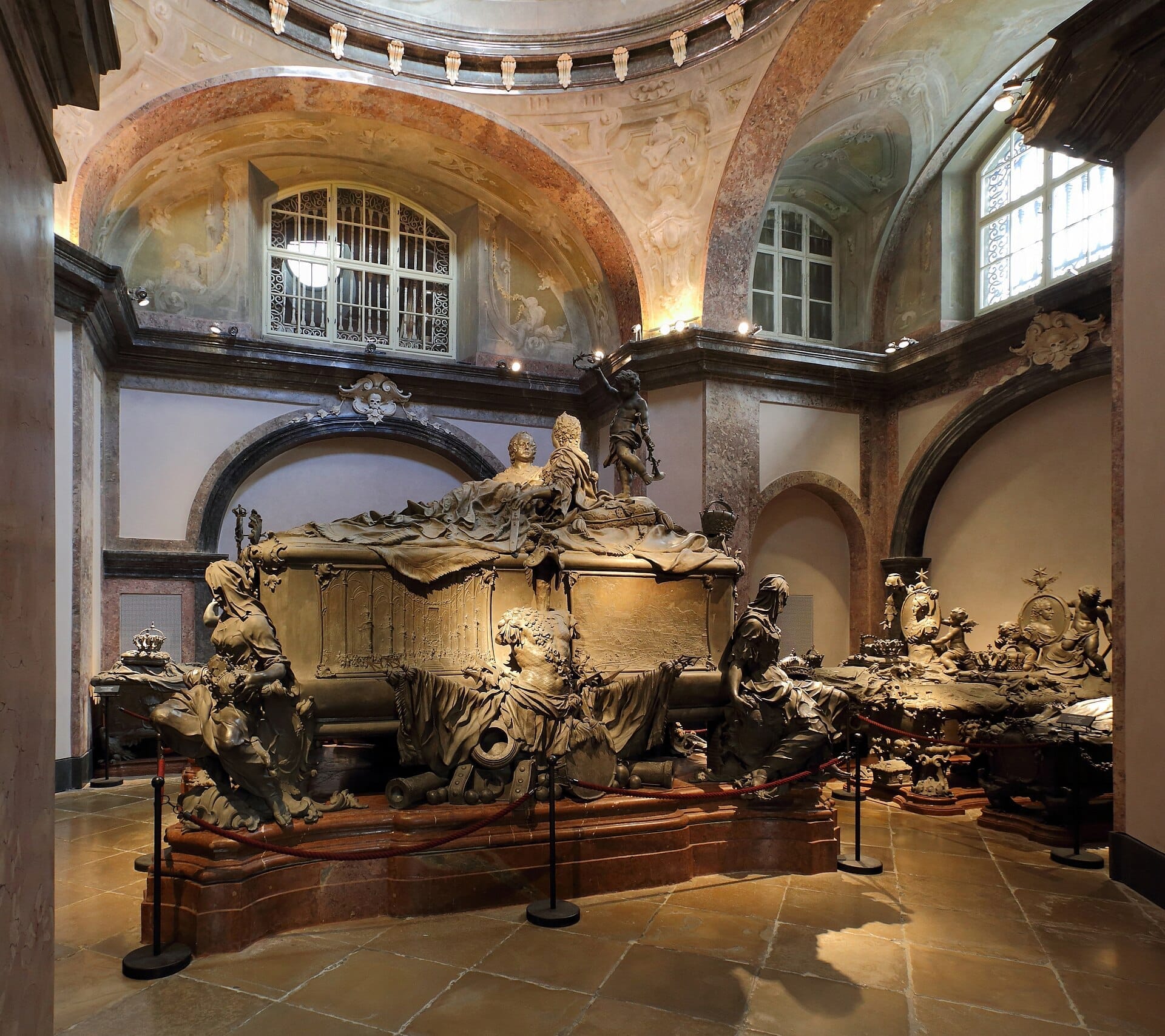
The centerpiece is the double sarcophagus of Empress Maria Theresa and her husband Emperor Francis I Stephen of Lorraine, completed in 1753. It is the largest piece in the entire crypt and commands an entire room to itself, the Maria Theresa Vault. Two life-size reclining figures of the royal couple crown the lid, depicted as if mid-conversation. The detail is extraordinary: court dress, lace, medals, and expressions that seem almost animate. It is the baroque tradition at full volume and worth spending several minutes with.
Franz Joseph I and Empress Elisabeth rest in adjacent sarcophagi in the Franz Joseph Vault. Elisabeth's coffin draws the most visitors, and there is almost always a small cluster of people around it. Franz Joseph's tomb is equally prominent but receives somewhat less attention, which gives you space to look carefully at it. The room has a different emotional register than the earlier baroque vaults: it feels more recent, more personally legible, less mythologized.
Tickets & tours
Hand-picked options from our booking partner. Prices are indicative; availability and final rates are confirmed when you complete your booking.
Imperial Vienna 72-hour hop-on hop-off bus
From 55 €Instant confirmationFree cancellationSkip-the-Line Entrance with Guide to Schonbrunn Palace and Gardens
From 45 €Instant confirmationFree cancellationLuggage Storage in Vienna
From 6 €Instant confirmationFree cancellationStrauss Dinner Show
From 99 €Instant confirmationFree cancellation
Atmosphere and Sensory Experience
The temperature underground stays noticeably cool year-round, around 10–12°C, so bring a light layer even in summer. The air carries a faint stone-and-earth smell, the kind you find in old churches and cellars, not unpleasant but unmistakably subterranean. The lighting is kept deliberately low, with individual spots on key sarcophagi, which means photographs require patience and a steady hand. The acoustics are muffled; conversations stay quiet without any need to enforce it.
At opening time, 10:00, the crypt is often close to empty. This is the best window if you want to move through the rooms at your own pace, stop in front of individual sarcophagi without crowds, and actually read the German-language labels. By late morning and through the afternoon, particularly between 11:00 and 14:00, tour groups arrive and the narrower vaulted corridors can feel genuinely congested. The audio guide (available in multiple languages) helps structure the visit without requiring you to wait for a guided tour.
💡 Local tip
Arrive at 10:00 or after 15:30 to avoid the peak tour-group window. The early morning slot also gives you natural quiet to read the inscriptions, which contain surprisingly specific biographical details.
Historical and Cultural Significance
The Habsburg dynasty ruled Austria and large parts of Central Europe for roughly 600 years. The Kapuzinergruft is the physical record of that dynasty's end-point: every emperor from Ferdinand II (died 1637) through Karl I (died 1922) is interred here. Karl I was the last Habsburg emperor, deposed after the collapse of the Austro-Hungarian Empire in 1918. His entombment in 1989 (his remains were returned from exile in Madeira) was the most recent imperial funeral in Vienna. Understanding this political history gives the visit genuine depth. For broader context on the Habsburg legacy across the city, the Habsburg imperial history guide covers the dynasty's reach across palaces, churches, and monuments.
The Capuchin friars still maintain the crypt today, continuing a tradition that began in the 17th century. The choice of a Capuchin church was itself symbolic: the Capuchins were a mendicant order emphasizing poverty and humility, creating a deliberate contrast with the imperial grandeur of the sarcophagi they housed. This tension, between monastic simplicity and dynastic ostentation, is present in every room and becomes more legible as you move through the complex.
The crypt connects naturally to other Habsburg sites across Vienna's Innere Stadt. The Hofburg Palace is a 10-minute walk north and includes the Sisi Museum and Imperial Apartments. The Imperial Treasury within the Hofburg complex holds the Habsburg Crown Jewels. Together, these three sites form a coherent arc through imperial Vienna.
Practical Walkthrough: Getting There and Getting In
The entrance is on Tegetthoffstraße 2, facing Neuer Markt square. The door to the crypt is to the right of the main church entrance and is clearly signposted. Tickets are purchased at a small desk just inside the entrance. The crypt is described as fully accessible, with no steps at the main entrance and a lift to the vaults, making it one of the more accessible underground historic sites in the city.
From Stephansplatz (U1/U3), walk south along Kärntner Straße for about five minutes, then turn right onto Tegetthoffstraße. From Karlsplatz (U1/U2/U4), it is a seven-minute walk north. Bus line 2A stops at Plankengasse/Albertinaplatz, putting you about two minutes from the entrance. The surrounding streets are part of Vienna's central pedestrian zone, so the walk from any direction is straightforward. If you are planning a full day in the first district, the Innere Stadt walking tour can help you organize the crypt visit within a broader route.
ℹ️ Good to know
Photography is permitted throughout the crypt. Tripods are not practical in the narrow passages, but compact cameras and phones perform well with the available low-level lighting. Flash is not appropriate here and tends to flatten the detail on the sarcophagi anyway.
Who Should Visit and Who Might Skip It
The Kapuzinergruft rewards visitors who arrive with some prior knowledge of Habsburg history or who take time to use the audio guide. Without that context, the rows of ornate coffins can feel repetitive after the first few rooms. The site is not a museum with interpretive displays in the conventional sense: the information is on labels and in the audio guide, and the experience is largely contemplative.
Travelers with a strong interest in the Sisi story specifically will find the visit worthwhile but brief. The sarcophagus of Empress Elisabeth is significant but the crypt provides little interpretive material about her life beyond the dates and titles on the coffin. The Sisi Museum at the Hofburg offers far more biographical depth on her life and is the better choice if Elisabeth is your primary interest. The crypt is better suited to those interested in dynastic history as a whole.
Young children may find the space unsettling or simply unengaging. The crypt is dark, cold, and the content is entirely about death and burial. It is not interactive and there are no facilities inside the vaults. Visitors with claustrophobia should note that several of the older vaulted rooms are narrow with low ceilings, though the newer sections open up considerably.
The Broader Neuer Markt Area
Neuer Markt itself is a pleasant, if understated, square with the Donnerbrunnen fountain at its center, a mid-18th-century work by Georg Raphael Donner that was once considered scandalous for its partially unclothed allegorical figures. After the crypt, the square provides a useful orientation point for the surrounding neighborhood. The Albertina Museum is a five-minute walk northwest, and the Vienna State Opera is a similar distance to the south. Kärntner Straße, the main pedestrian spine of the Innere Stadt, runs along the eastern edge of the square.
Several traditional Viennese coffeehouses are within easy walking distance and provide a natural endpoint to a visit that leaves most people wanting to sit quietly for a few minutes. The juxtaposition is very Viennese: imperial death below ground, Melange and Apfelstrudel above it.
Insider Tips
- The double sarcophagus of Maria Theresa and Francis I Stephen is often photographed from the doorway. Walk around to the far side of the room for a much clearer view of the sculptural detail on the lid, which is where the real craftsmanship is concentrated.
- The audio guide is worth the extra cost. The labels inside are primarily in German, and while an English pamphlet is available, the audio guide provides the biographical and historical context that transforms the visit from a row of coffins into a coherent dynastic narrative.
- The newest section of the crypt, added in the 20th century, is strikingly plain compared to the baroque vaults. Most visitors spend little time here, but the contrast in funerary aesthetics between the 17th and 20th centuries is one of the most instructive things about the entire complex.
- If you visit around 1–2 November (All Saints and All Souls Days), be aware that opening hours are reduced to 10:00–14:00. These dates carry particular significance at the crypt, and the atmosphere on those mornings is noticeably different from a regular day.
- The crypt is included on the Vienna PASS, which covers many of the city's major attractions. If you are visiting multiple Habsburg sites in a short trip, calculating whether the pass saves money overall is worthwhile before purchasing individual tickets.
Who Is Kapuzinergruft (Imperial Crypt) For?
- Travelers with a genuine interest in Habsburg or Central European history who want primary, physical contact with the dynasty's story
- Architecture and funerary art enthusiasts: the range of sarcophagus styles from 17th-century plain stone to 18th-century baroque is genuinely instructive
- Visitors combining the crypt with the Hofburg complex for a full imperial history day
- Those seeking a quiet, contemplative break from the more crowded outdoor attractions of the Innere Stadt
- Solo travelers who prefer self-guided audio experiences over group tours
Nearby Attractions
Other things to see while in Innere Stadt (1st District):
- Albertina Museum
Housed in a former Habsburg palace at the edge of the Ringstrasse, the Albertina holds one of the largest and finest graphic art collections in the world. With over one million drawings and prints alongside rotating exhibitions of modern masters, it rewards both the casual visitor and the serious art traveler.
- Austrian National Library (Prunksaal State Hall)
The Prunksaal, or State Hall of the Austrian National Library, is a Baroque masterpiece built for Emperor Charles VI between 1723 and 1726. At roughly 80 metres long and crowned by Daniel Gran's sweeping ceiling frescoes, it is one of the most visually arresting interiors in central Europe, and still holds around 200,000 historic volumes in its carved walnut shelves.
- Burgtheater
The Burgtheater is Austria's national theatre and one of the most significant German-language stages in the world. Its Neo-Renaissance building on Vienna's Ringstraße dates to 1888, and its institutional history stretches back to the court of Empress Maria Theresa. Whether you come for a performance or a guided tour, it rewards attention.
- Café Central
Housed inside the Palais Ferstel in Vienna's historic first district, Café Central has been serving coffee and conversation since 1876. Once the gathering point for Freud, Trotsky, and a constellation of Central European intellectuals, it remains one of the most architecturally remarkable coffeehouses in the world.