Sisi Museum Vienna: The Empress Behind the Myth
The Sisi Museum occupies the Reichskanzleitrakt wing of the Hofburg Imperial Palace and traces the life of Empress Elisabeth of Austria through around 300 objects, from her personal jewelry and fitness equipment to her assassination cloak. It is one of the most visited sites in the Innere Stadt, and for good reason: the collection goes well beyond the romanticized image most visitors arrive with.
Quick Facts
- Location
- Hofburg, Michaelerplatz, 1010 Vienna (Innere Stadt)
- Getting There
- U3 Herrengasse; Trams 1, 2, D to Burgring; Bus 1A/2A to Hofburg
- Time Needed
- 1.5 to 2.5 hours (combined with Imperial Apartments)
- Cost
- Adults approx. €20; children (6+) approx. €12; Sisi Pass (Schönbrunn + Furniture Museum) approx. €57. Prices subject to change.
- Best for
- History enthusiasts, Habsburg admirers, visitors who want depth over spectacle
- Official website
- www.sisimuseum-hofburg.at
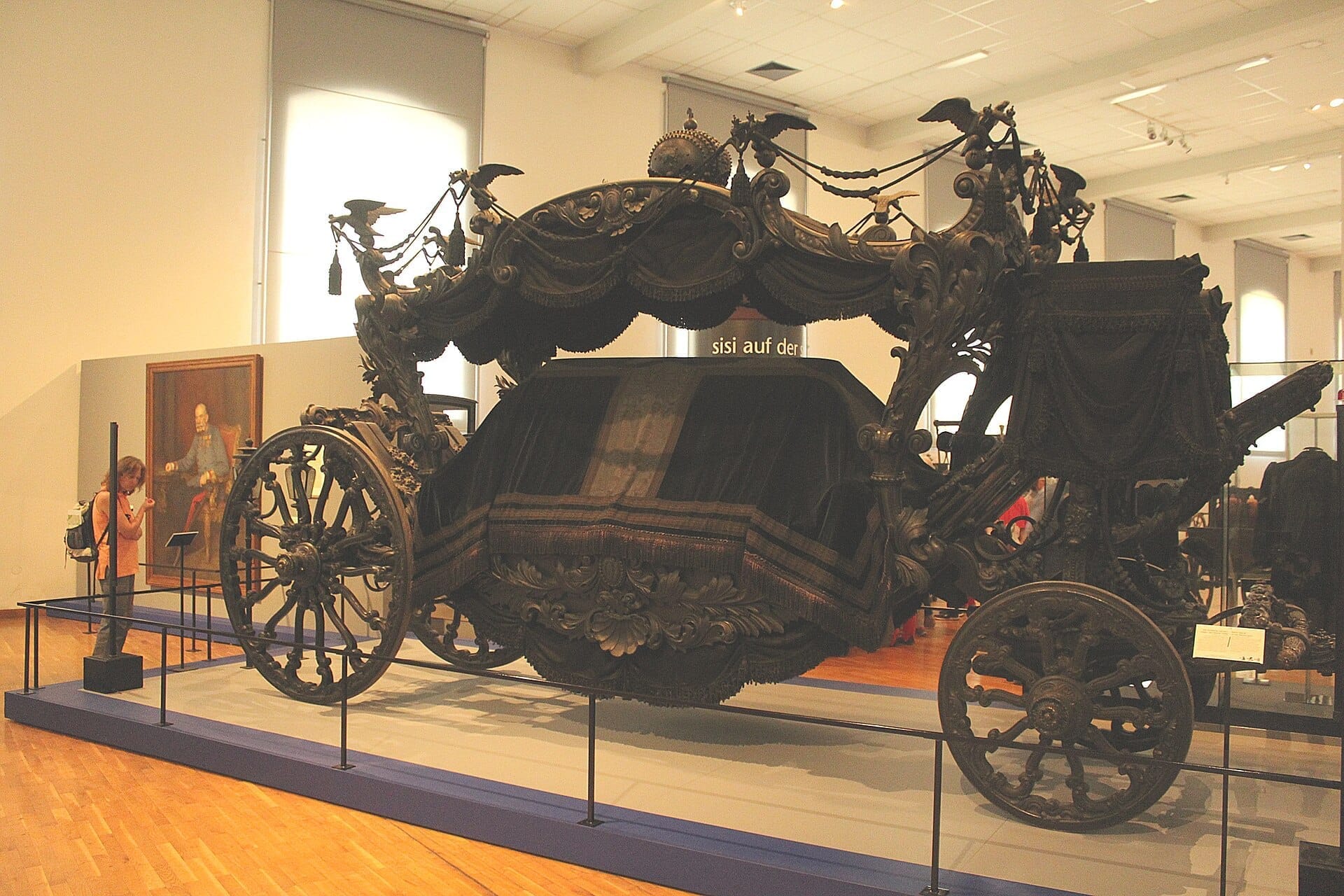
What the Sisi Museum Actually Is
The Sisi Museum opened on 24 April 2004, chosen to mark the 150th anniversary of the wedding of Empress Elisabeth (1837-1898) and Emperor Franz Joseph I. It occupies a series of rooms within the Reichskanzleitrakt, a wing of the Hofburg Imperial Palace, and flows directly into the Imperial Apartments and the Imperial Silver Collection as part of a combined ticket experience.
The museum is not a shrine to a fairy-tale princess. It makes a deliberate effort to complicate the popular image of Sisi, the one shaped by Romy Schneider films and commemorative plates. The curatorial approach addresses her obsessive exercise regimes, her difficult relationship with the Habsburg court, her long self-imposed absences from Vienna, and ultimately her assassination in Geneva by the Italian anarchist Luigi Lucheni in September 1898. Visitors who arrive expecting soft imperial nostalgia often leave surprised by how psychologically layered the presentation is.
ℹ️ Good to know
The Sisi Museum, Imperial Apartments, and Imperial Silver Collection are sold as a single combined ticket. You cannot purchase entry to the Sisi Museum in isolation. Budget time for all three, or at minimum plan two hours.
The Collection: 300 Objects and What They Reveal
Around 300 objects are on display. Some are intimate in scale: hairpins from her famously elaborate coiffure, a portable gymnastics bar she had installed in various royal residences, the lightweight scale she reportedly used to monitor her weight almost daily. Others carry a heavier historical charge. The black dress she wore in mourning after the death of her son Crown Prince Rudolf at Mayerling in 1889 is exhibited alongside personal correspondence that gives the grief a human dimension.
The assassination cloak, the actual garment she was wearing when Lucheni stabbed her with a file in Geneva, stops most visitors. It is displayed with the small wound visible. The audio guide, included in the ticket price, provides context that the plaques alone cannot fully deliver, particularly around her later years of travel and her deliberate distancing from Vienna.
Elisabeth's relationship with her own appearance is given serious curatorial attention. Her 142-centimeter waist measurement, achieved through extreme corsetry and near-starvation diets, is not presented as admirable. The museum contextualizes it within 19th-century court expectations and her own psychological struggles in a way that reads as genuinely considered rather than performative.
Tickets & tours
Hand-picked options from our booking partner. Prices are indicative; availability and final rates are confirmed when you complete your booking.
Skip-the-line Sisi Museum, Imperial Apartments and Hofburg tour
From 52 €Instant confirmationFree cancellationEmpress Sisi and Imperial Apartments tour in Vienna
From 38 €Instant confirmationFree cancellationSkip-the-Line Sisi Museum, Hofburg and Gardens Tour Vienna in French
From 52 €Instant confirmationFree cancellationVienna combo tickets with Schonbrunn, Sisi, transport and walking tour
From 129 €Instant confirmation
Moving Through the Space: Layout and Atmosphere
The rooms are not large, and the flow is linear, which prevents backtracking but also means congestion during peak hours. The ceilings are appropriately imperial, though the display design is relatively modern, with dark backgrounds, spot lighting, and explanatory panels in German and English. It does not feel like a state room that has been converted as an afterthought; the curatorial design has clearly been given real resources.
After the Sisi Museum section, the route continues into the Imperial Apartments, which were used by Franz Joseph and, at various points, Empress Elisabeth. These rooms have a quieter, more austere atmosphere. Franz Joseph's study and bedroom reflect a working monarch with notably spartan personal tastes, which sits in interesting contrast to the elaborate public spaces elsewhere in the Hofburg.
💡 Local tip
The audio guide is included in your ticket and is genuinely worth using. It adds context the wall panels cannot fully provide, especially in the sections covering Elisabeth's later life and the political tensions of the Habsburg court.
When to Visit and How Crowds Behave
The museum is open daily including public holidays from 09:00 to 17:30, with last admission at 16:30. Mornings between 09:00 and 10:30 are consistently the quietest window. By mid-morning, tour groups from the major central hotels begin arriving in volume, and the narrower display corridors become difficult to navigate slowly. Afternoons, particularly between 12:00 and 15:00 in the summer months, are the most congested period.
If you are visiting in July or August, arriving at opening time is not just a suggestion. The Hofburg complex draws significant tourist traffic across all its components, and the Sisi Museum is the most popular draw within the combined ticket. A 09:00 arrival on a weekday gives you perhaps 30 to 45 minutes of near-empty rooms before the pace shifts.
For a broader understanding of how the Sisi Museum fits into the Hofburg complex, it helps to read up on the Hofburg Palace as a whole before visiting. The complex contains multiple institutions spread across a large site, and knowing the layout in advance saves time and prevents confusion at the entrance.
Getting There and Arriving at the Right Door
The entrance is under the Michaelerkuppel at Michaelerplatz, a large domed rotunda on the northeast edge of the Hofburg. This is not the same as the main Heldenplatz entrance or the Burggarten side. First-time visitors sometimes waste time approaching from the wrong direction.
By U-Bahn, take the U3 (orange line) to Herrengasse and walk south through the arcade toward Michaelerplatz, roughly a three-minute walk. Trams 1, 2, D, and 71 stop at Burgring, which puts you at the southern edge of the palace complex, about a five-minute walk to the Michaelerplatz entrance. Buses 1A and 2A stop directly at Hofburg. The entire Innere Stadt is compact enough that walking from most central hotels takes under fifteen minutes.
If you are planning a full day in the first district, the Sisi Museum pairs logically with the Imperial Treasury, which is also within the Hofburg complex, and the Spanish Riding School if performances are scheduled during your visit.
Tickets, Passes, and What They Cover
As of 2026, the standard adult ticket is approximately €20, with reduced pricing around €18 for eligible visitors. Children aged 6 and above pay approximately €12. The ticket covers the Sisi Museum, the Imperial Apartments, and the Imperial Silver Collection as a single combined experience, and includes the audio guide.
A Sisi Pass combines entry to Schönbrunn Palace, the Sisi Museum, and the Imperial Furniture Museum at a discounted combined rate of approximately €57 instead of €65. If you are planning to visit Schönbrunn anyway, the pass offers reasonable value. Prices should be verified at the time of booking, as they are subject to revision.
If you are considering a multi-attraction pass for your stay in Vienna, it is worth checking whether the Vienna Pass covers the Sisi Museum against your planned itinerary, since the combined ticket already includes several attractions.
⚠️ What to skip
Ticket prices and the Sisi Pass bundle are subject to change. Always verify current pricing on the official website at sisimuseum-hofburg.at or hofburg-wien.at before booking.
Accessibility and Practical Notes
The museum is described as wheelchair accessible. The Hofburg complex is large and parts of the exterior involve uneven historic paving, so approaching from the Michaelerplatz entrance (where the museum entrance sits) involves relatively manageable terrain. Anyone with mobility considerations should confirm current access arrangements directly with the venue before visiting, as historic buildings can have intermittent restrictions.
Photography policies should be confirmed on-site, as rules for personal photography in Austrian museum collections can vary by room and exhibition. The audio guide is available in multiple languages, making the museum navigable without German fluency.
The Sisi Museum sits within Vienna's Innere Stadt, which is dense with major sights. A well-structured walking itinerary through the first district can help you avoid doubling back across the same ground.
Who Should Manage Their Expectations
Visitors looking for opulent gilded state rooms will find more of that in Schönbrunn Palace or in the Upper Belvedere. The Sisi Museum rooms themselves are relatively modest in scale and heavily focused on objects and interpretation rather than architectural spectacle. Anyone who has already read extensively about Empress Elisabeth, or who has visited similar Habsburg-focused collections in Prague or Budapest, may find the exhibition covers familiar ground.
Families with young children may find the pacing slow. The exhibition is text-heavy and the objects, though significant, do not have the immediate visual drama that keeps younger visitors engaged. The audio guide is not calibrated for children.
Insider Tips
- Buy tickets online in advance, especially in summer. The ticket queue under the Michaelerkuppel moves slowly and wastes time you could spend inside.
- The Imperial Silver Collection, the third component of the combined ticket, is frequently skipped by visitors in a rush. It is less glamorous than its name suggests, but the sheer scale of Habsburg table settings on display gives a concrete sense of how seriously court ceremony was taken.
- The Michaelerplatz itself, immediately outside the entrance, is worth pausing at before you go in. Excavations in the 1990s uncovered Roman remains and an 18th-century burial ground, both visible through glass panels set into the square. It costs nothing and takes five minutes.
- The audio guide chapters are numbered to match the room sequence. Do not skip ahead even if a room seems less interesting; the narrative builds context that makes later rooms more legible.
- If you are visiting in late afternoon, note that last admission is at 16:30 and the staff begin winding down the audio guide return desks shortly after 17:00. Give yourself enough time to finish comfortably.
Who Is Sisi Museum For?
- Travelers with genuine interest in 19th-century European history and the Habsburg dynasty
- Visitors who want more than surface-level imperial pageantry and appreciate curatorial depth
- Those combining the Sisi Museum with Schönbrunn Palace for a full day focused on Habsburg Vienna
- Couples and solo travelers who prefer self-guided, audio-tour-led experiences over guided group tours
- Anyone researching the political and cultural context of the Austro-Hungarian Empire
Nearby Attractions
Other things to see while in Innere Stadt (1st District):
- Albertina Museum
Housed in a former Habsburg palace at the edge of the Ringstrasse, the Albertina holds one of the largest and finest graphic art collections in the world. With over one million drawings and prints alongside rotating exhibitions of modern masters, it rewards both the casual visitor and the serious art traveler.
- Austrian National Library (Prunksaal State Hall)
The Prunksaal, or State Hall of the Austrian National Library, is a Baroque masterpiece built for Emperor Charles VI between 1723 and 1726. At roughly 80 metres long and crowned by Daniel Gran's sweeping ceiling frescoes, it is one of the most visually arresting interiors in central Europe, and still holds around 200,000 historic volumes in its carved walnut shelves.
- Burgtheater
The Burgtheater is Austria's national theatre and one of the most significant German-language stages in the world. Its Neo-Renaissance building on Vienna's Ringstraße dates to 1888, and its institutional history stretches back to the court of Empress Maria Theresa. Whether you come for a performance or a guided tour, it rewards attention.
- Café Central
Housed inside the Palais Ferstel in Vienna's historic first district, Café Central has been serving coffee and conversation since 1876. Once the gathering point for Freud, Trotsky, and a constellation of Central European intellectuals, it remains one of the most architecturally remarkable coffeehouses in the world.