Imperial Treasury Vienna (Schatzkammer): What to Expect Inside the Hofburg's Greatest Collection
Housed in the oldest wing of the Hofburg Palace, the Imperial Treasury Vienna, or Kaiserliche Schatzkammer Wien, contains one of the most significant collections of royal regalia and religious relics in the world. From the Holy Lance to the Habsburg crown jewels, this is where centuries of imperial ambition are preserved in gold, gemstone, and enamel. It rewards slow, deliberate visitors far more than rushed ones.
Quick Facts
- Location
- Hofburg, Schweizerhof, 1010 Vienna (Innere Stadt)
- Getting There
- U3 Herrengasse (5-min walk); Trams 1, 2, D to Burgring; Bus 1A/2A to Michaelerplatz
- Time Needed
- 1.5 to 2.5 hours
- Cost
- Paid entry (under 19 free); verify current prices at kaiserliche-schatzkammer.at
- Best for
- History enthusiasts, Habsburg era travelers, art and jewellery lovers
- Official website
- www.kaiserliche-schatzkammer.at/en
What Is the Imperial Treasury and Why Does It Matter?
The Imperial Treasury Vienna, officially the Kaiserliche Schatzkammer Wien, occupies a suite of 21 rooms in the Schweizerhof, the Swiss Courtyard of the Hofburg Palace. This is the oldest surviving section of the Hofburg complex, rebuilt in Renaissance style under Emperor Ferdinand I in the 16th century. The building's stone archways and thick walls give it a gravity that even the grandest sections of the Hofburg cannot match.
What the Treasury contains is, without exaggeration, among the most historically significant collections of royal objects in Europe. The holdings span more than a thousand years: from Carolingian relics and medieval regalia to the ceremonial crown jewels of the Austrian Empire, accumulated across the long arc of Habsburg rule. This is not a museum that recreates history with reproductions. Everything here is original, and most of it was created for rulers who expected permanence.
For visitors working through Vienna's imperial story, the Treasury provides context that no other single venue can. If you have already visited the Hofburg Palace apartments or the Sisi Museum, the Schatzkammer fills in the deeper ceremonial and dynastic picture that those rooms gesture toward.
The Collection: What You Will Actually See
The Treasury divides into two broad sections: the Secular Treasury and the Ecclesiastical Treasury. Most visitors gravitate toward the secular rooms first, and the density of remarkable objects can be disorienting. It helps to know what to look for before you enter.
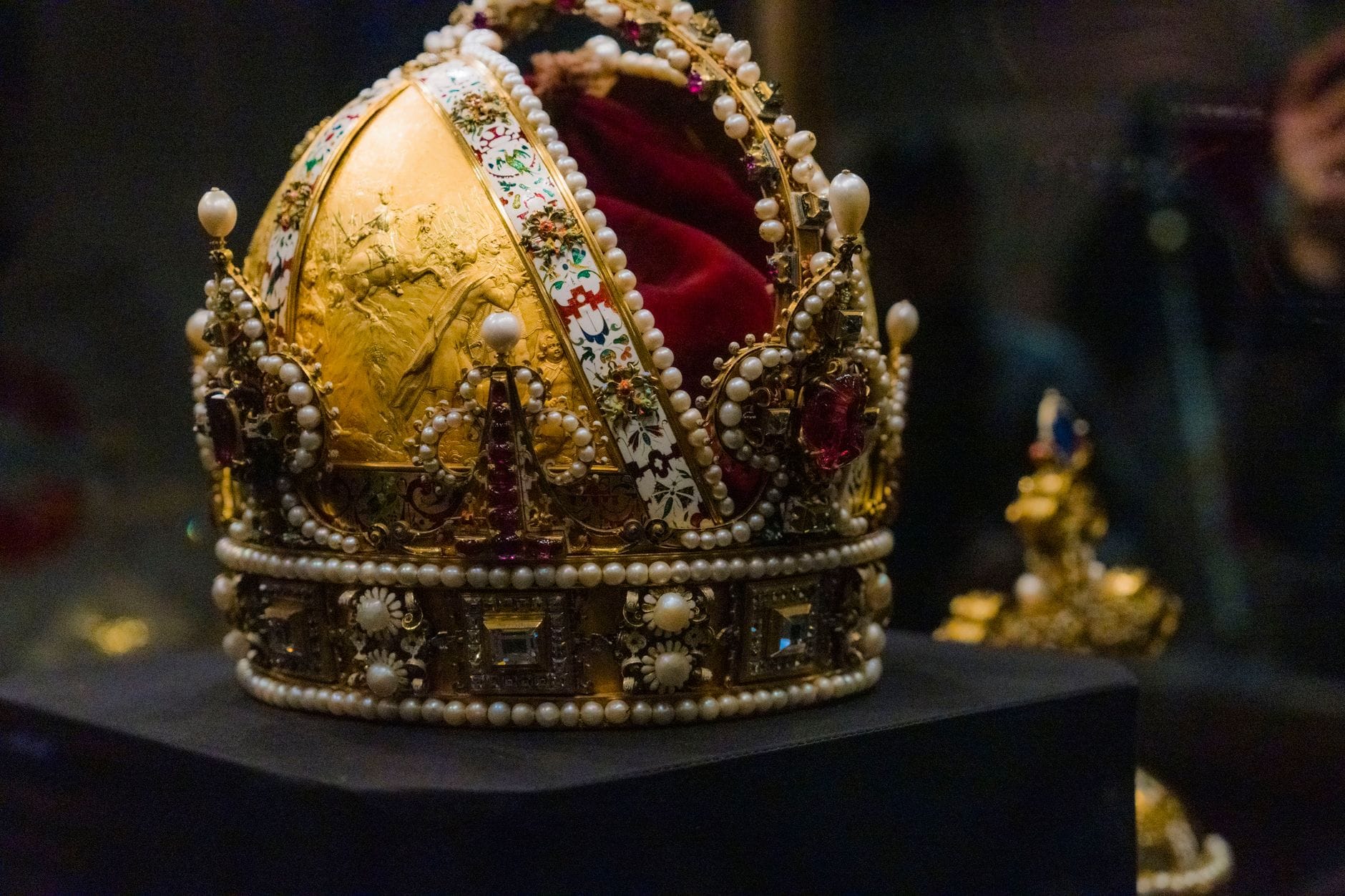
The Imperial Crown of the Holy Roman Empire is the anchor of the entire collection. Made in the late 10th century, possibly around 962 for Otto the Great's coronation, it is an octagonal gold crown set with precious stones and enamel plaques depicting biblical kings. Standing in front of it, the age of the object registers in a way that photographs do not prepare you for. The craftsmanship is extraordinary even by contemporary standards, and the fact that it survived intact across more than a thousand years of European upheaval is remarkable in itself.
Also in the secular rooms: the Imperial Orb and Sceptre, the ceremonial robes of the Order of the Golden Fleece, and the Habsburg imperial crown made for Rudolf II in 1602, which later became the crown of the Austrian Empire. One room holds the Cradle of the King of Rome, a gift made for Napoleon's son in 1811, gold and silver with a sculpted eagle at its head. It sits in a glass case looking both magnificent and faintly melancholy.
The Ecclesiastical Treasury is quieter and often less visited, but it contains some of the oldest and most theologically significant objects in the entire museum. The Holy Lance, a medieval iron lance believed for centuries to be the spear that pierced Christ's side at the Crucifixion, is displayed here. Its documented history goes back to at least the 8th century, and it was one of the most politically powerful relics in medieval Europe. The Agate Bowl, once believed to be the Holy Grail, is also here, though modern analysis has definitively dated it to late antiquity.
💡 Local tip
The audio guide is worth taking. Many of the objects have no obvious visual cues to explain their historical significance, and the labels alone cannot carry the weight of a thousand years of context. The guide is available at the entrance and covers the key pieces in both the secular and ecclesiastical sections.
Tickets & tours
Hand-picked options from our booking partner. Prices are indicative; availability and final rates are confirmed when you complete your booking.
Imperial Treasury entry ticket and Vienna self-guided audio tour
From 32 €Instant confirmationTickets for the Imperial Treasury at Vienna Hofburg Palace
From 14 €Instant confirmationImperial Vienna 72-hour hop-on hop-off bus
From 55 €Instant confirmationFree cancellationEmpress Sisi and Imperial Apartments tour in Vienna
From 38 €Instant confirmationFree cancellation
How the Experience Changes by Time of Day
The Treasury opens at 09:00 and the first hour is consistently the quietest. Tour groups tend to arrive between 10:30 and 11:30, which compresses the narrow rooms and makes it difficult to stand in front of the most important displays without waiting. If you arrive at opening and move through the secular rooms first, you will likely have the Imperial Crown almost entirely to yourself for the first fifteen to twenty minutes.
Midday brings the heaviest traffic, particularly on weekends and during summer. The rooms are not large, and the lighting is deliberately dim to protect the objects, so a crowded room in the Treasury feels significantly more congested than the same number of people in a conventional gallery. Late afternoon, from around 15:30 onward, sees a notable drop in visitors as tour groups move on to evening meals. This is a good window if you prefer to take your time with specific objects.
The lighting inside is consistent regardless of the time of day, since the Treasury has no natural light in most rooms. The experience does not change with weather, which makes this one of the better options on a rainy Vienna afternoon when outdoor sightseeing becomes uncomfortable.
Getting There and Finding the Entrance
The Schatzkammer is not immediately obvious from the outside. The entrance is in the Schweizerhof, the inner Swiss Courtyard of the Hofburg, accessed through the Schweizertorm, the Swiss Gate, which dates from 1552. The gate is decorated with the coats of arms of the territories under Ferdinand I's rule and is itself a notable piece of Renaissance carving. Follow signs from Michaelerplatz or the Burggarten side toward the Schweizertorm.
By U-Bahn, line U3 to Herrengasse is the most direct connection, a five-minute walk through the Herrengasse toward Michaelerplatz. Trams 1, 2, and D stop at Burgring, which brings you to the Burggarten side of the Hofburg. Bus lines 1A and 2A stop at Michaelerplatz, placing you almost at the Schweizertorm. The Hofburg complex is entirely walkable from most of the Innere Stadt.
If you are planning a half-day in this part of the Innere Stadt, the Treasury pairs logically with the Austrian National Library Prunksaal and the Hofburg's ceremonial rooms. The Spanish Riding School is also within the same complex, though it requires separate tickets and advance booking.
ℹ️ Good to know
The Treasury is closed on Tuesdays. On 24 December it closes early at 15:00. Last admission is 30 minutes before closing on all other days. Visitors under 19 are admitted free of charge. Verify current adult pricing at the official site before your visit.
Accessibility and Practical Logistics
The Hofburg complex has been progressively adapted for accessibility, and the Treasury provides facilities for visitors with reduced mobility. The official Vienna tourism page lists accessibility information for the site. If you have specific requirements, contact the museum directly before your visit to confirm arrangements, as some sections of the older Schweizerhof building have architectural constraints.
Photography is generally permitted without flash throughout the collection, though rules can change and signs in individual rooms should be followed. The rooms are carpeted and relatively quiet, which makes the atmosphere contemplative. Bags should be compact; there is a cloakroom available near the entrance for larger items.
Ticket purchases can be made at the entrance or in advance online. During peak season in summer and around the Christmas market period in late November and December, online booking is advisable to avoid queues, particularly around the 09:00 opening window.
Honest Assessment: Is It Worth Your Time?
For visitors with a genuine interest in European history, medieval art, or the Habsburg dynasty, the Imperial Treasury is one of the most rewarding museums in Vienna. The density of genuinely significant objects per square meter is almost unmatched anywhere in the city. The Holy Roman Empire crown alone justifies the admission for many visitors.
For visitors who are less drawn to historical objects and prefer experiential or interactive exhibitions, the Treasury may feel static. The display cases are traditional, the rooms are dark, and there is relatively little curatorial storytelling beyond the audio guide. Children under ten are likely to lose interest quickly, and the hushed atmosphere is not well-suited to families with young kids.
Travelers interested in the broader context of Habsburg art and power might also want to plan time at the Kunsthistorisches Museum, which holds the great painting collection assembled by the same dynasty. The two museums together provide a comprehensive picture of Habsburg cultural ambition, though doing both in a single day is tiring. See our Vienna Habsburgs Imperial History guide for how to sequence them effectively.
⚠️ What to skip
The Treasury can feel overwhelming without preparation. With 21 rooms and hundreds of objects, unfocused visitors often exit feeling they have seen a lot without remembering much. Identify five or six key pieces you want to see beforehand and use those as anchors for the rest of the visit.
Insider Tips
- Enter at 09:00 on a Wednesday or Thursday morning. These are the quietest days, and the first forty-five minutes before tour groups arrive give you real space in front of the imperial crown and the Holy Lance.
- The Ecclesiastical Treasury rooms are frequently skipped by visitors who rush through the secular section. Room 14 onward contains some of the oldest objects in the entire collection and is almost always uncrowded.
- If you are visiting the Hofburg area on a budget, the Vienna City Card and the Vienna PASS both include the Schatzkammer. Check whether either card makes financial sense against your planned itinerary before paying full admission.
- The Schweizertorm (Swiss Gate) outside the entrance is one of the finest pieces of Renaissance stonework in Vienna and is almost always overlooked. Spend a few minutes examining it before you go inside.
- The museum shop near the exit sells high-quality reproductions of the crown and orb in various formats. These are among the better souvenir options in the Hofburg area, where lower-quality merchandise is the norm.
Who Is Imperial Treasury Vienna (Schatzkammer) For?
- History and European culture enthusiasts who want depth, not overview
- Habsburg dynasty followers completing the imperial circuit through Vienna
- Art and jewellery scholars with interest in medieval goldsmithing
- Travelers on rainy days looking for a full indoor session with serious content
- Visitors who have already seen the Hofburg apartments and want to understand the ceremonial dimension of Habsburg rule
Nearby Attractions
Other things to see while in Innere Stadt (1st District):
- Albertina Museum
Housed in a former Habsburg palace at the edge of the Ringstrasse, the Albertina holds one of the largest and finest graphic art collections in the world. With over one million drawings and prints alongside rotating exhibitions of modern masters, it rewards both the casual visitor and the serious art traveler.
- Austrian National Library (Prunksaal State Hall)
The Prunksaal, or State Hall of the Austrian National Library, is a Baroque masterpiece built for Emperor Charles VI between 1723 and 1726. At roughly 80 metres long and crowned by Daniel Gran's sweeping ceiling frescoes, it is one of the most visually arresting interiors in central Europe, and still holds around 200,000 historic volumes in its carved walnut shelves.
- Burgtheater
The Burgtheater is Austria's national theatre and one of the most significant German-language stages in the world. Its Neo-Renaissance building on Vienna's Ringstraße dates to 1888, and its institutional history stretches back to the court of Empress Maria Theresa. Whether you come for a performance or a guided tour, it rewards attention.
- Café Central
Housed inside the Palais Ferstel in Vienna's historic first district, Café Central has been serving coffee and conversation since 1876. Once the gathering point for Freud, Trotsky, and a constellation of Central European intellectuals, it remains one of the most architecturally remarkable coffeehouses in the world.