Spanish Riding School Vienna: Performances, Morning Exercise, and How to Visit
The Spanish Riding School is one of the world's oldest classical riding academies, housed inside a Baroque masterpiece at the heart of Vienna's Hofburg Palace. Whether you attend a full gala performance or an early morning exercise session, this is a rare window into a living equestrian tradition that has been practiced continuously for over 450 years.
Quick Facts
- Location
- Michaelerplatz 1, 1010 Wien (inside Hofburg Palace), Innere Stadt
- Getting There
- U3 Herrengasse (5-min walk); Trams 1, 2, D to Burgring
- Time Needed
- 45 min (guided tour) to 2 hours (full performance)
- Cost
- Guided tour from €18–€20; Morning exercise €18–€22; Full performance €35–€120
- Best for
- History lovers, equestrian enthusiasts, architecture admirers, families with older children
- Official website
- www.srs.at/en
What the Spanish Riding School Actually Is
The Spanish Riding School, known in German as the Spanische Hofreitschule, is not a museum or a tourist recreation. It is a working institution that has trained horses and riders in classical dressage since it was first documented in 1565. The horses are Lipizzaners, a breed developed specifically for this purpose, and the movements they perform, including the famous Airs Above the Ground, represent centuries of accumulated equestrian knowledge passed from rider to rider without interruption.
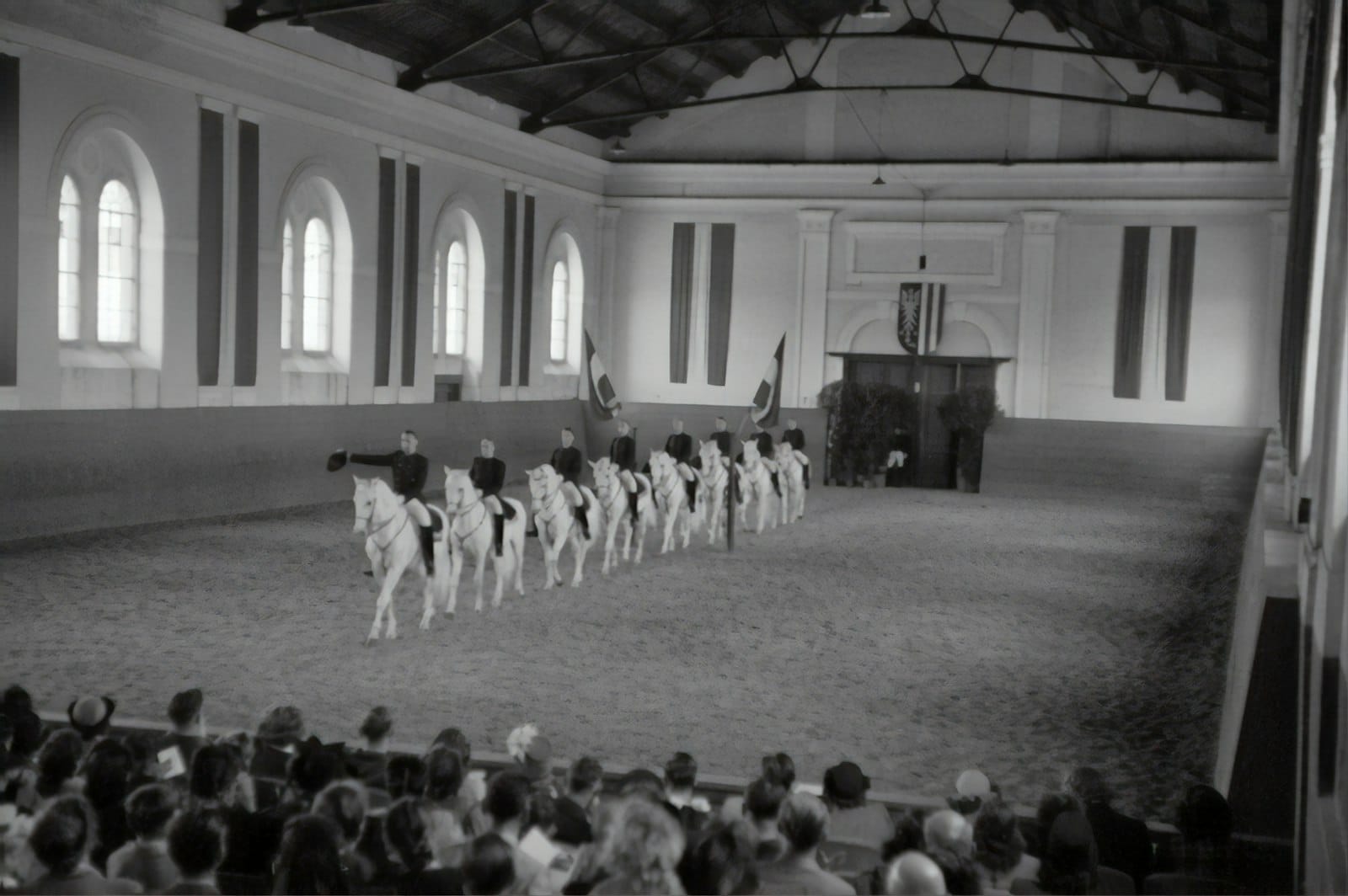
The school operates inside the Winter Riding School hall within the Hofburg Palace complex, a Baroque arena commissioned by Emperor Charles VI and completed in 1735 to designs by Johann Bernhard Fischer von Erlach. The hall itself is spectacular: a white stucco interior, three tiers of galleries supported by Corinthian columns, and a portrait of Charles VI watching from above the entrance. Even if you have no particular interest in horses, the room alone justifies the visit.
ℹ️ Good to know
The school follows an academic calendar. Formal performances and public morning exercises typically run from September through June. In July and August, the Lipizzaner stallions are at the Piber stud farm in Styria and public riding programs are suspended. The visitor centre remains open year-round, Monday to Sunday, 09:00–16:00.
The Three Ways to Experience It
Visitors can access the Spanish Riding School in three different ways, each offering a distinct level of immersion and a different price point.
Full Gala Performances
The gala performance is the complete show: riders in white breeches and bicorn hats, stallions performing choreographed movements to live or recorded classical music, the whole spectacle unfolding in that luminous Baroque arena. Tickets range from approximately €35 for a standing place up to €120 for a premium seated position. These performances sell out weeks in advance, particularly between April and June. Booking through the official site at srs.at is strongly recommended.
Seated tickets are divided into categories based on the gallery tier and angle of view. The lower gallery seats are closer to the action but can feel cramped. Upper gallery positions offer a fuller overhead view of the formations, which is where the choreography reads most clearly. If you care more about the spectacle than proximity to individual horses, the upper tiers are worth considering.
Morning Exercise Sessions
Morning exercise is the working training session, held without ceremony or narration. Riders work through movements with the horses at their own pace, sometimes stopping to repeat a sequence or adjust a position. It is less polished than a performance and considerably more honest. Tickets cost approximately €18 to €22 and are available on a first-come, first-served basis at the door, though checking availability in advance is advisable.
Sessions typically begin around 10:00 and last roughly an hour, though duration varies. Arrive early. The hall fills steadily from the moment doors open and the standing area near the railing goes quickly. The light inside the hall in the morning, filtering through tall windows onto white horses, makes this one of the better photography opportunities in Vienna if you are patient about timing your shots between movements.
💡 Local tip
Morning exercise is often described as the more 'authentic' experience precisely because it is unscripted. You see the work behind the performance, including the repetition and correction that define serious equestrian training. For many visitors, this is actually more interesting than the gala show.
Guided Tours
Guided tours of the Winter Riding School and stables run when no riding program is scheduled. Standard seated and standing-access ticket prices for these tours are approximately €18 to €20. Tours allow you to walk the arena floor, see the historic stalls, and learn the architectural and institutional history of the school. If performances are fully booked during your visit, a tour still gets you inside the hall and provides enough context to make the visit worthwhile.
Tickets & tours
Hand-picked options from our booking partner. Prices are indicative; availability and final rates are confirmed when you complete your booking.
Spanish Riding School Vienna Training
From 16 €Instant confirmationFree cancellationSkip-the-Line Sisi Museum, Hofburg and Gardens Tour Vienna in Spanish
From 52 €Instant confirmationFree cancellationSkip-the-Line Schonbrunn Palace and Gardens with Guide in Spanish
From 53 €Instant confirmationFree cancellationImperial Vienna 72-hour hop-on hop-off bus
From 55 €Instant confirmationFree cancellation
The Building: A Baroque Riding Hall Unlike Any Other
The Winter Riding School was designed as a celebration of imperial power as much as a practical facility. Fischer von Erlach, who also contributed to the design of the Hofburg Palace more broadly, created a hall that functions equally well as a performance space and a piece of propaganda architecture. The portrait of Emperor Charles VI, who commissioned the building, hangs prominently so that every rider performs, symbolically, in his presence.
The stucco decoration is restrained by Baroque standards, which actually gives the hall its peculiar elegance. The whiteness of the walls, the galleries, and the horses themselves creates a visual coherence that no renovation has significantly disrupted. The arena floor is covered in sand, and the smell of that sand mixed with horse and old timber is the first thing you notice when you enter. It is not unpleasant. It is simply very specific.
If the Baroque interior leaves you wanting more context on Vienna's architectural heritage, the Vienna architecture guide covers how the Hofburg's various building phases fit together and what to look for in the surrounding complex.
History, Horses, and Why 'Spanish' Is in the Name
The school takes its name from the Spanish horses that formed the original breeding stock, not from any Spanish institution or sponsorship. When the riding stable was formally established in the sixteenth century, the Habsburg court imported horses of Iberian lineage, specifically the ancestors of today's Lipizzaners. The Spanish Riding Stable already existed by 1572 with a rule that only horses of Spanish stock could be admitted.
Lipizzaners are born dark and turn white between ages four and ten. The breed is closely associated with the Piber Federal Stud Farm in Styria, which has supplied the school's horses since 1920. The stallions in the riding school are all male and are selected from Piber after demonstrating sufficient aptitude. Only a fraction of horses bred there will ever reach performance level. The training itself takes years, progressing through increasingly complex movements that develop the horse's strength, balance, and responsiveness.
The Spanish Riding School sits at the center of a much larger story about Habsburg court culture and imperial ceremony. For more on how the dynasty shaped what you see across Vienna today, the Vienna Habsburgs and imperial history guide offers useful background before you arrive.
Getting There and Practical Logistics
The main visitor entrance is at Michaelerplatz 1, on the north side of the Hofburg complex. The U3 line stops at Herrengasse, from which the entrance is about a five-minute walk. Tram lines 1, 2, and D stop at Burgring on the south side of the Hofburg, which requires slightly longer to reach the Michaelerplatz entrance on foot. Bus lines 1A and 2A stop directly at Michaelerplatz.
The visitor centre is open Monday to Sunday from 09:00 to 16:00. Wheelchair users who want to attend morning exercises, tours, or performances should contact the school directly by email at office@srs.at to request adapted spaces in advance. The building is a historic Baroque structure, so step-free access is not universal and specific details should be confirmed before your visit.
⚠️ What to skip
Ticket prices and program schedules change regularly. Always verify current availability and pricing at srs.at before booking, especially for gala performances, which require advance purchase and sell out quickly in peak season.
What the Experience Feels Like at Different Times
A morning exercise session on a weekday has a different atmosphere from a weekend performance. On weekday mornings, the crowd is thinner and the mood is quieter. You hear the horses breathe, the sand shift underfoot, and the occasional low command from a rider. The absence of recorded music makes it easier to concentrate on the mechanics of what you are watching.
A full performance on a Saturday afternoon fills the hall to capacity. The galleries warm up from body heat and the smell of the arena intensifies. There is applause between movements, which the horses largely ignore. The ceremony of it, the riders' formal dress, the precise collective choreography, does feel genuinely impressive rather than theatrical for its own sake. The movements performed, particularly the Levade and Capriole, are physically demanding feats that the horses execute with apparent ease only because of years of preparation.
The Hofburg complex is large enough that a visit to the Spanish Riding School pairs naturally with the nearby Imperial Treasury or the Sisi Museum, both of which are within the same palace complex and share the same historical context.
Who Should Consider Skipping It
If you have a strong aversion to animal performance or questions about the welfare implications of training horses for display, this attraction will be uncomfortable regardless of how it is presented. The school maintains that its methods are rooted in classical equestrian tradition rather than coercion, but that is a judgment each visitor has to make for themselves.
Visitors with very young children may find both the formal performances and morning exercise sessions difficult. The hall requires quiet observation and the program is not interactive. Children below school age tend to lose interest quickly. Older children with an existing interest in horses or history generally find it more engaging.
Finally, if your Vienna schedule is tight and you cannot secure tickets for a performance or morning exercise in advance, the guided tour alone may feel thin relative to the price. The hall is remarkable, but the experience is most complete when the horses are actually in it.
Insider Tips
- Book gala performance tickets several weeks ahead, particularly for April through June. The school's official site at srs.at allows advance booking and shows real-time availability by date.
- For morning exercise, arrive at the visitor centre at least 20 minutes before the listed start time. Standing spaces near the barrier go first and give the best unobstructed view of the arena floor.
- The upper gallery tiers at gala performances offer a fuller view of formation patterns. If the choreography of multiple horses moving together interests you more than close-up views of individual animals, upper seats are the better choice.
- Combine your visit with the Hofburg's other attractions on the same day. The Imperial Treasury and the Sisi Museum are both within a short walk and share the Habsburg historical thread that runs through the riding school.
- Photography is generally permitted during morning exercise but not always during formal performances. Check the current policy on the official site or at the door before assuming either way.
Who Is Spanish Riding School For?
- History and Habsburg imperial culture enthusiasts who want more than a palace tour
- Architecture visitors interested in high Baroque interior design from Fischer von Erlach
- Equestrian enthusiasts and anyone curious about the mechanics of classical dressage training
- Travelers who want a genuinely unusual spectacle that exists nowhere else in the world in the same form
- Families with older children who have an interest in horses or European history
Nearby Attractions
Other things to see while in Innere Stadt (1st District):
- Albertina Museum
Housed in a former Habsburg palace at the edge of the Ringstrasse, the Albertina holds one of the largest and finest graphic art collections in the world. With over one million drawings and prints alongside rotating exhibitions of modern masters, it rewards both the casual visitor and the serious art traveler.
- Austrian National Library (Prunksaal State Hall)
The Prunksaal, or State Hall of the Austrian National Library, is a Baroque masterpiece built for Emperor Charles VI between 1723 and 1726. At roughly 80 metres long and crowned by Daniel Gran's sweeping ceiling frescoes, it is one of the most visually arresting interiors in central Europe, and still holds around 200,000 historic volumes in its carved walnut shelves.
- Burgtheater
The Burgtheater is Austria's national theatre and one of the most significant German-language stages in the world. Its Neo-Renaissance building on Vienna's Ringstraße dates to 1888, and its institutional history stretches back to the court of Empress Maria Theresa. Whether you come for a performance or a guided tour, it rewards attention.
- Café Central
Housed inside the Palais Ferstel in Vienna's historic first district, Café Central has been serving coffee and conversation since 1876. Once the gathering point for Freud, Trotsky, and a constellation of Central European intellectuals, it remains one of the most architecturally remarkable coffeehouses in the world.