Jiufen Old Street: The Hillside Town That Earns Its Reputation
Jiufen Old Street (Jishan Street) is a narrow, lantern-lit lane winding through a former gold-mining town above Taiwan's northeast coast. Free to enter and accessible by train and bus from Taipei, it rewards visitors who arrive early or stay for dusk, when the red lanterns glow against the mountain fog.
Quick Facts
- Location
- Jishan Street, Ruifang District, New Taipei City, Taiwan
- Getting There
- TRA train to Ruifang Station, then bus or taxi up to Jiufen
- Time Needed
- 2–4 hours for the street; half a day if combining nearby attractions
- Cost
- Free to enter; food and teahouses cost extra (prices in TWD)
- Best for
- History lovers, photographers, teahouse culture, evening atmosphere
- Official website
- newtaipei.travel/en/attractions/detail/112939
What Is Jiufen Old Street, Exactly?
Jiufen Old Street is not a theme park or a managed tourist site. It is a real working lane, officially known as Jishan Street, that happens to be the historic commercial spine of a gold-mining town built into the steep hills above Taiwan's northeast coastline. There are no gates, no admission tickets, and no timed-entry system. The street is open around the clock, though most shops operate roughly 08:00 to 20:00 on weekdays, with some staying open until around 22:00 on weekends.
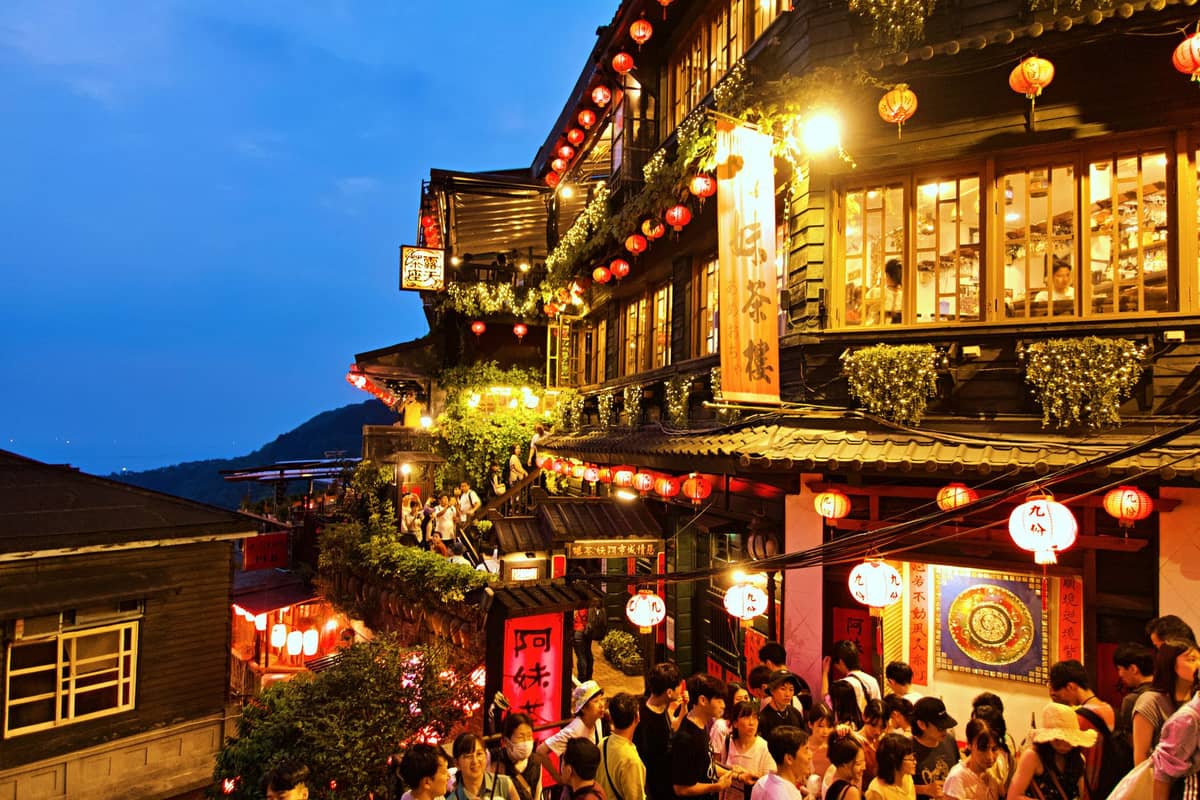
The town of Jiufen sits in Ruifang District, New Taipei City, about 35 kilometers northeast of central Taipei. It is compact, vertical, and genuinely old. Stone steps connect tiered lanes, and the architecture reflects a layered history: Japanese colonial-era shophouses sit alongside teahouses that cling to the hillside on timber stilts, their windows framing uninterrupted views of the Keelung Mountain and the Pacific coast below.
ℹ️ Good to know
Jiufen is technically in New Taipei City, not Taipei City, though it is universally sold as a day trip from Taipei. Travel time from Taipei Main Station to Ruifang Station by TRA regional train is around 40–50 minutes.
A Brief History: Gold, Decline, and Reinvention
Jiufen's rise and fall tracks closely with gold. Significant gold deposits were discovered in the area in the late 19th century, and the town grew rapidly into one of northern Taiwan's most commercially active settlements. During the Japanese colonial period, from 1895 to 1945, the mining infrastructure expanded substantially, and the hillside filled with workers, merchants, and the dense, tiered architecture still visible today.
When the gold ran out and the mines closed in the mid-20th century, Jiufen faded quickly. For decades it was largely overlooked. The town's second life began in 1989 when Taiwanese director Hou Hsiao-hsien filmed parts of his award-winning film 'A City of Sadness' here, using Jiufen's atmospheric alleyways as a backdrop. The film won the Golden Lion at Venice and introduced the town to a generation of cinephiles across Asia. Tourism followed.
International visitors often associate Jiufen with the animated film 'Spirited Away,' though Studio Ghibli has never officially confirmed that connection. The resemblance between certain teahouse interiors and the film's aesthetic is visually striking, and the association has proven durable in travel culture regardless of its official status. What matters for the visitor is that the atmosphere prompting that comparison, the lanterns, the mist, the stacked wooden balconies, is entirely real.
Walking Jishan Street: What You Actually See
The main lane narrows quickly from the bus stop entrance. Within the first fifty meters, the path is lined on both sides by food stalls and small shops selling taro balls (yu yuan), fish balls, pineapple cakes, and locally made sweets. The smells are layered: frying oil and sesame mix with the occasional drift of incense from a small roadside shrine tucked between storefronts.
As you move deeper into the street and begin descending the stone steps, the crowds thin slightly and the views open. Teahouses occupy the best vantage points, their balconies extending over the hillside with views of the coastline and, on clear days, the Keelung Islet offshore. The most photographed section is the Shuqi Road staircase, a steep stone descent lined with red lanterns that glows dramatically at dusk and again under nighttime lighting.
The street surface is uneven stone, often wet from rain or sea moisture. Footwear with grip is practical rather than optional. The gradient is significant in places, and the lane is narrow enough that opposing foot traffic creates genuine bottlenecks during peak hours.
⚠️ What to skip
Jiufen Old Street is not accessible for wheelchair users or visitors with significant mobility limitations. The core lanes involve dozens of stone steps and steep uneven paths with no ramp alternatives.
Timing Your Visit: How the Experience Changes by Hour
The difference between a 10:00 arrival and a 15:00 arrival on a Saturday is significant. Weekend afternoons, particularly from around noon to 16:00, bring the heaviest tourist traffic. The narrow lanes become difficult to navigate at a comfortable pace, queues form at popular food stalls, and photography becomes a challenge unless you are patient with crowds. If your goal is to feel the place rather than push through it, timing matters.
Morning visits, arriving before 11:00 on weekdays, offer a quieter version of the street. Shopkeepers are setting up, the lane smells of tea and fresh pastries rather than fried food, and the light hitting the hillside from the east is clean and photogenic. The fog that frequently settles over Jiufen in the mornings can add atmosphere or frustrate photographers, depending on what you are after.
Dusk is the most atmospheric time to be here. As daylight fades, the red paper lanterns lining the main staircase and the teahouse balconies are lit. The effect is genuinely striking and not manufactured for tourists: the lanterns have been part of the streetscape for decades. Arriving around 17:00 lets you catch the transition from afternoon to evening light, then stay for the full lantern effect after dark. If you plan to visit at night, note that many food stalls begin closing from around 20:00 onward.
💡 Local tip
Weekday mornings between October and April offer the best combination of manageable crowds, comfortable temperatures, and atmospheric mist. Jiufen receives heavy rain year-round, particularly from the northeast monsoon between October and March, so bring a compact umbrella regardless of the forecast.
Getting There from Taipei
The standard route from Taipei uses the Taiwan Railways Administration (TRA) network. Trains from Taipei Main Station heading toward Ruifang depart regularly; the journey takes approximately 40 to 50 minutes depending on the service. From Ruifang Station, buses labeled for Jiufen and Jinguashi run from the stop just outside the station, and the ride up the hill takes around 15 to 20 minutes. Taxis from Ruifang Station are also available and offer a fixed or metered fare up to Jiufen.
Many visitors combine Jiufen with a stop at the Jinguashi Gold Ecological Park, located a short bus ride beyond Jiufen on the same route. The gold museum offers historical context on the mining era that shaped both communities. For a broader northeast Taiwan itinerary, the Taipei to Jiufen day trip guide covers transport options, timing, and what to combine.
If you are traveling as part of an organized day tour, most pickups are from central Taipei and the journey is similar in duration. The advantage of independent travel is the ability to control your timing, which, as noted above, significantly affects the quality of the visit.
Teahouses and Food: What to Eat and Where
Taro ball soup is the food most associated with Jiufen, and most first-time visitors try it from one of the street stalls near the main entrance. The dish consists of chewy balls made from taro, sweet potato, or red bean, served in a light sweet broth, hot or cold. Quality and sweetness varies considerably between vendors; the stalls with visible queues during morning hours tend to reflect local preference more accurately than those near the bus entrance.
For sitting down, the hillside teahouses provide the best excuse to slow the visit considerably. Many teahouses serve traditional Taiwanese teas, including oolong and Oriental Beauty, accompanied by small snacks. Prices are higher than street level, but you are paying for the view and the duration: most teahouses allow guests to sit as long as they like after ordering. Taiwan's broader tea culture has deep roots in the hillside communities east of Taipei, and Jiufen's teahouses reflect that tradition at its most scenic.
Photography Notes
The Shuchi Road lantern staircase is the image most people come to capture. The best conditions for this shot are at dusk on a clear or lightly overcast day, when the warm lantern light contrasts with the blue hour sky. On foggy days, the mist softens the image in a way that can be beautiful but eliminates coastal views in the background. Full midday sun flattens the lanterns and creates harsh shadows on the stone steps.
Arriving at the staircase before 17:30 on a weekday gives you windows between tour group movements for a cleaner foreground. Weekends before 10:00 also offer brief moments of relative quiet. A wide-angle lens or a phone camera with a wide mode captures the full depth of the staircase; a short telephoto compresses the lanterns nicely for the layered effect many visitors are after.
Who This Attraction Is Not Right For
Visitors who prioritize uncrowded, contemplative experiences may find Jiufen frustrating, particularly on weekend afternoons and public holidays. The street's fame means tourist density is high during peak hours, and the commercial character of the main lane, with its repetitive souvenir shops and food stalls competing loudly for attention, can feel overwhelming if you arrive expecting a quiet historic village. Those looking for genuine historical depth without the crowds might find more reward at Bopiliao Historic Block in Wanhua or the quieter precincts of Dihua Street in Dadaocheng.
The steep terrain also makes this a poor choice for visitors using wheelchairs, strollers, or those with significant knee or balance issues. Rain, which falls frequently here due to the northeast monsoon, makes the stone steps slippery. There are no covered rest areas along the core lane, so wet-weather visits require waterproof clothing rather than just an umbrella.
Insider Tips
- Take the bus beyond Jiufen to Jinguashi rather than turning back. The fare is minimal, the crowds drop sharply, and the Gold Ecological Park provides the historical framework that makes Jiufen's architecture make sense.
- If a teahouse has a balcony view and a queue, the wait is usually worth it. Reserve a window or railing seat if given the option; interior seating loses most of the reason to be there.
- The bus back to Ruifang Station fills up quickly after 19:00. If you plan to stay for the evening lanterns, check the latest evening bus times before you arrive, or budget for a taxi down the hill.
- Jiufen's fog is unpredictable and can descend in under 30 minutes even on a clear morning. If coastal views matter to you, confirm conditions from the bus window as you approach. The view from the lane above the teahouses is the most exposed vantage point.
- Small shops on the upper lanes above Jishan Street, away from the main tourist flow, often sell the same locally made goods at lower prices with no queue.
Who Is Jiufen Old Street For?
- Photographers targeting the lantern staircase at dusk or in morning mist
- Travelers interested in Taiwan's gold-mining history and Japanese colonial architecture
- Tea enthusiasts looking for a scenic teahouse setting with genuine oolong culture
- Day-trippers from Taipei wanting a full half-day excursion without needing a car
- Visitors combining northeast Taiwan stops including Jinguashi, Shifen, or Yehliu
Nearby Attractions
Combine your visit with:
- Bitou Cape Trail
The Bitou Cape Trail (鼻頭角步道) traces a narrow coastal ridge above the Pacific Ocean in Ruifang District, New Taipei City. Free to enter and roughly 3.5 km long, it rewards hikers with some of the most dramatic ocean scenery within striking distance of Taipei. Note that sections have been under reconstruction since 2020, so checking current trail status before visiting is essential.
- Houtong Cat Village
Houtong Cat Village is a retired mining settlement in New Taipei City's Ruifang District where a large resident cat population transformed a fading industrial town into one of Taiwan's most photographed day trips. The village is free to enter, reached by a scenic Taiwan Railways train ride from Taipei, and pairs well with the adjacent Houtong Coal Mine Ecological Park.
- Jinguashi Gold Museum Area
Set high in the mountains of Ruifang District, the Gold Museum in Jinguashi preserves an entire Japanese-era gold and copper mining complex. Expect underground tunnel walks, colonial architecture, a POW camp memorial, and sweeping Pacific coastline views, all within a single open-air park.
- Pingxi Old Street
Pingxi Old Street is a narrow, railway-hugging lane in New Taipei City where Taiwan's sky lantern tradition comes to life. Built on the bones of a coal mining community, this free-admission street rewards visitors with lantern shops, traditional snacks, and mountain valley scenery that feels genuinely removed from the capital.