Dihua Street: Taipei's Oldest Commercial Strip, Still Very Much Alive
Dihua Street is the preserved heart of Dadaocheng, Taipei's 19th-century trading hub. Its colonnaded shophouses sell everything from century-old dried goods to single-origin coffee, making it one of the city's most layered and walkable historic districts. Entry to the street is free and open daily.
Quick Facts
- Location
- Section 1, Dihua Street, Datong District, Taipei City 103, Taiwan
- Getting There
- Beimen Station (Songshan-Xindian Line, Exit 3) — approx. 9–10 min walk; Daqiaotou Station (Zhonghe-Xinlu Line) also viable
- Time Needed
- 1.5 to 3 hours for a relaxed walk; half a day if you browse shops and eat
- Cost
- Free to enter the street; individual shops charge for goods and food (prices in NTD)
- Best for
- Architecture lovers, foodies, photographers, history seekers, Lunar New Year shoppers
- Official website
- www.travel.taipei/en/attraction/details/572
What Dihua Street Actually Is
Dihua Street (迪化街) is the main artery of the Dadaocheng district in Taipei's Datong District, and it ranks as one of the oldest continually commercial streets in the city. Unlike many urban heritage zones that have been sanitized into theme parks, Dihua Street is genuinely mixed: a herbalist who has worked the same counter for decades stands two doors down from a design studio selling indigo-dyed linens. The tension between old trade and new creative economy is exactly what makes the street worth your time.
The street sits within the broader Dadaocheng neighborhood, a district that grew into Taipei's dominant trading hub in the late 19th century after foreign merchants and Taiwanese traders established warehouses and shops along the Danshui River. That commercial DNA has never fully disappeared — it has simply evolved across generations.
ℹ️ Good to know
Access to Dihua Street is free. The street itself is public and open 24 hours. Most traditional shops open around 09:00–18:00; creative shops and cafés typically operate 10:00–20:00, though hours vary by individual business.
The Architecture: What You're Actually Looking At
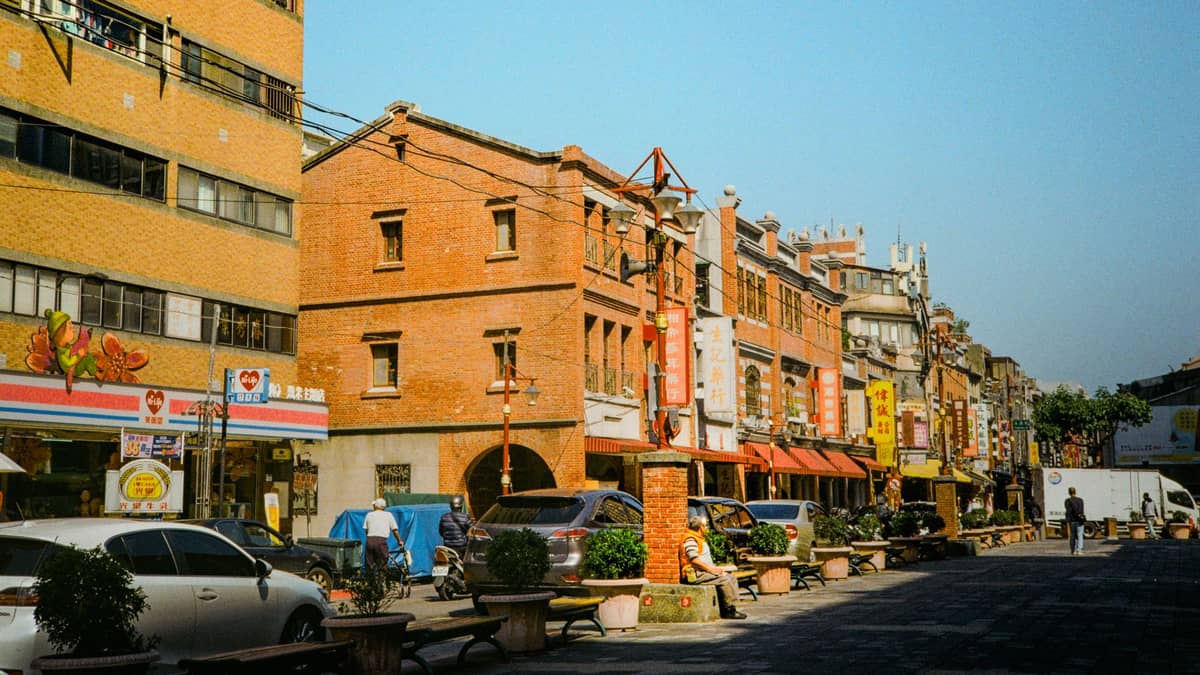
The buildings along Dihua Street's Section 1 are its most distinctive feature, and understanding them makes the walk significantly more rewarding. The dominant style is the Southern Fujian shophouse with colonnaded covered walkways at street level — practical design for Taipei's relentless summer rain and winter drizzle. Walking under these arcades, you pass facades that range from raw brick with minimal ornamentation to elaborate baroque-influenced stucco work added during the Japanese colonial period (1895–1945), when the administration promoted modernization of commercial streetscapes.
Look closely at the upper facades and you will find layered history compressed into single structures: Chinese decorative motifs, Western neoclassical columns, Art Deco geometric panels, and occasionally a roofline with clearly Minnan-influenced curved tiles. Some buildings have been carefully restored; others are mid-renovation with scaffolding and raw plaster visible. Neither state is less interesting than the other. The active preservation process itself tells you something about how the city values this street.
The buildings narrow toward the rear — a characteristic of traditional long-house layouts designed to maximize frontage on the street while extending storage and living space deep into the lot. A few shops still operate with this original footprint visible: the front third is retail, the middle is workspace, and a small interior courtyard or back room carries the smell of aging wood and dried goods.
The Goods: From Dried Mushrooms to Craft Beer
The traditional commercial core of Dihua Street has always been dried goods, Chinese herbal medicine, and temple supplies. That trade is still very real. Whole stretches of the street are stacked with sacks of dried longan, cloud ear fungus, lotus seeds, jujubes, and wolfberries. The smell in this section is earthy and slightly sweet, with undertones of medicinal roots. Herb shops display elaborate arrays of dried bark and roots in labeled drawers or glass jars behind dark wood counters. Staff in older establishments will sometimes discuss the properties of individual ingredients if you show genuine interest — though English is not always available.
The Yongle Market building (at the northern section near Guisui Street) anchors the fabric trade: its upper floors are packed with vendors selling bolt fabric, buttons, zippers, and tailoring supplies. This is an almost entirely local scene with little concession to tourism, which makes it one of the more authentic corners of the district.
Alongside the traditional trade, a wave of creative businesses has moved in since the 2010s. You will find concept stores selling locally designed homeware, specialty coffee roasters, tea shops with serious sourcing credentials (a good match for Taipei's broader tea culture), gin bars, and bakeries working with traditional Taiwanese ingredients. The contrast is not jarring in person — the street absorbs it.
How the Street Changes by Time of Day
Early morning, before 09:00, Dihua Street is quiet and genuinely beautiful. The low light hits the brick facades at a sharp angle, delivery scooters idle at doorways, and shop owners sweep the covered walkways with wide bamboo brooms. There are almost no other tourists. This is the best window for photography: the street is clear, the light is warm, and the working rhythm of the place is visible without crowds.
Midday on weekends sees the street at its most congested. The covered walkways fill with moving bodies, and the narrow lane itself gets blocked by people photographing facades. If you are visiting primarily for the architecture or the shopping experience, a weekday morning is a meaningfully different and better visit than a Saturday afternoon.
Late afternoon on weekdays brings a more relaxed pace, with cafés filling and the light warming again after the flat midday glare. The street begins to empty after 18:00 as traditional shops close, though the newer food and drink establishments stay open well into the evening.
💡 Local tip
Weekday mornings before 10:00 are the best combination of good light, open shops, and manageable crowds. Weekend afternoons, particularly during Lunar New Year preparations, see very high pedestrian density — plan significantly more time and expect slower movement.
Lunar New Year: The Street at Peak Intensity
For roughly three to four weeks before the Lunar New Year holiday, Dihua Street transforms into one of Taipei's major seasonal shopping destinations. The Taipei City Government recognizes the area officially as the city's primary Lunar New Year Shopping Area, covering Section 1 of Dihua Street and surrounding streets in Datong District. Vendors set up stalls beyond the permanent shops, selling candied fruits, dried seafood, festive snacks, New Year couplets, and decorations. The density of people is extreme by ordinary standards — but for visitors interested in witnessing a real functional cultural tradition, not a staged performance, this is one of the most genuine experiences Taipei offers.
If you are visiting specifically for the Lunar New Year market, cross-reference your dates with the Taipei Lantern Festival guide to understand how the holiday calendar affects the broader city. The weeks leading up to the New Year are the high-water mark of activity; the holiday period itself sees most shops closed.
Getting There and Practical Walkthrough
The most direct MRT route is to Beimen Station on the Songshan-Xindian Line. From Exit 3, it is approximately a 9 to 10 minute walk north through the Beimen area to the southern end of Dihua Street. The walk itself passes the North Gate (Beimen), one of Taipei's original Qing-dynasty city gates, which is worth a pause on the way.
Alternatively, Daqiaotou Station (also Green Line) puts you closer to the northern section of Dihua Street, useful if you want to start at the Yongle Market end and walk south. Zhongshan Station (Red and Green Lines) is another option at roughly 10 to 15 minutes on foot. If you are combining this visit with other nearby attractions, consider the guide to getting around Taipei for MRT line orientation.
Bus routes stop near the Nanjing West Road intersection or Yongle Market, providing access from central districts without requiring a transfer. If you are driving, paid parking is available along Civic Boulevard (Shimin Blvd) to the south, from where you can walk north into the district.
The street runs roughly north-south and is easily walkable end to end in under 30 minutes at a strolling pace. The most concentrated heritage section sits between Nanjing West Road to the south and Guisui Street to the north. Allow extra time if you plan to enter any of the larger herbal shops or the Yongle Market fabric floors. Footwear should be flat and comfortable; the covered walkways have uneven tile surfaces in some sections.
⚠️ What to skip
Some interior spaces in traditional shophouses have very low thresholds or steps. Wheelchair and stroller access along the street itself is generally possible, but individual shops vary widely in their interior accessibility. The covered walkway surfaces can also be slippery when wet.
Who Should Temper Their Expectations
Dihua Street is often described in shorthand as a shopping destination, which sets up a particular type of disappointment. If you are looking for a curated retail experience with clear price tags, English menus, and air-conditioned comfort throughout, you will find only pockets of that. The traditional herb and dried goods shops require either Mandarin, patience, or pointing. The street is narrow and can feel claustrophobic on crowded days. Travelers who prefer the modern commercial fluency of Xinyi or Ximending may find the atmosphere here more demanding than rewarding.
The street is also not particularly dramatic at first glance. It requires some architectural literacy or curiosity to appreciate what you are looking at. If you arrive without context, it can read as simply an old street with some nice buildings. The payoff scales directly with how much attention you bring.
Insider Tips
- The covered walkways along the colonnaded shophouse fronts are the best rain shelter on a wet day — and Taipei gets a lot of rain. Use them, and use the wet weather as an excuse to move slowly and look up at the facade details you would otherwise pass quickly.
- The fabric floors of Yongle Market (upper levels of the market building near Guisui Street) are almost entirely locals-only and largely untouched by tourism. Even if you have no intention of buying fabric, the density and variety of the textile trade on display is worth a 20-minute wander.
- Many of the creative and design shops that have moved into the heritage buildings only open around 11:00 or later, sometimes not until noon. If your priority is the newer food and design scene rather than the traditional trade, plan a late morning start rather than arriving at opening time.
- The south end of the street, approaching the Beimen area, transitions into what becomes an increasingly interesting cluster of repurposed heritage buildings. The nearby North Gate (Beimen) is one of Taiwan's best-preserved Qing-era city gates and takes less than five minutes to view — it is a natural complement to the Dihua Street walk.
- Dried goods from the traditional shops make practical, lightweight souvenirs: vacuum-packed mushrooms, dried longan, or high-quality red dates are genuinely used in home cooking and far more interesting than mass-produced gift items. Bring a small reusable bag.
Who Is Dihua Street For?
- Architecture and urban history enthusiasts who want to read a city's layers in its buildings
- Food and ingredient hunters interested in traditional Chinese culinary staples and herbal ingredients
- Photographers looking for well-preserved early 20th-century streetscapes with active commercial use
- Lunar New Year visitors wanting to experience a seasonal market with genuine local participation
- Slow travelers who enjoy mixing heritage context with independent cafés, design shops, and tea houses
Nearby Attractions
Other things to see while in Dadaocheng:
- Dalongdong Baoan Temple
Dalongdong Baoan Temple (大龍峒保安宮) is one of Taipei's most architecturally significant and spiritually active places of worship. Located in the Datong District, this free-entry Qing dynasty temple draws both devoted worshippers and curious visitors with its intricate stone carvings, colorful painted facades, and centuries of community history.
- Taipei Confucius Temple
Built in 1879 and redesigned in classical Southern Fujian style, the Taipei Confucius Temple is one of Taiwan's most architecturally refined Confucian sites. Admission is free, the grounds are uncrowded most mornings, and the annual Teacher's Day ceremony in September draws thousands. Here is everything you need to plan a worthwhile visit.