Taipei Confucius Temple: History, Architecture, and What to Expect on a Visit
Built in 1879 and redesigned in classical Southern Fujian style, the Taipei Confucius Temple is one of Taiwan's most architecturally refined Confucian sites. Admission is free, the grounds are uncrowded most mornings, and the annual Teacher's Day ceremony in September draws thousands. Here is everything you need to plan a worthwhile visit.
Quick Facts
- Location
- No. 275, Dalong St., Datong District, Taipei City
- Getting There
- Yuanshan Station (Red Line, Exit 2) — approx. 10-min walk
- Time Needed
- 45–90 minutes
- Cost
- Free admission
- Best for
- History lovers, architecture enthusiasts, and travelers exploring Datong District
- Official website
- english.tct.gov.taipei/Default.aspx
What Is the Taipei Confucius Temple?
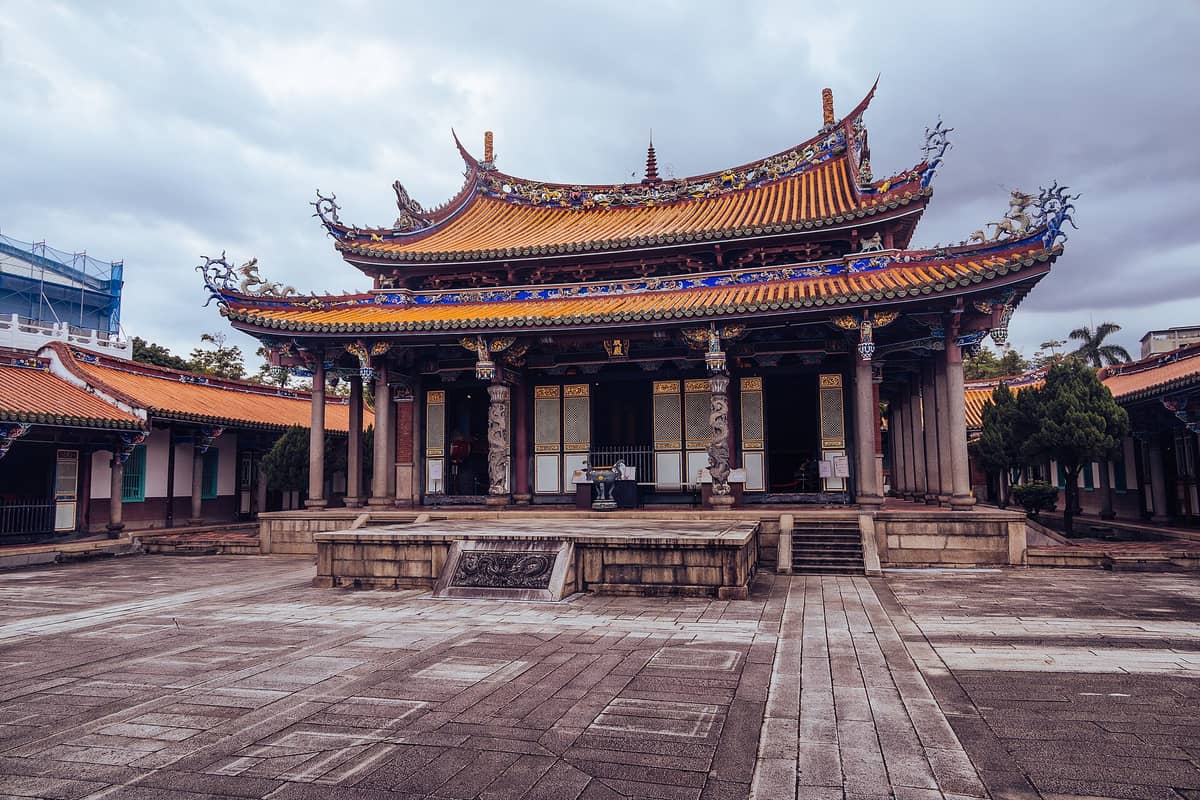
The Taipei Confucius Temple, known locally as 臺北孔子廟 or Dalongdong Confucius Temple, is a Confucian ceremonial complex in the Datong District of northern Taipei. Originally constructed in 1879 during the Qing dynasty, following the establishment of Taipeh Prefecture in 1875, the temple was designed according to classical principles derived from the Confucius Temple in Qufu, China — the birthplace of Confucius himself. The architecture follows Southern Fujian (Minnan) convention, the same regional tradition that shaped many of Taiwan's most distinctive temple structures.
This is not a religious temple in the everyday sense. There are no deity statues lining the halls, no incense smoke billowing from courtyard burners, and no worshippers kneeling at altars. Confucian temples are ceremonial and scholarly spaces, dedicated to honoring a philosopher rather than a god. That distinction changes the atmosphere entirely. The complex is quieter, more orderly, and more formal than the popular spirit temples of Wanhua or Datong's own Baoan Temple nearby. Visitors who come expecting colorful folk-religion spectacle will find something more austere — and, for the right traveler, far more interesting.
ℹ️ Good to know
Opening hours: Tuesday to Sunday and national holidays, 08:30–21:00. Closed on Mondays. Confirm via the official site before visiting, as hours are occasionally adjusted for special events.
The Architecture: What You Actually See
Entering through the main gate, the first thing that registers is the precision of the tilework. The temple's sweeping double-eave roofs are layered with glazed ceramic tiles in a deep earthy green, edged with ridge ornaments shaped as fish tails and mythological figures. Unlike the dragon-heavy decoration found in Taiwanese folk temples, the Confucius Temple's ornamentation is restrained. Confucian doctrine prized order and refinement, and the architecture reflects that: symmetry is strict, surfaces are clean, and nothing is excessive.
The complex is organized around a series of courtyards leading toward the main hall, the Dacheng Hall (大成殿), which enshrines a wooden spirit tablet bearing Confucius's title rather than a sculptural likeness. This deliberate absence of imagery is architectural theology: Confucius as a thinker, not a deity. The hall's columns, carved brackets, and exposed timber ceiling are worth studying slowly. The joinery represents traditional Minnan craftsmanship that became increasingly rare in Taiwan during the twentieth century.
Flanking the main courtyard are side halls dedicated to Confucius's most accomplished disciples, as well as gates and ceremonial spaces used during the annual rites. Morning light enters the courtyard at a low angle before 10:00, casting long shadows across the stone paving and illuminating the carved eave brackets in sharp relief — if photography matters to you, arrive early.
The Crowd Rhythm: When to Come and When to Avoid
On most weekday mornings between 08:30 and 10:00, the Taipei Confucius Temple is nearly empty. A handful of older residents may be sitting in the outer courtyard, and the occasional school group passes through, but the complex feels genuinely spacious. This is the best window for photography and unhurried exploration. By late morning, tour groups begin arriving, and the main hall area becomes noticeably more congested.
Weekend afternoons are busy with domestic visitors, families, and tourists combining this stop with nearby Baoan Temple. The crowds are manageable by most standards — this is not the kind of attraction that feels oppressively packed — but anyone prioritizing quiet or wanting clear photographs of the main hall's interior should aim for a Tuesday through Friday morning.
The single day when the temple is transformed entirely is September 28, Taiwan's Teacher's Day (教師節), which is also the observed birthday of Confucius. The annual release ceremony, the Shidian Ceremony (釋奠典禮), begins before dawn at 06:00 and draws large crowds. Performers in traditional Confucian ceremonial dress conduct rituals involving dance, music on ancient instruments, and the presentation of offerings. This is one of the most intact Confucian ceremonies still practiced in the Chinese-speaking world, and attending it — even briefly — provides context that no amount of reading can replicate.
💡 Local tip
For the Teacher's Day Shidian Ceremony on September 28, arrive well before 06:00 if you want a clear view. The ceremony draws very large crowds and viewpoints near the main hall fill quickly. Check the official website in advance for the exact schedule each year.
Cultural Context: Why This Temple Exists Here
Confucius temples were civic infrastructure in imperial Chinese society. Every prefecture of any standing built one: it served as the site of official ceremonies, functioned as a center of classical education, and symbolized the state's commitment to Confucian values. When Taipeh Prefecture was established in 1875, constructing a Confucius temple was among the first priorities — not as an act of piety, but as an act of institutional legitimacy. The original 1879 structure was later damaged and fell into disrepair during the Japanese colonial period. The current structure reflects a restoration effort completed in 1939 under Japanese colonial administration, rebuilt in the classical Minnan style using Fujian craftsmen.
That colonial-era reconstruction history makes the temple's architecture an interesting case study. Taiwan's Japanese administration, while aggressively modernizing the island, sometimes preserved or restored traditional Chinese cultural sites for complex political and administrative reasons. Visitors with a broader interest in Taiwan's layered cultural history may want to pair this stop with nearby Dalongdong Baoan Temple, which sits just a few minutes' walk away and represents a very different side of the same neighborhood's heritage.
The Datong District as a whole — often referred to under the older historical name Dadaocheng in parts of the neighborhood further south — is one of Taipei's densest concentrations of pre-war architecture and traditional institutions. If you have more than an hour, the area rewards walking. For a broader sense of the district, the Dadaocheng neighborhood guide covers the surrounding streets in detail.
Getting There and Getting Around
The most straightforward approach is the Tamsui–Xinyi (Red) Line to Yuanshan Station. Take Exit 2 and walk roughly 10 minutes north along the side streets toward Dalong Street. The walk is flat and straightforward, passing through a low-rise residential neighborhood that gives you a grounded sense of the area before you arrive at the temple gates.
Several bus routes also serve the area directly, stopping at Baoan Temple Station, Jiuquan Street Station, or Kulun Street Station. Buses 2, 41, 215, 246, 288, 669, 811, and Red 33 all make nearby stops. If you are combining this visit with a broader exploration of Datong or the historic streets further south, the guide to getting around Taipei provides a clear overview of how to use EasyCard across MRT and buses.
Accessibility: The temple has wheelchair-accessible areas, but as a historic complex it includes stone courtyards, elevated thresholds, and some uneven paving. Visitors with specific mobility needs should contact the temple directly or confirm with staff on arrival rather than assuming full barrier-free access throughout.
Practical Details: What to Wear and Bring
Dress respectfully. The temple is a working ceremonial site, not just a tourist attraction, and modest clothing is appropriate. This does not require formal attire: covered shoulders and avoiding very short shorts or skirts is sufficient. The complex is largely outdoors and the stone courtyards absorb significant heat in summer. Between June and September, lightweight clothing and hydration matter — midday visits in peak summer are uncomfortable by any standard.
Taipei's climate is humid subtropical, with the hottest and rainiest months running from May through September. October through April offers the most comfortable visiting conditions, with lower humidity and milder temperatures. For a detailed breakdown of seasonal conditions, the best time to visit Taipei guide covers all months with specific temperature and rainfall data.
Photography is permitted throughout the complex. A wide-angle lens is useful for the main courtyard, where the full sweep of the Dacheng Hall's roof is difficult to capture in tight framing. The carved eave brackets and ridge ornaments reward a longer zoom for detail shots. The interior of the main hall tends to be dim, so shooting in RAW or adjusting exposure compensation before entering saves frustration later.
An Honest Appraisal: Is It Worth Your Time?
For a first-time visitor to Taipei with limited days, the Taipei Confucius Temple is genuinely worth an hour, particularly when combined with Dalongdong Baoan Temple next door. The two sites together form one of the more coherent architectural and cultural half-days in the city, and neither charges admission. The Confucius Temple specifically is the more serene of the two — less theatrical but architecturally more precise, and far less crowded than many of Taipei's headline attractions.
Travelers whose primary interest is Taiwan's folk religion traditions, colorful deity worship, or busy ceremonial activity may find Longshan Temple in Wanhua more immediately captivating. That temple, covered in the Longshan Temple guide, offers a sharply different atmosphere — dense with incense, sound, and constant devotional activity. The Confucius Temple and Longshan Temple together represent opposite ends of Taiwan's spiritual spectrum, and visiting both in the same trip provides a genuinely useful comparison.
Who might skip it: travelers who find classical Chinese architectural details repetitive, those with very limited time who have not yet seen other Taipei landmarks, or visitors during a Monday when the temple is closed. If your itinerary is already dense and you have only two or three days in Taipei, the Confucius Temple is best treated as an add-on to an existing Datong walk rather than a standalone destination worth crossing the city for.
Insider Tips
- The temple's outer gates are photogenic early in the morning when foot traffic is near zero and the light is directional. Arrive at 08:30 when doors open for the cleanest shots of the main entrance and forecourt.
- The small exhibition space inside the complex provides bilingual panels on Confucian philosophy and the temple's restoration history — worth 10 minutes if you want interpretive context before walking the main halls.
- Dalongdong Baoan Temple is a three-minute walk east of the Confucius Temple. Combining both sites in one loop takes about two hours total and covers two distinct architectural and cultural traditions without retracing your steps.
- On Teacher's Day (September 28), the pre-dawn Shidian Ceremony is free to observe, but the best viewing positions near the Dacheng Hall fill up 30 to 45 minutes before the 06:00 start. Bring a jacket: September mornings in Taipei are still humid but cooler than midday.
- The temple gift shop near the entrance sells reproductions of ceremonial items and Confucius-themed stationery at reasonable prices — a more considered souvenir option than most tourist shops in the area.
Who Is Taipei Confucius Temple For?
- Travelers interested in Chinese classical architecture and Minnan craftsmanship
- History-focused visitors exploring Qing dynasty and Japanese colonial-era Taipei
- Anyone visiting Taipei in late September who can attend the Teacher's Day ceremony
- Those building a walking itinerary through Datong District's historic core
- Photographers seeking uncrowded architectural subjects before 10:00
Nearby Attractions
Other things to see while in Dadaocheng:
- Dalongdong Baoan Temple
Dalongdong Baoan Temple (大龍峒保安宮) is one of Taipei's most architecturally significant and spiritually active places of worship. Located in the Datong District, this free-entry Qing dynasty temple draws both devoted worshippers and curious visitors with its intricate stone carvings, colorful painted facades, and centuries of community history.
- Dihua Street
Dihua Street is the preserved heart of Dadaocheng, Taipei's 19th-century trading hub. Its colonnaded shophouses sell everything from century-old dried goods to single-origin coffee, making it one of the city's most layered and walkable historic districts. Entry to the street is free and open daily.