Longshan Temple (艋舺龍山寺): Taipei's Most Atmospheric Place of Worship
Founded in 1738 by Fujianese settlers, Longshan Temple in Wanhua District is one of Taipei's oldest and most historically significant temples. With over 100 deities, intricate Qing-era architecture, and a courtyard that hums with incense smoke at any hour, this is a living religious site that rewards visitors who take their time.
Quick Facts
- Location
- No. 211, Guangzhou St., Wanhua District, Taipei
- Getting There
- Longshan Temple Station (Bannan/Blue Line), Exit 1, then 2–3 min walk
- Time Needed
- 45 minutes to 1.5 hours
- Cost
- Free entry
- Best for
- History, architecture, local religious culture, early morning visits
- Official website
- www.lungshan.org.tw
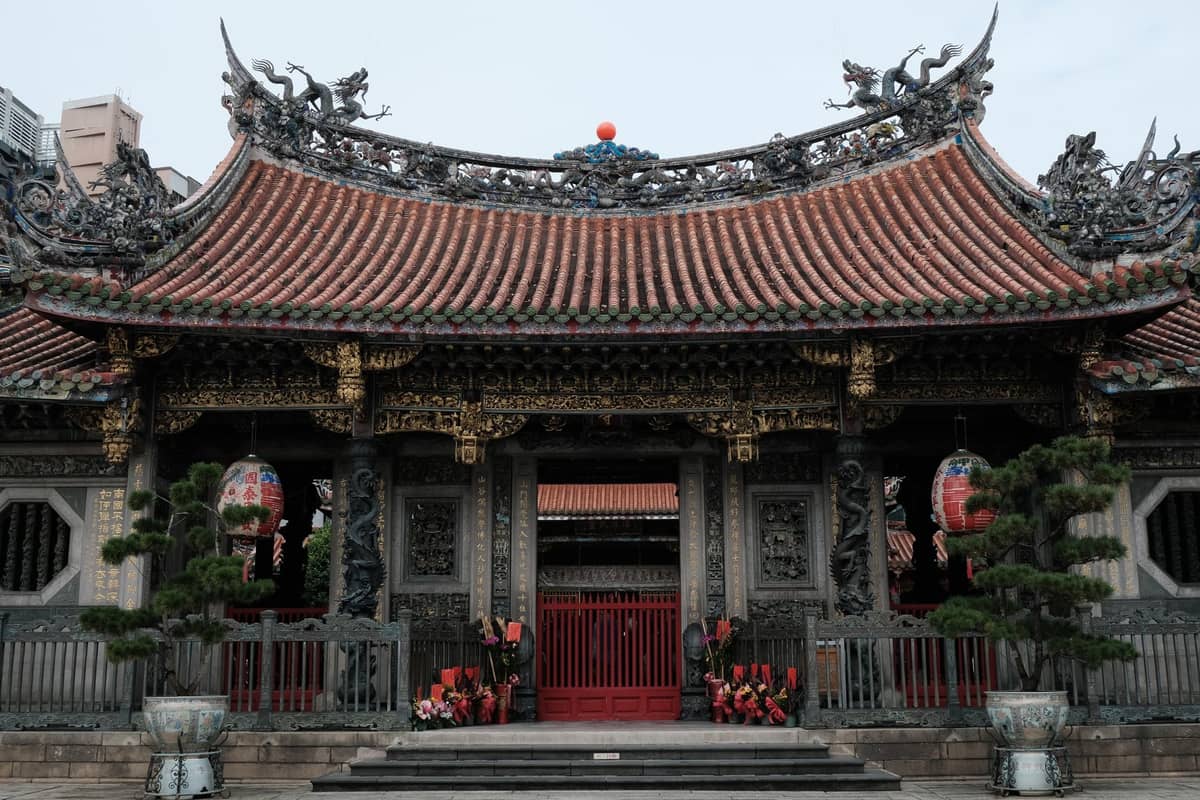
What Longshan Temple Actually Is
Longshan Temple, officially named 艋舺龍山寺 (Měngjiǎ Lóngshān Sì), is a Taiwanese folk religion temple dedicated primarily to Guanshiyin (Avalokiteśvara, the goddess of mercy) and a constellation of more than 100 other deities. It sits in Wanhua, Taipei's oldest urban district, on a site that has been continuously used for worship since 1738. That is not a heritage display or a restored monument. This is a functioning temple that local people visit multiple times a week, sometimes daily.
The founding story connects Longshan Temple to early Han Chinese settlement in Taiwan. Migrants from Fujian Province brought a piece of the Longshan Temple in Jinjiang with them, and when it is said that the amulet they carried began to glow at night, they took it as a sign to build a permanent shrine on this site. Whether you take that account literally or not, the result after nearly three centuries of continuous use, destruction, and rebuilding is one of the most architecturally refined and spiritually charged temple complexes in Taiwan.
ℹ️ Good to know
Longshan Temple is open daily from 06:00 to around 21:45–22:00. Admission is completely free. The closest MRT station is Longshan Temple Station on the Bannan (Blue) Line; use Exit 1 for the shortest walk.
The Architecture: What to Actually Look At
The current structure reflects centuries of reconstruction, most recently following severe damage during World War II Allied bombing in 1945. The rebuilding effort restored and in some ways enhanced the original Qing-dynasty style, producing a compound organized around three main halls arranged on a central axis, a layout standard to southern Fujianese temple design.
Walk in from Guangzhou Street and pause in the front courtyard before you enter the main gate. The roof ridgelines carry dense ceramic sculptures of dragons, phoenixes, fish, and divine figures, all formed using a technique called jiannan (cut-and-paste ceramic mosaic). Look at the columns flanking the main gate: the spiraling dragon columns in the front hall are cast in copper, a material choice unusual enough that they attract the attention of even visitors who arrived with no interest in temple architecture.
The rear hall, dedicated to lunar deities and gods of love and marriage, is structurally separate from the main hall and holds its own crowd. The altar arrangements here are dense and deliberate: different sections correspond to specific life concerns, from finding a spouse to seeking good health for children. Locals know which deity to approach and why. If you are unsure, watching how people move through the space is itself instructive.
💡 Local tip
Photography is permitted in most areas of the complex, but position yourself carefully around active worshippers. Do not photograph people in prayer without discretion, and avoid blocking access to the main altars during peak worship hours.
How the Temple Changes by Time of Day
Arriving at 06:00 when the gates open gives you an experience almost nothing else in Taipei matches. The incense smoke is heavy and low in the morning cool, and the crowd consists almost entirely of regulars: older men and women who move through the rituals with practiced ease, shaking fortune sticks, consulting divination blocks, burning paper offerings. There is chanting, the rhythmic knock of wooden prayer blocks, and the smell of sandalwood smoke that settles into your clothes. The quality of light through the incense haze in early morning is also the best condition for photography.
By mid-morning on weekends and during holidays, the dynamic shifts. Tour groups arrive, and the courtyard fills with people consulting smartphones and pointing at roof decorations. The devotional atmosphere does not disappear, but it competes with visitor foot traffic. Weekday mornings remain calmer throughout the day.
Late afternoon and early evening bring a second wave of worshippers, particularly around 17:00 to 19:00. The temple is lit from within, the lanterns glow red against the darkening sky, and the sound of prayer bells and chanting intensifies. This is arguably the most photogenic time of day, and the spiritual atmosphere is again more concentrated. If you cannot make a morning visit, an evening visit is the next best option.
Understanding the Religious Practice
Longshan Temple follows Taiwanese folk religion, a syncretic tradition that blends Taoism, Buddhism, and local deity cults into a single practical framework. Guanshiyin, the primary deity in the main hall, is a Mahayana Buddhist bodhisattva, but many of the other deities throughout the complex are Taoist figures: Mazu (sea goddess), Wenchang Dijun (god of culture and education), and Yue Lao (the matchmaker god of the rear hall), among others. This mixing is not contradiction; it is characteristic of how religion is practiced in Taiwan.
Visitors who want to participate in ritual can purchase incense sticks from vendors near the entrance. The standard practice is to hold the incense upright with both hands and bow toward each major altar, beginning with the main hall facing south, then moving clockwise through the secondary shrines. Divination blocks (jiaobei, a pair of crescent-shaped wooden pieces) can be used to seek guidance; fortune stick tubes are available in the main hall. Staff and volunteer guides at the temple are accustomed to curious visitors and are generally patient with questions.
For a deeper look at how Longshan Temple fits into Taipei's wider religious landscape, the Taipei temples guide covers other significant sites across the city, including Xingtian Temple and Dalongdong Baoan Temple.
The Surrounding Wanhua Neighborhood
The area around Longshan Temple repays exploration on foot. Guangzhou Street and the lanes to the north are lined with shops selling incense, religious paraphernalia, dried herbs, and traditional remedies, reflecting the district's history as Taipei's oldest commercial hub. The neighborhood known as Mengjia (艋舺), now part of Wanhua, was the first major Han Chinese settlement in the Taipei basin.
A short walk north brings you to Bopiliao Historic Block, a preserved stretch of Qing and Japanese colonial-era shophouses that functions as an open-air museum of Wanhua's architectural heritage. It is quieter than the temple, often overlooked, and worth thirty minutes if you have them.
If you are building a half-day itinerary around Wanhua, consider combining Longshan Temple with the Ximen Red House to the northeast, a Japanese-era octagonal market building that now operates as a creative and cultural venue. The walk between the two takes under fifteen minutes and passes through Ximending, Taipei's youth culture and shopping district.
Practical Considerations Before You Go
Dress modestly. There is no enforced dress code, but sleeveless tops and very short shorts are out of place in the main halls during active worship. Light layers are also sensible: the incense smoke is thick, and the temple can feel warm and close during crowded periods.
The temple sits directly off Longshan Temple MRT Station on the Bannan (Blue) Line. Exit 1 leads almost directly to the Guangzhou Street entrance. There is no practical reason to take a taxi or ride-share unless you are arriving from somewhere not served by the MRT.
Major Taiwanese holidays, particularly Lunar New Year, the Lantern Festival, and Guanshiyin's birthday (the 19th day of the second lunar month), draw enormous crowds and see the temple at its most ceremonially significant. These occasions are extraordinary to witness but require patience with crowds and very limited space to move. If you are visiting during the Lantern Festival period specifically, the area around Longshan Temple is one of the focal points of public celebration.
For more on seasonal timing in Taipei, the best time to visit Taipei guide covers how weather, festivals, and crowd patterns vary across the year.
⚠️ What to skip
The area immediately outside Longshan Temple's park, particularly along Kunming Street after dark, has a reputation for street activity including unlicensed gambling and a visible homeless population. This does not affect the temple visit, but solo travelers at night should be aware of their surroundings.
Who Might Not Enjoy This Visit
Longshan Temple is not a museum or a tourist attraction in the conventional sense. There are no English-language audio guides, no exhibition panels, and no curated visitor pathway. If you are looking for an explained experience of Taiwanese religious culture, you will need to do background reading before you arrive or accept that much of what is happening around you will be unclear. Travelers who find active religious sites uncomfortable, or who object to strong incense smoke, will find the visit genuinely unpleasant. The smoke is constant and dense throughout the courtyard and main halls.
Visitors with significant mobility challenges should note that the temple complex involves uneven stone flooring and tight pedestrian flow during peak hours. No detailed official accessibility information is available from the temple, so it is worth contacting the temple directly before visiting if step-free access is a requirement.
Insider Tips
- Arrive before 07:30 on a weekday morning for the most concentrated devotional atmosphere and the best incense-light conditions for photography. By 09:00 on weekends, tour groups dominate the main hall.
- The rear hall, dedicated to lunar deities including Yue Lao the matchmaker god, draws a distinctly different crowd from the main hall. Singles and couples seeking romantic blessings tie red string to the altar railing; it is one of the more human and quietly moving corners of the complex.
- Fortune stick divination (chouqian) is practiced in the main hall. The process involves shaking a cylindrical cup of numbered bamboo sticks until one falls out, then matching the number to a printed prophecy sheet. Staff near the altar can help with interpretation, and some printed guides are available in English.
- The temple complex is surrounded by vendors selling religious supplies. The cluster of traditional medicine and dried goods shops on the surrounding streets, particularly on Xichang Street, has been serving the neighborhood for generations and is worth a slow walk even if you have no intention of buying anything.
- If you are visiting multiple temples in one day, Longshan Temple combines logically with Dalongdong Baoan Temple in Datong District. The architectural styles differ enough to make the comparison worthwhile, and they represent different poles of Taipei's temple heritage.
Who Is Longshan Temple For?
- Travelers interested in living religious culture rather than static heritage sites
- Architecture enthusiasts focused on Qing-era southern Fujianese temple design
- Early risers who want a meaningful experience before the city fully wakes up
- Anyone building a walking itinerary through Wanhua's historic streets
- Photographers working with natural light and atmospheric interiors
Nearby Attractions
Other things to see while in Wanhua District:
- Bopiliao Historic Block
Bopiliao Historic Block is a restored Qing-era street in Wanhua District that survived decades of urban pressure to become Taipei's most atmospheric heritage site. Free to enter, quietly fascinating, and often overlooked by tourists racing to nearby Longshan Temple.