Dalongdong Baoan Temple: Taipei's Most Ornate Historic Shrine
Dalongdong Baoan Temple (大龍峒保安宮) is one of Taipei's most architecturally significant and spiritually active places of worship. Located in the Datong District, this free-entry Qing dynasty temple draws both devoted worshippers and curious visitors with its intricate stone carvings, colorful painted facades, and centuries of community history.
Quick Facts
- Location
- No. 61, Hami St., Datong District, Taipei City
- Getting There
- Yuanshan MRT Station (Red Line / Tamsui-Xinyi Line), approx. 10-minute walk
- Time Needed
- 45 minutes to 1.5 hours
- Cost
- Free admission
- Best for
- History lovers, architecture enthusiasts, cultural travelers, and those interested in Taiwanese religious practice
- Official website
- www.baoan.org.tw
What Is Dalongdong Baoan Temple?
Dalongdong Baoan Temple (大龍峒保安宮) stands at No. 61, Hami Street in Taipei's Datong District — a neighborhood whose name itself translates roughly to 'Great Harmony,' a phrase that fits the temple's role as a communal anchor for over two centuries. Dedicated to the divine physician Baosheng Dadi (the Great Emperor Who Protects Life), the temple has served the Dalongdong community since the Qing dynasty, when Fujian immigrants first established a place of worship here in the early nineteenth century.
Unlike some of Taipei's more tourist-facing temples, Baoan retains a strong devotional atmosphere. Incense smoke rises through the courtyard throughout the day. Worshippers leave offerings of fruit and flowers, and the rhythmic sound of wooden prayer blocks hitting stone floors is a constant background presence. It is a working temple, not a museum — and that distinction matters for how you experience it.
ℹ️ Good to know
Opening hours vary slightly by source: the official religious culture registry lists 6:30 a.m.–10:00 p.m. daily, while the Taipei Travel portal lists 6:00 a.m.–9:00 p.m. Check the official website (baoan.org.tw) before planning an early morning or late evening visit.
The Architecture: Why This Temple Stands Apart
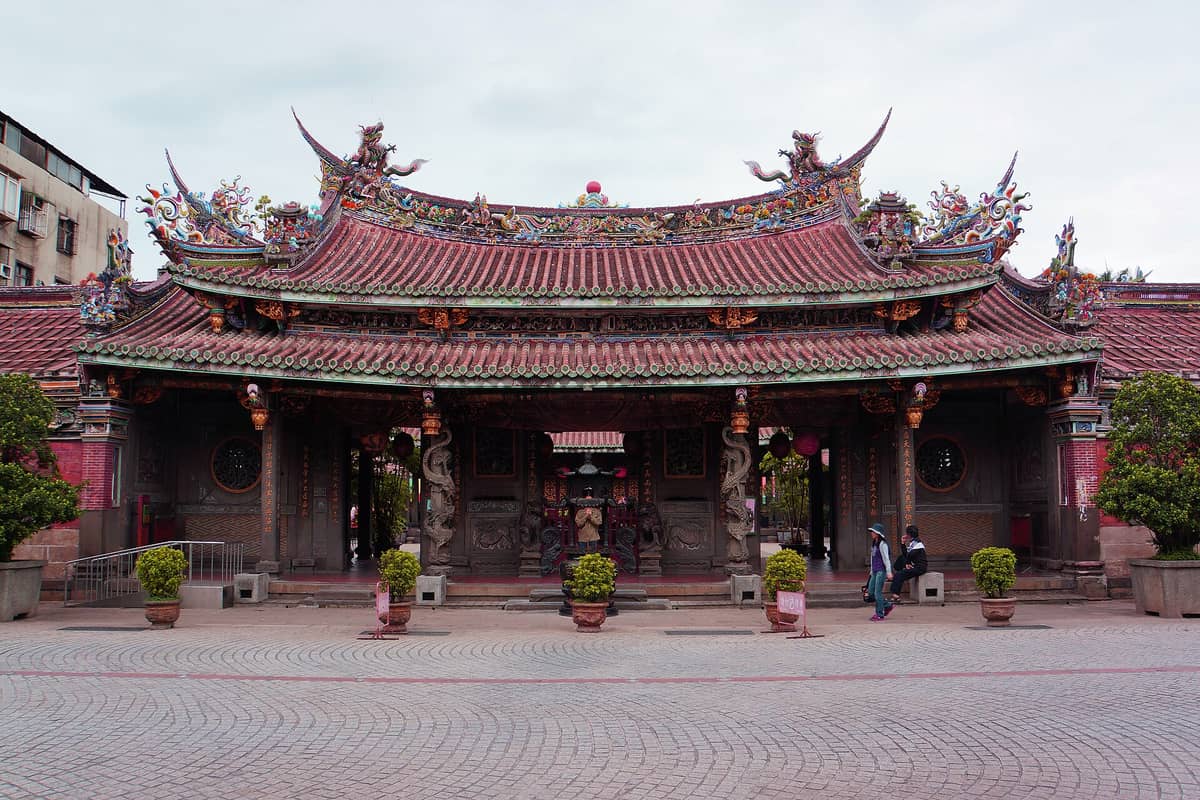
Baoan Temple is widely considered one of the finest examples of southern Fujian (Minnan) temple architecture in Taiwan. The compound follows a traditional three-hall axial layout, with the main gate, front courtyard, central worship hall, and rear hall aligned on a single north-south axis. What immediately distinguishes it from other urban temples is the quality and density of its decorative work.
The roof ridges are packed with figures: dragons, phoenixes, generals, and mythological scenes rendered in glazed ceramic. The technique, called jiannan (cut-and-paste porcelain), involves fragmenting ceramic bowls and reassembling the shards into detailed sculptural compositions. Up close, the texture is almost mosaic-like. From the street, the roofline reads as an explosion of color against the sky. The columns flanking the main hall feature hand-carved stone dragons coiling upward in different postures, each carved by a different master craftsman. According to temple records, rival artisans competed to outdo each other on opposite sides of the hall — a tradition of competitive craftsmanship that produced asymmetrical but equally extraordinary results.
The interior paintings are also worth slowing down for. Panels depicting scenes from classical Chinese literature and religious narrative cover the beams and walls of the main hall. Many were restored in the late twentieth century under strict historical preservation guidelines, earning the temple a UNESCO Asia-Pacific Heritage Award for Cultural Heritage Conservation in 2003 — a recognition listed on the temple's own materials and widely cited in coverage of the site.
How the Atmosphere Changes by Time of Day
Early mornings, from around 7:00 to 9:00 a.m., bring a different version of the temple than what most visitors see. Older neighborhood residents arrive to pray before heading to markets or morning exercise. The light at this hour cuts at a low angle through the gate, casting long shadows across the courtyard flagstones and picking out the texture of the stone relief carvings. Incense is freshly lit, and the smell is cleaner and sharper than later in the day when it builds to a heavier, resinous haze.
Midday draws more visitors and school groups, particularly on weekdays during the school year. The courtyard fills with sound: tour guides speaking Mandarin, temple staff maintaining offerings, and the occasional percussion of temple rituals. Photography is more complicated at this hour due to the harsh overhead light washing out the roof details.
Late afternoon, roughly 4:00 to 6:00 p.m., is often the most photogenic window. The sun drops toward the west and side-lights the main facade and gate pillars, bringing out the depth of the stone carvings. The courtyard is usually quieter than midday but still active with worshippers arriving after work. If you plan to photograph the architecture, this is the window to target.
💡 Local tip
Photography tip: Stand at the rear of the main courtyard and shoot toward the main gate at around 5:00 p.m. in the warmer months. The late light falls directly on the carved pillars and roof ridge, and the incense smoke adds atmospheric depth without obscuring the details.
Cultural Significance and the Dalongdong Community
Baoan Temple has never been purely a place of individual worship. It has historically functioned as a civic institution for the Dalongdong neighborhood, which developed as one of Taipei's earliest settled areas. The temple administers a range of community programs, including traditional arts education and an annual birthday celebration for Baosheng Dadi, held on the fifteenth day of the third lunar month. This festival, known for its elaborate parades, traditional music performances, and ritual processions, draws crowds from across Taipei and has been recognized as an important piece of intangible cultural heritage. For visitors interested in Taiwanese religious culture, the broader temple culture of Taipei provides context for how places like Baoan fit into a city-wide landscape of belief, community, and history.
The temple is also located within walking distance of the Confucius Temple of Taipei, which sits only a few hundred meters to the west. The two institutions reflect different aspects of traditional Chinese civic life: one centered on devotional and folk religious practice, the other on Confucian rites and moral education. Visiting both in the same half-day gives a fuller picture of how pre-modern Taiwanese communities organized their cultural and spiritual lives.
Practical Walkthrough: What to Expect on Arrival
The temple entrance opens onto Hami Street. The outer gate — a three-bay structure with stone columns and a tiled roof — is visible from the street. There is no entry fee and no formal ticketing. Visitors walk directly into the front courtyard, which is open to the sky. The central hall beyond contains the main altar to Baosheng Dadi, flanked by secondary shrines to other deities including Guan Di and the Earth God.
Respectful behavior is expected: avoid standing directly in front of the main altar during active worship, keep voices low inside the halls, and ask before photographing worshippers closely. The temple staff and volunteers are generally welcoming to visitors who approach with genuine curiosity rather than treating the space as a backdrop for social media content.
Modest dress is advisable. Shorts and short sleeves are generally accepted, but avoid anything overly revealing. The temple is listed as wheelchair accessible, with an accessible elevator and accessible toilets on site, according to the Taipei Travel official portal. The surrounding neighborhood of Datong is walkable and connects naturally to Dadaocheng, the adjacent historic district whose restored Qing and Japanese colonial-era shophouses, tea merchants, and cultural venues make for a natural extension of a temple visit.
Getting There and Nearby Context
The closest MRT station is Yuanshan Station on the Red Line (Danshui-Xinyi Line). From the station exit, the walk to the temple takes approximately ten minutes through residential streets. Alternatively, the temple is reachable on foot from the Minquan W. Road Station on the Brown Line (Zhonghe-Xinlu Line), depending on your starting point. If you are coming from the Dadaocheng waterfront area around Dihua Street, the temple is about a fifteen-minute walk northeast — manageable if you plan the route in advance.
This part of Datong District tends to be less trafficked by tourists than central Taipei or the Xinyi shopping district, which contributes to the temple's calmer atmosphere. If you are building a full-day itinerary in the historic north of Taipei, combining Baoan Temple with the nearby Taipei Confucius Temple and an afternoon walk through Dadaocheng's old commercial streets gives a coherent and genuinely rewarding half-day without feeling rushed.
⚠️ What to skip
The temple is located in a residential neighborhood. Street parking is limited and the surrounding lanes are narrow. If you are arriving by taxi or ride-hailing service, use the GPS coordinates (25.07307°N, 121.51555°E) or the full address in Chinese (台北市大同區哈密街61號) for accurate navigation.
Is It Worth Your Time? Honest Assessment
Dalongdong Baoan Temple is not the most famous temple in Taipei. That distinction belongs to Longshan Temple in Wanhua, which draws larger crowds and has a higher international profile. But Baoan's comparative quietness is part of its appeal. The architecture is, by most specialist assessments, more refined than Longshan's, and the atmosphere is less overwhelming for visitors who find heavily crowded devotional spaces difficult to navigate.
Who should skip it: travelers with no interest in religious architecture or cultural history will find limited payoff here. There are no English-language audio guides or extensive interpretive materials on site, so visitors who prefer context provided at the attraction rather than researched in advance may feel disoriented. The surrounding neighborhood offers few immediate food or shopping options, so this works best as part of a planned route rather than a standalone stop.
For travelers with an interest in Taiwanese religious life, architectural craft, or the history of the city's early settlement, Baoan Temple is one of the most rewarding stops in Taipei. It fits naturally into any walking tour of historic Taipei and takes under two hours to experience thoroughly, making it a low-cost, high-quality addition to almost any itinerary.
Insider Tips
- Visit on a weekday morning to see the temple in its quietest, most atmospheric state. Weekend afternoons bring noticeably larger crowds, particularly near the main altar area.
- The rear hall is often overlooked by visitors who stop at the central worship hall. It contains additional shrines and some of the more intricate ceiling paintings in the complex.
- The annual birthday festival for Baosheng Dadi (fifteenth day of the third lunar month, typically falling in April or May) transforms the surrounding streets with processions and traditional performance troupes. It is one of the most visually spectacular religious events in northern Taiwan and requires no special ticket.
- Temple volunteers who speak English are occasionally present on weekends. If you encounter one, they can provide context on the specific deities and ritual objects that most signage does not explain.
- Combine the visit with the Taipei Confucius Temple, about a ten-minute walk away. The two sites share architectural DNA but serve very different ceremonial functions, and comparing them side by side is genuinely instructive.
Who Is Dalongdong Baoan Temple For?
- Architecture and design enthusiasts drawn to traditional Minnan craftsmanship
- Travelers interested in Taiwanese religious practices and folk belief
- Photographers looking for ornate, layered subjects in natural and incense-filtered light
- History-focused visitors exploring Taipei's pre-colonial and Qing-era settlement patterns
- Anyone building a half-day itinerary through historic Datong and Dadaocheng
Nearby Attractions
Other things to see while in Dadaocheng:
- Dihua Street
Dihua Street is the preserved heart of Dadaocheng, Taipei's 19th-century trading hub. Its colonnaded shophouses sell everything from century-old dried goods to single-origin coffee, making it one of the city's most layered and walkable historic districts. Entry to the street is free and open daily.
- Taipei Confucius Temple
Built in 1879 and redesigned in classical Southern Fujian style, the Taipei Confucius Temple is one of Taiwan's most architecturally refined Confucian sites. Admission is free, the grounds are uncrowded most mornings, and the annual Teacher's Day ceremony in September draws thousands. Here is everything you need to plan a worthwhile visit.