Ho Chi Minh Statue: The Heart of Nguyen Hue Walking Street
Standing at the northern end of Nguyen Hue Walking Street, the bronze Ho Chi Minh Statue is one of District 1's most photographed landmarks. Free to visit at any hour, it frames perfectly against the colonial facade of the People's Committee Building and offers a concentrated dose of Vietnamese political history in a lively pedestrian setting.
Quick Facts
- Location
- Nguyen Hue Walking Street, District 1, Ho Chi Minh City
- Getting There
- Walk from Ben Thanh Market (~10 min); taxis and ride-hailing apps drop off on Le Loi or Ton Duc Thang
- Time Needed
- 15–30 minutes at the statue; 1–2 hours if walking the full pedestrian boulevard
- Cost
- Free, open 24/7
- Best for
- History enthusiasts, photographers, evening strollers, first-time visitors to HCMC
What You Are Actually Looking At
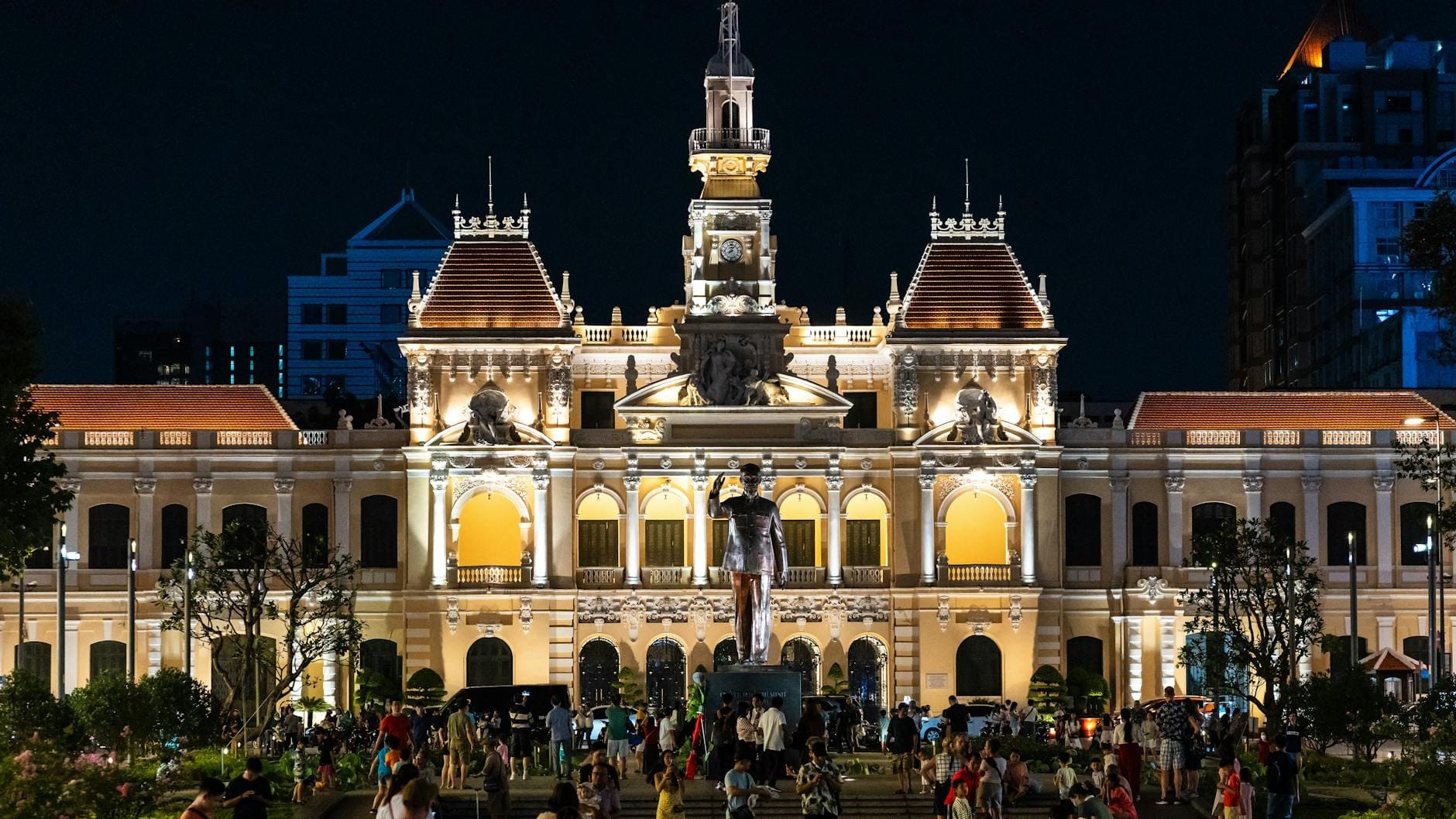
The Ho Chi Minh Statue, officially known as Tượng Chủ tịch Hồ Chí Minh (Statue of President Ho Chi Minh), stands at the northern terminus of Nguyen Hue Walking Street in District 1. Cast in bronze and mounted on a raised stone plinth, the sculpture depicts Ho Chi Minh reaching one arm downward toward a child, a gesture the city government presents as symbolizing his connection to ordinary Vietnamese people and to future generations.
The backdrop is deliberate and important: the statue faces south down the full length of the pedestrian boulevard, with the ornate yellow facade of the People's Committee Building directly behind it. The building, a French colonial structure completed in 1909, was designed by architect Fernand Gardès and originally served as the colonial Hôtel de Ville. That visual pairing, a revolutionary leader placed in front of a colonial-era seat of government, carries a layered symbolism that rewards a moment's thought.
ℹ️ Good to know
The statue is best understood as part of a trio: Ho Chi Minh Statue, People's Committee Building (behind), and the full length of Nguyen Hue Walking Street stretching south. Plan to take in all three together.
Historical Context: Who Was Ho Chi Minh?
Born Nguyễn Sinh Cung in 1890, Ho Chi Minh became the central figure of Vietnamese independence from French colonial rule. He founded the Democratic Republic of Vietnam in 1945 and led the country through decades of conflict. He died in 1969, six years before Saigon fell and the city was renamed in his honor. Understanding even a fraction of that history transforms the statue from a decorative landmark into a point of genuine reflection.
The renaming of Saigon to Ho Chi Minh City after 1975 remains a lived tension in the city: locals still frequently call it Saigon in everyday conversation, and the informal name persists on business signage, menus, and in casual speech. First-time visitors sometimes find this confusing. For context on how the city's identity has evolved, the Ho Chi Minh City Museum nearby offers a detailed walk through that history.
Tickets & tours
Live prices and dates from our booking partner. If you book, we may earn a commission at no extra cost to you.
Private full-day trip from Ho Chi Minh City to Mekong Delta
From 52 €Instant confirmationFree cancellationLandmarks of Ho Chi Minh City half-day tour
From 33 €Instant confirmationFree cancellationCu Chi tunnels guided experience from Ho Chi Minh City
From 33 €Instant confirmationFree cancellationHalf-day Cu Chi Tunnels guided tour from Ho Chi Minh City
From 21 €Instant confirmationFree cancellation
The Experience at Different Times of Day
Morning visits, roughly 7:00 to 9:00, are calm and photogenic. The light falls from the east and catches the bronze surface cleanly. Joggers and tai chi practitioners use the wider boulevard, and the square around the statue is quiet enough to linger and read the plaques without crowds pressing in. The air still carries something of the night's cooler temperature before the midday heat arrives.
By mid-afternoon, the walking street fills with schoolchildren, domestic tourists, and vendors. The square becomes more of a social space than a contemplative one. Noise from cafés and the fountain installations along Nguyen Hue carries upward. It is still entirely worth visiting, but expect company and treat it as a people-watching opportunity as much as a historical stop.
Evening is when the area reaches its peak energy. The People's Committee Building is lit up in gold, and the statue is illuminated from below, which creates a dramatic silhouette for photography. Families spread out across the plaza, couples take photos in front of the plinth, and the fountain along the boulevard is active. The heat has dropped, street food carts set up on the side streets, and the atmosphere is relaxed in a way that feels distinctly local rather than tourist-facing.
💡 Local tip
For the best photograph of the statue with the People's Committee Building in the background, position yourself about 30 to 40 meters south along the walking street and use a slightly longer focal length. A wide-angle lens from directly in front tends to distort the building facade.
Getting There and Getting Around
The statue sits at 1 Nguyen Hue Street in District 1's Bến Nghé ward. It is one of the most centrally located landmarks in the city. From Ben Thanh Market, the walk takes roughly 10 minutes northeast along Le Loi Street. From the Saigon Opera House, it is a 3-minute walk northwest. Ride-hailing apps (Grab is the most widely used in the city) cannot stop directly on the pedestrian street; ask to be dropped at the intersection of Nguyen Hue and Le Loi, or Nguyen Hue and Ton Duc Thang.
The entire Nguyen Hue Walking Street runs for approximately 670 meters between the statue and the Saigon River waterfront. It is a flat, fully paved pedestrian zone, which makes it accessible for wheelchairs and pushchairs, though the paving stones have slight gaps that users should be aware of.
What Surrounds the Statue
The statue does not exist in isolation. Within a 5-minute walk, you have the People's Committee Building immediately behind it, the Saigon Opera House one block east, and the Central Post Office and Notre Dame Cathedral about 10 minutes northeast on foot. This cluster of French colonial-era architecture makes District 1 the most historically concentrated area in the city, and the statue sits at its geographical and symbolic core.
Along Nguyen Hue itself, the boulevard hosts rotating public art installations, a long reflecting pool with fountains, and benches shaded by young trees. Coffee shops and casual restaurants line the buildings on either side. During Tết (Lunar New Year), the street transforms into an elaborate flower market, and the square around the statue becomes the focal point of city-wide celebrations, with lights strung across the full length of the boulevard.
⚠️ What to skip
During Tết and major national holidays, the area becomes extremely congested, especially in the evenings. If you visit during this period, go before 09:00 or expect long waits to get close to the statue.
Honest Assessment: Is It Worth Your Time?
The statue itself is not a large or particularly complex sculpture. Visitors expecting something on the scale of a national monument may find it modestly proportioned. The real value lies not in the object itself but in the setting: standing here, with the colonial-era building behind you and a modern Vietnamese city stretching in every direction, provides a compact encounter with the city's layered past.
On its own, the statue warrants 15 to 20 minutes. It earns longer if you treat it as the starting point for a full walk down Nguyen Hue to the waterfront, then east to Dong Khoi Street. That 45-minute loop takes you through the core of colonial-era District 1 and is one of the most efficient ways to orient yourself on a first visit to the city.
Travelers who are primarily interested in the Vietnam War period may find more narrative depth at the War Remnants Museum or the Reunification Palace, both within a 20-minute walk or short taxi ride. Those who want deeper context on Vietnamese history spanning earlier centuries should consider the HCMC Museum of History in District 1.
Insider Tips
- The square in front of the statue fills with local teenagers and young adults on weekend evenings, particularly between 19:00 and 21:00. This is one of the more genuine social scenes in central District 1, and it makes for compelling street photography if you ask permission before pointing a camera at individuals.
- The People's Committee Building behind the statue is not open to the general public for interior visits. Do not waste time seeking entry; photograph it from the statue plaza and move on.
- If you visit in the early morning, combine the stop with a coffee at one of the cafés on the eastern side of Nguyen Hue. Many open by 07:00 and face directly toward the statue and building, giving you a seated, shaded view across the plaza.
- The statue is illuminated at night by warm uplights. For long-exposure night photography, bring a small portable tripod since resting a camera on the paving stones leaves limited angles.
- Street vendors near the plaza sell cold coconuts and fresh sugar cane juice. Both are inexpensive and worth trying in the afternoon heat. Prices are generally posted; if not, agree on the price before accepting anything.
Who Is Ho Chi Minh Statue For?
- First-time visitors to Ho Chi Minh City needing a geographic and historical orientation point
- Photographers working on the architecture and street life of District 1
- Travelers combining a walk from Ben Thanh Market to the Saigon River waterfront
- History enthusiasts with interest in 20th-century Vietnamese political history
- Evening strollers looking for a lively, free, central gathering point
Nearby Attractions
Other things to see while in District 1 (Colonial Quarter):
- Bến Nghé Canal & Riverside Walk
The Bến Nghé Canal cuts through the heart of District 1 as one of Ho Chi Minh City's oldest urban waterways, linking the Saigon River to the city's colonial core. Free to walk any hour of the day, the riverside path offers a grounded, unhurried perspective on a city that rarely slows down.
- Bến Thành Market
Bến Thành Market has anchored the heart of Saigon since 1912 and remains one of Ho Chi Minh City's most recognizable landmarks. With nearly 1,500 booths spread across 13,000 square meters, it sells everything from fresh produce and dried seafood to ao dai fabric, lacquerware, and street food. This guide covers the realities of visiting, including when it is worth your time and when it is not.
- Bitexco Financial Tower & Saigon Skydeck
The Bitexco Financial Tower is District 1's most recognizable skyscraper, its lotus-inspired silhouette rising 262 meters above the Saigon River. The Saigon Skydeck on the 49th floor offers a glass-enclosed, 360-degree panorama that takes in the whole city at once, from colonial rooftops to the river bends to the sprawling suburbs beyond.
- Saigon Central Post Office
Built between 1886 and 1891 and attributed to Gustave Eiffel's engineering office, the Saigon Central Post Office is one of the finest French colonial buildings in Southeast Asia. It functions as a working post office to this day, meaning you can mail a postcard home from inside a genuine architectural landmark. Free to enter and centrally located in District 1, it earns its place on most itineraries.
Planning a trip? Discover personalized activities with the Nomado app.