Hellfire Club, Montpelier Hill: Dublin's Most Atmospheric Ruin
Perched on Montpelier Hill in the Dublin Mountains, the Hellfire Club is a roofless 18th-century hunting lodge wrapped in legend and commanding panoramic views across Dublin Bay. Free to visit, it rewards a short but steep hike with scenery and atmosphere that few city-edge destinations can match.
Quick Facts
- Location
- Montpelier Hill, Rathfarnham, South Dublin, Dublin Mountains
- Getting There
- Car via R115 (70-space car park on site); no direct public transport to trailhead
- Time Needed
- 2–3 hours including the hike up and back
- Cost
- Free admission
- Best for
- Hikers, history lovers, photographers, and anyone wanting city views with substance
What the Hellfire Club Actually Is
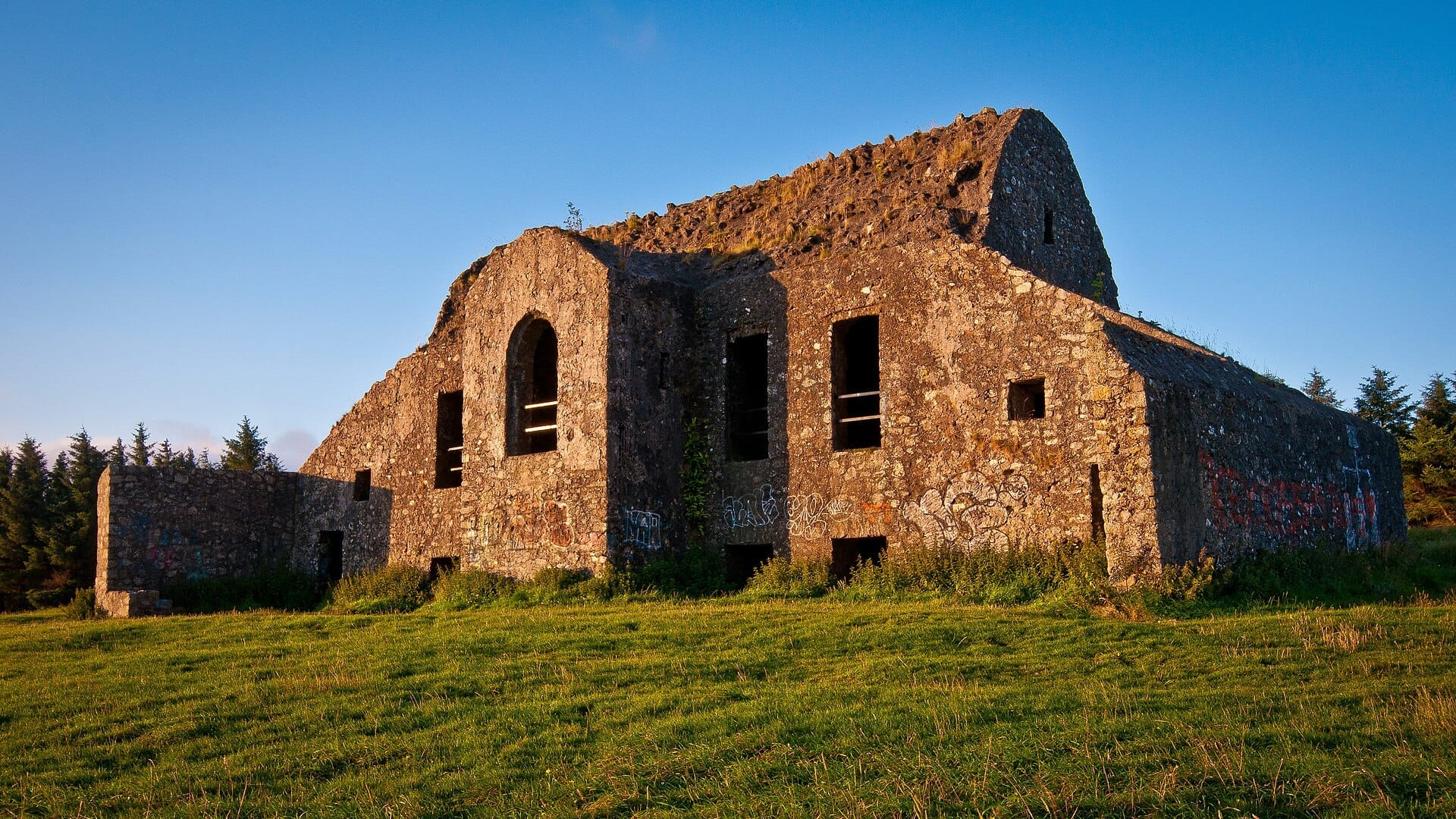
The Hellfire Club on Montpelier Hill is not a functioning building, a museum, or a ticketed attraction. It is an open-air ruin: a roofless stone shell sitting at roughly 383 metres above sea level in the Dublin Mountains, about 10–11 kilometres south of the city centre. What draws people here is the combination of a legitimate hike, a genuinely strange piece of 18th-century history, and one of the most expansive views of Dublin, the Bay, and on clear days, the Wicklow Mountains beyond.
The structure you see today was built around 1725 by William Conolly, then Speaker of the Irish House of Commons and one of the wealthiest men in Ireland.[9] He intended it as a hunting lodge. The site he chose was not empty: a Neolithic passage grave and cairn already occupied the hilltop, and accounts suggest Conolly's builders used stones from that prehistoric monument in the lodge's construction.[9] Whether through folklore or genuine structural consequence, the building was roofless not long after it was completed, supposedly after a storm. It has stayed that way.
The Irish name sometimes recorded for the site is Club Thine Ifreann, a direct translation.[9] The building became associated with a loose gathering of Dublin's 18th-century elite who met there for drinking and reportedly transgressive behaviour. Stories of devil worship, black cats, and card games with Satan became attached to the place over time. Historians treat most of these accounts with appropriate scepticism, but they have given the ruin its enduring reputation.
ℹ️ Good to know
Opening hours: March to October 7:00am–9:00pm; November to March 7:00am–5:00pm.[1][2][4] Entry is free. A 70-space car park and bike rack are available at the trailhead off the R115 county road.
The Hike Up: What to Expect on the Trail
The ascent from the car park to the summit takes roughly 30 to 45 minutes at a moderate pace. The path is well-worn but can be slippery when wet, and this stretch of the Dublin Mountains sees regular rainfall and mist. The trail climbs through managed conifer forest before breaking into open heathland near the top, where gorse and heather line the path and the wind picks up noticeably.
Wear proper footwear. The combination of exposed tree roots in the lower section and muddy open ground near the summit makes trainers a genuinely poor choice, especially between October and April. Layers are advisable regardless of the season: temperatures at the top can be several degrees colder than in the city, and cloud cover can roll in quickly from the west.
⚠️ What to skip
The path can become deeply muddy after rain. Waterproof boots are strongly recommended year-round. Do not rely on mobile signal for navigation near the summit — download offline maps before setting out.
The trail is not technically difficult, but the gradient is consistent enough that it feels like a real climb rather than a stroll. Children who are comfortable on uneven ground can manage it; pushchairs and wheelchairs cannot. There is no accessible route to the summit.
Tickets & tours
Hand-picked options from our booking partner. Prices are indicative; availability and final rates are confirmed when you complete your booking.
In Stitches Comedy Club Dublin Saturday early show tickets
From 20 €Instant confirmationFree cancellationIn Stitches Comedy Club Dublin Fridays tickets
From 20 €Instant confirmationFree cancellationIn Stitches Comedy Club Tuesdays tickets
From 18 €Instant confirmationFree cancellationIn Stitches Comedy Club 7 nights a week tickets
From 18 €Instant confirmationFree cancellation
The Summit: Views, Ruins, and the Prehistoric Layer Beneath
When the cloud is low, you arrive at the ruin and see almost nothing beyond the stone walls. When it clears, the reward is immediate: Dublin spreads out below in a wide arc, the bay catching light to the east, the flat coastal plain giving way to the city's dense grid of streets. On the clearest days, the Welsh coast is reputedly visible, though this requires exceptional conditions.
The ruin itself is compact. The walls of the lodge still stand to a reasonable height, and you can walk through the shell, where modern concrete stairs and iron safety rails have been installed across the upper windows for safety.[4][9] There are no interpretive boards inside the structure. What you notice, once you look more carefully, is the older archaeology beneath it: the disturbed remnants of the Neolithic passage tomb and cairn on which the lodge was partly built.[9] The fact that a prehistoric presence predates Conolly's 18th-century vanity project by several thousand years adds a different kind of weight to the place.
For historical context, the Hellfire Club sits at the edge of the same landscape that stretches into the Wicklow Mountains National Park to the south. The Dublin Mountains Way long-distance trail passes through this area, and Montpelier Hill can be incorporated into longer mountain routes.
How the Experience Changes by Time of Day and Season
Early morning visits in summer offer the strongest light for photography and the fewest other people on the trail. The city sits in soft haze below, and the path through the upper heathland smells of wet earth and gorse flowers. Arriving before 9am on a weekday in June or July means you will likely have the summit largely to yourself.
By mid-morning on weekends, the car park fills quickly. Families, trail runners, dog walkers, and groups of teenagers drawn partly by the folklore all converge on the same path. The atmosphere near the ruins becomes more social than contemplative. This is not necessarily a bad thing, but it is worth knowing.
In winter, the site takes on a completely different character. The trees are bare, the light is flat and low, and the surrounding heathland shifts from green to brown-purple. Mist frequently sits on the summit for hours. If you are prepared for this, it is genuinely atmospheric in a way that suits the site's reputation. If you are hoping for panoramic views, winter is a gamble.
The seasonal patterns of the Dublin Mountains are worth understanding before you visit. The best time to visit Dublin guide covers general weather patterns across the city and surrounding areas, which apply directly to planning a Montpelier Hill visit.
Photography at the Hellfire Club
The ruin photographs well from both inside and outside the walls. The most compelling angles place the jagged stone frame against an open sky or use the doorway or windows as natural frames for the city view beyond. Wide-angle lenses work particularly well given the compact footprint of the building.
Golden hour in the evening, when the sun drops toward the mountains to the west and casts long shadows across the heathland, produces the warmest tones. This works in both spring and autumn, when the light is lower in the sky for a longer portion of the evening. Check sunset times before visiting if this is your goal, and allow enough time to descend the trail safely before dark. The path is not lit.
💡 Local tip
Photography tip: For dramatic silhouette shots of the ruin, position yourself to the east of the building in the late afternoon with the sun behind you. The roofless profile against a clearing sky is the shot most associated with this location.
Getting There and Practical Logistics
The honest reality is that the Hellfire Club is most accessible by car. The trailhead car park sits off the R115 county road and holds approximately 70 vehicles, with a bike rack available.[2][4] On busy summer weekends, the car park fills by mid-morning. Arriving before 9am or after 4pm avoids the worst congestion.
There is no daily direct bus service to the trailhead, but a Local Link Kildare South Dublin Saturday service (route SD4 Tibradden Wood to Tallaght) now stops at Hell Fire Club/Massy’s Estate and Cruagh Wood.[2] Some visitors reach the general area by regular bus from the city to Rathfarnham or Tallaght and then walk or cycle the remaining distance, but this adds significant time and route-planning.
If you are planning a day that combines the Hellfire Club with other sites, the hiking near Dublin guide covers several other trailheads and routes across the Dublin Mountains that pair naturally with a Montpelier Hill visit.
Who This Attraction Is and Is Not For
The Hellfire Club suits people who want a genuine outdoor experience combined with history and views. It is a particularly good choice on a clear day when you have two to three hours free and want something that feels meaningfully different from the city's indoor cultural attractions.
It is not for visitors who cannot manage a 30-45 minute uphill walk on uneven ground, or those expecting a curated heritage experience with signage, interpretation, and facilities. There are no toilets at the site, no cafe, and no shelter beyond the open ruins themselves. If your travel priorities lean toward comfort and convenience, this is a straightforward skip.
If you want accessible green space closer to the city, St Stephen's Green and the National Botanic Gardens offer well-maintained parkland with no hiking required. For more structured heritage outside the city, Malahide Castle is a better-serviced alternative.
Insider Tips
- The car park fills fast on summer weekends. Arriving before 9am or after 4pm gives you a real chance of finding space without circling.
- Bring water and a snack. The hike is short but the wind at the top makes it feel more demanding than the elevation suggests, especially in cooler months.
- The site is open year-round, but from November to March the car park closes at 5pm.[1][2][4] Plan your descent to be off the upper trail before dark: the path through the forest section has no lighting.
- The ruins are not roped off or managed as a ticketed site, which means you can move freely through and around the structure. Treat the stonework with care: the building is genuinely old and fragile in places.
- On exceptionally clear days, look northeast from the summit for the full sweep of Dublin Bay from Howth Head to Killiney Hill. This is the view that justifies the effort on days when mist would otherwise obscure it.
Who Is Hellfire Club, Montpelier Hill For?
- Hikers and trail walkers looking for a meaningful half-day outing from Dublin
- History enthusiasts interested in 18th-century Irish gentry and prehistoric archaeology
- Photographers seeking elevated city views with architectural foreground interest
- Visitors who want to escape the city without taking a full day trip
- Families with older children comfortable on rough, uneven terrain
Nearby Attractions
Combine your visit with:
- Abbey Theatre
Founded in 1904 by W.B. Yeats and Lady Gregory, the Abbey Theatre is Ireland's National Theatre and one of the most historically significant stages in the English-speaking world. Sitting on Lower Abbey Street in the heart of Dublin city centre, it continues to produce new Irish work alongside classic plays that shaped a nation's identity.
- Blessington Street Basin
Once the Royal George Reservoir supplying water to Dublin's north side, Blessington Street Basin is now a free public park in Phibsborough. The central lake, Tudor gate lodge, and resident wildfowl make it one of the most quietly rewarding green spaces within walking distance of Dublin city centre.
- Casino Marino
Casino Marino is an 18th-century Neo-Classical pleasure house in north Dublin, designed by Sir William Chambers for the Earl of Charlemont. Despite its compact exterior, the building conceals 16 rooms across three floors — a feat of architectural illusion that continues to astonish visitors. Access is by guided tour only, with admission from €3 for children and students and €5 for adults.
- Clontarf Promenade
Clontarf Promenade stretches 4.5 kilometres along Dublin Bay from Fairview to the Bull Wall at Dollymount, offering open sea views, public art, and a marked cycle route along much of its length. It costs nothing to visit, runs along a flat sea wall path, and delivers some of the most expansive coastal scenery accessible from Dublin city centre.