Hackesche Höfe: Berlin's Most Architecturally Ambitious Courtyard Complex
Built in 1906 and stretching across 27,000 square metres, Hackesche Höfe is a chain of eight interconnected courtyards in the heart of Mitte. Restored after decades of GDR neglect, it now holds independent boutiques, cinemas, restaurants, and bars behind one of Berlin's finest Jugendstil facades. Entry is free during opening hours.
Quick Facts
- Location
- Rosenthaler Straße 40–41, 10178 Berlin (Mitte)
- Getting There
- S Hackescher Markt (S3, S5, S7, S9, S75); U Weinmeisterstrasse (U8); trams and buses also stop at Hackescher Markt
- Time Needed
- 45 minutes to 2 hours depending on how much you explore
- Cost
- Free to enter the courtyards during opening hours; individual venues charge separately
- Best for
- Architecture lovers, casual walkers, afternoon coffee, independent shopping
- Official website
- www.hackesche-hoefe.de/en
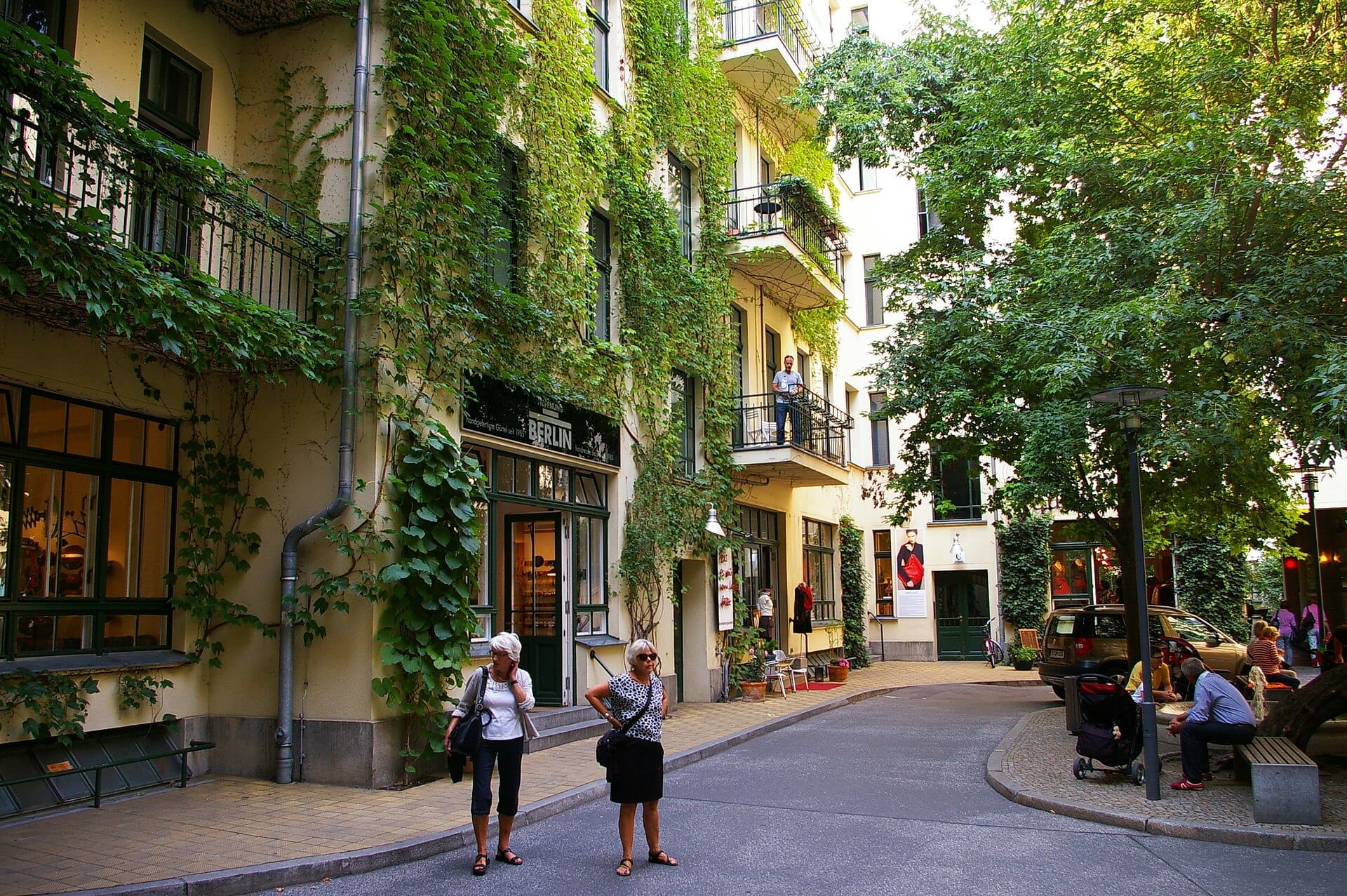
What Hackesche Höfe Actually Is
Hackesche Höfe is a courtyard complex of eight interconnected inner yards, built in 1906 and covering 27,000 square metres in the Spandauer Vorstadt quarter of Mitte. It is the largest such courtyard ensemble in Berlin, and the largest single courtyard complex in Germany. The address, Rosenthaler Straße 40–41, puts you a short walk from the Spree and directly between two of the city's most visited neighbourhoods.
The complex functions as a kind of compressed neighbourhood. Walk through the arched entrance off Rosenthaler Straße and you move from the noise of the street into a sequence of yards, each with its own atmosphere, tenants, and level of foot traffic. The first courtyard is the most photographed and the most crowded. By the fourth or fifth, the crowds thin and the pace slows noticeably.
The complex sits at the edge of what was historically the Jewish quarter of Berlin. The Neue Synagoge on Oranienburger Straße is a ten-minute walk west. That proximity is not incidental: the Spandauer Vorstadt was a centre of Jewish commercial and cultural life in Berlin before 1933, and the courtyards reflect that layered history in their architecture and the institutions that have returned to the area since reunification.
💡 Local tip
Entry to the courtyards is free during opening hours and there is no single 'opening time' for the complex as a whole. The front courtyards, bars, cinema, and theatres operate into the evening. The residential yards close at night.
The Architecture: Jugendstil in Detail
The first courtyard stops most visitors in their tracks. Its walls are covered floor-to-roofline in ceramic tiles in the Jugendstil style, the German variant of Art Nouveau. The tiles are glazed in shades of cream, cobalt, and sage green, arranged in geometric and floral patterns that catch different qualities of light depending on the hour. On an overcast morning the tiles have a muted, restrained quality. In direct afternoon sun they become noticeably more vivid, almost saturated.
The complex was designed by Kurt Berndt and August Endell, with Endell responsible for the tilework on the first courtyard. Endell was one of the leading figures of German Jugendstil, and this commission gave him a large-scale canvas. The result is less ornate than his earlier work in Munich, but more coherent: the entire courtyard reads as a single designed surface rather than a collection of decorative gestures.
The complex opened in 1906. It survived the Second World War with significant damage, then entered a long period of neglect under the GDR administration. A major restoration programme took place in 1993 following German reunification, returning the tilework and facades to something close to their original condition. The restoration took several years and was considered contentious at the time, with debates about whether it constituted genuine preservation or a kind of commercial makeover. What exists today is a careful reconstruction rather than an untouched original. It survived the Second World War with significant damage, then entered a long period of neglect under the GDR administration. A major restoration programme began in 1993 following German reunification, returning the tilework and facades to something close to their original condition. The restoration took several years and was considered contentious at the time, with debates about whether it constituted genuine preservation or a kind of commercial makeover. What exists today is a careful reconstruction rather than an untouched original.
Tickets & tours
Hand-picked options from our booking partner. Prices are indicative; availability and final rates are confirmed when you complete your booking.
Uber Arena to Hackescher Markt with the Kaiser Friedrich historic boat
From 17 €Instant confirmationFree cancellationSkip-the-line ticket for Gemaldegalerie Berlin
From 14 €Instant confirmationPanoramapunkt Berlin ticket with skip-the-line option
From 9 €Instant confirmation1-Hour Berlin Spree River Cruise with On-Board Guide
From 21 €Instant confirmationFree cancellation
Moving Through the Eight Courtyards
Most visitors enter from Rosenthaler Straße and progress roughly east toward Sophienstraße, though you can also enter from the Rosenthaler Straße side via a second entrance, or from Sophienstraße itself. The layout is not rigidly linear: some yards connect at angles, and staircases and covered passages link levels in ways that are not always obvious. It rewards slow exploration rather than a determined march from one end to the other.
The first courtyard holds the majority of the commercial activity visible from the street: restaurants with outdoor seating, boutiques, a café or two. By the third and fourth courtyards the function shifts more toward offices, residential apartments, and quieter independent shops. The Hackesche Höfe Kammerspiele, a small theatre, is housed within the complex. The Hackesche Höfe Filmtheater, an arthouse cinema, occupies another corner.
The sounds change as you move deeper in. At the entrance, you hear tram bells from Rosenthaler Straße, the scrape of chairs on cobblestones, conversations in several languages. Deeper into the complex, those sounds drop away and are replaced by muffled music from somewhere above, pigeons on window ledges, and the particular resonance of footsteps on uneven stone. The smell shifts too: coffee and cooking near the front, something older and damper in the less-trafficked rear yards.
ℹ️ Good to know
Accessibility varies significantly across the complex. The cobblestone surfaces in several courtyards make wheelchair navigation difficult, and some connections between yards involve steps. Visitors with limited mobility should expect to access parts of the complex rather than all of it.
When to Visit and What Changes by Time of Day
The first courtyard is genuinely photogenic, but it is rarely quiet on weekends between late morning and early evening. Guided tour groups arrive by mid-morning, and by noon the café seating is full. The architecture photographs best in the two hours after opening, when the angle of light hits the tilework from the east, or in the late afternoon when it comes from behind you as you face the main facade from inside the yard.
Weekday mornings before 10:00 offer the most space and the least noise. The courtyards are almost empty, the cafés are just setting up, and the residential character of the deeper yards is more apparent. If you are primarily interested in the architecture rather than the shops or restaurants, this is the most rewarding window. Evening visits have a different appeal: the arthouse cinema and theatre programme draws a quieter, more local crowd, and the courtyard lighting gives the tilework a warmer tone than daylight.
In winter, the open yards are cold and the outdoor seating disappears. The complex is less atmospheric without the street life, but also less crowded, and the tilework is arguably easier to study without the distraction of other people. Summer evenings bring a sustained buzz from the bars and restaurants that can last well past midnight.
The Wider Area: Hackescher Markt and the Neighbourhood
The S-Bahn station at Hackescher Markt is directly in front of the courtyards and is a transit hub with tram connections and a market on some mornings. Immediately north along Rosenthaler Straße, the neighbourhood becomes the Spandauer Vorstadt proper: denser, quieter, with a higher ratio of independent bookshops and galleries to tourist infrastructure. The Neue Synagogue and the Museum Island are both reachable on foot, the latter in about 20 minutes heading northwest. The square itself is a transit hub with tram connections and a market on some mornings. Immediately north along Rosenthaler Straße, the neighbourhood becomes the Spandauer Vorstadt proper: denser, quieter, with a higher ratio of independent bookshops and galleries to tourist infrastructure. The Neue Synagoge and the Hamburger Bahnhof are both reachable on foot, the latter in about 20 minutes heading northwest.
For a broader orientation to central Berlin, Museum Island is roughly 15 minutes on foot southeast along the Spree, and Alexanderplatz is about the same distance heading east. The Hackesche Höfe sits at a natural midpoint that makes it a logical stop on a walking route through central Mitte rather than a standalone destination requiring a dedicated journey.
Is Hackesche Höfe Overhyped?
The first courtyard has become a fixture on Berlin highlight reels, and that visibility has consequences. On a Saturday afternoon in summer, the main yard can feel more like a bottleneck than an architectural experience. The shops lean toward independent fashion and design, but several of the more characterful original tenants have been displaced over the years by higher rents, and the commercial mix now reflects that pressure. It is not a place that has remained unchanged since restoration.
That said, the architectural quality of the tilework is genuine and rarely reproduced elsewhere in the city. For anyone with an interest in late Wilhelmine commercial architecture, or in the specific aesthetic of German Jugendstil, this is a serious site rather than just a backdrop for photographs. The theatre and cinema represent a sustained cultural commitment that is not typical of commercial heritage restorations. The complex earns its place on most Berlin itineraries, but visitors who arrive expecting a quiet discovery will need to adjust their timing.
Visitors primarily focused on Berlin's Cold War or political history may find the complex less essential. The Cold War sites in Berlin are concentrated in other parts of Mitte and along the former Wall route, and Hackesche Höfe, despite its GDR-era history, does not engage directly with that layer. Similarly, those in Berlin specifically for contemporary art and nightlife may find the area around Friedrichshain or Kreuzberg more rewarding for that purpose.
Getting There and Practical Notes
The S-Bahn lines S3, S5, S7, S9, and S75 all stop at Hackescher Markt, which places you within a short walk of the entrance on Rosenthaler Straße. U-Bahn U8 stops at Weinmeisterstrasse, which is also walkable. Multiple tram lines and bus routes also serve Hackescher Markt, making this one of the better-connected points in central Berlin.
There is no general admission charge for the courtyards. The theatre and cinema sell tickets separately for their programmes, and individual shops and restaurants operate on their own schedules. Be aware that residential areas within the complex are exactly that: people live there, and the later courtyards function as access routes to private apartments rather than public thoroughfares at all hours.
⚠️ What to skip
The cobblestones throughout the complex can be uneven. Comfortable, flat-soled shoes make a significant difference, especially if you are combining this with a longer walk through Mitte.
Insider Tips
- Enter from Sophienstraße at the eastern end if you want to experience the courtyards in reverse, starting with the quieter residential yards and moving toward the more active front. It is a noticeably different introduction to the complex.
- The tilework in the first courtyard changes character with the weather. An overcast day reveals the geometry of the patterns more clearly than bright sun, which creates glare on the glazed surfaces. Serious architectural photographers often prefer grey-sky conditions.
- The Hackesche Höfe Filmtheater shows films in original language with German subtitles, meaning English-language films are screened in English. Checking the programme before your visit can turn a short stop into an afternoon.
- Walk the full length to the last courtyard even if the shops do not interest you. The shift in atmosphere from the tourist-facing front to the quiet, residential rear yards is one of the more instructive things the complex demonstrates about how Berlin's inner-city courtyards, called Hinterhöfe, actually function.
- The area around Sophienstraße directly east of the complex has a quieter, less commercial character than Rosenthaler Straße and repays a short detour after you finish in the courtyards.
Who Is Hackesche Höfe For?
- Architecture enthusiasts interested in German Jugendstil and Wilhelmine commercial design
- Travelers combining a walking route through central Mitte with Museum Island or the Spandauer Vorstadt
- Anyone wanting a short break from the street into a calmer, covered environment
- Film and theatre-goers looking for an independent, non-multiplex programme in a historic setting
- Visitors interested in the layered history of Berlin's Jewish quarter and its post-reunification transformation
Nearby Attractions
Other things to see while in Mitte:
- Alexanderplatz
Alexanderplatz sits at the geographical and historical heart of former East Berlin, a vast open square with roots going back to the 13th century. Today it's a free, always-open crossroads of transit, Cold War monuments, and everyday Berlin life — chaotic, fascinating, and impossible to avoid.
- Berlin Cathedral (Berliner Dom)
The Berlin Cathedral, or Berliner Dom, is Germany's largest Protestant church and one of the most architecturally striking buildings in the city. Built between 1894 and 1905, it anchors Museum Island with a dome you can climb, a royal crypt below ground, and a nave that rewards slow, unhurried attention.
- Berlin TV Tower (Fernsehturm)
Standing 368 metres above central Berlin, the Berliner Fernsehturm is the tallest structure in Germany and the tallest publicly accessible building in Europe. Its observation deck at 203 metres delivers an unobstructed 360-degree panorama of the city. This guide covers what you actually see up there, when crowds are worst, and whether the ticket price is justified.
- Berlin Victory Column (Siegessäule)
Rising from the centre of the Großer Stern roundabout in Tiergarten, the Siegessäule is one of Berlin's most recognisable monuments. At around 67 metres tall, it offers a sweeping panorama over the city's forest-park heart — but you earn the view with 285 steps and no lift.